---
title: Jason & the Argonauts: The Search for the Golden Fleece
author: Mark Cartwright
source: https://www.worldhistory.org/article/425/jason--the-argonauts/
format: machine-readable-alternate
license: Creative Commons Attribution-NonCommercial-ShareAlike (https://creativecommons.org/licenses/by-nc-sa/4.0/)
updated: 2025-05-13
---
# Jason & the Argonauts: The Search for the Golden Fleece
_Authored by [Mark Cartwright](https://www.worldhistory.org/user/markzcartwright/)_
The [pan](https://www.worldhistory.org/Pan/)-[Hellenic](https://www.worldhistory.org/greece/) mythological hero Jason was famed for his expedition with the Argonauts - as the sailors on their ship the Argo were known - in search of the [Golden Fleece](https://www.worldhistory.org/Golden_Fleece/) in Kolchis on the Black Sea, one of the most popular and enduring legends of [Greek mythology](https://www.worldhistory.org/Greek_Mythology/). The myth may reflect historical expeditions made by the Mycenaeans in the 13th century BCE as they explored lands to the east of the [Greek](https://www.worldhistory.org/disambiguation/greek/) world.
### Jason's Youth
Jason was believed to have been educated by the wise [centaur](https://www.worldhistory.org/centaur/) Cheiron in the forests of Mount Pelion. He had been placed under the centaur's care by his father Aison whose younger brother Pelias had usurped the throne of Iolkos in [Thessaly](https://www.worldhistory.org/disambiguation/Thessaly/). When he reached manhood, Jason participated in the celebrated hunt for the Kalydonian Boar which involved many Greek heroes such as [Theseus](https://www.worldhistory.org/Theseus/), the [Dioskouroi](https://www.worldhistory.org/Castor_and_Pollux/), [Atalanta](https://www.worldhistory.org/Atalanta/), and [Meleager](https://www.worldhistory.org/Meleager/). This huge creature terrorized the [city](https://www.worldhistory.org/city/) of Kalydon and the surrounding area in Aetolia, having been sent by the goddess [Artemis](https://www.worldhistory.org/artemis/) in order to punish Oineus, Meleager's father, for his impiety in not sacrificing to the goddess.
[  Attic Column-Krater Peter Roan (CC BY-NC-SA) ](https://www.worldhistory.org/image/1207/attic-column-krater/ "Attic Column-Krater")At the age of 20, Jason finally returned to Iolkos to claim his kingdom. On his return journey Jason somehow lost one of his sandals and when he re-entered the city, Pelias saw him and recalled an oracle some years before which had declared that Pelias would lose his life at the hands of a one-sandaled man. Identifying Jason as the oracle's man, he decided to send the hero on an impossibly difficult and probably fatal expedition to bring the fabled Golden Fleece to Iolkos.
### The Golden Fleece
The Golden Fleece came from a winged ram originally belonging to the [god](https://www.worldhistory.org/God/) [Hermes](https://www.worldhistory.org/Hermes/). The ram was sent by the goddess Nephele to rescue her children Phrixos and Helle from being sacrificed after [Ino](https://www.worldhistory.org/Ino/), their jealous step-mother, turned the people of [Thebes](https://www.worldhistory.org/disambiguation/Thebes/) against them. Saved just in time, the ram flew off over the sea with Phrixos and Helle. Unfortunately, during the flight, the latter fell off the ram into the sea and the place she landed - the modern straits of the Dardanelles - was thereafter called the Hellespont. Phrixos, however, was safely taken to Kolchis on the Black Sea and in thanks to the gods, he promptly sacrificed the ram and placed its golden fleece in the sacred grove of the god [Ares](https://www.worldhistory.org/Ares/) where a fearsome serpent was set to guard it.
### The Argo
Jason was a favourite with the goddess Athena and it was she who gave the first help to the expedition by having the great craftsman Argo build a strong fast boat to take the hero across the seas to Kolchis. The ship, reportedly the first Greek long ship, was named after its maker and even contained a plank of sacred wood with the power of speech, taken from the sanctuary of [Zeus](https://www.worldhistory.org/zeus/) at [Dodona](https://www.worldhistory.org/Dodona/). The Argo could carry 50 oarsmen and Jason filled the boat with an all-star crew of Greek heroes. Among the more famous were [Hercules](https://www.worldhistory.org/hercules/) from Boeotia, the Dioskouroi twins from [Sparta](https://www.worldhistory.org/sparta/), Meleager from Kalydon, Peleus from Thessaly, Amphiaraos from [Argos](https://www.worldhistory.org/argos/), Kalais and Zetes the sons of [Boreas](https://www.worldhistory.org/Boreas/) (the North Wind), and [Orpheus](https://www.worldhistory.org/Orpheus/) from Thrace.
On their voyage to Kolchis the Argonauts had many adventures. One of the more notable was the rescue of Phineus from the Harpies at Salmydessos in Thrace. These terrible winged creatures had been sent by Zeus to torment the blind Phineus as punishment for blinding his own sons on the advice of their scheming step-mother. Zetes and Kalais, themselves winged, chased away or killed the Harpies thus earning the gratitude of Phineus who gave them favourable winds and advice on the best route to Kolchis. Other diversions occurred on the island of Lemnos where the female inhabitants sought to ensnare the heroes, on the island of the Doliones where they were attacked by savage [giants](https://www.worldhistory.org/Giants/), and on the island of the Mysians where Hercules was lost to the expedition as he searched for his lover Hylas, taken by the water nymphs.
### Kolchis & King Aietes
On finally reaching Kolchis, Aietes the king, perhaps understandably, would not hand over the fleece to Jason without a struggle. Instead, he promised Jason the fleece only if he performed some particularly difficult and dangerous tasks. These were to plough a field using two fire-breathing bulls and to sow the teeth of a serpent in the field, and then fight the giants which sprang up from the magical teeth. Fortunately, Jason was assisted by [Medea](https://www.worldhistory.org/Medea/), the daughter of Aietes. Once again, Athena had intervened and sent [Eros](https://www.worldhistory.org/Eros/) to make Medea fall in love with the hero. Medea was knowledgeable in magic, and she gave Jason a magic lotion to protect him from the fire-breathing bulls and advised him to throw a stone amongst the giants so that they would fight each other.
Despite successfully completing the tasks, Aietes still refused to give Jason the fleece and even attempted to burn the Argo. However, Medea showed Jason the location of the sacred grove and gave him another potion to drug the serpent that guarded the Golden Fleece. Taking the fleece back to the Argo, Jason was pursued by the king's soldiers but Medea delayed them (even killing her brother Apsyrtus in the process) and she fled Kolchis with the heroes.
### The Voyage Home
The voyage back home to Iolkos was as protracted as the voyage out and the heroes once more had many adventures. A notable episode is the encounter with Talos, the [bronze](https://www.worldhistory.org/disambiguation/bronze/) man given to King Minos by [Hephaistos](https://www.worldhistory.org/Hephaistos/), and who ran around the island of [Crete](https://www.worldhistory.org/crete/) three times each day keeping guard. Talos tried to prevent the Argonauts from landing and so incurred the wrath of Medea who brought his downfall with one of her magic potions.
[  Harpies Attack King Phineus Egisto Sani (CC BY-NC-SA) ](https://www.worldhistory.org/image/11126/harpies-attack-king-phineus/ "Harpies Attack King Phineus")On the heroes' triumphant return to Iolkos, despite being given the Golden Fleece, Pelias refused to give up his throne, and it was discovered that Pelias had even conspired to kill Jason's father, Aison, whilst the hero had been away. Medea then made another magic potion, this time to convince the daughters of Pelias that if they cut up their father and boiled him in the potion, he would gain everlasting youth. This they did and, of course, it was the end of Pelias, but Jason did not become king, instead, he established Pelias' son Akastos as ruler. Jason, after marrying Medea, left to settle in [Corinth](https://www.worldhistory.org/corinth/) which had been inherited by Aietes from his father [Helios](https://www.worldhistory.org/Helios/). The couple had three sons and lived happily for ten years until Jason became captivated by the charms of Glauke, daughter of Kreon, the king of Corinth. In jealous revenge, Medea killed both Glauke (with a poisoned robe and crown) and her own children and fled to [Athens](https://www.worldhistory.org/Athens/), in some accounts in a flying [chariot](https://www.worldhistory.org/chariot/) pulled by dragons. This tragic end to the myth is the subject of [Euripides](https://www.worldhistory.org/Euripides/) tragedy Medea.
### Links With Reality
The myth of Jason and the Golden Fleece may have been an explanation of early Greek expeditions into the East around the 13th century BCE, when the [Mycenaean civilization](https://www.worldhistory.org/Mycenaean_Civilization/) was at its peak. The tale also has similarities to a [Hittite](https://www.worldhistory.org/hittite/) myth involving a fleece and the god Telipinu. A third connection with the East is the historical evidence suggesting that the area of Kolchis near the Caucasus Mountains was one rich in [gold](https://www.worldhistory.org/gold/), often panned from rivers using sheepskins.
[ 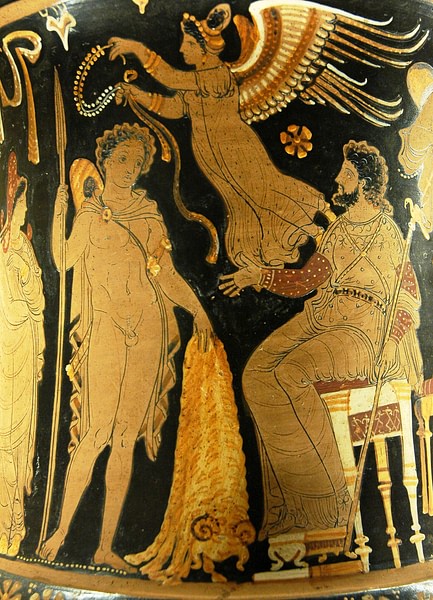 Jason Brings Pelias the Golden Fleece Marie-Lan Nguyen (CC BY-SA) ](https://www.worldhistory.org/image/780/jason-brings-pelias-the-golden-fleece/ "Jason Brings Pelias the Golden Fleece")### The Myth in Greek Art
The myths involving Jason were popular subjects in ancient Greek art. The antiquity of the subject is demonstrated by a scene on a Corinthian alabastron as early as the 7th century BCE. The earliest depiction of the Argo comes from a fragmentary metope from the Treasury of the Sicyonians at [Delphi](https://www.worldhistory.org/delphi/), c. 570 BCE. The presence of various scenes from the myths on Attic, Laconian, Corinthian, Chalcidian, and Southern Italian [pottery](https://www.worldhistory.org/pottery/) throughout the 5th and 6th centuries BCE and the re-telling of the tale in the Argonautica by Apollonius of [Rhodes](https://www.worldhistory.org/Rhodes/) in the 3rd century BCE are evidence of the far-reaching and long-lasting appeal of this truly pan-Hellenic hero.
#### Editorial Review
This human-authored article has been reviewed by our editorial team before publication to ensure accuracy, reliability and adherence to academic standards in accordance with our [editorial policy](https://www.worldhistory.org/static/editorial-policy/).
## Bibliography
- Carabatea, M. *Greek Mythology.* Pergamos, Peania, 2007
- [Carpenter, T.H. *Art and Myth in Ancient Greece.* Thames & Hudson, 2012.](https://www.worldhistory.org/books/B000EQ2DA0/)
- Hesiod. *Theogeny, Works & Days, Testimonia.* Harvard University Press, Cambridge, 2006
- Hope Moncrieff, A.R. *Classical Mythology.* Senate, London, 1994
- [National Geographic. *National Geographic Essential Visual History of World Mythology.* National Geographic, 2008.](https://www.worldhistory.org/books/142620373X/)
## About the Author
Mark is WHE’s Publishing Director and has an MA in Political Philosophy (University of York). He is a full-time researcher, writer, historian and editor. Special interests include art, architecture and discovering the ideas that all civilizations share.
## External Links
- [The expedition of the Argonauts](https://sigmapublications.com/maps_en_enArgoEur.html)
- [The Myth of Talos, the First Robot - Adrienne Mayor](https://ed.ted.com/lessons/the-greek-myth-of-talos-the-first-robot-adrienne-mayor)
## Cite This Work
### APA
Cartwright, M. (2012, July 21). Jason & the Argonauts: The Search for the Golden Fleece. *World History Encyclopedia*.
### Chicago
Cartwright, Mark. "Jason & the Argonauts: The Search for the Golden Fleece." *World History Encyclopedia*, July 21, 2012. .
### MLA
Cartwright, Mark. "Jason & the Argonauts: The Search for the Golden Fleece." *World History Encyclopedia*, 21 Jul 2012, .
## License & Copyright
Submitted by [Mark Cartwright](https://www.worldhistory.org/user/markzcartwright/ "User Page: Mark Cartwright"), published on 21 July 2012. The copyright holder has published this content under the following license: [Creative Commons Attribution-NonCommercial-ShareAlike](https://creativecommons.org/licenses/by-nc-sa/4.0/deed.en). This license lets others remix, tweak, and build upon this content non-commercially, as long as they credit the author and license their new creations under the identical terms. When republishing on the web a hyperlink back to the original content source URL must be included. Please note that content linked from this page may have different licensing terms.