---
title: The Island Kingdom of Aegina: The Old Gods Still Whisper Their Truths
author: Joshua J. Mark
source: https://www.worldhistory.org/article/39/the-island-kingdom-of-aegina-the-old-gods-still-wh/
format: machine-readable-alternate
license: Creative Commons Attribution-NonCommercial-ShareAlike (https://creativecommons.org/licenses/by-nc-sa/4.0/)
updated: 1970-01-01
---
# The Island Kingdom of Aegina: The Old Gods Still Whisper Their Truths
_Authored by [Joshua J. Mark](https://www.worldhistory.org/user/JPryst/)_
Today, traveling an hour by ferry from [Piraeus](https://www.worldhistory.org/Piraeus/), the port of [Athens](https://www.worldhistory.org/Athens/), the first remnant of [Aegina](https://www.worldhistory.org/Aegina/)'s great past a visitor will see is the lonely pillar of [Apollo](https://www.worldhistory.org/apollo/) rising from the trees on the hill of Kolona. Once a splendid complex of three buildings (the [Temple](https://www.worldhistory.org/temple/) of Apollo itself rose on eleven large pillars and six smaller ones) and a cemetery (in which a large collection of [gold](https://www.worldhistory.org/gold/) and jewelry was found in the tombs, now housed in the British Museum) the pillar of Apollo is all that remains. This seems a fitting symbol for the whole of Aegina's history: the island which once boasted the best wine, a high standard of living and a naval fleet which rivaled that of Athens is, today, known as the leading producer of pistachio nuts in [Greece](https://www.worldhistory.org/greece/).
[ 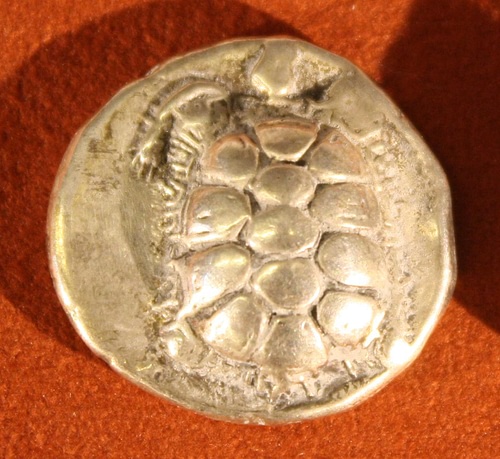 Silver Stater, Aegina Mark Cartwright (CC BY-NC-SA) ](https://www.worldhistory.org/image/3186/silver-stater-aegina/ "Silver Stater, Aegina")### Aegina in [Mythology](https://www.worldhistory.org/mythology/)
The [nymph](https://www.worldhistory.org/nymph/) Aegina was the daughter of the river-[god](https://www.worldhistory.org/God/) Asopus in the land of Sicyonia. [Zeus](https://www.worldhistory.org/zeus/), the king of the gods, fell in love with her and, in the shape of a flame, carried her off to the island of [Oenone](https://www.worldhistory.org/Oenone/). There she gave birth to Zeus' son, Aeacus, who then re-named the island in honor of his mother. Aeacus, according to the writer [Ovid](https://www.worldhistory.org/ovid/), was famous throughout Greece for his justice and wisdom and the island kingdom of Aegina prospered under his rule. He is said to have helped build the walls around [Troy](https://www.worldhistory.org/troy/) which kept the [Mycenaean](https://www.worldhistory.org/Mycenaean_Civilization/) force of [Agamemnon](https://www.worldhistory.org/disambiguation/Agamemnon/) at bay for ten years during the [Trojan War](https://www.worldhistory.org/Trojan_War/) and was so favored by the gods that his prayers were always answered. No less a figure than [Alexander the Great](https://www.worldhistory.org/Alexander_the_Great/) claimed descent from Aeacus on his mother's side and, once Aeacus had passed on to the afterlife, he was honored as one of the three judges of the dead along with Rhadamanthys and Minos.
### Prosperity through [Trade](https://www.worldhistory.org/disambiguation/trade/)
This illustrious mythological beginning for the island reflects the high regard ancient writers had for Aegina. Archaeological evidence points to thriving communities on the island as early as 3000 BCE and the island is cited by writers such as Aristotle and Strabo as the first to coin money in Greece (marked with the island's symbol of the tortoise) under the rule of Pheidon (though when exactly this took place is much disputed). The historian Will Durant writes, “Here the first [Greek](https://www.worldhistory.org/disambiguation/greek/) coins were made, and the Aeginetan weights and measures remained standard in Greece till its [conquest](https://www.worldhistory.org/warfare/) by [Rome](https://www.worldhistory.org/Rome/)” (95).The Aeginetans built their own ships and, as the land was not conducisve to much farming owing to the terrain of rock and hill, they quickly became masters of trade throughout the [Cyclades](https://www.worldhistory.org/Cyclades/) and, in the 6th and 7th centuries BCE, when Aegina was at its height of commercial trade, as far as [Egypt](https://www.worldhistory.org/egypt/) and its environs.
[ 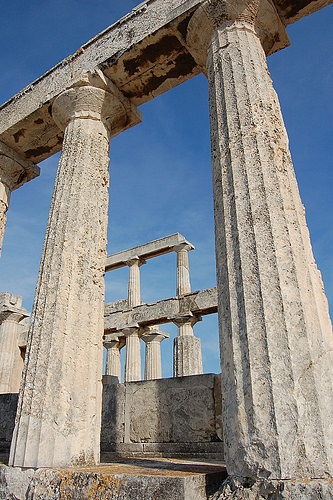 Temple of Aphaea Jan van der Crabben (Copyright) ](https://www.worldhistory.org/image/79/temple-of-aphaea/ "Temple of Aphaea")### Temple of Aphaia
In the famous [Battle of Salamis](https://www.worldhistory.org/Battle_of_Salamis/) of 480 BCE, which drove the Persian invaders from their goal of conquering Greece, Aegina played an important role and, [Herodotus](https://www.worldhistory.org/herodotus/) says, “their best thirty ships were the ones which fought at [Salamis](https://www.worldhistory.org/disambiguation/Salamis/)” (Book 8, 42). In gratitude for their victory over the Persians the Aeginetans built the Temple of Aphaia on Mesagro Hill, on the northwest part of the island. Aphaia was a goddess exclusive to the island (although she was linked with the goddess [Britomartis](https://www.worldhistory.org/Britomartis/) of [Crete](https://www.worldhistory.org/crete/)) and the Mesagro Hill site was her sacred place. Ruins of the Temple of Aphaia still stand on the hill in the present day and, even in ruin, speak of great artistry and opulence even though much has been lost (in 1811 CE the statues of the pediments were carried off by both German and British entrepreneurs who sold them. Today most of the sculptures are on display in Germany with only a handful in the Aegina museum and the National Museum in Athens).
### Decline
The decline of the island kingdom of Aegina is the direct responsibility of the [city-state](https://www.worldhistory.org/Polis/) of Athens who, jealous of the island's wealth and concerned about her naval strength after her successes at Salamis, attacked the island in 459 BCE, tore down the defensive walls and forced the surrender of the Aeginetan fleet. After this defeat Aegina slowly sank into the shadow of nearby Athens (reviving only for a brief phase from 1827-1829 CE after the Greek Revolution, which freed the country from Turkish rule, when it was the temporary capital of liberated Greece) until, today, many well-to-do Athenians regard the island as little more than a suburb of their own [city](https://www.worldhistory.org/city/) and a pleasant location for weekend getaways. Still, whether a visitor chooses to make the trip to the Temple of Aphaia or the lone Pillar of Apollo or simply stumbles upon the ruins of an ancient Aeginetan home or shrine, the glory which was once the island Kingdom of Aegina may still be glimpsed and, in these cthonic places, as the locals say, the old gods still whisper their truths.
#### Editorial Review
This human-authored article has been reviewed by our editorial team before publication to ensure accuracy, reliability and adherence to academic standards in accordance with our [editorial policy](https://www.worldhistory.org/static/editorial-policy/).
## Bibliography
- [Temple of Aphaia](http://www.greeklandscapes.com/greece/aegina/aphaia.html "Temple of Aphaia"), accessed 1 Dec 2016.
- De Selincourt, A. *The Histories of Herodotus.* 1954
- Durant, W. *The Life of Greece.* 1939
- Ovid. *Metamorphosis, Books VI & VII.*
- Smith, W. *Dictionary of Greek and Roman Biography and Mythology.* 1870
## About the Author
Joshua J. Mark is World History Encyclopedia's co-founder and Content Director. He was previously a professor at Marist College (NY) where he taught history, philosophy, literature, and writing. He has traveled extensively and lived in Greece and Germany.
- [Linkedin Profile](https://www.linkedin.com/pub/joshua-j-mark/38/614/339)
## Cite This Work
### APA
Mark, J. J. (2012, January 18). The Island Kingdom of Aegina: The Old Gods Still Whisper Their Truths. *World History Encyclopedia*.
### Chicago
Mark, Joshua J.. "The Island Kingdom of Aegina: The Old Gods Still Whisper Their Truths." *World History Encyclopedia*, January 18, 2012. .
### MLA
Mark, Joshua J.. "The Island Kingdom of Aegina: The Old Gods Still Whisper Their Truths." *World History Encyclopedia*, 18 Jan 2012, .
## License & Copyright
Submitted by [Joshua J. Mark](https://www.worldhistory.org/user/JPryst/ "User Page: Joshua J. Mark"), published on 18 January 2012. The copyright holder has published this content under the following license: [Creative Commons Attribution-NonCommercial-ShareAlike](https://creativecommons.org/licenses/by-nc-sa/4.0/deed.en). This license lets others remix, tweak, and build upon this content non-commercially, as long as they credit the author and license their new creations under the identical terms. When republishing on the web a hyperlink back to the original content source URL must be included. Please note that content linked from this page may have different licensing terms.