---
title: Battle of Hampton Roads: Clash of the Ironclads
author: Joshua J. Mark
source: https://www.worldhistory.org/article/3023/battle-of-hampton-roads/
format: machine-readable-alternate
license: Creative Commons Attribution-NonCommercial-ShareAlike (https://creativecommons.org/licenses/by-nc-sa/4.0/)
updated: 2026-11-05
---
# Battle of Hampton Roads: Clash of the Ironclads
_Authored by [Joshua J. Mark](https://www.worldhistory.org/user/JPryst/)_
The [Battle](https://www.worldhistory.org/disambiguation/battle/) of Hampton Roads (8-9 March 1862), also known as the Battle of the Monitor and the Merrimack, Battle of Ironclads, or Clash of the Ironclads, was a naval engagement at the roadstead of Hampton Roads, Virginia, during the [American Civil War](https://www.worldhistory.org/American_Civil_War/), during which the USS *Monitor* met the CSS *Virginia* (built from the remains of the USS *Merrimack*) in the world's first battle of ironclad warships.
[  Battle of Hampton Roads Kurz & Allison (Public Domain) ](https://www.worldhistory.org/image/22306/battle-of-hampton-roads/ "Battle of Hampton Roads")The engagement is sometimes mistakenly cited as the first time ironclads were used in battle, but it was not. Ironclads were used at the Battle of the Head of Passes (12 October 1861), the [Battle of Fort Henry](https://www.worldhistory.org/Battle_of_Fort_Henry/) (6 February 1862), the [Battle of Fort Donelson](https://www.worldhistory.org/Battle_of_Fort_Donelson/) (11-16 February 1862), and the Battle of Island Number Ten (28 February to 8 April 1862). The ironclad warship was also not an innovation of the American Civil [War](https://www.worldhistory.org/disambiguation/War/), as France had launched its ironclad *Gloire* in 1859 and [Britain](https://www.worldhistory.org/disambiguation/Britain/) its HMS *Warrior* in 1860.
The significance of the Battle of Hampton Roads is that it signaled the end of the wooden warship and the arrival of the steam-driven ironclad on the world's stage of naval engagements. The battle was inconclusive but drew international attention, as it was clear the CSS *Virginia* had easily defeated two wooden Union ships on the first day of battle and that the two ironclads had been able to fight each other to a draw on the second. The era of the wooden warship was over.
Even so, neither ship would last out the year. The CSS *Virginia* was destroyed by the Confederacy on 11 May 1862 to prevent its capture by the US Navy, and the USS *Monitor* sank in a storm off the coast of North Carolina on 31 December 1862.
### USS *Merrimack* to CSS *Virginia*
Although the so-called "Anaconda Plan" of General [Winfield Scott](https://www.worldhistory.org/Winfield_Scott/) had been rejected at the start of the Civil War, one aspect of it – a blockade of Southern ports – was implemented quickly in April 1861. There were large gaps in the blockade at first (as there would be throughout the war) – since the Union had only 43 warships to cover a coastline of 3,500 miles (5600 km) – but was effective enough to prevent international [trade](https://www.worldhistory.org/disambiguation/trade/) and capture ships trying to run through it. The Confederate navy was considerably smaller and no match for the Union ships.
The Confederacy needed a 'secret weapon' and found the makings of one in the abandoned Gosport Navy Yard in Portsmouth, Virginia. Union Captain Charles S. McCauley had ordered Gosport burned in April 1861 to prevent its capture by local secessionist militia. Scholar Matthew Ericson notes:
> Despite the conflagration, the yard was still salvageable. Many of its buildings, along with valuable machinery, were found to be intact along with the all-important dry dock. Over 1,000 canons fell into secessionist hands, but most importantly, some of the scuttled ships could be recovered.
> (18)
[ 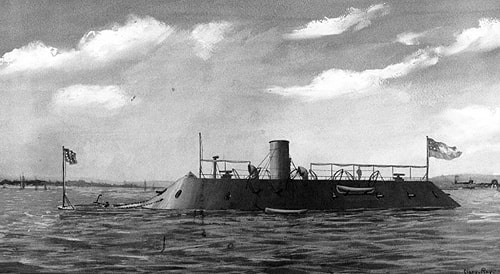 CSS Virginia (ex-USS Merrimack) Clary Ray (CC BY-NC-SA) ](https://www.worldhistory.org/image/22307/css-virginia-ex-uss-merrimack/ "CSS Virginia (ex-USS Merrimack)")Among these ships was the screw frigate *USS Merrimack*. It had been burned to the waterline, and its engines were in terrible condition, but it could be raised and restored – and it was. Scholar Alan Taylor writes:
> Seeking a new weapon to break the blockade, Confederates converted the captured hulk of a Union warship into an ironclad gunboat, the *CSS Virginia*…Covered with iron plates four inches thick, the ironclad could repel the cannon shot that wrecked wooden warships. The Confederates mounted ten cannon on the vessel, four on each broadside and one at bow and aft. An iron ram at the waterline on the bow provided another means to take out wooden hulls. Two steam engines propelled the ironclad.
> (179)
Confederate Secretary of the Navy Stephen R. Mallory, who had been advocating for ironclad ships, was confident this would be the 'secret weapon' that would break the blockade. As far as Mallory understood, the Union knew nothing of what was going on at Gosport, had no ironclads, and so the *CSS Virginia* would only be facing wooden ships in an unprecedented surprise attack. Due to this assumption, the new ironclad was only given explosive shell as ordnance, not solid shot, and the *Virginia* was commissioned on 17 February 1862, readied, according to all expectations, to sink the blockading Union vessels.
### The Monitor
Contrary to Mallory's assumption, Union Secretary of the Navy [Gideon](https://www.worldhistory.org/Gideon/) Welles was entirely aware of the Confederacy's ironclad plans and progress because he had been told of them by a formerly enslaved woman who had fled Norfolk, Virginia, and knew what was going on at Gosport. Welles received permission from Congress to begin building a Union fleet of ironclads in August 1861.
He appointed senior naval officers to the Ironclad Board, a commission that would choose the design for the new ships, and they approved three of the 17 submitted. Ericson writes:
> One of the three winning designs came from Swedish-born inventor John Ericsson. His design was conceived a decade earlier during the Crimean War, but his "iron-clad steam battery" elicited little attention from the French emperor. The board, eager to outpace Rebel progress, was elated by Ericsson's promise to build the ship in ninety days at a cost of $275,000.
> (129)
[ 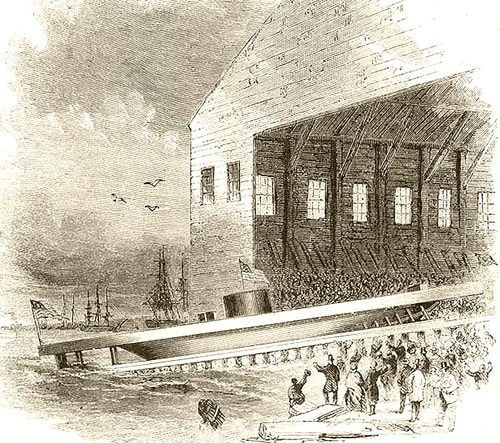 The Launch of the USS Monitor, 1862 Harper's Monthly (Public Domain) ](https://www.worldhistory.org/image/22308/the-launch-of-the-uss-monitor-1862/ "The Launch of the USS Monitor, 1862")The *Monitor* was unlike any ship ever seen at that time. Ericson continues:
> Ericsson's design challenged conventional norms, and he called his vessel a "fort on a raft." The hull was split between an upper and lower section. The upper section, entirely clad in iron armor, stretched 172 feet long and another 41 feet wide. The section supported the armored deck, which sat only thirteen inches above the waterline; the pilothouse; and its most distinguishable feature, the gun turret. Steam-powered engines below allowed the turret and the two large Dahlgrens \[guns\] inside full rotation…This purposeful design made the *Monitor* impervious to being rammed. As much of the ship was concealed below the waterline, it possessed a low silhouette, which frustrated enemy gunners. With a draft of only twelve feet, it could maneuver easily in shallow water.
> (129)
Work began on the ship in October 1861 and was completed in 101 days, commissioned on 25 February 1862. Unlike the *CSS Virginia*, the *Monitor* was both an ironclad and iron-hulled.
### Site of Battle & Situation
The name of the site, Hampton Roads, has nothing to do with a road; *Roads* in the name is short for *roadstead*, a sheltered body of water, and Hampton Roads was (and still is) among the world's largest natural harbors. It provides a channel for the Elizabeth, James, and Nansemond rivers, between Old Point Comfort and Sewell's Point, as they flow into Chesapeake Bay and out into the Atlantic Ocean.
In April 1861, after the Confederates took Gosport Navy Yard in Portsmouth, they controlled the southern side of Hampton Roads and set up batteries at Sewell's Point and on Craney Island. The Union, however, still held Fort Monroe at Old Point Comfort and so controlled the entrance to Hampton Roads from the sea. The battery at Fort Monroe and the Union blockade effectively cut off the [cities](https://www.worldhistory.org/city/) of Norfolk and Richmond from international trade.
The Confederate Navy was too small to go up against the Union warships that controlled Hampton Roads – the USS *Congress*, the USS *Cumberland*, and the USS *Minnesota* – all of which were supported by the batteries of Fort Monroe - and saw no way to resolve the situation until the coming of the CSS *Virginia*.
### Battle of Hampton Roads
Flag Officer Franklin Buchanan was selected to command the *Virginia* and planned to launch on 7 March 1862, but rough weather prevented this. The CSS *Virginia* had a draft of 22 feet (roughly 6.7 m) and so could not maneuver in shallow waters and, because of its iron plating, was top-heavy and could not manage rough seas. Further, as its engines had been repaired, not replaced, it could only manage a top speed of about 5 knots (roughly 6-8 mph). The *Virginia* was a slow-moving vessel, requiring approximately a mile turning radius, which took almost an hour to execute.
**Day One: 8 March**
On the morning of 8 March, the CSS *Virginia* appeared at Hampton Roads accompanied by the CSS *Beaufort, the* CSS *Raleigh*, and the smaller ships CSS *[Jamestown](https://www.worldhistory.org/Jamestown_Colony_of_Virginia/),* CSS *[Patrick Henry](https://www.worldhistory.org/Patrick_Henry/), and* CSS *Teaser*. This fleet was met by the USS *Cumberland,* USS *Congress,* USS *Minnesota,* USS *St. Lawrence,* USS *Roanoke*, and USS *Brandywine*. The *Brandywine, Roanoke*, and *Minnesota* maneuvered away as soon as the CSS *Virginia* entered Hampton Roads but ran around and became stuck.
Buchanan directed the *Virginia* to attack the *Cumberland* first because he believed its guns might be able to pierce the *Virginia's* armor plating and, therefore, was the greatest threat. The *Cumberland* and *Congress* fired on the *Virginia*, but their shots bounced harmlessly off its iron shell. The *Virginia* rammed the *Cumberland*, striking it below the waterline, and it began to sink.
[ 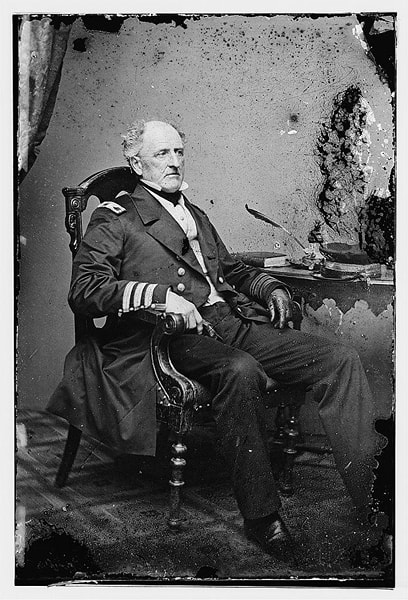 Captain Franklin Buchanan Mathew Brady (Public Domain) ](https://www.worldhistory.org/image/22317/captain-franklin-buchanan/ "Captain Franklin Buchanan")The ram on the *Virginia* became lodged in the *Cumberland,* and it was in danger of being pulled down with it. The ram, however, had been improperly attached in haste and broke off, freeing the *Virginia* to then turn on the *Congress*.
The captain of the *Congress*, Lt. Joseph B. Smith, believing the *Virginia's* ram was still intact, ordered his ship run aground in shallow water to prevent its sinking. At this point, the *Jamestown, Patrick Henry*, and *Teaser* joined the battle to support the *Virginia* in its assault on the *Congress*. After around an hour, the *Congress* raised the white flag of surrender.
Buchanan ordered his lesser ships to ferry the crew of the *Congress* to shore, but Union batteries at Newport News on the northern shore of the James River opened fire on the ships. Buchanan, standing on the deck of the *Virginia*, and enraged at the breach of protocol in firing under a flag of truce, ordered his guns to fire on the *Congress* with hot shot (heated cannonballs), which set *Congress* on fire and caused it to explode when that fire reached its magazine.
When evening came on 8 March, the CSS *Virginia* had sunk two Union warships, killed over 200 Union soldiers, and caused three other ships to run aground. Buchanan had been wounded in the thigh as he stood above deck and turned over command to Lt. Catesby ap Roger Jones.
The *Virginia*, now under Jones, directed its attack on the grounded USS *Minnesota* but, because of the falling tide and the ship's deep draft, Jones abandoned the assault and returned the ship to Sewell's Point for the night.
**Day Two: 9 March**
Although the CSS *Virginia* had done well on the first day, it was still damaged and needed some repair, which went on through the night. Jones was fully prepared to renew the battle on the morning of 9 March and was confident in the *Virginia's* abilities to sink the USS *Minnesota* with the same explosive shell that had destroyed the *Congress*.
In the morning, however, as the *Virginia* approached the *Minnesota*, there was a strange craft at its side – the *USS Monitor* – but no one aboard the *Virginia* recognized this 'thing' in the water as a warship. Jones thought it might be a ship's boiler taken from the *Congress* for salvage by the *Minnesota*.
The USS *Monitor* had been brought down from New York Navy Yard in Brooklyn, towed by the tugboat *[Seth](https://www.worldhistory.org/disambiguation/Seth/) Low*, because it had not been built for open-ocean conditions. It arrived in Hampton Roads the evening of 8 March and took position alongside the *Minnesota*. To the crew of the *Virginia*, the odd-looking [metal](https://www.worldhistory.org/disambiguation/metal/) thing seemed nothing more than a stray chunk of machinery.
Jones understood he was mistaken when the USS *Monitor* disengaged from the side of the *Minnesota* and approached for combat. The *Virginia* fired on the *Monitor* and was met with a broadside from the *Minnesota*. These shots bounced off the *Virginia's* iron shell, but the *Monitor* continued to pummel it.
[ 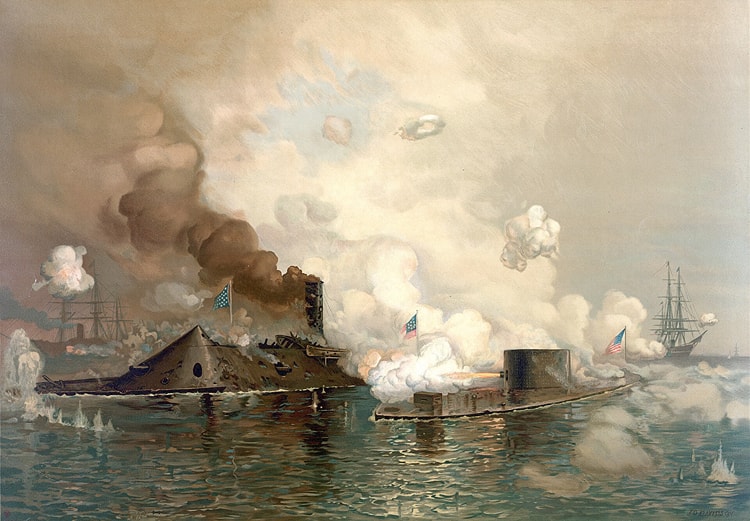 The Monitor and the Merrimack Louis Prang & Co. (Public Domain) ](https://www.worldhistory.org/image/22309/the-monitor-and-the-merrimack/ "The Monitor and the Merrimack")The USS *Monitor* was commanded by Lt. John L. Worden, who had been captured by the Confederates in 1861 and only recently returned in a prisoner exchange. Although he had doubts about the *Monitor* upon first seeing it, he was eager to test its strength against whatever the Confederacy had produced.
The Battle of Hampton Roads on the second day lasted roughly from 7:30 until 11:30 in the morning. The two ironclads pounded each other, but neither could gain an advantage. The *Virginia's* explosive shell, which had been so effective against the wooden warships on the first day, bounced off the *Monitor*. The *Monitor's* guns were using a charge of 15 pounds (6.8 kg) of gunpowder (because they were afraid that the untried weapons would explode with more), and this did not provide enough power to pierce the *Virginia*.
The *Monitor* was faster, more maneuverable, and, if the crew had used a larger gunpowder charge, could have probably disabled and sunk the *Virginia*. The *Virginia's* ten guns could have probably done the same to the *Monitor* if it had been equipped with solid armor-piercing ordnance instead of just explosive shot. As it was, however, the two ships could only circle each other, exchanging ineffectual fire.
Late in the battle, a shot from the *Virginia* struck the pilot house on the *Monitor*, hurling bits of iron into the viewing slit that struck Lt. Worden, temporarily blinding him. The *Monitor* withdrew so command could be passed to Lt. [Samuel](https://www.worldhistory.org/samuel/) D. Greene, but Jones, on the *Virginia*, interpreted this as a formal withdrawal from battle.
By the time *Monitor* had returned, they saw the *Virginia* steaming away and came to the same conclusion Jones had: the adversary had fled the field. Both sides claimed a victory that was widely reported not only in the newspapers of the North and South but around the world. Great Britain and France, as noted, had already developed ironclads; but they had no idea whether these would be effective in battle until the news broke about the engagement at Hampton Roads.
### Fate of Both Ships
While all of this was going on, Union Major General [George B. McClellan](https://www.worldhistory.org/George_B._McClellan/) was mobilizing the Union Army of the Potomac for the Peninsula Campaign with the goal of capturing the Confederate capital at Richmond. He began moving the army by ship from [Alexandria](https://www.worldhistory.org/alexandria/), Virginia, to Fort Monroe on 17 March 1862.
McClellan, overly cautious anyway, proceeded more slowly than usual because he feared the CSS *Virginia* would attack and sink his wooden transport vessels. Even though the USS *Monitor* had proven it could keep the *Virginia* in check, the Confederate ironclad was still operational, and all the Confederate batteries remained in place, hampering McClellan's plan to move swiftly up the peninsula to Richmond.
Even so, as more Union troops arrived at Fort Monroe, Confederate Major General Benjamin Huger came to believe his position at Norfolk was untenable and abandoned the [city](https://www.worldhistory.org/city/) on 9 May. He ordered the *Virginia* to be brought up the James River to Richmond, but its draft was too great for the river's depth. To prevent its capture, the *Virginia* was towed to Craney Island, where it was set on fire and blew up on 11 May 1862. McClellan's forces were then free to begin their push up the peninsula.
The USS *Monitor* remained at Hampton Roads and was easily able to navigate the James River to take part in the First Battle of Drewry's Bluff (15 May 1862). On 29 December of that year, it was towed to open water by the frigate USS *Rhode Island* to be used in an assault on Wilmington, North Carolina. On 30 December, the ships were caught in a severe storm off Cape Hatteras and the *Monitor* began taking on water. Early in the morning of 31 December 1862, it sank and, although many of the crew were rescued by the *Rhode Island*, 16 men went down with the ship.
### Conclusion
Although the Battle of Hampton Roads ended in a draw, the USS *Monitor* prevented the CSS *Virginia* from destroying the USS *Minnesota* and any of the other wooden ships of the Union, thereby keeping the blockade intact. The engagement could, therefore, be understood as a Union victory. The *Virginia's* entire purpose was to serve as a 'secret weapon' that would break the blockade, and it failed at this. That did not stop the Confederacy from trying again, however, as Taylor notes:
> The Confederates built twenty-one more ironclads on the *Virginia* model, and the Union countered with fifty-eight, primarily of the *Monitor* sort, although some had two, and even three gun turrets. As Union armies seized ports and advanced along rivers, Confederates destroyed most of their ironclads, which had failed to break the blockade.
> (179)
In the end, the Battle of Hampton Roads preserved the Union Blockade of Southern ports, which, although never as 'airtight' as Winfield Scott envisioned, certainly did disrupt Southern trade. More importantly, from a global perspective, the battle ended the age of wooden-hulled warships and signaled the advent of ironclad and iron-hulled maritime fleets.
#### Editorial Review
This human-authored article has been reviewed by our editorial team before publication to ensure accuracy, reliability and adherence to academic standards in accordance with our [editorial policy](https://www.worldhistory.org/static/editorial-policy/).
## Bibliography
- [Crenshaw, D. & Gruber, D. A. *To Hell or Richmond: The 1862 Peninsula Campaign.* Savas Beatie, 2023.](https://www.worldhistory.org/books/B0BY8LNRBN/)
- [Ericson, M. *The Civil War in Hampton Roads and the Outer Banks.* The History Press, 2026.](https://www.worldhistory.org/books/1467156779/)
- [Gott, K. D. *Where the South Lost the War: An Analysis of the Fort Henry-Fort Donelson Campaign, February 1862.* Stackpole Books, 2023.](https://www.worldhistory.org/books/B00AVZSQ78/)
- [McPherson, J. M. *Battle Cry of Freedom.* Oxford University Press, 2003.](https://www.worldhistory.org/books/019516895X/)
- [Sears, S. W. *To The Gates Of Richmond: The Peninsula Campaign.* Mariner Books, 2001.](https://www.worldhistory.org/books/0618127135/)
- [Taylor, A. *American Civil Wars: A Continental History, 1850-1873.* W. W. Norton & Company, 2024.](https://www.worldhistory.org/books/1324035285/)
## About the Author
Joshua J. Mark is World History Encyclopedia's co-founder and Content Director. He was previously a professor at Marist College (NY) where he taught history, philosophy, literature, and writing. He has traveled extensively and lived in Greece and Germany.
- [Linkedin Profile](https://www.linkedin.com/pub/joshua-j-mark/38/614/339)
## Questions & Answers
### What was the Battle of Hampton Roads?
The Battle of Hampton Roads was a naval engagement fought on 8-9 March 1862 during the American Civil War at the roadstead (harbor) of Hampton Roads, Virginia, best known for the second day when the ironclad ships USS Monitor and CSS Virginia fought each other.
### Why is called the Battle of Hampton Roads if it was a naval engagement?
It is called the Battle of Hampton Roads because "roads" is short for "roadstead" - a sheltered body of water (harbor). It can be understood as the Battle of Hampton Roadstead.
### Who won the Battle of Hampton Roads?
The Battle of Hampton Roads was a draw, though both sides claimed victory. It could be considered a Union victory, however, as the USS Monitor prevented the CSS Virginia from breaking the Union blockade.
### Why is the Battle of Hampton Roads significant?
The Battle of Hampton Roads is significant because it was the first time ironclad warships met in battle and, after the CSS Virginia had proven itself superior to wooden warships on the first day of the engagement, signaled the end of wooden warships and the advent of ironclad fleets.
## Cite This Work
### APA
Mark, J. J. (2026, November 05). Battle of Hampton Roads: Clash of the Ironclads. *World History Encyclopedia*.
### Chicago
Mark, Joshua J.. "Battle of Hampton Roads: Clash of the Ironclads." *World History Encyclopedia*, November 05, 2026. .
### MLA
Mark, Joshua J.. "Battle of Hampton Roads: Clash of the Ironclads." *World History Encyclopedia*, 05 Nov 2026, .
## License & Copyright
Submitted by [Joshua J. Mark](https://www.worldhistory.org/user/JPryst/ "User Page: Joshua J. Mark"), published on 05 November 2026. The copyright holder has published this content under the following license: [Creative Commons Attribution-NonCommercial-ShareAlike](https://creativecommons.org/licenses/by-nc-sa/4.0/deed.en). This license lets others remix, tweak, and build upon this content non-commercially, as long as they credit the author and license their new creations under the identical terms. When republishing on the web a hyperlink back to the original content source URL must be included. Please note that content linked from this page may have different licensing terms.