---
title: The Ideal of Christendom in the Middle Ages & Beyond
author: Rebecca Denova
source: https://www.worldhistory.org/article/3011/the-ideal-of-christendom-in-the-middle-ages--beyon/
format: machine-readable-alternate
license: Creative Commons Attribution-NonCommercial-ShareAlike (https://creativecommons.org/licenses/by-nc-sa/4.0/)
updated: 2026-10-21
---
# The Ideal of Christendom in the Middle Ages & Beyond
_Authored by [Rebecca Denova](https://www.worldhistory.org/user/rdenova/)_
The [ideal of Christendom in antiquity](https://www.worldhistory.org/article/2997/the-ideal-of-christendom-in-antiquity/) joined separate nations into one single community carrying out the precepts of the [God](https://www.worldhistory.org/God/) of [Israel](https://www.worldhistory.org/disambiguation/Israel/). [Constantine's conversion to Christianity](https://www.worldhistory.org/article/1737/constantines-conversion-to-christianity/) resulted in the merging of state and church, with a creed of what all Christians should believe and practice. As [Roman emperor](https://www.worldhistory.org/Roman_Emperor/), [Constantine](https://www.worldhistory.org/disambiguation/Constantine/) had the authority to enforce both religious and secular laws.
[  Doctrine of the Two Swords from the Sachsenspiegel Eike von Repgow (CC BY-NC-SA) ](https://www.worldhistory.org/image/14188/doctrine-of-the-two-swords-from-the-sachsenspiegel/ "Doctrine of the Two Swords from the Sachsenspiegel")The Vatican, under the auspices of popes, was created in the 5th century to provide spiritual guidance through Christian sacraments (rituals) that led to salvation. The secular rulers protected the faith and used their armies to maintain order. This included laws, community calendars, morality, and public policies that were based on Christian theology. Combined with religious authority, the Papacy was also a monarchy as the site of the throne of Peter. Rather than a bishop's headdress of a mitre, popes wore a tiara, a crown.
### The Divine Right of Kings
The divine right of kings was an ancient concept, with origins in kings validating their rule as the offspring of a god and a human woman. In ancient [Judaism](https://www.worldhistory.org/disambiguation/judaism/), the concept was derived from the story of the prophet [Samuel](https://www.worldhistory.org/samuel/) anointing [King David](https://www.worldhistory.org/King_David/) with oil. All Jewish kings were anointed upon their coronation. The [Greek](https://www.worldhistory.org/disambiguation/greek/) translation of the Hebrew messiah was *Christos* ("anointed one") and became a title for [Jesus of Nazareth](https://www.worldhistory.org/Jesus_Christ/), [Jesus Christ](https://www.worldhistory.org/Jesus_Christ/). Because monarchs were considered to act as carrying out the will of the gods on Earth, their commands were immune from judgement. Resisting or judging a king was both treason against the state and a direct sin against the gods.
### Early Middle Ages
[Charlemagne](https://www.worldhistory.org/Charlemagne/), King of the [Franks](https://www.worldhistory.org/Franks/) (reign 768-814), had conquered areas of modern Germany, Belgium, and the Netherlands. In 800 CE, Pope [Leo III](https://www.worldhistory.org/Leo_III/), during Christmas Mass, promoted him to the Holy [Roman](https://www.worldhistory.org/disambiguation/Roman/) Emperor. Historians point out that it was neither holy, nor Roman, nor an [empire](https://www.worldhistory.org/empire/). In the following centuries, many monarchs challenged the authority of the Vatican through their armies. The theoretical harmony between state and church often collapsed into fierce power struggles between the Pope and the Holy Roman Emperor as to who held supreme authority on Earth.
The divine right of kings began to be challenged beginning in the 12th century. The rapid population growth and innovations in technology and weapons of [war](https://www.worldhistory.org/disambiguation/War/) led to global expansion of the [trade](https://www.worldhistory.org/disambiguation/trade/) routes. The Italian states of Florence, Venice, and the Kingdom of Naples vied for dominance of the sea trade. The crisis of the [Black Death](https://www.worldhistory.org/Black_Death/) destroyed around half the population. The greed and corruption of the monarchs did not relieve the suffering of the majority of the poor, and the Vatican only offered relief after [death](https://www.worldhistory.org/disambiguation/Death/) in heaven if they obeyed the rules of the Church. Somehow [Jesus](https://www.worldhistory.org/Jesus_Christ/)'s preaching to love one's neighbor was lost.
[ 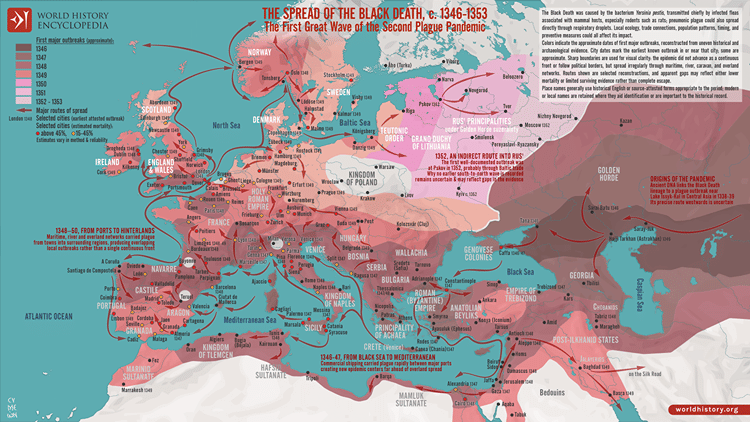 Map of the Spread of the Black Death, c. 1346–1353 Simeon Netchev (CC BY-NC-ND) ](https://www.worldhistory.org/image/12038/map-of-the-spread-of-the-black-death-c-1346-1353/ "Map of the Spread of the Black Death, c. 1346–1353")Social scientists describe periods such as this as anomie, a rapid breakdown caused by [industrialization](https://www.worldhistory.org/disambiguation/Industrialization/) and economic shifts that weaken traditional values, without clear moral guidelines, which leaves people in distress. People feel isolated, disoriented, or alienated from their community. With the failures of both the Church and secular leaders, various groups began their own interpretations of how to reform society.
### Mendicant Orders
The [monastic orders of the Middle Ages](https://www.worldhistory.org/article/1407/monastic-orders-of-the-middle-ages/) owned large tracts of farmland and the means to produce crops and herds. A [medieval monastery](https://www.worldhistory.org/Medieval_Monastery/) could accumulate great treasures from Christian donations of relics and art. But several monks led a movement that rejected both the ownership of property and the lifestyle of the clergy and kings and became itinerant orders known as mendicants.
Mendicant, from the Latin "to beg," was someone who survived through alms. They took the monastic ideal of asceticism from the monastery to the [cities](https://www.worldhistory.org/city/), administering to the poor and the sick. Members of these orders were known as friars and became infamous in their critique of both the monasteries, the [medieval Church](https://www.worldhistory.org/Medieval_Church/), and monarchs.
### Flagellants
Flagellants arose in the period of the Black Death in the mid-14th century. They believed that God had sent the [plague](https://www.worldhistory.org/disambiguation/plague/) as a punishment for the wicked evils of humanity. The name derived from publicly whipping themselves to atone for human sins and appease God's wrath. Flagellants traveled from town to town, performing penance, and ironically, their missions to cities most likely helped to spread the disease.
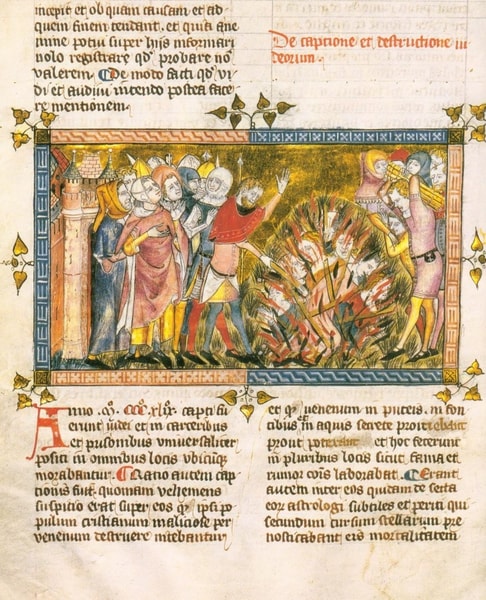
The movement sparked extreme religious hysteria and incited violent riots. The more extreme of the flagellants rejected the authority of the clergy and began hearing the confession of people's sins. The Vatican claimed that only the ordained clergy could forgive sins on Earth. Riots and violence also occurred against the Jews, who were also blamed for the disease, with a rumor that Jews were poisoning the wells. Pope Clement VI officially condemned the movement in 1349.
[  Persecution of Jews during the Black Death Unknown artist (Public Domain) ](https://www.worldhistory.org/image/12094/persecution-of-jews-during-the-black-death/ "Persecution of Jews during the Black Death")### A New Relationship Between Church & State
Countries in [Europe](https://www.worldhistory.org/europe/) began creating parliaments. A form of *parler*, "to speak," it originally referred to discussions by monks. Chroniclers began using the Latin *parliamentum* to describe formal council meetings called by a monarch that included advice to the king.
[Henry II of England](https://www.worldhistory.org/Henry_II_of_England/) (reign 1154-1189) reformed an earlier form of parliament and banned trials by ordeal, where God decided the outcome. Juries would now decide the fate of the accused. The role of the king was to oversee justice in the civil courts, issued by Parliament for secular administrators with codes of jurisprudence. Regional assizes were set up by judges for violations of various laws. But Henry also used Parliament to establish the tax codes of individuals and towns, as well as the lands and wealth of the clergy for the treasury.
When the position of Lord Chancellor became vacant, Henry appointed [Thomas Becket](https://www.worldhistory.org/Thomas_Becket/) (1118-1170), the Archbishop of Canterbury, as Lord Chancellor of [England](https://www.worldhistory.org/disambiguation/england/). However, a rift began to grow between Henry and Becket, involving the issue of ecclesiastical courts. A cleric accused of a crime was tried solely by the Church, and Henry insisted they should be tried according to his new concepts of English [law](https://www.worldhistory.org/disambiguation/law/). Beckett fled to France for a few years, where the French king offered him asylum, but then returned to England when Henry suggested a compromise. Henry was officially crowned king in 1170 at York by three bishops. Becket did not attend. He objected that this upended the traditional right of coronation being done by the Archbishop of Canterbury and excommunicated all three bishops.
At this point, different versions of the story survive as to exactly how Henry reacted. The most popular version was that four of Henry's knights interpreted Henry's exasperated outburst as a command to kill Becket and bludgeoned him to death. Becket's dying words were allegedly, "For the name of Jesus and the protection of the Church, I am ready to embrace death."
[ 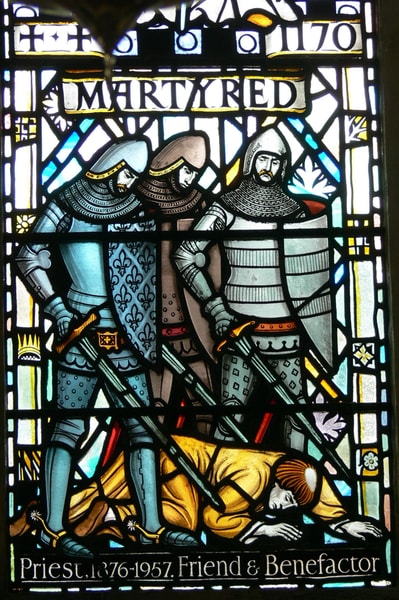 Martyrdom of Thomas Becket, St. David's Cathedral Wolfgang Sauber (GNU FDL) ](https://www.worldhistory.org/image/11570/martyrdom-of-thomas-becket-st-davids-cathedral/ "Martyrdom of Thomas Becket, St. David's Cathedral")The fame of Becket spread throughout England and Europe. Two years after his death, he was canonized as a saint by [Rome](https://www.worldhistory.org/Rome/). Accepting the inevitable, Henry underwent public flogging for his penance at his [tomb](https://www.worldhistory.org/tomb/). The shrine of Becket remains one of the most popular pilgrimage sites in England.
Henry's reign also saw the first of the [crusades](https://www.worldhistory.org/Crusades/). His eldest son, [Richard I of England](https://www.worldhistory.org/Richard_I_of_England/) (the Lionheart, reign 1189-1199), was away on this crusade for many years. Attempting to reach home, he was captured in 1192 and held for ransom. His brother, [King John of England](https://www.worldhistory.org/King_John_of_England/) (reign 1199-1216), took advantage of Richard's absence to attempt to usurp the throne and seize Richard's continental lands. He created a rival court and removed Richard's Chancellor. Instead of collecting the ransom for Richard, John increased the taxes for his own use. This period was the context of the later legends of a group of bandits under Robin Hood. This was an attempt to recover the original teachings of [Christianity](https://www.worldhistory.org/christianity/), with the bandits being tutored by a monk, Friar Tuck.
John's rebellion failed due to strong resistance from Richard's loyal ministers. When Richard returned in 1194, he easily crushed the remaining rebel forces and banished John, though he later forgave him and named him his heir.
### The [Magna Carta](https://www.worldhistory.org/Magna_Carta/)
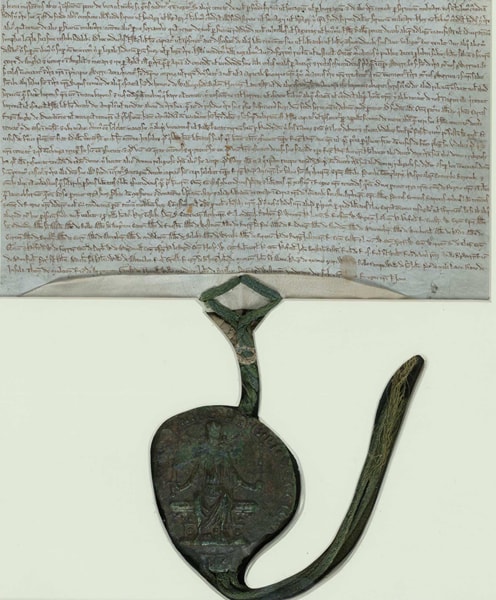
John was unpopular and was ultimately forced to sign the Magna Carta on 15 June 1215, which limited royal power. Core elements of the Magna Carta included:
- The Rule of Law: No one, including the king, is above the law.
- Due Process: No freeman could be imprisoned, stripped of property, or exiled except through the lawful judgment of their peers or the law of the land.
- Access to Justice: Justice would not be sold, delayed, or denied to anyone.
- No Taxation without Consent: This required the king to seek common counsel from his advisors before imposing certain feudal taxes.
- Freedom of the Church: The king could not meddle in church affairs nor appoint bishops or seize church revenues and land.
[  Magna Carta with Royal Seal British Library (Public Domain) ](https://www.worldhistory.org/image/9496/magna-carta-with-royal-seal/ "Magna Carta with Royal Seal")### The [Protestant Reformation](https://www.worldhistory.org/Protestant_Reformation/)
From the 14th to 16th centuries, criticism of the institution of the Catholic Church began to spread throughout Europe. The Vulgate Latin [Bible](https://www.worldhistory.org/bible/) was the main source for the scriptures. Early reformers such as [John Wycliffe](https://www.worldhistory.org/John_Wycliffe/) (1330-1384) and [Jan Hus](https://www.worldhistory.org/Jan_Hus/) (1369-1415) advocated for the production of Bibles in local languages for the uneducated instead of Latin. The invention of the printing press, credited to [Johannes Gutenberg](https://www.worldhistory.org/Johannes_Gutenberg/) in 1436, helped to spread Wycliffe's and Hus's translations in several countries as well as new views on reforms. Jan Hus was burned at the stake, and his followers, known as Hussites, were persecuted as heretics.
[Martin Luther](https://www.worldhistory.org/Martin_Luther/) (1483-1546), an Augustinian monk and priest who became a professor of theology in Germany, advocated against what he saw as the abuses of the Vatican: the many wars led by Popes against cities in [Italy](https://www.worldhistory.org/italy/), worship of saints, relics, and indulgences. [Martin Luther's 95 Theses](https://www.worldhistory.org/article/1891/martin-luthers-95-theses/) in 1517 and his subsequent refusal to renounce his beliefs resulted in his excommunication by Pope Leo X and the Holy Roman Emperor Charles V at the [Diet of Worms](https://www.worldhistory.org/Diet_of_Worms/) in 1520. Luther was declared a heretic and an outlaw.
[ 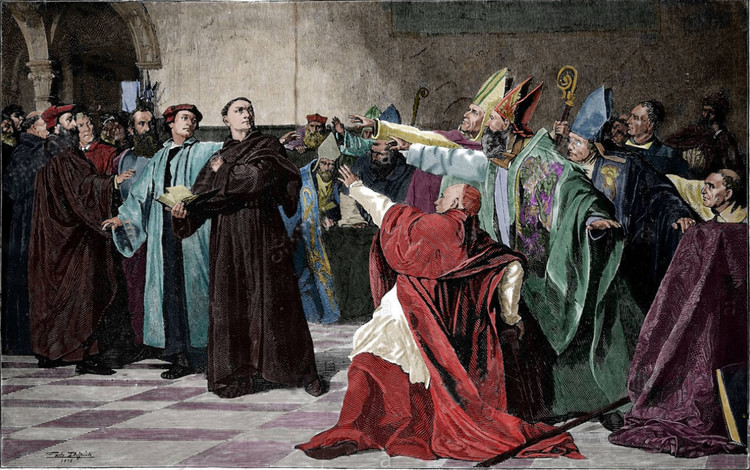 Martin Luther at the Diet of Worms Emile Delperée (Public Domain) ](https://www.worldhistory.org/image/14975/martin-luther-at-the-diet-of-worms/ "Martin Luther at the Diet of Worms")More than any other medieval theologian, Luther promoted Augustinian theology and [Augustine of Hippo](https://www.worldhistory.org/Augustine_of_Hippo/)'s interpretations of [Paul the Apostle](https://www.worldhistory.org/Paul_the_Apostle/). Luther maintained [Augustine](https://www.worldhistory.org/disambiguation/Augustine/)'s concept of "original sin," the inherited corruption and separation from God that affects every part of human nature. Luther extended Augustine's concept by adding that when God redeems a person, he redeems the entire person, including their will. Only after this is done is a believer liberated to serve God.
Luther also declared that the only true knowledge is found in *sola scriptura*, "scripture alone." Scripture can be mediated through creeds and councils, but while humans are fallible, scripture is divinely revealed. We are saved through the divine scriptures and God's gift of grace. As only God can do this, the saints and the clergy are not sacred mediators between God and humans. He renounced the clergy of having the ability to forgive sins on Earth. When Luther married [Katharina von Bora](https://www.worldhistory.org/Katharina_von_Bora/), a former nun, he also renounced the practice of clerical celibacy.
Luther's ideas were spread by another reformer, [John Calvin](https://www.worldhistory.org/John_Calvin/) (1509-1564), and his community at Geneva, Switzerland. Both upheld Augustine's doctrine of predestination: God already knows who will be saved and who will be condemned. Even after we sin, God decides, and only he decides, whether he will count our sins against us. Irresistible grace, coming from God, is a force that cannot be resisted no matter what we do.
Luther produced what was titled his Catechism in 1529, originally designed to teach children and the uneducated. This contained what is described as Luther's theology of the cross and his concepts of martyrdom. The suffering and misfortunes of Christians, according to Luther, meant that martyrdom could be experienced in the everyday life of Christians without waiting for the afterlife. The way one survived the exigencies of life, holding firmly to one's faith, would count toward their eventual salvation. This removed the Vatican as the only power to declare someone a [martyr](https://www.worldhistory.org/martyr/) or a saint. A major theme in Protestantism is the universal salvation of all the world. Protestantism contains an ongoing critique of contemporary individual behavior, society, and governments, all detrimental barriers to God's kingdom.
Martin Luther believed that church and state are two distinct realms ordained by God with completely separate duties and powers. He most likely had been influenced by Augustine's arguments in his *[City](https://www.worldhistory.org/city/) of God*, contrasting the heavenly city with the earthly city. For Luther, the Church is responsible for the spiritual realm, through grace, faith, and the teachings of [the Gospels](https://www.worldhistory.org/The_Gospels/). The state, the temporal realm, is responsible for law and order through the sword, punishing crime and protecting physical life and property. But the state should not force religious belief or rule over the human soul. Luther's rejection of papal supremacy meant that the clergy was subject to secular laws, as any other citizen in earthly matters. But Christians must obey secular authorities to maintain social order.
### Protestant Sects & the [English Reformation](https://www.worldhistory.org/English_Reformation/)
Mirroring ancient Christianity, Protestantism evolved into sects that disagreed over governance, how many of the sacraments of the Vatican would be retained, and variations on how people could be saved. Some radical sects, such as the Anabaptists, rejected any authority from either the church or the state. In the city of Münster, they ejected the Catholic bishop and replicated the first Christians as living in common. Ownership of property was forbidden because it led to greed and corruption.
The period following the Protestant [Reformation](https://www.worldhistory.org/disambiguation/Reformation/) is incredibly complicated, with several continuing "reforms" in several countries. Various church leaders followed Luther and broke with Rome, while simultaneously aligning with the emerging nation-states and their monarchs. Subsequent centuries would see periods of religious wars between Catholics and Protestants.
[ 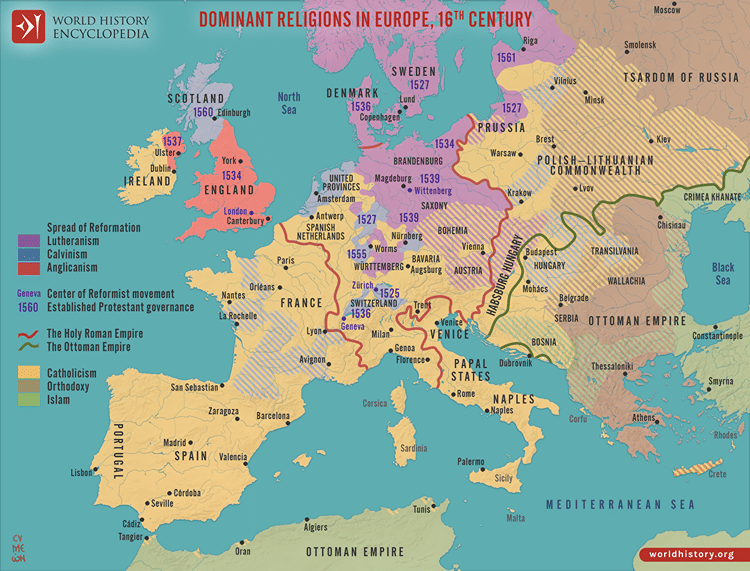 Map of the Dominant Religions in Europe, 16th Century Simeon Netchev (CC BY-NC-ND) ](https://www.worldhistory.org/image/14972/map-of-the-dominant-religions-in-europe-16th-centu/ "Map of the Dominant Religions in Europe, 16th Century")[Henry VIII of England](https://www.worldhistory.org/Henry_VIII_of_England/) (reign 1509-1547) initially rejected all forms of Protestantism, [writing](https://www.worldhistory.org/writing/) a treatise against it which he sent to Luther. However, when his first wife, [Catherine of Aragon](https://www.worldhistory.org/Catherine_of_Aragon/), failed to produce a son for Henry, he wanted a divorce, and the only way in which a monarch could upend the marriage vows was through the granting of an annulment by the Vatican. An annulment was granted if the consummation of the marriage did not take place (no sexual intercourse), an investigation of degrees of incest, or if something in the conditions of the marriage contract were unmet. He consistently appealed to Rome for an annulment, but was consistently denied one.
Henry had appointed [Thomas Cranmer](https://www.worldhistory.org/Thomas_Cranmer/) (1489-1556) as the Archbishop of Canterbury, who helped build the legal case for annulment. During Cranmer's tenure, he established the first doctrinal and liturgical structures of the reformed Church of England, which became the Anglican Church. With the assistance of several Continental reformers to whom he gave refuge, he changed doctrine or discipline in areas such as the Eucharist, clerical celibacy, the role of images in places of worship, and the veneration of saints.
Henry, in a private ceremony, married [Anne Boleyn](https://www.worldhistory.org/Anne_Boleyn/). The Vatican excommunicated Henry for this act, in theory, excommunicating all Christians in England who supported it. His chancellor, [Thomas Cromwell](https://www.worldhistory.org/Thomas_Cromwell/), helped Henry with the Parliamentary passage of a law that made Henry the Supreme Head of the Church of England. As such, Henry could dictate doctrinal religious matters, including his own annulment. All people were to sign an oath of loyalty to the king under pain of death. The [dissolution of the monasteries](https://www.worldhistory.org/Dissolution_of_the_Monasteries/) followed, and Catholic churches were closed in England. Statues and relics were destroyed, and the wealth of the institutions was transferred to the treasury.
Henry was succeeded by his daughter, the Catholic [Mary I of England](https://www.worldhistory.org/Mary_I_of_England/) (reign 1553-1588). Mary had Archbishop Cranmer put on trial for treason and heresy and burned at the stake in 1556. Mary was later known as "Bloody Mary" because of the high number of Protestants that she had executed.
Henry's other daughter, [Elizabeth I of England](https://www.worldhistory.org/Elizabeth_I_of_England/) (reign 1558-1603), had, however, been raised as a Protestant. When she inherited the throne after Mary's death, she continued and updated many of her father's concepts. But the traditionalists of England could not condone a woman as head of the Church. Instead, Parliament passed the Act of Supremacy in 1559, designating her as the Supreme Governor of the Church of England. Her Parliament passed laws that legally defined practicing Catholics and supporters of Catholicism as political treason against the crown.
[ 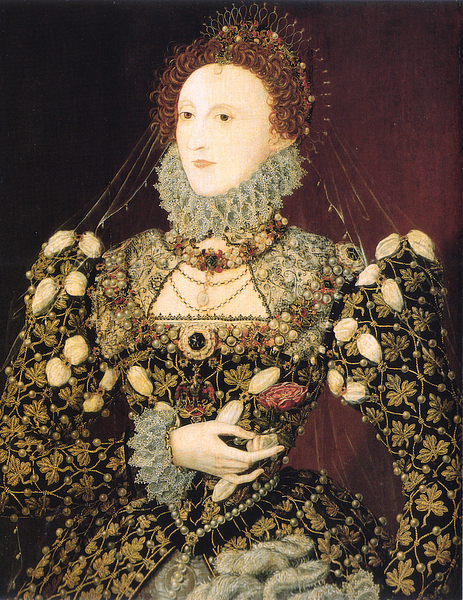 Elizabeth I Phoenix Portrait Nicholas Hilliard (Public Domain) ](https://www.worldhistory.org/image/14899/elizabeth-i-phoenix-portrait/ "Elizabeth I Phoenix Portrait")In 1570, Pope Pius V issued a papal bull that excommunicated Elizabeth and told Catholics they no longer had to obey her. This made the English government view all committed Catholics as potential security threats and enemies of the state. Any Catholic priest ordained abroad and found in England was declared guilty of treason and sentenced to death. People who sheltered priests, attended secret Catholic masses, or refused to attend Church of England services faced heavy fines, imprisonment, or execution.
### The [Counter-Reformation](https://www.worldhistory.org/Counter-Reformation/)
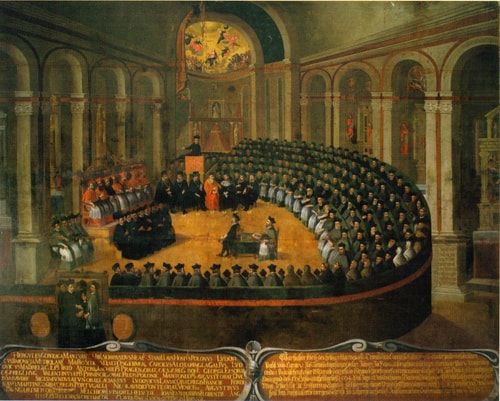
The Counter-Reformation, or Catholic Reformation, was a major 16th-17th-century movement within the Roman Catholic Church aimed at reform, doctrinal clarification, and revitalization of spiritual life, culminating in the [Council of Trent](https://www.worldhistory.org/Council_of_Trent/) (1545-1563). This reaffirmed the concept that salvation consisted of both faith and works, and that both scripture and the Church held authority. Bishops were required to reside in their dioceses; clergy were to be educated in seminaries for teaching devotional and spiritual enlightenment. New religious orders such as the Jesuits emphasized missionizing to the new colonies of North and South America, [China](https://www.worldhistory.org/china/), [Japan](https://www.worldhistory.org/disambiguation/Japan/), and [Africa](https://www.worldhistory.org/disambiguation/africa/).
[  Council of Trent Elia Naurizio (Public Domain) ](https://www.worldhistory.org/image/15987/council-of-trent/ "Council of Trent")In the Lateran Treaty of 1929, the Vatican became an independent nation-state in the city of Rome. Vatican City is ruled by the Pope, who serves as the absolute monarch and head of state. Governance is assigned to the College of Cardinals, who elect a pope for life. Having rejected the concept of the Papacy, Protestantism has no equivalent. Protestant theology emphasizes the "priesthood of all believers" and individual or congregational religious autonomy rather than a centralized body. International, yearly conferences, such as the World Council of Churches, bring together Lutherans, Baptists, Anglicans, Methodists, Episcopalians, and various Protestant sects for dialogue and issues as they arise. Both institutions address modern social issues in light of their individual theology.
#### Editorial Review
This human-authored article has been reviewed by our editorial team before publication to ensure accuracy, reliability and adherence to academic standards in accordance with our [editorial policy](https://www.worldhistory.org/static/editorial-policy/).
## Bibliography
- [Bernard, G.W. *The King’s Reformation.* Yale University Press, 2007.](https://www.worldhistory.org/books/0300122713/)
- [Logan, F Donald. *A History of the Church in the Middle Ages.* Routledge, 2012.](https://www.worldhistory.org/books/0415669944/)
- [Southern, R. W. *Western Society and the Church in the Middle Ages.* Penguin Books, 1970.](https://www.worldhistory.org/books/0140205039/)
## About the Author
Rebecca I. Denova, Ph.D. is Emeritus Professor of Early Christianity in the Department of Religious Studies, University of Pittsburgh. She has written a series of textbooks for Wiley-Blackwell.
## Cite This Work
### APA
Denova, R. (2026, October 21). The Ideal of Christendom in the Middle Ages & Beyond. *World History Encyclopedia*.
### Chicago
Denova, Rebecca. "The Ideal of Christendom in the Middle Ages & Beyond." *World History Encyclopedia*, October 21, 2026. .
### MLA
Denova, Rebecca. "The Ideal of Christendom in the Middle Ages & Beyond." *World History Encyclopedia*, 21 Oct 2026, .
## License & Copyright
Submitted by [Rebecca Denova](https://www.worldhistory.org/user/rdenova/ "User Page: Rebecca Denova"), published on 21 October 2026. The copyright holder has published this content under the following license: [Creative Commons Attribution-NonCommercial-ShareAlike](https://creativecommons.org/licenses/by-nc-sa/4.0/deed.en). This license lets others remix, tweak, and build upon this content non-commercially, as long as they credit the author and license their new creations under the identical terms. When republishing on the web a hyperlink back to the original content source URL must be included. Please note that content linked from this page may have different licensing terms.