---
title: Sectional Divisions of the Civil War: The Correspondence of A. Nicholas and J.M. McCue
author: Joshua J. Mark
source: https://www.worldhistory.org/article/2981/sectional-divisions-of-the-civil-war/
format: machine-readable-alternate
license: Creative Commons Attribution-NonCommercial-ShareAlike (https://creativecommons.org/licenses/by-nc-sa/4.0/)
updated: 2026-09-03
---
# Sectional Divisions of the Civil War: The Correspondence of A. Nicholas and J.M. McCue
_Authored by [Joshua J. Mark](https://www.worldhistory.org/user/JPryst/)_
Sectional divisions between the North and South in the United States began long before the [American Civil War](https://www.worldhistory.org/American_Civil_War/) (1861 to 1865) and, in fact, were noted at the [Constitutional Convention](https://www.worldhistory.org/Constitutional_Convention/) of 1787. It was during this convention that the first in a series of compromises between North and South was made [law](https://www.worldhistory.org/disambiguation/law/) through the Three-Fifths Clause in the US Constitution. The Three-Fifths Compromise was a concession to the Southern states, with fewer people than the North, agreeing to count three out of every five enslaved Africans as part of a state's population to inflate numbers and give Southern States more balanced political power in the House of Representatives.
[ 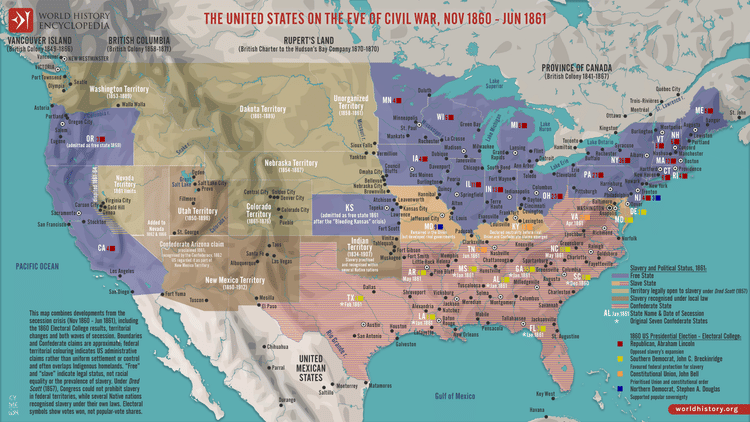 Map of the United States at the Outbreak of Civil War, 1861 Simeon Netchev (CC BY-NC-ND) ](https://www.worldhistory.org/image/20390/map-of-the-united-states-at-the-outbreak-of-civil/ "Map of the United States at the Outbreak of Civil War, 1861")Other compromises followed, including:
- **The Fugitive Slave Act of 1793** – allowing Southern slaveholders to reclaim fugitive slaves from Northern states.
- **The [Missouri Compromise](https://www.worldhistory.org/Missouri_Compromise/) of 1820** – maintaining the balance of power between free and slave states. Missouri was admitted to the Union as a slave state and Maine as a free state.
- **The [Fugitive Slave Act of 1850](https://www.worldhistory.org/Fugitive_Slave_Act_of_1850/)** – requiring people in the Northern states, by law, to assist slaveholders and slave catchers in reclaiming fugitive slaves.
- **The Kansas-Nebraska Act of 1854** – repealed the Missouri Compromise and mandated popular sovereignty as the means by which a state in the newly opened Western territories could decide for itself whether it would be free or slave.
Southern threats of secession over perceived wrongs inflicted on slave states by the free states of the North had been made in the past but in the 1850s grew louder and bolder. Scholar James McPherson notes the North's response through the farewell speech of President James Buchanan in 1860 and how his sentiments resonated with those in the North and enflamed tensions in the South:
> In his final message to Congress, on December 3, 1860, James Buchanan surprised some of his southern allies with a firm denial of the right of secession. The Union was not "a mere voluntary association of States, to be dissolved at pleasure by any one of the contracting parties," said Buchanan. "We the People" had adopted the Constitution to form "a more perfect Union than the one existing under the [Articles of Confederation](https://www.worldhistory.org/Articles_of_Confederation/), which had stated that "the Union shall be perpetual."
> The framers of the national government "never intended to implant in its bosom the seeds of its own destruction, nor were they guilty of the absurdity of providing for its dissolution." State sovereignty was not superior to national sovereignty, Buchanan insisted…
> Lincoln too considered secession the "essence of anarchy." He branded state sovereignty a "sophism." "The Union is older than any of the States," Lincoln asserted, "and, in fact, it created them as States." The [Declaration of Independence](https://www.worldhistory.org/article/2411/declaration-of-independence/) transformed the "United Colonies" into the United States; without this union then, there would never have been any "free and independent States."
> (246-247)
Buchanan's and Lincoln's sentiments, widely echoed in newspapers throughout the North, were just as widely denounced, mocked, and rejected by the Southern states.
### Escalating Tensions
Between 1850 and the US presidential election of 1860, tensions escalated dramatically, especially after [John Brown's raid on Harpers Ferry](https://www.worldhistory.org/article/2772/john-browns-raid-on-harpers-ferry/) in 1859. After [Abraham](https://www.worldhistory.org/Abraham,_the_Patriarch/) Lincoln was elected in 1860, running on a platform that included restrictions on any expansion of slavery westward, South Carolina seceded, and other Southern States soon followed.
The South blamed the North for the conflict – and the North blamed the South. Divisions were not only sectional, however, but personal. Family, friends, and neighbors – whether in New York or Virginia – came into conflict over secession, states' rights, slavery and, finally, the [war](https://www.worldhistory.org/disambiguation/War/). Modern discussions of the American Civil War frequently include the observation that it pitted brother against brother and father against son – which it did – but also turned brother against sister, sister against brother, friend against friend, and often made one's neighbor, who had previously been a close companion, into an enemy.
In Texas, [Sam Houston](https://www.worldhistory.org/Sam_Houston/) – hero of the [Texas Revolution](https://www.worldhistory.org/Texas_Revolution/) and former President of the Republic of Texas – became a polarizing figure and a social pariah for arguing against secession. In Virginia, the close relationship [Stonewall Jackson](https://www.worldhistory.org/Stonewall_Jackson/) enjoyed with his sister, Laura, seems to have ended when Jackson sided with the Confederacy and Laura with the Union. This same sad pattern also appears in the correspondence of two friends, A. Nicholas of New York [City](https://www.worldhistory.org/city/) and Colonel J. M. McCue of Mount [Solon](https://www.worldhistory.org/solon/), Virginia, whose relationship also ended as the American Civil War began.
### Nicholas & McCue
The letters of Nicholas and McCue were published in the newspaper, the *Staunton Spectator*, on 30 April 1861, a little over two weeks after the [Battle of Fort Sumter](https://www.worldhistory.org/Battle_of_Fort_Sumter/) (12-13 April 1861), the first engagement of the Civil War. Confederate General [P. G. T. Beauregard](https://www.worldhistory.org/P._G._T._Beauregard/) had ordered the batteries of Charleston, South Carolina, to fire upon the fort in Charleston Harbor, which was garrisoned by Union troops under Major Robert Anderson, who had been Beauregard's favorite teacher at West Point Military Academy.
[  Bombardment of Fort Sumter by Currier & Ives Currier & Ives (Public Domain) ](https://www.worldhistory.org/image/21516/bombardment-of-fort-sumter-by-currier--ives/ "Bombardment of Fort Sumter by Currier & Ives")News of the fall of Fort Sumter galvanized both North and South as Lincoln issued a call for 75,000 volunteers to put down the rebellion and Confederate President [Jefferson Davis' message to Congress](https://www.worldhistory.org/article/2976/jefferson-davis-message-to-congress/) made clear to his audience that the North had started the war and the South had no choice but to now defend itself.
Nicholas wrote to McCue two days after Sumter was taken by the Confederacy, on 15 April, asking whether Virginia would remain in the Union and help keep the border states from seceding. McCue responded angrily on 21 April, noting that Virginia had already seceded and, further, that the entire conflict was the fault of the Northern states who had allowed themselves to fall under the spell of abolitionists.
### The Hartford Convention
In his response, McCue references the Hartford Convention of 1814, and accuses Northerners of cowardice and hypocrisy, characterizing them along the same lines as "the men of New York and New [England](https://www.worldhistory.org/disambiguation/england/) who, in the [war of 1812](https://www.worldhistory.org/War_of_1812/), could stand by with folded hands and see the flag of their country trailed and trampled in the dust…"
The Hartford Convention was a series of meetings that took place in Hartford, Connecticut, convened by the New England Federalist Party between 15 December 1814 and 5 January 1815, protesting the War of 1812. The war was negatively impacting the maritime [trade](https://www.worldhistory.org/disambiguation/trade/) of the New England states while seeming to encourage that of the South. The delegates drafted seven amendments to the Constitution limiting Southern political power and abolishing the Three-Fifths Compromise to even the playing field between New England and the Southern States in policymaking and trade agreements.
These meetings were held in secret and concluded as news arrived of the signing of the Treaty of Ghent, ending the war. The convention's proposals, once they became known, were regarded as unpatriotic, appearing at precisely the wrong time when pro-American sentiment was at its height, and the backlash led to the downfall of the Federalist Party.
The Hartford Convention is another example of the long-standing friction between the North and the South and is tellingly cited by McCue to characterize Northerners as backstabbing cowards and Southerners as true patriots who fought against the British in that same Charleston Harbor where the Civil War had just begun.
### Text
The following text is taken from the website *Valley of the Shadow,* which reprints the letters of the *Staunton Spectator*, a weekly newspaper published in Staunton, Virginia, starting in 1861. Presumably, McCue provided the publisher, Mr. Richard Mauzy, with the letters.
The letters are also included in *The Civil War: The North*, edited by Thomas Streissguth, where they appear under the title *On Opposite Sides*.
> **Banking Office of A. Nicholas & Co.,
> No. 70 [Wall](https://www.worldhistory.org/wall/) Street,
> New York, 15th April, '61.**
> Col. J. M. McCue, - Mt. Solon, - Dear Sir: -
> It is a long time since I had the pleasure of [writing](https://www.worldhistory.org/writing/) you of your health. I have been frequently informed by my friend Sibert who has been kind enough to advise me occasionally respecting Mt. Solon and yourself.
> We have in this city become highly excited by the news that Fort Sumter was fired into and taken by the troops of the Cotton States. The President's message, calling first for 75,000 troops and then increasing the demand to 175,000, has produced a profound and deep impression that we are about entering into an awful performance, the end of which no man can tell.
> The only hope now is, that Va. will stand firm by the Union and hold all the border States to the same line of policy – if she does, our misguided South Carolina friends can soon be brought to reason – if she does not, but goes to swell the triumphal car of secession, [God](https://www.worldhistory.org/God/) knows the end.
> The universal sentiment here is, that if the Border States do go out, then the war must exterminate the cause which has created this contention. When I heard that South Carolina fired coolly and deliberately and wantonly upon our flag, I cried like a child, that our brothers should fire into us.
> If the men that did the deed could have seen the eyes that were dimmed, and the stout frames of strong men that shook when the news was received here, they would have wished that the earth had swallowed them up. The newspapers and office seekers have done their best to set the sections against each other.
> May God forgive them, I can't! – My Dear Sir, will Virginia secede? What is your opinion? Pray let me hear from you soon.
> Yours, A. Nicholas
> **Mt. Solon, 21st April, '61.**
> Mr. A. Nicholas - Dear Sir:
> Yours of the 15th inst., came to hand a few days ago. Circumstances that have occurred since, have more than answered one of the interrogatories you ask with so much apparent feeling, "Has Virginia seceded?"
> She has not only seceded, but has on this morning, an army in the field, to defend our rights and institutions, that will carry terror to the hearts of those who vauntingly boast that they will "exterminate the cause," as you are pleased to term it, of all the difficulties between us.
> Could you, and the myrmidons of abolition, of agrarianism and all that is abominable in a free government, see, as I have had the opportunity within the past few days, the spirit of our people, your craven hearts would collapse within your cowardly carcasses. You who possess means to justify it, will send your hired mercenaries to overpower us, it may be. You may devastate our country, burn our towns, insult and abuse our [women](https://www.worldhistory.org/disambiguation/women/), but [conquer](https://www.worldhistory.org/warfare/) us you can never do.
> When our brave and gallant sons are exterminated, if such could be, you will find our wives and daughters more than a match for all the Beechers, and Cheevers and Stowes \[famous abolitionists\] and that damnable set that you have so long paid Court to, and encouraged, until you have brought this affliction upon the country.
> You speak of our "institutions" being the cause of this war, and you will exterminate it forsooth. Let me tell you, sir, that it has been the misguided frenzy and folly and madness of your people, that has been the cause; and that people that has fattened and flourished upon the labor of this institution, and in your pharisaical and puritanical self-righteousness, after hoarding this wealth, would say to us, "stand aside, we are holier than thou," and cannot live under the same government with you.
> Let me say to you, sir, that the men of New York and New England who, in the war of 1812, could stand by with folded hands and see the flag of their country trailed and trampled in the dust, and convene themselves into a Hartford convention, and refuse to furnish men and means to defend their country and that flag from an insolent foreign foe, can with a very bad grace now shed tears, as you say you did, when you heard that flag was fired upon at Fort Sumter.
> Your damnable hypocrisy makes my blood boil, and in spite of myself, makes me pray that we may have the earnestly hoped for opportunity of meeting you in sight of the Potomac, and all those who, like you, have been shedding those crocodile tears, and there testing, in the sight of the ashes of the Father of his Country, your sincerity in defending that flag.
> But permit me to say, sir, that you will not be there. You, and those who think like you, will send as your personal representatives, the miserable mercenary foreigners, that you can gather up in your [cities](https://www.worldhistory.org/city/) at $10 per month to do your fighting.
> Would to God it were otherwise, and we could meet you all in person, and your boasted Seventh Regiment besides, who have warmed at our firesides, slept under our roofs, shared our hospitality, and when it was in your interest to do so, have preached up your conservatism.
> But enough, sir, I have not patience to say more. In the hope I may meet you at Washington, (what I do not expect,) I am, sir, yours.
> J. Marshall McCue
### Conclusion
It is unclear what happened to A. Nicholas after his 1861 letter, but J. M. McCue is listed as a property owner in Staunton, Virginia, in the 1870s. Nicholas' letter suggests a long-standing correspondence, but there is no information regarding the friendship between the two men prior to their very public falling out in April 1861.
Nicholas' letter clearly suggests that he expects McCue to share his feelings on the fall of Fort Sumter, his apprehension over Virginia's secession, and the war. McCue's disdainful response exemplifies the unease and daily tension of the people of the USA before, during, and even after the Civil War, as one could not even be confident in one's old expectations of how a friend might feel or what their response to a letter might be.
[ 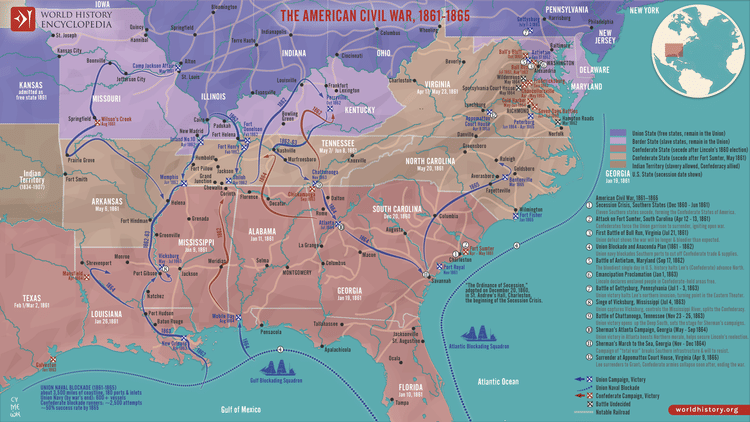 Map of the American Civil War, 1861-1865 Simeon Netchev (CC BY-NC-ND) ](https://www.worldhistory.org/image/21119/map-of-the-american-civil-war-1861-1865/ "Map of the American Civil War, 1861-1865")Their exchange is often anthologized in works on the American Civil War, such as Streissguth's book, to show how dramatically the war, and the political and social situation leading up to it, divided the people of the United States, not only the political parties of the North and South, nor only various factions in each, but family, neighbors, and those who were once friends.
#### Editorial Review
This human-authored article has been reviewed by our editorial team before publication to ensure accuracy, reliability and adherence to academic standards in accordance with our [editorial policy](https://www.worldhistory.org/static/editorial-policy/).
## Bibliography
- [Chadwick, B. *The Cannons Roar: Fort Sumter and the Start of the Civil War, An Oral History.* Pegasus Books, 2023.](https://www.worldhistory.org/books/1639363394/)
- [McPherson, J. M. *Battle Cry of Freedom.* Oxford University Press, 2003.](https://www.worldhistory.org/books/019516895X/)
- [Streissguth, T. *The Civil War: The North.* Greenhaven Press, 2001.](https://www.worldhistory.org/books/0064405885/)
- [Taylor, A. *American Civil Wars: A Continental History, 1850-1873.* W. W. Norton & Company, 2025.](https://www.worldhistory.org/books/132411049X/)
- [Valley of the Shadow/Staunton Spectator: April 30, 1861 Newspapers](https://valley.newamericanhistory.org/newspapers/staunton-spectator/1861/04/30 "Valley of the Shadow/Staunton Spectator: April 30, 1861 Newspapers"), accessed 25 Aug 2026.
- [Wheeler, R. & Catton, B. *Voices of the Civil War.* Meridian Press, 2001.](https://www.worldhistory.org/books/0064405885/)
## About the Author
Joshua J. Mark is World History Encyclopedia's co-founder and Content Director. He was previously a professor at Marist College (NY) where he taught history, philosophy, literature, and writing. He has traveled extensively and lived in Greece and Germany.
- [Linkedin Profile](https://www.linkedin.com/pub/joshua-j-mark/38/614/339)
## Questions & Answers
### What caused sectional divisions in the American Civil War?
Causes of sectional divisions in the American Civil War were slavery, states' rights, secession, and policies concerning slavery. Once the war began, it became the major cause of division.
### Who were A. Nicholas and J. M. McCue?
A. Nicholas and J. M. McCue were former friends whose letters were published in the Staunton Spectator newspaper in April 1861. Nicholas lived in New York and expressed typical Northern sympathies; McCue lived in Virginia and voiced the Southern view on the fall of Fort Sumter and the Civil War. Their correspondence is frequently anthologized to showcase how divisive the war was.
### What are some examples of sectional divisions of the Civil War?
Some examples of sectional divisions of the Civil War are friends becoming enemies, family members not speaking to each other, members of families serving on opposing sides in the war, people attacking or burning down the homes and barns of neighbors who held opposing views on slavery, states' rights, and the war.
### What resolved the sectional divisions of the Civil War?
Nothing. Sectional divisions of the Civil War lasted beyond the conflict. Northerners distrusted and disliked Southerners, and Southerners felt the same way. These divisions have never really been resolved and still crop up today.
## External Links
- [Kentucky Historical Society/Civil War Sniper Jack Hinson](https://history.ky.gov/markers/civil-war-sniper)
- [Project Muse/The Sectionalization of American Politics by Stephen E. Maizlish](https://muse.jhu.edu/article/28955/summary)
- [The West Virginia Encyclopedia Online/Laura Jackson Arnold, sister of Stonewall Jackson](https://www.wvencyclopedia.org/entries/2410)
- [The Valley of the Shadow/Staunton Spectator: April 30, 1861 Newspapers](https://valley.newamericanhistory.org/newspapers/staunton-spectator/1861/04/30)
## Cite This Work
### APA
Mark, J. J. (2026, September 03). Sectional Divisions of the Civil War: The Correspondence of A. Nicholas and J.M. McCue. *World History Encyclopedia*.
### Chicago
Mark, Joshua J.. "Sectional Divisions of the Civil War: The Correspondence of A. Nicholas and J.M. McCue." *World History Encyclopedia*, September 03, 2026. .
### MLA
Mark, Joshua J.. "Sectional Divisions of the Civil War: The Correspondence of A. Nicholas and J.M. McCue." *World History Encyclopedia*, 03 Sep 2026, .
## License & Copyright
Submitted by [Joshua J. Mark](https://www.worldhistory.org/user/JPryst/ "User Page: Joshua J. Mark"), published on 03 September 2026. The copyright holder has published this content under the following license: [Creative Commons Attribution-NonCommercial-ShareAlike](https://creativecommons.org/licenses/by-nc-sa/4.0/deed.en). This license lets others remix, tweak, and build upon this content non-commercially, as long as they credit the author and license their new creations under the identical terms. When republishing on the web a hyperlink back to the original content source URL must be included. Please note that content linked from this page may have different licensing terms.