---
title: Battle of Guam: The US Takes Back its Territory in WWII
author: Mark Cartwright
source: https://www.worldhistory.org/article/2980/battle-of-guam/
format: machine-readable-alternate
license: Creative Commons Attribution-NonCommercial-ShareAlike (https://creativecommons.org/licenses/by-nc-sa/4.0/)
updated: 2026-08-31
---
# Battle of Guam: The US Takes Back its Territory in WWII
_Authored by [Mark Cartwright](https://www.worldhistory.org/user/markzcartwright/)_
The [Battle](https://www.worldhistory.org/disambiguation/battle/) of Guam, in the Mariana Islands, took place in July and August 1944 during the Pacific [War](https://www.worldhistory.org/disambiguation/War/) of the Second World War (1939-45). Guam had been US territory prior to the conflict but was occupied by the Japanese military in 1941. A massive US naval bombardment and amphibious assault eventually cleared the island of the Japanese occupiers but at the cost of around 1,700 US lives. Guam became an important naval and air base for the rest of the war, greatly helping US forces move deeper into [Japan](https://www.worldhistory.org/disambiguation/Japan/)'s Pacific [empire](https://www.worldhistory.org/empire/) and attack Japan itself.
[  Amphibious Assault, Guam Imperial War Museums (CC BY-NC-SA) ](https://www.worldhistory.org/image/22060/amphibious-assault-guam/ "Amphibious Assault, Guam")### The Pacific War So Far
Seeking to push back the Japanese Empire in the Pacific and gain revenge for the Japanese [attack on Pearl Harbor](https://www.worldhistory.org/article/2954/the-attack-on-pearl-harbor/) in December 1941, US naval forces earned a sort of draw in the [Battle of the Coral Sea](https://www.worldhistory.org/article/2957/battle-of-the-coral-sea/) in May 1942 and then a decisive victory at the [Battle of Midway](https://www.worldhistory.org/article/2964/battle-of-midway/) the next month. More victories came in the [Guadalcanal Campaign](https://www.worldhistory.org/Guadalcanal_Campaign/) in the [Solomon](https://www.worldhistory.org/solomon/) Islands (August 1942 to February 1943) and in the [Gilbert and Marshall Islands Campaign](https://www.worldhistory.org/Gilbert_and_Marshall_Islands_Campaign/) (November 1943 to February 1944). The main Japanese naval and air base in the Pacific was at Truk Atoll (modern name: Chuuk Lagoon, part of the Caroline group), and it was destroyed in February 1944.
As the US forces 'island-hopped' across the Pacific, each time using a captured island group to build a new base from which another advance could be made, Japan went on the defensive. US forces then targeted the Mariana Islands in the [Battle of Saipan](https://www.worldhistory.org/article/2975/battle-of-saipan/) in June-July 1944. At the contemporary Battle of the Philippine Sea (19-20 June), the much larger US Navy fleet and accompanying aircraft were not to be separated in diversionary attacks, and they won a one-sided battle. The Japanese lost three aircraft carriers, 17 submarines, and, in what the US servicemen labelled 'The Great Marianas [Turkey](https://www.worldhistory.org/Asia_Minor/) Shoot,' over 400 aircraft. The battle effectively destroyed the Imperial Japanese Navy's capability to conduct an offensive war.
### Guam
The Mariana Islands (except Guam) had been controlled by Japan ever since it gained them after WWI, but if US forces could control them, then their airfields could be used by long-range bombers to attack Tokyo and other Japanese [cities](https://www.worldhistory.org/city/). Once Saipan was secured, an amphibious assault was launched on Guam, the southernmost island in the archipelago, and also on Tinian, another island in the group. These assaults were given massive naval support from carrier groups whose planes and battleships could bombard the islands' defensive positions.
[ 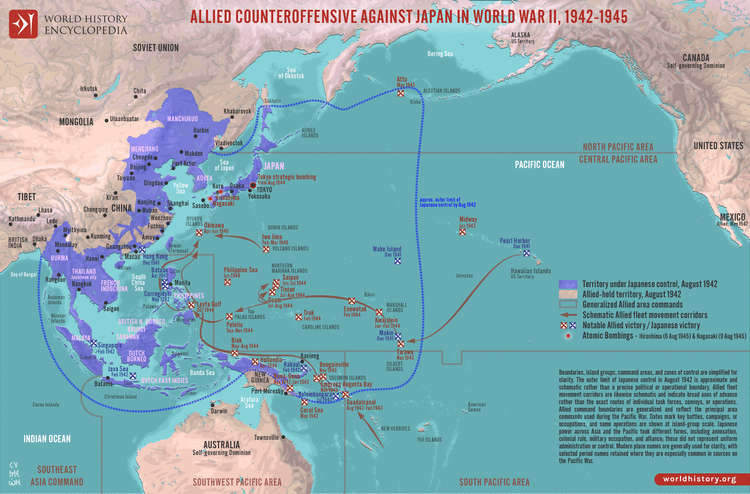 Map of the Allied Pacific Counteroffensive, 1942–1945 Simeon Netchev (CC BY-NC-ND) ](https://www.worldhistory.org/image/22056/map-of-the-allied-pacific-counteroffensive-1942-19/ "Map of the Allied Pacific Counteroffensive, 1942–1945")Guam, the largest island in the group, is 34 miles (55 km) long and presented the US forces with some of the most difficult terrain to fight in so far in the war. Guam possessed the best harbour in the Marianas and, unlike other islands in the group, did have its own water supply. The island was under US control from 1898 but had been bombed and then occupied by the Japanese military at the start of the Pacific War in 1941. The US garrison of 300 men had been swiftly overwhelmed by 5,000 Japanese. Unlike with many other Pacific Island assaults so far in the Pacific War then, this battle would be a matter of recapturing lost US territory. The assault on Guam was given the code name Operation Stevedore.
### Bombardment & Amphibious Assault
The fact that the taking of Saipan had required three weeks of heavy fighting rather than the anticipated three days meant that the landings at Guam were delayed. The Japanese used this reprieve well and constructed the best beach defences the US Marines had yet come up against. On the other hand, the delay also helped the US Navy better prepare for a truly devastating pre-invasion bombardment of the island; in fact, the longest and most intense of the Pacific War. Lasting two weeks, the bombardment was delivered by the massive guns of battleships, heavy cruisers, and destroyers, which collectively fired over 27,000 shells onto Guam.
The amphibious assault involved 55,000 US Marines of the 3rd Marine Division and 1st Marine Brigade. The 77th Infantry Division was to be held as a reserve in the operation, with one regiment landing once the beaches had been secured. A number of Chamorros, the indigenous people of Guam, were also directly involved in the military operation.
[  Guam Operation, 1944 Naval History & Heritage Command (Public Domain) ](https://www.worldhistory.org/image/22058/guam-operation-1944/ "Guam Operation, 1944")The attack was both planned and led by Major-General Roy Geiger (1885-1947). The troops were taken by LVTs (Landing Vehicles, Tracked) to the beaches on 21 July, but only after navy divers had managed to blast a path through the obstacles laid down by the Japanese. The two target beaches were located on the western side of the island, one to the south and one in the centre.
The Japanese defences on land had been severely disrupted by the naval and air bombardment, as was their ability to coordinate an effective massed counterattack against the Marines. Fighting was, therefore, sporadic, although one surviving concrete block with a 74-mm (2.9-in) gun and a 37-mm (1.4-in) gun on Ga'an Point caused havoc on the southern landing beach until it was captured. The US know-how concerning amphibious assaults was getting better and better with experience. Beach masters were used to organise troops on the beach, keep people moving inland, direct medical teams, and evacuate the wounded to waiting ships. Large rafts were now being used to aid landing vehicles in getting essential supplies ashore such as ammunition, fresh water, radio batteries, blood plasma, and sandbags.
### Defence to the Last Man
Many Japanese soldiers had survived the initial bombardment by hiding in caves. The Japanese commander, as had happened at Saipan, followed his orders to prolong the defence of the island as long as possible and inflict as many casualties as possible (in the hope this would deter future assaults on other Japanese-held islands). To achieve these aims, the Japanese retreated to successive defensive lines as the US forces progressed further and further north through the island's interior; the ultimate aim was to clear the island and capture its vital airstrip, Orote Airfield, at the northern tip. The progress was slow given the myriad of defensive positions of bunkers and trenches, and the difficult terrain of mangrove swamps and dense jungle.
[  US Marines & Dogs, Guam War in the Pacific National Historical Park (Public Domain) ](https://www.worldhistory.org/image/22059/us-marines--dogs-guam/ "US Marines & Dogs, Guam")As in other battles, the Japanese soldiers considered surrender highly dishonourable, and so they fought to the [death](https://www.worldhistory.org/disambiguation/Death/). It took three weeks, until 10 August, to clear the island completely of its last remaining snipers using tanks, flame-throwers, grenades, mortars, and explosives. The Marines were working steadily from cave to cave, valley to valley. In addition, 60 specially trained dogs, mostly German shepherds and Dobermann Pinschers, earned their nickname of 'the Devil Dogs' as they sniffed out hidden defenders, snipers, and landmines. The animals also acted as guards for the camps at night. The dogs certainly saved hundreds of US lives, but 25 of them did not survive the battle.
Despite the US onslaught, one Japanese soldier, Shōichi Yokoi, escaped detection in the rugged mountains of the interior, and, incredibly, he remained out of contact with the outside world until January 1972. Still prepared to fight on, Yokoi was informed that his country had surrendered 27 years before.
The Japanese death toll was 10,646, ten times more than the losses suffered by the attackers (Dear, 407). Some historians put the Japanese dead much higher, with figures ranging from 16,000 to 26,000. In addition to those US service personnel killed, around 6,000 were wounded in the battle.
### Aftermath
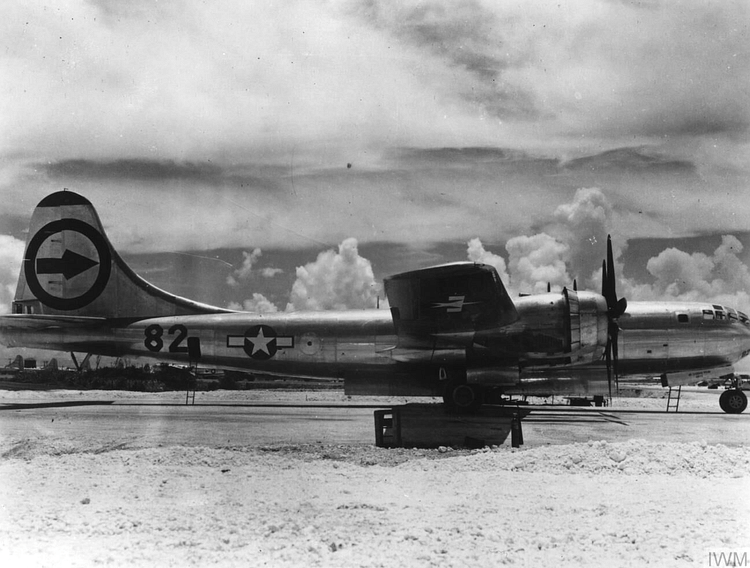
The US had already begun its strategic bombing campaign against Japan itself using bases in [China](https://www.worldhistory.org/china/) and Saipan. To these bases, Guam could now be added. Tinian, also in the Mariana Islands, was attacked from 24 July 1944. The island was captured by 1 August after US aircraft dropped napalm bombs, the first time this highly flammable chemical was used in the war. Control of the Marianas meant that long-range [Boeing B-29 Superfortress](https://www.worldhistory.org/Boeing_B-29_Superfortress/) bombers could strike any Japanese [city](https://www.worldhistory.org/city/). Guam also became an important fuel dump, supporting future operations in the Pacific by filling up and sending out fuel tankers, sometimes as many as three per day.
[  Enola Gay B-29 Superfortress USAF - Imperial War Museums (CC BY-NC-SA) ](https://www.worldhistory.org/image/20100/enola-gay-b-29-superfortress/ "Enola Gay B-29 Superfortress")After the loss of the Marianas, the Japanese prime minister, General Hideki Tojo (1884-1948), no longer supported by the Japanese emperor, was ousted from power in Tokyo. Tojo was replaced by Kuniaki Koiso (1880-1950), but the war went on. Meanwhile, Admiral Chester W. Nimitz (1885-1966), Commander-in-Chief of the US Pacific Fleet, set up his headquarters on Guam, and from here, he would direct the rest of the Pacific campaign.
More amphibious landings were successfully launched as the US forces crept closer to the Japanese homeland. There were notable, if gruelling victories in the Battle of Iwo Jima and Battle of Okinawa in the spring of 1945. Japanese forces fought with tremendous tenacity and, even in defeat, continued to inflict heavy casualties on the US forces. Finally, the terrible destruction of Hiroshima and Nagasaki using nuclear bombs brought Japan's surrender in August 1945.
Guam continues to host a US military base today, and 21 July, the day US troops first landed on the beaches back in 1944, is celebrated as Guam Liberation Day.
#### Editorial Review
This human-authored article has been reviewed by our editorial team before publication to ensure accuracy, reliability and adherence to academic standards in accordance with our [editorial policy](https://www.worldhistory.org/static/editorial-policy/).
## Bibliography
- [Battle of Guam - War In The Pacific National Historical Park (U.S. National Park Service)](https://www.nps.gov/wapa/learn/historyculture/battle-of-guam.htm "Battle of Guam - War In The Pacific National Historical Park (U.S. National Park Service)"), accessed 25 Aug 2026.
- [Battles of Guam: From Defeat to Victory](https://www.war.gov/News/Feature-Stories/story/Article/1946563/battles-of-guam-from-defeat-to-victory/ "Battles of Guam: From Defeat to Victory"), accessed 25 Aug 2026.
- [Boatner, Mark. *The Biographical Dictionary of World War II.* Presidio Press, 1996.](https://www.worldhistory.org/books/0891415483/)
- [Dear, I. C. B. & Foot, M. R. D. *The Oxford Companion to World War II.* Oxford University Press, 1995.](https://www.worldhistory.org/books/0198662254/)
- [Guam - Photo Gallery](https://www.history.navy.mil/content/history/museums/nmusn/explore/photography/wwii/wwii-pacific/mariana-islands/guam.html "Guam - Photo Gallery"), accessed 25 Aug 2026.
- [Horner, David . *Second World War The Pacific.* Osprey Publishing, 2002.](https://www.worldhistory.org/books/1841762296/)
- [Liddell Hart, B. H. *History of the Second World War Volume 1.* Capricorn Books, 1972.](https://www.worldhistory.org/books/B00JSCLTYW/)
- [Marston, Daniel. *Pacific War.* Osprey Publishing, 2010.](https://www.worldhistory.org/books/1849083827/)
- [Smurthwaite, David. *The Pacific War Atlas 1941-1945.* Facts on File, 2000.](https://www.worldhistory.org/books/0816032858/)
## About the Author
Mark is WHE’s Publishing Director and has an MA in Political Philosophy (University of York). He is a full-time researcher, writer, historian and editor. Special interests include art, architecture and discovering the ideas that all civilizations share.
## External Links
- [T. Stell Newman Visitor Center - War In The Pacific National Historical Park (U.S. National Park Service)](https://www.nps.gov/wapa/t-stell-newman-visitor-center.htm)
- [Invasion of Guam: July 21-August 10, 1944](https://www.history.navy.mil/content/history/museums/nmusn/explore/photography/wwii/wwii-pacific/mariana-islands/guam.html)
- [The Recapture Of Guam : United States. Marine Corps](https://archive.org/details/TheRecaptureOfGuam)
- [Battle of Guam - War In The Pacific National Historical Park (U.S. National Park Service)](https://www.nps.gov/wapa/learn/historyculture/battle-of-guam.htm)
## Cite This Work
### APA
Cartwright, M. (2026, August 31). Battle of Guam: The US Takes Back its Territory in WWII. *World History Encyclopedia*.
### Chicago
Cartwright, Mark. "Battle of Guam: The US Takes Back its Territory in WWII." *World History Encyclopedia*, August 31, 2026. .
### MLA
Cartwright, Mark. "Battle of Guam: The US Takes Back its Territory in WWII." *World History Encyclopedia*, 31 Aug 2026, .
## License & Copyright
Submitted by [Mark Cartwright](https://www.worldhistory.org/user/markzcartwright/ "User Page: Mark Cartwright"), published on 31 August 2026. The copyright holder has published this content under the following license: [Creative Commons Attribution-NonCommercial-ShareAlike](https://creativecommons.org/licenses/by-nc-sa/4.0/deed.en). This license lets others remix, tweak, and build upon this content non-commercially, as long as they credit the author and license their new creations under the identical terms. When republishing on the web a hyperlink back to the original content source URL must be included. Please note that content linked from this page may have different licensing terms.