---
title: The Integration of Church and State in the Roman Empire
author: Rebecca Denova
source: https://www.worldhistory.org/article/2966/the-integration-of-church-and-state-in-the-roman-e/
format: machine-readable-alternate
license: Creative Commons Attribution-NonCommercial-ShareAlike (https://creativecommons.org/licenses/by-nc-sa/4.0/)
updated: 2026-08-12
---
# The Integration of Church and State in the Roman Empire
_Authored by [Rebecca Denova](https://www.worldhistory.org/user/rdenova/)_
In the ancient world, "[religion](https://www.worldhistory.org/religion/)" and society were not separate entities. Various gods dictated covenants, "[law](https://www.worldhistory.org/disambiguation/law/)-codes," and social conventions. Such law-codes were most often the responsibility of the king, endowing him with authority to punish any violations. The rationalization for this concept was that the gods or [God](https://www.worldhistory.org/God/) endowed the ruler with a share of "divinity," as a unified society and political order where the secular government protects each community and provides moral guidance for everyday life. It was a symbiotic authority, the belief that spiritual and temporal leaders complement one another. Cultural uniformity and national borders were transcended under a common spiritual overlay. In many ancient cultures, the king simultaneously served as "the high-priest."
[  St. Ambrose Fr Lawrence Lew, O.P. (CC BY-NC-SA) ](https://www.worldhistory.org/image/5335/st-ambrose/ "St. Ambrose")Christian tradition has always claimed that [Jesus of Nazareth](https://www.worldhistory.org/Jesus_Christ/) taught new concepts of behavior, as opposed to the dominant [culture](https://www.worldhistory.org/disambiguation/culture/) of the [Roman Empire](https://www.worldhistory.org/Roman_Empire/). This is always articulated through the literary device of polemic, shared stereotypes of what was wrong with human relationships in both [Judaism](https://www.worldhistory.org/disambiguation/judaism/) and the [Roman](https://www.worldhistory.org/disambiguation/Roman/) [Empire](https://www.worldhistory.org/empire/). [The gospels](https://www.worldhistory.org/The_Gospels/) claimed that [Jesus](https://www.worldhistory.org/Jesus_Christ/) introduced a new concept of "table fellowship." This related to social contacts as a new way to treat neighbors and others. The "dinner table" was also the way in which business and commercial transactions were negotiated. The Christian tradition is that Jesus introduced new rules against economic rules for [trade](https://www.worldhistory.org/disambiguation/trade/) and banking.
The book of Leviticus outlined both the purity/impurity rituals and rules for Jews. "Impurity" was constued as "contagion." But these rules only applied to Jews, not Gentiles. "Impurity" related to rituals and life-styles that God had originally forbidden. Polemically, the [gospels](https://www.worldhistory.org/The_Gospels/) claimed that the [Pharisees](https://www.worldhistory.org/Pharisees/) and [Sadducees](https://www.worldhistory.org/Sadducees/) in the [Temple](https://www.worldhistory.org/temple/) had "strict rules," selfishly denying "salvation" to non-Jews. But "strictness" relates to enforcement. We have little information on how these rules were carried out in the synagogues in the Roman Empire. The Jews at the Temple had no civil or religous authority beyond [Jerusalem](https://www.worldhistory.org/jerusalem/). Roman sacrifices were based upon "contracts" of reciprocal benefits, *do ut des*, which translates to "I give so that you may give" or "That I will receive the benefits." Thus, the Christian claim that Jews and pagans were only concerned with "the letter of the Law', as legalistic and lacking spiritual enlightenment.
In the 2nd century, a [Gnostic](https://www.worldhistory.org/Gnosticism/) Bishop Marcion claimed that there were two "high gods;" the God of [Israel](https://www.worldhistory.org/disambiguation/Israel/) and the God of Christians. The God of Israel was solely responsible for "punishment for sins," But the God of Christians, through Jesus, introduced the "forgiveness of sins." If you have heard or read that the God of Israel was a "god of wrath," but the God of [Christianity](https://www.worldhistory.org/christianity/) was a "god of love," this is the source.
[ 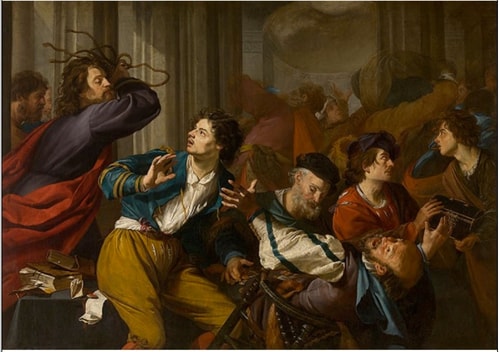 Christ Driving the Money-changers from the Temple Theodoor Rombouts (Public Domain) ](https://www.worldhistory.org/image/14740/christ-driving-the-money-changers-from-the-temple/ "Christ Driving the Money-changers from the Temple")The dominant culture was described as the standard term for "paganism," the beliefs and concepts of hundreds of different ethnic native cults. The assumption was that Jesus, and then Christianity, introduced moral and family values that were absent in paganism. This was patently false. Ancient religions and native cults all taught moral and family values, particularly in their gender roles. Kings and subsequent emperors set the tone for morality and family values. Ironic of course, as morality was violently enforced.
Moral and family values were found in the teachings of the schools of [philosophy](https://www.worldhistory.org/philosophy/), which Christians also adopted. Hollywood retains the image of blatant sexual immorality and violence in "sword and sandal" epics." Some epicures in [Rome](https://www.worldhistory.org/Rome/) indulged in exotic foods and drink, and drunkeness that led to adultery. The [Greek](https://www.worldhistory.org/disambiguation/greek/) word, *orgia*, the term for religious rituals, became "orgies."
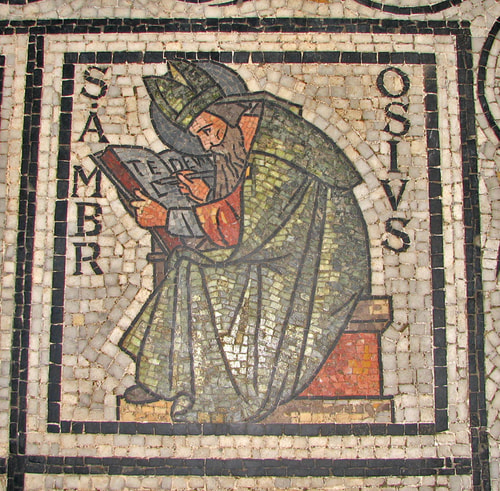
Bishop Ambrose of Milan (339-397, aka Saint Ambrose) was a Roman magistrate in areas north of Rome. Known as a negotiator of various legal elements, he was surprisingly elected Bishop in Milan and converted to Christianity. Ambrose started building his own cathedral in Milan. At the time, the Roman Empire was still embroiled over the problems of the "Arian controversy" that led to the concept of "the [Trinity](https://www.worldhistory.org/Trinity/)" at Nicea in 325. Arius, a presbyter in the church in [Alexandria](https://www.worldhistory.org/alexandria/), [Egypt](https://www.worldhistory.org/egypt/) had taught that "the son," was subordinate to the "father," created at the time of the creation of the universe. The Trinity was a concept of three aspects or natures of one godhead, in descending order of divinity and authority.
[ 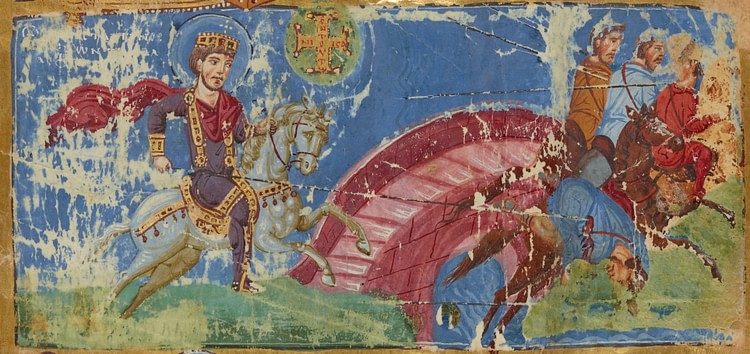 Constantine's Vision Bibliothèque Nationale de France (Public Domain) ](https://www.worldhistory.org/image/13988/constantines-vision/ "Constantine's Vision")The Emperor [Constantine I](https://www.worldhistory.org/Constantine_I/) converted to Christianity in 306, and made Christianity a legal religion in the "Edict of Milan" in 313. But Christians were embroiled in "schisms," over the problem that during the last Roman persecution under emperor [Diocletian](https://www.worldhistory.org/Diocletian/), some bishops had avoided [death](https://www.worldhistory.org/disambiguation/Death/) by sacrificing to the traditional gods. Appealing to the now Christian emperor, they petitioned Constantine to rule on what should be done with the schismatics. This is when Constantine was elevated as the 'head of the Church', as well as the state.
At the meeting at Nicea, Constantine created "the creed," what all Christians should believe and practice. Anyone who diverted or opposed the creed was deemed an heretic. Heresy meant that you did not want want the empire to prosper, it was the equivalent of treason which always carried the death penalty. More Christians, as "heretics" died in the arena after Constantine than during the Roman persecution.
Emperor Theodosius I (347-395) was noted for his conservative orthodoxy. However, his mother had remained an "Arian," in her view of the godhead in the Trinity. Arian followers had insisted that Ambrose build a cathedral for their group, but Ambrose consistently refused. He explained his decision to the emperor several times.
[ 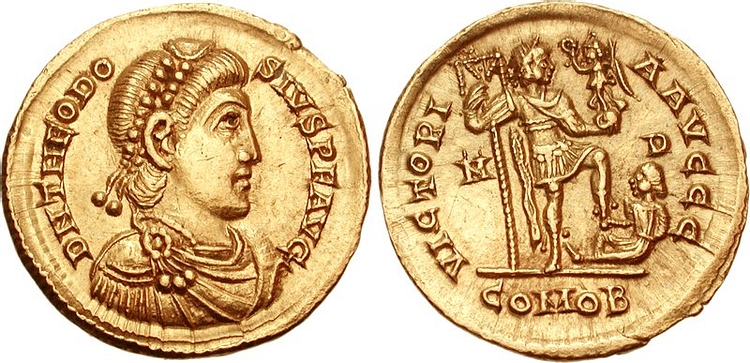 Theodosius I Solidus CNG (GNU FDL) ](https://www.worldhistory.org/image/8280/theodosius-i-solidus/ "Theodosius I Solidus")Two other important events occurred during the reign of Theodosius I. Firstly, in 388, a zealous mob of vigilante monks burned down a synagogue in the town of Callinicum, [Syria](https://www.worldhistory.org/syria/). Theodosius ordered the monks to pay financial compensation for damages to the Jews. Ambrose castigated him for this; if he carried it out, people would "he think was a Jew." Theodosius then relented the compensation, but ordered the ruins to be maintained as a sign of the end of Judaism.
The second event was a [chariot](https://www.worldhistory.org/chariot/) race in Thessonalica in 390. The winner of this chariot race was a pagan, but a Roman magistrate denounced him for rumors of immoral sexuality. He was condemned and executed. A mob reacted and tore the magistrate from limb to limb. Theodosius sent in the legions, resulting in a massacre of 7,000 citizens. Ambrose was appalled at this; he accused Theodosius of letting the mob take control and the reaction was too extreme. After all, the driver was simply a pagan.
Bishop Ambrose took the unprecedented step of excommunicating the emperor for these actions. Excommunication meant that the emperor could not participate in the Eucharist and other sacraments. As the head of the church, this affected all Christians.
In a treatise known as *[De officiis](https://www.worldhistory.org/De_Officiis/) Ministrorum* (377–391), Ambrose began with an exegesis on Genesis. The "state" was created at the beginning of the world in Eden and thus divine. Adam and Eve in their fellowship and subsequent roles set the template for the role of human leaders on earth. Ambrose outlined the role of emperors and magistrates, the "dutiful sons of the Church." When it came to theological issues (dogma), emperors and magistrates could not rule on matters of faith and moral conduct using their personal views. That is the job of bishops in the Church. An emperor is simply an elevated Christian and his main duty is to carry out punishments for what was deemed divergent, or heresy, and to punish sinners according to the dictates of bishops. As such, the emperor is "in the Church but not over the Church." Over the centuries, more Council meetings and more treatises were added. Ambrose and Theodosius were finally reconciled when Theodosius performed public penance.
#### Editorial Review
This human-authored article has been reviewed by our editorial team before publication to ensure accuracy, reliability and adherence to academic standards in accordance with our [editorial policy](https://www.worldhistory.org/static/editorial-policy/).
## Bibliography
- [Ambrose of Milan & Ex Fontibus Company & Deferarri, Roy J. *Theological and Dogmatic Works.* Ex Fontibus Company, 2017.](https://www.worldhistory.org/books/1635489814/)
- [Fredriksen, Paula. *Ancient Christianities.* Princeton University Press, 2026.](https://www.worldhistory.org/books/0691266417/)
- [McLynn, Neil B. B. *Ambrose of Milan.* University of California Press, 2014.](https://www.worldhistory.org/books/0520283880/)
## About the Author
Rebecca I. Denova, Ph.D. is Emeritus Professor of Early Christianity in the Department of Religious Studies, University of Pittsburgh. She has recently completed a textbook, "The Origins of Christianity and the New Testament" (Wiley-Blackwell)
## External Links
- [A Study of How the Relationship of Church and State Evolved in](https://thescholarship.ecu.edu/bitstreams/eac683e3-a966-4119-845a-253d1f644471/download)
- [Church and State: A conflicting collaboration](https://scielo.org.za/scielo.php?script=sci_arttext&pid=S1017-04992018000300007)
- [Church and State in Late Roman Antiquity](https://popular-archaeology.com/article/church-and-state-in-late-roman-antiquity/)
## Cite This Work
### APA
Denova, R. (2026, August 12). The Integration of Church and State in the Roman Empire. *World History Encyclopedia*.
### Chicago
Denova, Rebecca. "The Integration of Church and State in the Roman Empire." *World History Encyclopedia*, August 12, 2026. .
### MLA
Denova, Rebecca. "The Integration of Church and State in the Roman Empire." *World History Encyclopedia*, 12 Aug 2026, .
## License & Copyright
Submitted by [Rebecca Denova](https://www.worldhistory.org/user/rdenova/ "User Page: Rebecca Denova"), published on 12 August 2026. The copyright holder has published this content under the following license: [Creative Commons Attribution-NonCommercial-ShareAlike](https://creativecommons.org/licenses/by-nc-sa/4.0/deed.en). This license lets others remix, tweak, and build upon this content non-commercially, as long as they credit the author and license their new creations under the identical terms. When republishing on the web a hyperlink back to the original content source URL must be included. Please note that content linked from this page may have different licensing terms.