---
title: Battle of the Coral Sea: First Aircraft Carrier Battle in History
author: Mark Cartwright
source: https://www.worldhistory.org/article/2957/battle-of-the-coral-sea/
format: machine-readable-alternate
license: Creative Commons Attribution-NonCommercial-ShareAlike (https://creativecommons.org/licenses/by-nc-sa/4.0/)
updated: 2026-07-31
---
# Battle of the Coral Sea: First Aircraft Carrier Battle in History
_Authored by [Mark Cartwright](https://www.worldhistory.org/user/markzcartwright/)_
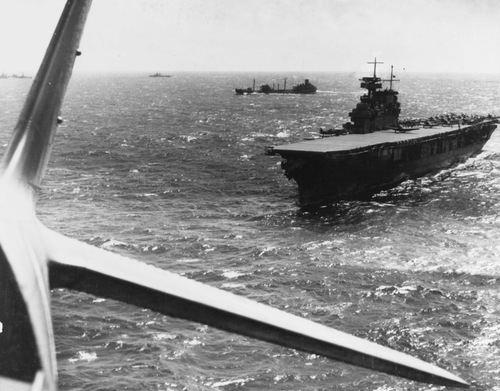
The [Battle](https://www.worldhistory.org/disambiguation/battle/) of the Coral Sea, the first naval battle in history between aircraft carriers, took place between 4 and 8 May 1942 during the Second World [War](https://www.worldhistory.org/disambiguation/War/) (1939-45). The Japanese navy hoped to occupy the eastern part of Papua and the [Solomon](https://www.worldhistory.org/solomon/) Islands, but the US Navy was determined to prevent further Japanese expansion in the region. In the battle, the Japanese lost the light carrier *Shōhō* while the US Navy lost the carrier *Lexington*, one of only four carriers it possessed in the Pacific. The battle was a Japanese tactical victory given the tonnage sunk, but an Allied strategic victory since Japanese expansion had been halted. In addition, two Japanese carriers were so badly damaged they could not participate in the crucial Battle of Midway the following month, an absence which helped ensure a US victory, finally turning the tide of the Pacific War.
[  USS Yorktown, 1942 US Navy (Public Domain) ](https://www.worldhistory.org/image/21992/uss-yorktown-1942/ "USS Yorktown, 1942")### [Japan](https://www.worldhistory.org/disambiguation/Japan/)'s Expansion in the Pacific
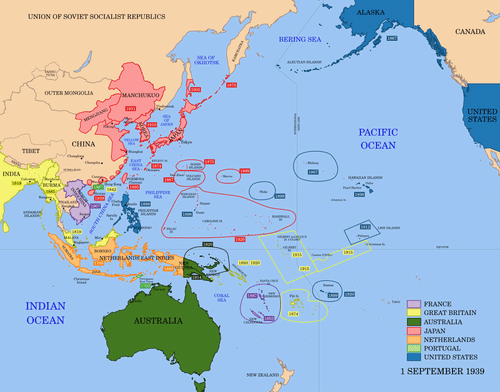
In search of prestige, territory, new markets, and vital resources like oil, the Japanese military had been steadily expanding the Japanese [Empire](https://www.worldhistory.org/empire/) through the 1930s. By late 1941, Japan occupied Manchuria, Formosa (Taiwan), [Korea](https://www.worldhistory.org/Korea/), parts of coastal [China](https://www.worldhistory.org/china/), and French Indo-China (which included what is today Laos, Cambodia, and parts of Thailand).
In December 1941, Japan infamously launched its [attack on Pearl Harbor](https://www.worldhistory.org/article/2954/the-attack-on-pearl-harbor/) in Hawaii, home of the US Pacific Fleet. That same month, Japan launched attacks on the US-controlled Philippines, and British-controlled Malaya, Burma (Myanmar), and Hong Kong. With the US Navy temporarily crippled and the British distracted by events in other theatres of WWII, the Japanese Empire expanded dramatically. Singapore was captured in February 1942. Through March and April, Japanese forces ripped through the main islands of the Dutch East Indies (Sumatra, Java, Borneo, Celebes, and New Guinea). It looked like Japan would soon control the entire western Pacific from northern China to Australia. All that remained to grab was Papua and the Solomon Islands. Once those islands were in Japanese hands, Australia would be fearfully exposed to Japanese air attacks. If Japan could then take Fiji, Samoa, and New Caledonia, further east in the Pacific, the US Navy would be completely cut off from its supply chain that began in Brisbane and Sydney.
### Into the Coral Sea
Japanese Vice-Admiral Inoue Shigeyoshi (1889-1975), the commander of the Japanese 4th Fleet, organised three attack groups which assembled around the islands of Truk Atoll (now called Chuuk Lagoon) in Micronesia, Japan's main naval base in the region, and Rabaul on Papua in preparation for a triple-headed expansion of Japanese territory in the final pocket of the southwest Pacific not under Japanese control. The three objectives were Port Moresby, the major port on Papua and location of an airstrip; Tulagi Island in the Solomons; and the Louisiades Islands at the eastern end of Papua. The largest invasion force headed for Port Moresby. The other two forces were tasked with establishing bases, which could be used by Japanese seaplanes. All three destinations are located in the Coral Sea, hence the name of the coming battle with US naval forces.
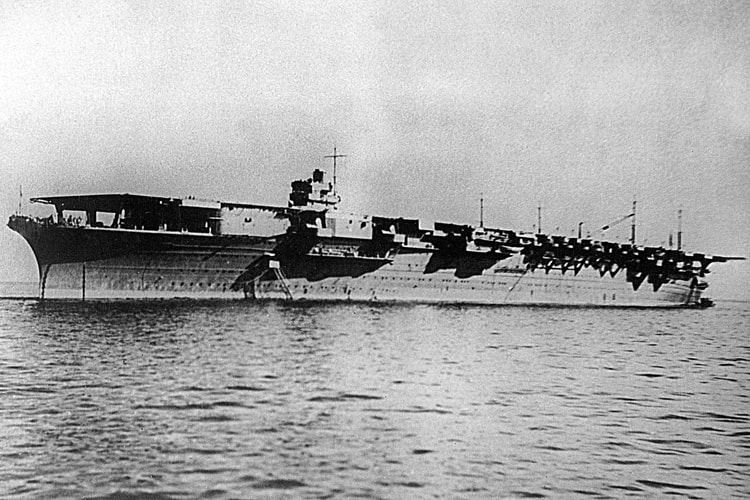
[  Map of Imperial Pacific Territories, 1939 Emok (CC BY-SA) ](https://www.worldhistory.org/image/21959/map-of-imperial-pacific-territories-1939/ "Map of Imperial Pacific Territories, 1939")The Japanese invasion convoys were protected by a naval force commanded by Rear-Admiral Gotō Aritomo (1888-1942). This force was composed of one light carrier, the *Shōhō*, four heavy cruisers, and one destroyer. In addition, an even bigger naval strike force, commanded by Vice-Admiral Tagaki Takeo, spearheaded the invasion. This force was comprised of two fleet carriers, the *Shōkaku* and the *Zuikaku*, two heavy cruisers, and six destroyers. In all, Operation MO would involve 60 Japanese ships.
### The US Response
The Japanese naval planners had anticipated a response from the US to its latest expansion, which was why they had split the attack force into two arms, hoping to catch US ships in the middle and, while battle raged, the main invasion force could proceed unmolested to Port Moresby.
The US Navy did indeed respond, but it did so much quicker than the Japanese had anticipated, thanks to intelligence gathered from decoded messages as early as 9 April. The commander of the US Pacific Fleet, Admiral Chester W. Nimitz (1885-1966), was also made aware of the two-pronged approach strategy of the Japanese force. Accordingly, Nimitz created two groups of his own, each with its own aircraft carrier. The two carriers deployed were *Lexington* and *Yorktown*. Nimitz only had four carriers in the entire Pacific, and so committing two of them was something of a risk. Nimitz's other two carriers, the *Hornet* and *Enterprise*, were, in any case, both unavailable, having taken part in the daring [Doolittle Raid](https://www.worldhistory.org/Doolittle_Raid/) on Tokyo in April. Each carrier had its escort: the *Lexington* with two cruisers and five destroyers, and the *Yorktown* with three cruisers and four destroyers.
[ 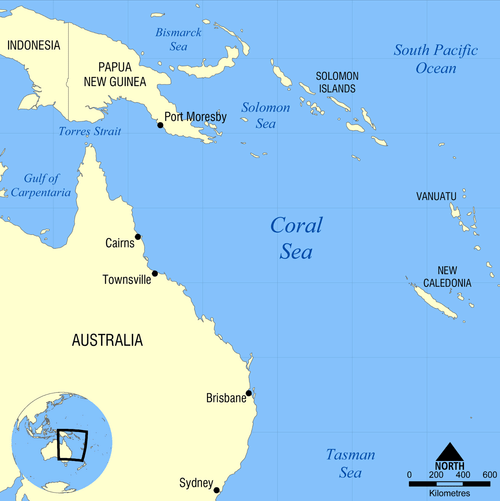 Map of the Coral Sea Norman Einstein (CC BY-SA) ](https://www.worldhistory.org/image/21990/map-of-the-coral-sea/ "Map of the Coral Sea")A third force was deployed; this one, commanded by Rear-Admiral John G. Crace of the Royal Navy, was composed of the US cruiser *Chicago*, two Australian cruisers, *Australia* and *Hobart*, and one US destroyer, the *Perkins*. This force was tasked with defending Port Moresby. Four US submarines and 12 Catalina flying boats also joined the US ships amassing in the South Seas; their mission was principally to provide reconnaissance. Nimitz also ordered the two carriers, *Hornet* and *Enterprise,* to sail to the Coral Sea as soon as they could, even if their arrival would probably be (and indeed was) too late to participate in the coming battle.
### A Confused Battle
The Japanese force targeting Tulagi and neighbouring Gavutu in the Solomons managed to land without difficulties on 3 May, but 24 [hours](https://www.worldhistory.org/Horae/) later, Rear-Admiral Frank Jack Fletcher (1885-1973), the commander of the *Yorktown* group, responded by sending fighters, torpedo-bombers, and dive-bombers to attack the invaders. Crucially, the Japanese land force had not received, as was planned, a complement of Mitsubishi A6M Zero fighters because of poor weather. The absence of air protection proved to be significant. One Japanese destroyer, the *Kikuzuki,* had very little in the way of anti-aircraft defences and was so badly damaged in the attack that its captain was obliged to beach the ship. A number of other smaller support ships were sunk: three minesweepers and four landing barges. Five Japanese flying boats were also destroyed. Meanwhile, out at sea, poor weather hampered both sides' attempts to locate each other through 5 May.
On 6 May, the three separate Allied groups joined together, with Fletcher taking overall command. Admiral Nimitz had given Fletcher clear orders for the coming clash:
> Your task assist in checking further advance by the enemy in the above areas \[New Guinea-Solomons\] by seizing favourable opportunities to destroy ships and aircraft.
> (Stille, 42)
[  Japanese Aircraft Carrier Zuikaku Unknown Photographer (Public Domain) ](https://www.worldhistory.org/image/21993/japanese-aircraft-carrier-zuikaku/ "Japanese Aircraft Carrier Zuikaku")The fleet of US ships headed for the Japanese force intended for Port Moresby and the carriers commanded by Tagaki Takeo. On 7 May, Crace split off with his group to attack the invasion transports while Fletcher headed north to confront the Japanese carriers. This would be the first time in naval history that aircraft carriers took on each other in direct battle. It would also be the first battle where the protagonists operated without actually seeing each other since the fighting was between aircraft and ships, not ship-against-ship.
A visual sighting might have been useful since incorrect intelligence led Fletcher to mistake the invasion escort for the carrier group. Consequently, on 7 May, aircraft from the *Yorktown* were sent against only a secondary target. With its escort under attack, the Japanese invasion transports held station and then turned back. The *Lexington* group did locate the enemy carrier *Shōhō* and sent word to Fletcher, who redirected his aircraft to join the battle. The *Shōhō*, hit by at least 13 bombs (including two direct hits with 1,000-lb/453-kg bombs) and seven torpedoes, sank in minutes. Only 203 of the 834 crew members survived. This attack cost the loss of just three US aircraft. It was the first time in the war that Japan had lost an aircraft carrier.
Meanwhile, the two missing Japanese carriers, *Shōkaku* and *Zuikaku*, attacked Fletcher's group from the south but, mistakenly believing they had found the US carrier, only sank one destroyer, the *Sims*, and one tanker, both of which had been sent far to the rear of the group by Fletcher. A night attack on the *Yorktown* ended in failure, and only six of 27 Japanese aircraft involved in the mission returned to their ship.
[ 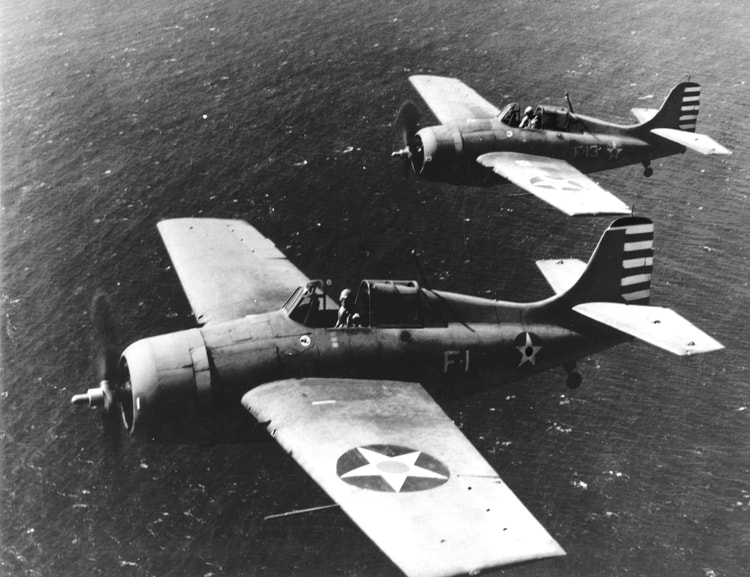 Two US Grumman F4F-3 Wildcats US Navy (Public Domain) ](https://www.worldhistory.org/image/21994/two-us-grumman-f4f-3-wildcats/ "Two US Grumman F4F-3 Wildcats")### The Carriers Attack
On 8 May, the main battle groups of each side sent out large numbers of reconnaissance aircraft and finally located each other. All aircraft, bombers and fighters, were then launched for the attack. The Allies were able to put 122 aircraft in the air and the Japanese 121. The US fighter-bombers from *Yorktown* and *Lexington* managed to attack and seriously damage the *Shōkaku,* thanks to three direct hits with 1,000-lb bombs. The Japanese carrier had successfully avoided at least 11 torpedoes by zig-zagging the ship but was now unable to launch aircraft from the damaged flight deck. The *Shōkaku* was obliged to withdraw from the battle, escorted by two destroyers.
In increasingly cloudy weather, the US aircraft could not find the *Zuikaku*, which was hidden in a local rainstorm. The Japanese planes located and attacked the US carriers, hitting the *Lexington* with two armour-piercing bombs. Neither bomb compromised the operation of the ship, but they did cause personnel casualties. The first seven Japanese torpedoes aimed at the ship missed, but the next two struck on the port side. With multiple internal fires out of control and sporadic explosions caused by gasoline fuel vapours leaking from the cracked port aviation fuel tank, the *Lexington*, now noticeably down at the bow, was in dire straits. The decision was taken to abandon ship and scuttle the carrier by having a destroyer fire five torpedoes into the hull. 216 members of the crew were lost in the battle.
The *Yorktown* was also attacked, but the Japanese bombers were much less accurate here. One 550-lb (250-kg) bomb did smash its way straight down through four decks before detonating in a storeroom. Another bomb hit amidships. The combined damage meant the ship had to reduce speed. The *Yorktown* was obliged to withdraw and seek much-needed repairs at Pearl Harbor.
[  Sinking of the USS Lexington US Navy (Public Domain) ](https://www.worldhistory.org/image/21991/sinking-of-the-uss-lexington/ "Sinking of the USS Lexington")Wrongly believing they had done irreparable damage to both US carriers, the Japanese fighters returned to their ships, which then withdrew to the north. Despite dealing a heavier blow to the enemy's shipping, Inoue took the decision to abandon the planned invasion of Papua. The admiral was criticised at home and by his superiors for not capitalising on his advantageous position in the battle. However, the Battle of the Coral Sea had been tremendously costly in terms of aircraft losses, and Inoue could not now support the proposed amphibious landing or attack again the one remaining US carrier. Fletcher also decided to withdraw his force, having had the *Lexington*'s now homeless fighters land on the *Yorktown*. Further action would have endangered the capability to protect the Allied fleet from the air.
### Assessment
The Japanese lost 77 aircraft and suffered 1,074 casualties in the battle. The US lost 66 aircraft. The Allied forces suffered 543 casualties in the battle. The Battle of the Coral Sea was a Japanese tactical victory – they had destroyed a heavier carrier than was lost – but it was an Allied strategic victory, since the invasion of Port Moresby was driven back, and so this crucial zone of the Pacific could continue to support the Allied war effort. The Japanese had suffered their first operational failure of the war in the Pacific. Significantly, too, the damage suffered by the *Shōkaku* and the heavy aircraft losses sustained by the *Zuikaku* at the Battle of the Coral Sea meant that neither ship was able to play a role in the Battle of Midway in June 1942, a tight battle but one won by the US Navy. Midway is considered the turning point of the Pacific War and the start of the Japanese retreat all the way back to the home islands.
#### Editorial Review
This human-authored article has been reviewed by our editorial team before publication to ensure accuracy, reliability and adherence to academic standards in accordance with our [editorial policy](https://www.worldhistory.org/static/editorial-policy/).
## Bibliography
- [Boatner, Mark. *The Biographical Dictionary of World War II.* Presidio Press, 1996.](https://www.worldhistory.org/books/0891415483/)
- [Dear, I. C. B. & Foot, M. R. D. *The Oxford Companion to World War II.* Oxford University Press, 1995.](https://www.worldhistory.org/books/0198662254/)
- [Horner, David. *Second World War The Pacific.* Osprey Publishing, 2002.](https://www.worldhistory.org/books/1841762296/)
- [Liddel Hart, Basil. *History of the Second World War, Part 15.* Marshall Cavendish Ltd, 1973.](https://www.worldhistory.org/books/B00918FHX2/)
- [Marston, Daniel. *Pacific War.* Osprey Publishing, 2010.](https://www.worldhistory.org/books/1849083827/)
- [Smurthwaite, David. *The Pacific War Atlas 1941-1945.* Facts on File, 2000.](https://www.worldhistory.org/books/0816032858/)
- [Stille, Mark. *Midway 1942.* Osprey Publishing, 2010.](https://www.worldhistory.org/books/1846035015/)
- [Stille, Mark. *The Coral Sea 1942.* Osprey Publishing, 2009.](https://www.worldhistory.org/books/184603440X/)
## About the Author
Mark is WHE’s Publishing Director and has an MA in Political Philosophy (University of York). He is a full-time researcher, writer, historian and editor. Special interests include art, architecture and discovering the ideas that all civilizations share.
## External Links
- [Battle of the Coral Sea, 4-8 May 1942](https://www.awm.gov.au/articles/encyclopedia/coral_sea/doc)
- [The Battle of the Coral Sea](https://www.navy.gov.au/about-navy/history/history-milestones/battle-coral-sea)
- [The Battle of the Coral Sea](https://anzacday.org.au/ww2-the-battle-of-the-coral-sea/)
## Cite This Work
### APA
Cartwright, M. (2026, July 31). Battle of the Coral Sea: First Aircraft Carrier Battle in History. *World History Encyclopedia*.
### Chicago
Cartwright, Mark. "Battle of the Coral Sea: First Aircraft Carrier Battle in History." *World History Encyclopedia*, July 31, 2026. .
### MLA
Cartwright, Mark. "Battle of the Coral Sea: First Aircraft Carrier Battle in History." *World History Encyclopedia*, 31 Jul 2026, .
## License & Copyright
Submitted by [Mark Cartwright](https://www.worldhistory.org/user/markzcartwright/ "User Page: Mark Cartwright"), published on 31 July 2026. The copyright holder has published this content under the following license: [Creative Commons Attribution-NonCommercial-ShareAlike](https://creativecommons.org/licenses/by-nc-sa/4.0/deed.en). This license lets others remix, tweak, and build upon this content non-commercially, as long as they credit the author and license their new creations under the identical terms. When republishing on the web a hyperlink back to the original content source URL must be included. Please note that content linked from this page may have different licensing terms.