---
title: Ivory & the Colonization of Africa
author: Mark Cartwright
source: https://www.worldhistory.org/article/2941/ivory--the-colonization-of-africa/
format: machine-readable-alternate
license: Creative Commons Attribution-NonCommercial-ShareAlike (https://creativecommons.org/licenses/by-nc-sa/4.0/)
updated: 2026-06-10
---
# Ivory & the Colonization of Africa
_Authored by [Mark Cartwright](https://www.worldhistory.org/user/markzcartwright/)_
European colonising powers sought to exploit [Africa](https://www.worldhistory.org/disambiguation/africa/)'s resources from the 15th century onwards. Arab traders had been doing the same in North Africa and East Africa through the Middle Ages, but it was from the 17th century that European traders began to penetrate deep into the interior in search of high-value goods. Traders, often alerted by the work of explorers and missionaries, were interested in anything that could be sold, such as [gold](https://www.worldhistory.org/gold/), palm oil, rubber, and slaves. One of the most valuable commodities was ivory, in great demand in [India](https://www.worldhistory.org/india/) for jewellery and in [Europe](https://www.worldhistory.org/europe/) in the 18th century for everything from decorative boxes to piano keys to billiard balls. The consequences of this lucrative [trade](https://www.worldhistory.org/disambiguation/trade/) included cultural upheaval, the construction of transport systems, wars, colonisation, and the [death](https://www.worldhistory.org/disambiguation/Death/) of tens of thousands of elephants each year.
[ 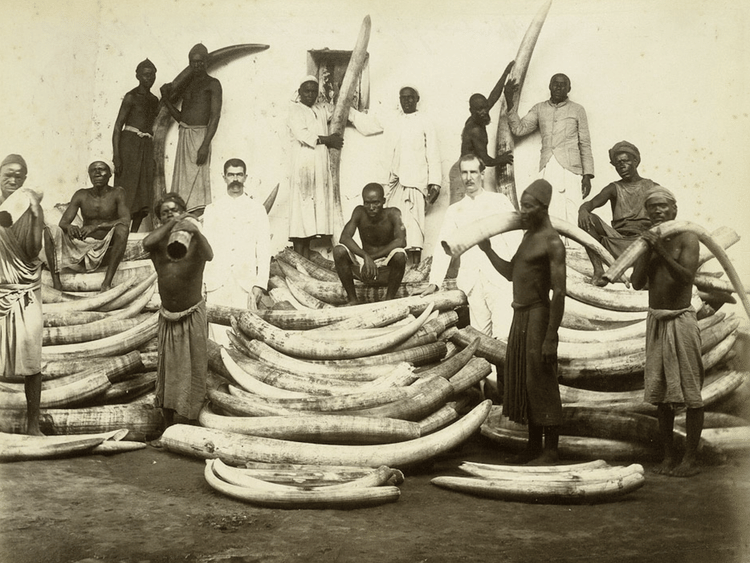 19th-Century Ivory Traders, East Africa, Unknown Photographer (Public Domain) ](https://www.worldhistory.org/image/21872/19th-century-ivory-traders-east-africa/ "19th-Century Ivory Traders, East Africa,")### Sources of Ivory
Ivory was traded between Africa and Europe in ancient times; the Romans, for example, imported ivory from North Africa and Central Africa via the [camel caravans of the ancient Sahara](https://www.worldhistory.org/article/1344/the-camel-caravans-of-the-ancient-sahara/). In the Middle Ages, Arab traders founded trade centres to specifically profit from ivory, such as on the island of Zanzibar and along the [Swahili Coast](https://www.worldhistory.org/Swahili_Coast/) of East Africa, although they did not establish any sort of political control beyond the coast. Portuguese traders sought out ivory through the 15th and 16th centuries, establishing trade centres on the west coast of Africa ranging from Upper Guinea to [Portuguese Angola](https://www.worldhistory.org/Portuguese_Angola/). Portuguese traders also acquired ivory on the Swahili Coast in Portuguese Mozambique. The Portuguese often had Africans carve ivory into finished products suitable for the European market, such as salt cellars, walking canes, and cutlery handles. For artworks in ivory, the sculptors of Benin were considered the finest.
By the 17th century, slaves and gold dominated African exports, but ivory was still the third most coveted trade item. In the modern period, European imperial powers like France and [Britain](https://www.worldhistory.org/disambiguation/Britain/) sought out new sources of ivory and set up trading stations not only on the coast of the continent but, for the first time, deep in Africa's interior. Traders were first alerted to the potential of Africa's interior by explorers and missionaries. David Livingstone (1813-1873), for example, noted in his travels in the 1850s that
> …If it is profitable for those who are engaged in in the coast trade to pass along in their ships and and pick up ivory, bees wax &c., those who may have enterprise enough to push into the interior and receive the goods at first hand would surely find it more profitable…
> (Chamberlain, 99)
[ 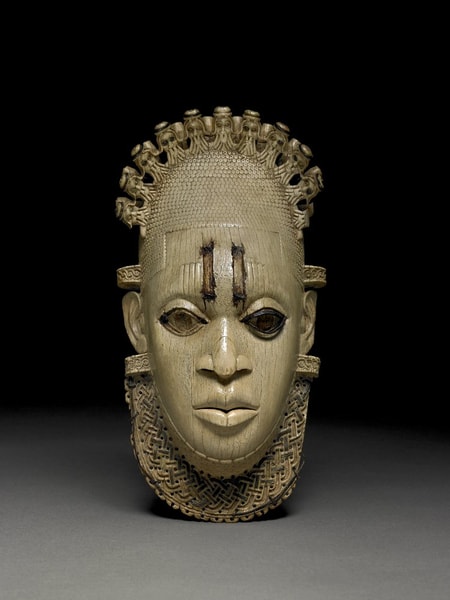 Benin Ivory Hip Pendant Mask The British Museum (Copyright) ](https://www.worldhistory.org/image/10343/benin-ivory-hip-pendant-mask/ "Benin Ivory Hip Pendant Mask")That riches were to be had in Africa's interior for a fraction of the cost of coastal prices was confirmed by other explorers. Lieutenant Verney Lovett Cameron (1844-1894), [writing](https://www.worldhistory.org/writing/) in the 1870s, describes the ivory in the region of Katanga in what is today DR Congo:
> To the eastward of Lovalé ivory is marvellously plentiful. The price among the Arab traders at Nyangwé was 7 1/2 pounds of beads, or 5 pounds of cowries, for 35 pounds of ivory; and the caravans that went out from there for ivory would obtain tusks, irrespective of weight, for an old knife, a [copper](https://www.worldhistory.org/copper/) bracelet, or any other useless thing which might take the fancy of the natives.
> (Chamberlain, 99-100)
Such tales of riches in ivory inspired rulers like Leopold II, King of the Belgians (reign 1865-1909), to establish a permanent control over certain regions. Leopold formed the Congo Free State (later to become the [Belgian Congo](https://www.worldhistory.org/Belgian_Congo/)) in 1885, although, in the end, it was rubber that made the king a fortune. Similarly, the presence of ivory convinced imperial Germany to create the colonies of German South West Africa in 1884 and [German East Africa](https://www.worldhistory.org/German_East_Africa/) the year after. The lure of ivory was also a factor in enticing the British to expand deeper into Southern Africa through the 1880s-90s.
[ 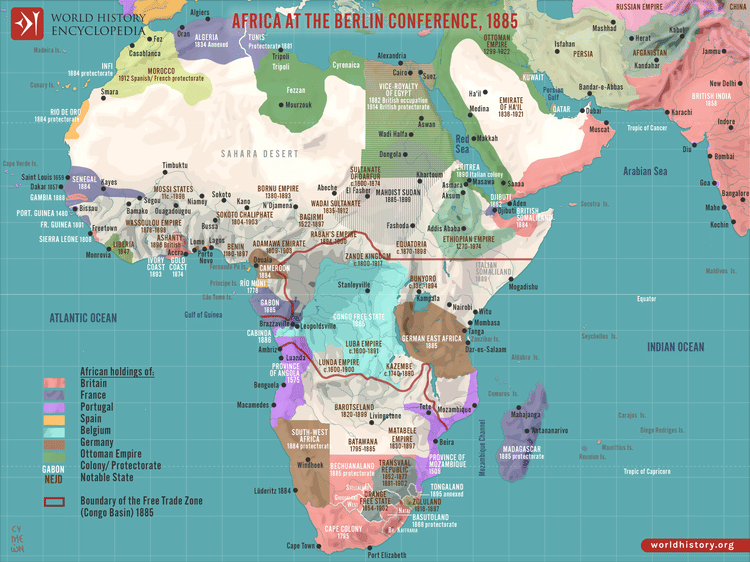 Map of the Scramble for Africa after the Berlin Conference Simeon Netchev (CC BY-NC-ND) ](https://www.worldhistory.org/image/19247/map-of-the-scramble-for-africa-after-the-berlin-co/ "Map of the Scramble for Africa after the Berlin Conference")Regions where the ivory trade was particularly developed included East Africa, the Congo Basin, Southern Africa, and the coastal region in West Africa named after the precious commodity: Ivory Coast (Côte d'Ivoire). African hunters traded the ivory to other tribes, who then traded it with Arabs or Europeans. The chain of trade could be quite convoluted. In the Congo basin, for example, the Bonjo people hunted the elephants and then traded the ivory with the Loi people. The Loi, in turn, traded the ivory with the Bobangi people, who then traded it with Arabs and Europeans, who transported it out of Africa. Ivory traders might also be involved in more localised trade, using the network's canoes and land routes to additionally trade goods like cassava and palm oil between African tribes.
The wealth generated by the ivory trade (and that in other goods) increased competition between African tribes and encouraged the formation of powerful kingdoms to better monopolise it, examples being the Maravi near Lake Malawi and the Kingdom of [Mutapa](https://www.worldhistory.org/Mutapa/) on the Zambezi River. As the historian A. E. Atmore notes:
> The pursuit of ivory was generally destructive and often violent. It involved the organisation of hunting bands, which even when developed locally, were disruptive of older social groupings. Too frequently, it involved raiding across the countryside by alien gangs.
> (Fage, 24)
[ 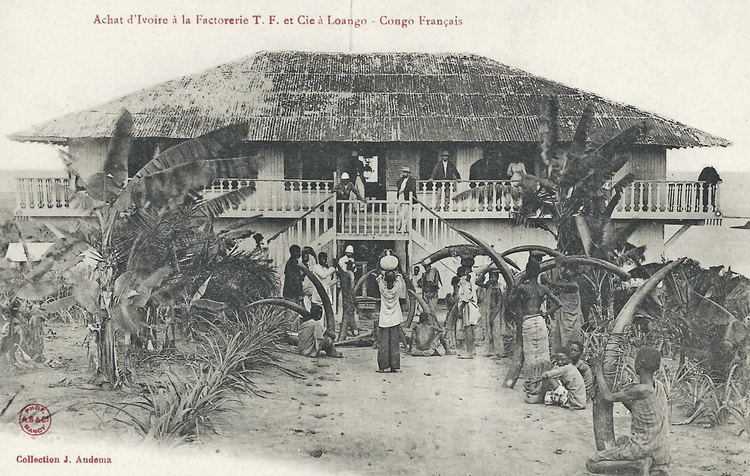 Ivory Trading Station, French Congo Jean Audema (Public Domain) ](https://www.worldhistory.org/image/21873/ivory-trading-station-french-congo/ "Ivory Trading Station, French Congo")Competition between European, Arab, and African traders often led to open warfare and territorial conquest, with the Africans and Arabs usually coming off worse against the superior weaponry of the Europeans. Even those Africans who directly benefited from the ivory trade did so only in the short term since, with hunting conducted on the scale that it was and using modern weapons supplied by Europeans, ivory in effect became a non-renewable resource as animals were systematically wiped out in one region after another.
### Ivory Caravans & Steamships
As ivory sources were depleted, traders were obliged to venture further and further into Africa's interior as the trading frontier moved to more remote areas. Even in the 16th century, before hunters used firearms, 4-5,000 elephants were killed each year in the Mutapa Kingdom, for example. When firearms were more widely used, figures rocketed: In the latter half of the 19th century, when the ivory trade was at its peak, 65,000 elephants were killed annually in tropical Africa (Fage, 24). The insatiable demand, particularly for East African ivory where supply could not meet the quantities desired, led to a steep rise in the price of ivory throughout the 19th century, quadrupling between 1823 and 1873.
Huge caravans of camels or donkeys were formed, for example, in East Africa from the 1810s to find ivory deep in Africa's interior. These caravans, which often also traded in slaves, travelled up to 1,000 miles (1,600 km) to reach Africa's Great Lakes. In the more difficult passages through forested areas, porters travelled on foot, each man carrying a tusk. The slave and ivory trade were well suited to each other. African hunters of elephants were easily converted into hunters of men, rounding up slaves for the Arabs and Europeans to gather en masse. Another advantage of this double-trade was that slaves were used to carry ivory to the coast instead of paid porters, greatly reducing transport costs.
[  Transporting Ivory, French Congo Albert Courboin (Public Domain) ](https://www.worldhistory.org/image/21874/transporting-ivory-french-congo/ "Transporting Ivory, French Congo")African peoples had long used ivory for jewellery, carvings such as statuary, and items of ceremonial significance such as masks, but they were tempted to give up the material to gain items they could not produce themselves. Europeans traded low-value goods (to them), such as cotton cloth, [silk](https://www.worldhistory.org/Silk/), knives, beads, and brass rods, for the ivory tusks. However, it was not always a simple matter to exchange goods to receive the ivory from local elephant hunters. Negotiations could be complex, and all kinds of ruses were used to extract the maximum value from the ivory. In Kenya, the Embu hunters had a tradition of taking their entire family along with them when negotiating the sale of their ivory:
> Elephant hunters would take their relatives along to bargain with the coastal ivory traders. In the final stages of bargaining, each relative would sit on the ivory in sorrow at its loss. The trader could take the ivory only after paying each one to agree to the trade. The hunter's important relatives were paid more, the minor ones less.
> (Curtin, 365)
Some of the caravans were followed by European explorers – Richard Francis Burton (1821-1890) gave a notable account of one such voyage in 1857 – but an unexpected consequence of this was the spread of diseases new to certain regions, such as smallpox. Another consequence of the rolling trade frontier was economic disaster for those areas once prosperous but now with no ivory left with which to trade. The only way African chiefs left behind by this shifting frontier could still gain a slice of the ivory trade was to exact tolls on caravans passing through their territory.
[  Bell Piano with Ivory Keys Lx 121 (Public Domain) ](https://www.worldhistory.org/image/21875/bell-piano-with-ivory-keys/ "Bell Piano with Ivory Keys")As central Africa opened up to global trade, largely through [giant](https://www.worldhistory.org/Giants/) inland waterways like the [Nile](https://www.worldhistory.org/nile/), Niger, Zambezi, and Congo rivers, European trading companies were formed, which established permanent trading stations across the continent. Such stations were connected by small steamships, which travelled up and down the great rivers. The next step was investment from European governments to fund projects like [railways](https://www.worldhistory.org/disambiguation/Railways/), which could greatly reduce the cost of transporting goods like ivory to the coast. Better harbours were also constructed to allow bigger ships to take on bigger loads of cargo. Next came professional soldiers and the building of forts in order to defend these assets, and so the process of colonisation began, removing indigenous peoples from their land through wars of territorial expansion. There were, too, conflicts between European and Arab traders and between Europeans as the Scramble for Africa became ever more frantic from the mid-1880s.
### Uses of Ivory
African ivory was transported to the [Mediterranean](https://www.worldhistory.org/disambiguation/mediterranean/) and Europe, but also to India, [China](https://www.worldhistory.org/china/), and the United States. East African tusk ivory was particularly prized for its softness, making it easier to carve than other forms. India, in particular, provided a lucrative market, as here explained by the historian P. Curtin: "It was used for the bangles worn by Indian brides. When either the woman or her husband died the bangles were destroyed, thus insuring continuous demand" (126).
In Europe, ivory was used for decorative objects like figurines and storage boxes, but also for more mundane items given a touch of luxury, such as combs, hairpins, and cutlery. There was, too, a fashion in the 19th century for using ivory as an inlay material in decorative pieces, cabinets, and smaller items of furniture. The Romans had used ivory to make gaming dice, and this sporting trend continued in modern times, since it was the boom in billiards and piano playing in Europe that created an ever-increasing demand for the softer ivory of East Africa. Indeed, billiard balls and piano keys became the most important products made using African ivory. The harder ivory from West Africa remained a popular material for knife handles in Europe and the United States.
By the 1880s, the ivory trade was in decline and had been replaced in importance in terms of Africa's exports by such goods as gold, diamonds, rubber, and beeswax, and foodstuffs grown on purpose-built plantations, such as coffee and sugar. The trade in ivory continued on a smaller scale, not infrequently supplied by poachers illegally killing elephants on game reserves. The trade in ivory was finally prohibited by the Convention on International Trade in Endangered Species of Wild Fauna and Flora (CITES), a multilateral treaty signed in 1989.
#### Editorial Review
This human-authored article has been reviewed by our editorial team before publication to ensure accuracy, reliability and adherence to academic standards in accordance with our [editorial policy](https://www.worldhistory.org/static/editorial-policy/).
## Bibliography
- [Boahen, A. Adu. *UNESCO General History of Africa, Vol. VII, Abridged Edition.* University of California Press, 1990.](https://www.worldhistory.org/books/0520067029/)
- [Chamberlain, M. E. *The Scramble for Africa.* Routledge, 2010.](https://www.worldhistory.org/books/1408220148/)
- Curtin, P.D. *African History.*
- [Disney, A. R. *A History of Portugal and the Portuguese Empire, Vol. 2.* Cambridge University Press, 2009.](https://www.worldhistory.org/books/0521738229/)
- [Fage, . *The Cambridge History of Africa.* Cambridge University Press, 1985.](https://www.worldhistory.org/books/0521228034/)
- [McEvedy, Colin. *The Penguin Atlas of African History.* Penguin Books, 1996.](https://www.worldhistory.org/books/0140513213/)
- [Ogot, B.A. *General History of Africa volume 5.* James Currey, Unesco, 1999.](https://www.worldhistory.org/books/0852550952/)
- Oliver, R. A. *The Cambridge Encyclopedia of Africa .*
- [Pakenham, Thomas. *The Scramble for Africa.* Random House, 1991.](https://www.worldhistory.org/books/0394515765/)
- [Reid, Richard J. *A History of Modern Africa.* Wiley-Blackwell, 2020.](https://www.worldhistory.org/books/1119381924/)
- [Russell-Wood, A. J. R. *The Portuguese Empire, 1415-1808.* Johns Hopkins University Press, 1998.](https://www.worldhistory.org/books/0801859557/)
## About the Author
Mark is WHE’s Publishing Director and has an MA in Political Philosophy (University of York). He is a full-time researcher, writer, historian and editor. Special interests include art, architecture and discovering the ideas that all civilizations share.
## External Links
- [Mapping the Elephants of the 19th Century East African Ivory Trade ...](https://pmc.ncbi.nlm.nih.gov/articles/PMC5070863/)
- [Full article: Turning South African History Upside Down: Ivory and ...](https://www.tandfonline.com/doi/full/10.1080/03057070.2024.2436329)
## Cite This Work
### APA
Cartwright, M. (2026, June 10). Ivory & the Colonization of Africa. *World History Encyclopedia*.
### Chicago
Cartwright, Mark. "Ivory & the Colonization of Africa." *World History Encyclopedia*, June 10, 2026. .
### MLA
Cartwright, Mark. "Ivory & the Colonization of Africa." *World History Encyclopedia*, 10 Jun 2026, .
## License & Copyright
Submitted by [Mark Cartwright](https://www.worldhistory.org/user/markzcartwright/ "User Page: Mark Cartwright"), published on 10 June 2026. The copyright holder has published this content under the following license: [Creative Commons Attribution-NonCommercial-ShareAlike](https://creativecommons.org/licenses/by-nc-sa/4.0/deed.en). This license lets others remix, tweak, and build upon this content non-commercially, as long as they credit the author and license their new creations under the identical terms. When republishing on the web a hyperlink back to the original content source URL must be included. Please note that content linked from this page may have different licensing terms.