---
title: Witwatersrand Gold & the Creation of South Africa
author: Mark Cartwright
source: https://www.worldhistory.org/article/2927/witwatersrand-gold--the-creation-of-south-africa/
format: machine-readable-alternate
license: Creative Commons Attribution-NonCommercial-ShareAlike (https://creativecommons.org/licenses/by-nc-sa/4.0/)
updated: 2026-05-13
---
# Witwatersrand Gold & the Creation of South Africa
_Authored by [Mark Cartwright](https://www.worldhistory.org/user/markzcartwright/)_
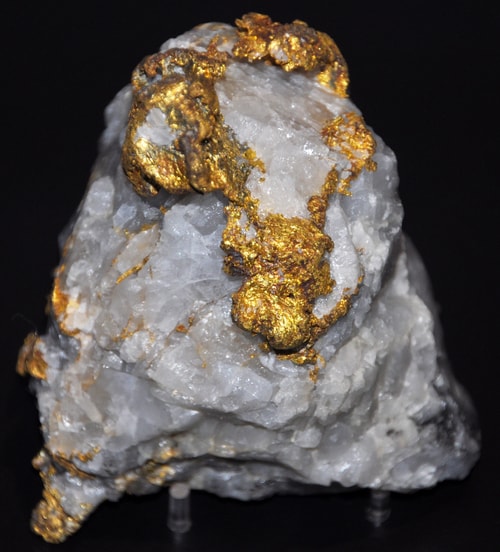
The discovery of [gold](https://www.worldhistory.org/gold/) at Witwatersrand in Transvaal in 1886, coupled with that of diamonds at Kimberley in 1867, transformed the entire region of Southern [Africa](https://www.worldhistory.org/disambiguation/africa/). The 'Rand' proved to be the largest gold deposit in the world, and it led to mass immigration, urbanisation, and, in order for the mine owners to maximise their wealth, the creation of a low-paid and segregated workforce of Black Africans. The wealth of Transvaal, a Boer republic, was one of the reasons for the Anglo-Boer Wars, which led to a British takeover and the creation of the Union of South Africa in 1910.
[  Witwatersrand Gold James St John (CC BY) ](https://www.worldhistory.org/image/21810/witwatersrand-gold/ "Witwatersrand Gold")### The Tip of an [Empire](https://www.worldhistory.org/empire/)
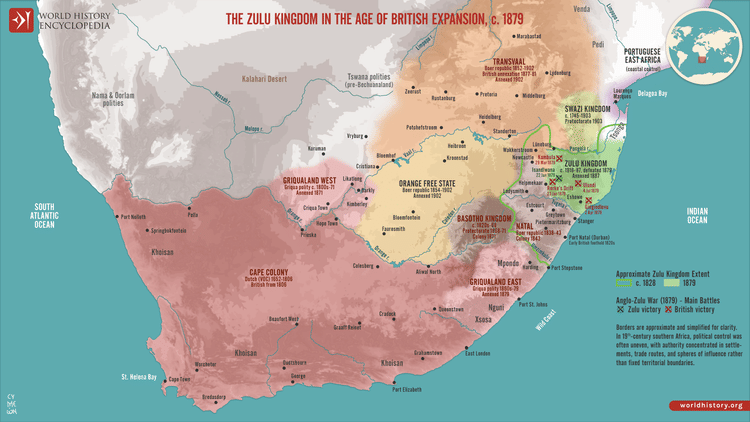
In the early 19th century, Southern Africa had only really been of strategic interest to the British, the Cape Colony (founded 1806) and Cape of Good Hope acting as an important stopping point for ships sailing to and from [Britain](https://www.worldhistory.org/disambiguation/Britain/) and its possessions in Asia, particularly British [India](https://www.worldhistory.org/india/). Another British colony in the region was Natal (founded 1843). The British had competition, not only from indigenous Africans but also from the Boers. The Boers were White settlers in Southern Africa who had Dutch or French ancestry. The name Boer means "farmer." They were also known as Afrikaners because they spoke Afrikaans. Through the 1830s, as the British outlawed slavery, and population growth applied too much pressure to land and resources around the Cape, over 14,000 Boers migrated to find land elsewhere. One of the new territories became the Boer Republic of Transvaal in 1852 (the other was the Orange Free State, founded in 1854). Largely rural and with only a modest [trade](https://www.worldhistory.org/disambiguation/trade/) related to [agriculture](https://www.worldhistory.org/disambiguation/Agriculture/), Southern Africa's fortunes were transformed following the discovery of diamonds at Kimberley in 1867 and then by the remarkable discovery of the largest and deepest gold mine in the world.
### Discovery of Gold
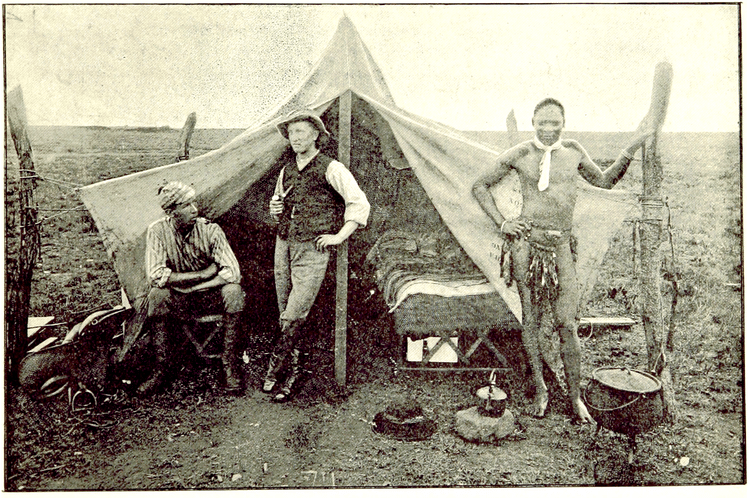
Sporadic gold finds had occurred in Transvaal in previous decades, but the most important discovery is usually credited to George Harrison, an Australian prospector, who found gold in February 1886 at Langlaagte farm in the Witwatersrand Basin. Harrison was pleased enough with his find, but what he did not realise, and nor did anyone else at the time, was that this was the beginning of excavations on a massive gold belt that was almost 31 miles (50 km) long and 1.8 miles (3 km) deep. Aside from a thin top layer, it was not easy to extract the gold since the rock was very low-grade, producing around 5 ounces (15 g) of gold per tonne. This fact made extraction expensive, and, as with the Kimberley diamond mines, the number of claims gradually condensed into fewer and fewer hands, those remaining having the necessary capital for expensive machinery. Indeed, the investors in the gold mines were typically the very same men who had made their fortunes from the diamonds of Kimberley. The richest mine owners, known as the 'Randlords', were [Julius](https://www.worldhistory.org/disambiguation/Julius/) Wernher, Barney Barnato, Alfred Beit, and Cecil [Rhodes](https://www.worldhistory.org/Rhodes/).
The colonial authorities responded to the news of the gold find by sending surveyors to choose a suitable nearby site where the inevitable influx of gold prospectors from all over the world could live. The site chosen would eventually become the great [city](https://www.worldhistory.org/city/) of Johannesburg. Within a decade, the young town boasted 100,000 inhabitants, and by 1900, this figure had risen to 166,000. Johannesburg became the largest African city south of the Sahara. It was a wild place in the early days where the spending was as loose as the morals. One contemporary described Johannesburg as "Monte Carlo imposed on Sodom and Gomorrah" (Jackson, 14).
[  Map of the Zulu Kingdom and British Imperial Expansion Simeon Netchev (CC BY-NC-ND) ](https://www.worldhistory.org/image/21669/map-of-the-zulu-kingdom-and-british-imperial-expan/ "Map of the Zulu Kingdom and British Imperial Expansion")### Huge Wealth
The first and most obvious consequence of the gold discoveries was the sudden creation of massive wealth. The Transvaal Republic reaped in £4 million each year from the mining royalties alone, a figure that had doubled by 1896. Transvaal "was transformed into the richest independent state in Africa" (James, 101). The state could build its own railway from Johannesburg to Lourenço Marques (Maputo) and so now had access to a port independent of any British concern. The Transvaal government, aware of the covetous eyes of the British, began to spend big on military hardware, importing the latest rifles, machine guns, and artillery pieces from France and Germany.
The gold seemed inexhaustible. "By 1890, £10 million-worth of gold was being exported, which made gold the leading South African export; this had risen to £25 million by 1905 and to between £45 and £50 million \[£5,000 million today\] by 1910" (Boahen, 183). By 1915, South Africa was producing 40% of the world's gold. The rich worldwide bought shares in the Transvaal gold mines, so much so, that "from 1886 until 1913 between £116 million and £134 million was invested in the Witwatersrand" (Fage, 434). Gold was fast becoming the international monetary standard for currencies, and the demand was insatiable.
British rivalry with the Boer republics now intensified. The British were determined to create a federation of South Africa, which could take over and protect the lucrative diamond and gold mines. This plan had already taken a step forward when the British defeated the [Zulu Kingdom](https://www.worldhistory.org/Zulu_Kingdom/) in 1879. Zululand became a crown colony in 1887 and was absorbed into Natal in 1897.
The Transvaal Boers successfully fought off the British in the First Anglo-Boer [War](https://www.worldhistory.org/disambiguation/War/) between 1880 and 1881, but a decade later, Britain was well on its way to surrounding the two Boer republics. The British had acquired both the Basutoland Protectorate (modern Lesotho) in 1884 and the Bechuanaland Protectorate (modern Botswana) in 1885. Swaziland and Pondoland were added to Britain's motley collection of Southern African states in 1893 and 1894, respectively. The Transvaal mines even inspired imperialist adventurers like Rhodes to move north of the Limpopo River in the (what turned out to be mistaken) belief that similar riches must surely be found there, too.
[  Early Prospectors, Witwatersrand J. Davis (Public Domain) ](https://www.worldhistory.org/image/21812/early-prospectors-witwatersrand/ "Early Prospectors, Witwatersrand")### A Captive Labour Force
The gold mines had consequences for the workplace and wider society, too. White miners, on average, received more than ten times the wage of a Black miner. Whites were attracted from all over the world to come and work in Witwatersrand; 44,000 of them came to the mines by 1896. In 1870, Southern Africa had around 250,000 White settlers. By 1891, there were 600,000. The Boers, jealous of their privileged position, passed laws to ensure these new White workers, known as *Uitlanders* ('Outsiders'), could not vote and did not enjoy the same rights of citizenship as Boers in Transvaal. The President of Transvaal, [Paul](https://www.worldhistory.org/disambiguation/Paul/) Kruger (1825-1904), passed a [law](https://www.worldhistory.org/disambiguation/law/) that only after 14 years of residency could a White immigrant vote in political elections.
The mine magnates, disparagingly called the 'gold bugs' by Kruger, were not very happy at the restrictions on the more skilled element of their workforce. The White workers themselves did not take kindly either to having no voting rights but still having the obligation to pay taxes and perform military service for the Transvaal government. The British colonial authorities in Cape Colony and Natal certainly did not agree with Kruger's discrimination against White immigrants, and a conference was set up to discuss the issue, the Bloemfontein Conference of June 1889. When the British cut this conference short, the Boers had one more gripe against their rivals in Southern Africa.
For Black workers, and there were over one million of them in the gold mines by 1899, the prejudice was much worse than this. First and foremost, mine owners worked tirelessly to keep the cost of labour down, especially as the Witwatersrand deposits were low-grade and labour/machine intensive. Unlike the White miners, Black miners were not permitted to form trade unions. In addition, powerful White worker unions protected themselves by ensuring the mine owners did not employ cheaper African labour for skilled positions. In 1899, the Chamber of Mines was formed, and one of its main functions was to recruit cheap, unskilled labour and make sure it stayed cheap. The excuse for paying subpar wages was that Africans were usually employed on a seasonal basis and so could supplement their income by returning to their farms. Another method to drive down wages, employed from the early 20th century, was for the mining companies to import tens of thousands of Chinese labourers who were treated little better than slaves.
[ 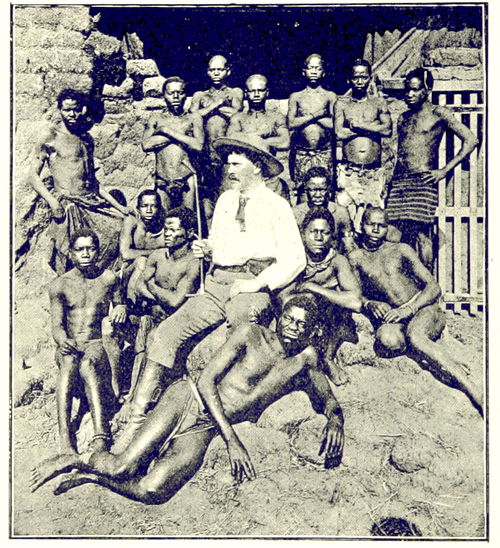 Black Miners with White Overseer, Witwatersrand, 1893 J. Davis (Public Domain) ](https://www.worldhistory.org/image/21811/black-miners-with-white-overseer-witwatersrand-189/ "Black Miners with White Overseer, Witwatersrand, 1893")Black miners were obliged to live in caged compounds, the excuse being that they could not pass out stolen gold to an outside accomplice. They also needed a pass to freely circulate in the towns. Punishments for not having such a pass ranged from a hefty fine to three weeks' hard labour. Such discriminatory laws became the foundation of the system of apartheid and added fuel to the existing White prejudice against Africans.
Other consequences of the mining boom included the rapid industrialisation of the region, almost uniquely in the African continent. There was a rapid urbanisation as towns grew up to cater for the needs of the miners. Roads and [railways](https://www.worldhistory.org/disambiguation/Railways/) were built to facilitate the movement of goods and workers. In 1860, Southern Africa had a mere 1.8 miles (3 km) of railway and no roads at all suitable for wheeled vehicles. By 1889, there were 2,050 miles (3,300 km) of railway. By 1914, there were 46,000 miles (75,000 km) of roads.
### The Creation of South Africa
As the 19th century came to a close, Britain had to defend its acquisitions from the Boers in the Second Anglo-Boer War (1899-1902). The causes of this war were varied and not restricted to the gold and diamond mines, but it was also true that the mine magnates had plotted a takeover of the Transvaal government, funding and arming the failed Jameson Raid of December 1895. The British government was certainly concerned that a wealthy Transvaal could link up with a rival colonial power such as Germany, and such a partnership could threaten British interests in Southern Africa. Another important motivation was the fact that British investments in Transvaal totalled over £350 by 1899, and two-thirds of Witwatersrand's mines were owned by British shareholders.
[ 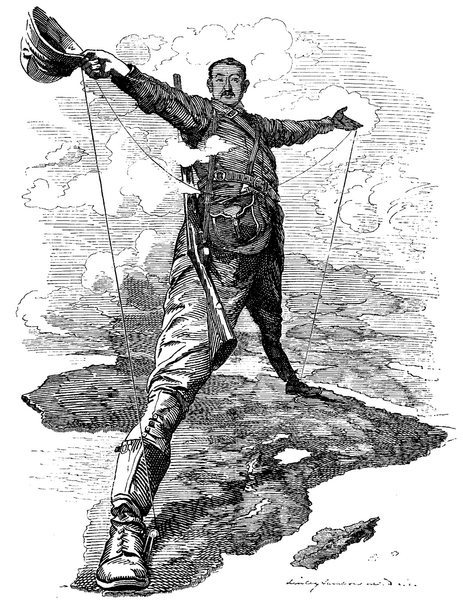 Cecil Rhodes Colossus Cartoon Edward Linley Sambourne (Public Domain) ](https://www.worldhistory.org/image/21725/cecil-rhodes-colossus-cartoon/ "Cecil Rhodes Colossus Cartoon")In the end, Britain was victorious in the Second Boer War, and so, at last, the British colonial dream was realised, and the Union of South Africa was formed in 1910. This colony was composed of Cape Colony, Natal, Transvaal, and Orange Free State, and included what had been Zululand, Tongaland, and Griqualand. It would be a prosperous but highly divided colony. Various discriminatory acts were passed, such as the Mines and Works Act of 1911, which excluded Africans from certain skilled mining jobs, and the Natives Land Act of 1913, which removed land from Africans to force them to become labourers in the mines. Even when South Africa gained independence in 1961, it remained notorious worldwide for its policies of racial segregation.
As *The Cambridge History of Africa* notes:
> The gold-mining industry was at the heart of the structure and evolution of modern South Africa – 'it was there that…the first and most extensive industrial institutionalisation of racial discrimination in South Africa' occurred.
> (Fage, 425)
#### Editorial Review
This human-authored article has been reviewed by our editorial team before publication to ensure accuracy, reliability and adherence to academic standards in accordance with our [editorial policy](https://www.worldhistory.org/static/editorial-policy/).
## Bibliography
- [Boahen, A. Adu. *UNESCO General History of Africa, Vol. VII, Abridged Edition.* University of California Press, 1990.](https://www.worldhistory.org/books/0520067029/)
- [Chamberlain, M. E. *The Scramble for Africa.* Routledge, 2010.](https://www.worldhistory.org/books/1408220148/)
- [Curtin, Philip. *African History.* Pearson, 1995.](https://www.worldhistory.org/books/0582050707/)
- [Dalziel, Nigel & Mackenzie, John. *The Penguin Historical Atlas of the British Empire.* Penguin Books, 2006.](https://www.worldhistory.org/books/0141018445/)
- [Fage, . *The Cambridge History of Africa.* Cambridge University Press, 1985.](https://www.worldhistory.org/books/0521228034/)
- [Green, Timothy. *The Gold Companion.* Rosendale Press, 1992.](https://www.worldhistory.org/books/1872803024/)
- [Jackson, Tabitha. *The Boer War.* Channel 4 Book, 1999.](https://www.worldhistory.org/books/075221702X/)
- [James, Lawrence. *Empires in the Sun.* Pegasus Books, 2017.](https://www.worldhistory.org/books/1681774631/)
- [James, Lawrence. *The Rise and Fall of the British Empire.* St Martins Pr, 1995.](https://www.worldhistory.org/books/0312140398/)
- [Knight, Ian & Embleton, Gerry. *The Boer Wars .* Osprey Publishing (Military), 1997.](https://www.worldhistory.org/books/1855326132/)
- [Marshall, P. J. *The Cambridge Illustrated History of the British Empire.* Cambridge University Press, 1996.](https://www.worldhistory.org/books/0521432111/)
- [Pakenham, Thomas. *Scramble for Africa.* Weidenfeld & Nicolson History, 2001.](https://www.worldhistory.org/books/184212448X/)
- [Pakenham, Thomas. *The Boer War.* Random House, 1979.](https://www.worldhistory.org/books/0394427424/)
- [Reid, Richard J. *A History of Modern Africa.* Wiley-Blackwell, 2020.](https://www.worldhistory.org/books/1119381924/)
- [Smith, Simon C. *British Imperialism 1750–1970.* Cambridge University Press, 1998.](https://www.worldhistory.org/books/052159930X/)
## About the Author
Mark is WHE’s Publishing Director and has an MA in Political Philosophy (University of York). He is a full-time researcher, writer, historian and editor. Special interests include art, architecture and discovering the ideas that all civilizations share.
## External Links
- [140 Years of Mining the Witwatersrand Basin | SRK News | Gold](https://www.srk.com/en/publications/140-years-mining-witwatersrand-basin)
- [[PDF] The Origin of Gold in South Africa](https://www.sas.rochester.edu/ees/ees119/reading2.pdf)
## Cite This Work
### APA
Cartwright, M. (2026, May 13). Witwatersrand Gold & the Creation of South Africa. *World History Encyclopedia*.
### Chicago
Cartwright, Mark. "Witwatersrand Gold & the Creation of South Africa." *World History Encyclopedia*, May 13, 2026. .
### MLA
Cartwright, Mark. "Witwatersrand Gold & the Creation of South Africa." *World History Encyclopedia*, 13 May 2026, .
## License & Copyright
Submitted by [Mark Cartwright](https://www.worldhistory.org/user/markzcartwright/ "User Page: Mark Cartwright"), published on 13 May 2026. The copyright holder has published this content under the following license: [Creative Commons Attribution-NonCommercial-ShareAlike](https://creativecommons.org/licenses/by-nc-sa/4.0/deed.en). This license lets others remix, tweak, and build upon this content non-commercially, as long as they credit the author and license their new creations under the identical terms. When republishing on the web a hyperlink back to the original content source URL must be included. Please note that content linked from this page may have different licensing terms.