---
title: Scandinavia Before the Vikings
author: John Haywood
source: https://www.worldhistory.org/article/2922/scandinavia-before-the-vikings/
format: machine-readable-alternate
updated: 2026-05-04
---
# Scandinavia Before the Vikings
_Authored by John Haywood_
In the Merovingian period, Scandinavia was only just emerging from its prehistoric [Iron Age](https://www.worldhistory.org/disambiguation/Iron_Age/). A process of political centralization that had begun in the Migration Period led to the emergence of the first Scandinavian kingdoms and a warlike society with a tradition of [piracy](https://www.worldhistory.org/Piracy/). During the late [Roman](https://www.worldhistory.org/disambiguation/Roman/) period, the Scandinavians were still divided into tribes, each dominated by a warrior aristocracy that maintained its status with raiding.
[  Nydam Ship Erik Christensen (CC BY-SA) ](https://www.worldhistory.org/image/8030/nydam-ship/ "Nydam Ship")### [Viking](https://www.worldhistory.org/Vikings/) Naval Expeditions
Because of its indented coastline and many islands and lakes, travel in Scandinavia was easiest by water. Shipbuilding and seafaring skills therefore developed early, as did piracy. Most of this was probably local in nature, but at the end of the third century the Heruls from Jutland joined the [Saxons](https://www.worldhistory.org/Saxons/) in raids on the [Roman Empire](https://www.worldhistory.org/Roman_Empire/).
Much of the loot was cast into bogs as votive offerings. One of the most spectacular of these was at Nydam in Jutland, where hundreds of weapons were interred, along with two ships and a boat. The Nydam ships showed many of the characteristics of the longships that carried the [Vikings](https://www.worldhistory.org/Vikings/) on their terrifying raids in the ninth century.
#### Book Excerpt
[  ](https://www.worldhistory.org/books/0500029806 "The Making of the Middle Ages: An Atlas of Europe")### The Making of the Middle Ages: An Atlas of Europe
by John Haywood Trace the tumultuous history of Europe during the Early Middle Ages through 90 specially commissioned maps and a authoritative narrative. Medieval Europe remains a mystery to many, yet the relative dearth of information about the period cannot mask its crucial importance in history. Often mischaracterized as a time of darkness and decline, the period from 476 to 1000 CE was marked by turmoil, rebirth and transformation. [Learn More](https://www.worldhistory.org/books/0500029806)
.sponsor.book img.key_art {
box-shadow: none !important;
}
.button_container {
margin-top: 1em;
}
.sponsor.book h3 {
text-transform: none;
margin-top: 0px;
margin-bottom: 15px;
font-family: "Libre Baskerville", "Palatino Linotype", "Book Antiqua", Palatino, serif;
}
.sponsor_message {
margin-left: 190px;
font-family: Karla, Arial, Helvetica, sans-serif;
line-height: 140%;
min-height: 200px;
}
.sponsor.book {
padding: 20px;
margin: 25px 0px;
background-color: #f3f3f3;
}
.sponsor.book .key_art {
margin-top: 0px;
margin-bottom: 10px;
float: left;
}
.sponsor h4 {
font-weight: bold;
text-transform: uppercase;
color: #000;
margin-bottom: 10px;
margin-top: 0px;
font-family: Karla,Arial,Helvetica,sans-serif;
font-size: 13px;
padding: 0;
}
.sponsor_book_author {
color: #999;
margin: -10px 0px 20px;
}
@media (max-width: 1199px) {
.sponsor.book .key_art {
float: none;
width: 100%;
}
.sponsor.book .sponsor_message {
margin-left: 0px;
}
.sponsor.book h3 {
margin-top: 20px;
margin-bottom: 10px;
}
}
@media (max-width: 767px) {
}
### Population Movement & Consolidation
Fortresses proliferated across Scandinavia during the Migration Period and the semi-legendary traditions recorded by the medieval Danish historian Saxo Grammaticus (c. 1150-1220) hold that it was a time of intense conflict between competing tribes. As had happened in Germany 200 years earlier, tribes formed alliances and merged or were conquered and assimilated by stronger rivals. In this way the Danes emerged as the dominant people of southern Scandinavia during the sixth century. Successful leaders concentrated more and more wealth and power in their own hands; society became increasingly militarized and predatory. Piracy was so rife that some coastal areas of Scandinavia became depopulated.
Scandinavia largely escaped the wider disruptions caused by the Germanic migrations: it was a place people migrated out of, rather than into. Many Germanic peoples, including the [Goths](https://www.worldhistory.org/Goths/), Burgundians, [Vandals](https://www.worldhistory.org/Vandals/) and [Lombards](https://www.worldhistory.org/Lombards/), believed (incorrectly as far as the Goths were concerned, according to new genetic evidence) that they had originated in Scandinavia but been forced to emigrate because of overpopulation and a shortage of good farmland. In the fifth century, Angles and Jutes from Jutland migrated to [Britain](https://www.worldhistory.org/disambiguation/Britain/) and the Heruls were hired as mercenaries for the [Byzantine Empire](https://www.worldhistory.org/Byzantine_Empire/), launching pirate raids as far afield as Spain. The earliest named Scandinavian ruler, Hygelac, was also a pirate. He was a king of the Geats (probably the Götar of southern Sweden) who made an unsuccessful raid on the lower Rhine c. 528. His [death](https://www.worldhistory.org/disambiguation/Death/) in [battle](https://www.worldhistory.org/disambiguation/battle/) against the [Franks](https://www.worldhistory.org/Franks/) was recorded by Gregory of Tours and in the Old English epic poem [Beowulf](https://www.worldhistory.org/Beowulf/).
[ YouTube Follow us on YouTube!](https://link.worldhistory.org/youtube_intext)
### Early Scandinavian Kingdoms
Archaeological evidence points to the development of several small kingdoms in Scandinavia by 750. One of these was in the Vestfold of Norway, where the pagan cult centre and impressive [burial](https://www.worldhistory.org/burial/) mounds at Borre are evidence of a royal dynasty. Rich warrior burials, some of them in ships, at Vendel and Valsgärde near Uppsala point to the emergence of a dynasty among the Svear, the people from whom Sweden takes its name. The Svear kings probably controlled the cult centre and seasonal market on the island of Helgö (Holy Island), which had [trade](https://www.worldhistory.org/disambiguation/trade/) links with the [Mediterranean](https://www.worldhistory.org/disambiguation/mediterranean/) and perhaps farther afield. The most exotic find from the site was a statuette of the [Buddha](https://www.worldhistory.org/Siddhartha_Gautama/), made in northern [India](https://www.worldhistory.org/india/) c. 600.
[ 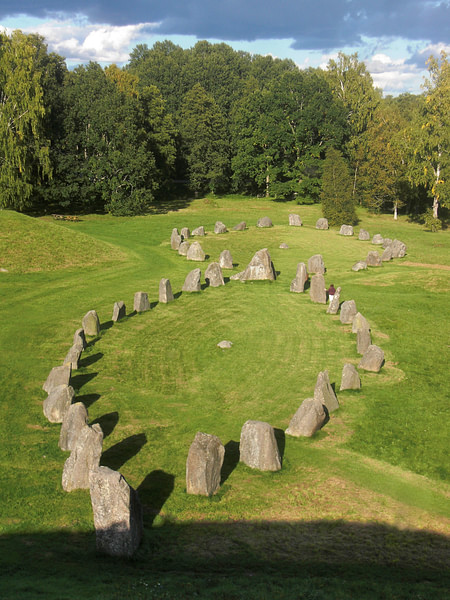 Scandinavian Stone Ship Burial Achird (CC BY-SA) ](https://www.worldhistory.org/image/8064/scandinavian-stone-ship-burial/ "Scandinavian Stone Ship Burial")Jutland was the centre of the most impressive early Scandinavian kingdom, evidence for which comes from large-scale public works. In 726 a canal was dug across the island of Samsø, probably to regulate shipping, and in 737 a rampart – the Danevirke – was built across the neck of the Jutland peninsula as a defence against the Saxons. Such major projects could only have been ordered by a ruler who commanded the labour and resources of a wide area.
Around the same time, a well-planned trading place was founded at Ribe. Large quantities of Frisian coins, evidence of leatherworking and huge quantities of cattle dung suggest that Ribe was exporting hides to the Frankish kingdom. The ruler responsible for all these works was probably Angantyr, the earliest historical Danish king, whom the Anglo-[Saxon](https://www.worldhistory.org/Saxons/) St Willibrord (658–739) met on the first Christian mission to Scandinavia c. 725.
## Bibliography
- [Haywood, John & Wood, Michael. *The Making of the Middle Ages.* Thames & Hudson, 2026.](https://www.worldhistory.org/books/0500029806/)
## Cite This Work
### APA
Haywood, J. (2026, May 04). Scandinavia Before the Vikings. *World History Encyclopedia*.
### Chicago
Haywood, John. "Scandinavia Before the Vikings." *World History Encyclopedia*, May 04, 2026. .
### MLA
Haywood, John. "Scandinavia Before the Vikings." *World History Encyclopedia*, 04 May 2026, .
## License & Copyright
© Thames & Hudson. Republished with permission. [Original article](https://www.worldhistory.org/books/0500029806) by [**John Haywood**](https://www.worldhistory.org/books/0500029806). Submitted by [Jan van der Crabben](https://www.worldhistory.org/user/jvdc/ "User Page: Jan van der Crabben"), published on 04 May 2026. The copyright holder has published this content under the following license: [Copyright](http://en.wikipedia.org/wiki/Copyright). You cannot use, copy, distribute, or modify this item without explicit permission from the author. Please note that content linked from this page may have different licensing terms.