---
title: The After-Life In Ancient Greece
author: Joshua J. Mark
source: https://www.worldhistory.org/article/29/the-after-life-in-ancient-greece/
format: machine-readable-alternate
license: Creative Commons Attribution-NonCommercial-ShareAlike (https://creativecommons.org/licenses/by-nc-sa/4.0/)
updated: 2024-05-28
---
# The After-Life In Ancient Greece
_Authored by [Joshua J. Mark](https://www.worldhistory.org/user/JPryst/)_
In ancient [Greece](https://www.worldhistory.org/greece/) the continued existence of the dead depended on their constant remembrance by the living. It was understood that the soul lived on after bodily [death](https://www.worldhistory.org/disambiguation/Death/) in the realm known as [Hades](https://www.worldhistory.org/Hades/); but that land had different regions the soul might fly to depending on the deeds done in life and, also, how the living remembered them.
The after-life, for the ancient Greeks, consisted of a grey and dreary world in the time of [Homer](https://www.worldhistory.org/homer/) (8th century BCE) and is depicted, most famously, in the scene from Book 11 of Homer's *[Odyssey](https://www.worldhistory.org/Odyssey/)* in which [Odysseus](https://www.worldhistory.org/odysseus/) meets the spirit of the great warrior [Achilles](https://www.worldhistory.org/achilles/) in the nether-world where Achilles tells him he would rather be a landless slave on earth than a king in the underworld. By the time of [Plato](https://www.worldhistory.org/plato/), however (4th century BCE) the after-life had changed in character so that souls were better rewarded for their pains once they had left the earth; but only in so much as the living kept their memory alive.
[  Funeral Stele of Artistion Mark Cartwright (CC BY-NC-SA) ](https://www.worldhistory.org/image/408/funeral-stele-of-artistion/ "Funeral Stele of Artistion")### The Land of the Dead
The afterlife was known as Hades and was a grey world ruled by Hades, the Lord of the Dead, and his queen [Persephone](https://www.worldhistory.org/persephone/). Within this misty realm, however, were different planes of existence the dead could inhabit. If they had lived a good life, and were remembered well by the living, they could enjoy the sunny pleasures of the Plain of Asphodel (Aspodel Meadows); if they had been warriors who died bravely in [battle](https://www.worldhistory.org/disambiguation/battle/) then they went to Elysium; if they were wicked then they fell into the darker pits of [Tartarus](https://www.worldhistory.org/Tartarus/) where they were punished while, if they were forgotten, they wandered eternally in the blackness of Tartarus. While Asphodel, Elysium, and Tartarus existed in the time of the writer [Hesiod](https://www.worldhistory.org/hesiod/) (contemporary of Homer) - as well as the Isles of the Blessed where the spirits pure in heart lived - they were not understood then in the same way they came to be.
In Plato's dialogue of the *Phaedo*, [Socrates](https://www.worldhistory.org/socrates/) delineates the various plateaus of the after-life and makes it clear that the soul who, in life, devotes itself to the Good is rewarded in the beyond with a much more pleasant existence than those who indulged their appetites and lived only for the pleasures the world has to offer. This was always the case, long before Plato's time (4th century BCE), although he added a philosophical flourish to the vision but, overall, the depiction of the collective dead was of a large group of dismal, unpleasant, individuals, disappointed in their final fate and yearning for what had been lost.
It is likely that many of the dead felt the same way when they lived - thinking only of the past and wishing for what they could not have - but this is not how the living were encouraged to remember them. It was, in fact, considered one's duty to the dead to remember them well, regardless of the life they had lived, the mistakes they had made, and, thereby, provide them with continued existence in Asphodel and, in time, Elysium. This remembrance was not considered a matter of personal choice but, rather, an important part of what the Greeks knew as *eusebia*.
In dealing with the spirits of the departed, *eusebia* took the form of observing proper [burial](https://www.worldhistory.org/burial/) practices, providing the deceased with food and drink offerings, and erecting a proper memorial in their honor. One's [tomb](https://www.worldhistory.org/tomb/) or tombstone might depict one's likeness, or an especially dear memory, or some verse but, whatever appeared on one's [grave](https://www.worldhistory.org/burial/) marker, it was there to remind the living of who was interred there and what honors were due them.
### Piety in Ancient Greece
The [Greek](https://www.worldhistory.org/disambiguation/greek/) word *eusebia* is usually translated into English as `piety' but *eusebia* was much more than that: it was one's duty to oneself, others, and the gods which kept society on track and made clear one's place in the community. Socrates, for example, was executed by the [city-state](https://www.worldhistory.org/Polis/) of [Athens](https://www.worldhistory.org/Athens/) after having been convicted of impiety for allegedly corrupting the youth of Athens and speaking against the established gods. However unjust one may see Socrates' end today he would, in fact, have been guilty of impiety in that he encouraged the youth of Athens, by his own example, to question their elders and social superiors. This behavior would have been considered impious in that the youth were not acting in accordance with *eusebia*, i.e. they were forgetting their place and obligations in society.
[ 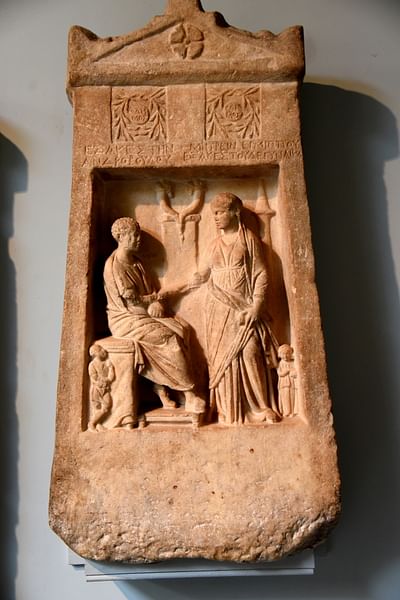 Grave Stela of Exakestes Osama Shukir Muhammed Amin (Copyright) ](https://www.worldhistory.org/image/5066/grave-stela-of-exakestes/ "Grave Stela of Exakestes")### Eusebia & the After-life
In the same way that one had to remember one's duty toward others in one's life, one also had to remember one's duty to those who had departed life. If one forgot to honor and remember the dead, one was considered impious and, while this particular breach of social conduct was not punished as severely as Socrates', it was certainly frowned upon severely. Many of the tombstones of the ancient Greeks - whether in a museum or just below the [Acropolis](https://www.worldhistory.org/Acropolis/) in Athens or elsewhere - depict comfortable, common scenes: a husband sitting at table as his wife brings him his evening meal, a man being greeted by his dogs upon returning home.
These simple scenes were not merely depictions of moments the deceased enjoyed in life; they were meant to remind the living viscerally of who that person was had been, of who that person still was now in death, and to spark the light of continued remembrance in order that the `dead' should live in bliss eternally. In ancient Greece, death was defeated, not by the gods, but by the human agency of memory.
#### Editorial Review
This human-authored article has been reviewed by our editorial team before publication to ensure accuracy, reliability and adherence to academic standards in accordance with our [editorial policy](https://www.worldhistory.org/static/editorial-policy/).
## Bibliography
- [Durant, W. *The Life of Greece.* Simon & Schuster, 2011.](https://www.worldhistory.org/books/B004ZZS4YA/)
- [Hesiod & Hine, D. *Works of Hesiod and the Homeric Hymns.* University of Chicago Press, 2007.](https://www.worldhistory.org/books/0226329666/)
- [Homer & Lattimore, R. *The Odyssey of Homer.* Harper Perennial Modern Classics, 2007.](https://www.worldhistory.org/books/006124418X/)
- [Nardo, D. *Living in Ancient Greece.* Greenhaven Press, 2004.](https://www.worldhistory.org/books/1526754703/)
- [Plato & Reeve, C. D. C. *A Plato Reader.* Hackett Publishing Company, Inc., 2012.](https://www.worldhistory.org/books/1603848118/)
- [Waterfield, R. *Athens.* Basic Books, 2009.](https://www.worldhistory.org/books/B001LNO5VU/)
## About the Author
Joshua J. Mark is World History Encyclopedia's co-founder and Content Director. He was previously a professor at Marist College (NY) where he taught history, philosophy, literature, and writing. He has traveled extensively and lived in Greece and Germany.
- [Linkedin Profile](https://www.linkedin.com/pub/joshua-j-mark/38/614/339)
## Questions & Answers
### What was the afterlife in ancient Greece like?
The afterlife in ancient Greece was generally dismal but had regions like the Asphodel Plains and Elysium which were more pleasant than Tartarus, the dark pit.
### What was the ancient Greek afterlife called?
The ancient Greek afterlife was known as Hades. It was also ruled over by the god Hades, along with his queen Persephone.
### How did one reach the ancient Greek afterlife?
One reached the ancient Greek afterlife by passing over the River Styx, rowed in a boat by Charon.
### Why was remembrance of the dead so important to the ancient Greek afterlife?
The spirits of the dead in ancient Greece were thought to fare better if they were remembered by the living. Remembrance kept the spirit of the deceased alive.
## Cite This Work
### APA
Mark, J. J. (2012, January 18). The After-Life In Ancient Greece. *World History Encyclopedia*.
### Chicago
Mark, Joshua J.. "The After-Life In Ancient Greece." *World History Encyclopedia*, January 18, 2012. .
### MLA
Mark, Joshua J.. "The After-Life In Ancient Greece." *World History Encyclopedia*, 18 Jan 2012, .
## License & Copyright
Submitted by [Joshua J. Mark](https://www.worldhistory.org/user/JPryst/ "User Page: Joshua J. Mark"), published on 18 January 2012. The copyright holder has published this content under the following license: [Creative Commons Attribution-NonCommercial-ShareAlike](https://creativecommons.org/licenses/by-nc-sa/4.0/deed.en). This license lets others remix, tweak, and build upon this content non-commercially, as long as they credit the author and license their new creations under the identical terms. When republishing on the web a hyperlink back to the original content source URL must be included. Please note that content linked from this page may have different licensing terms.