---
title: Treasures of Roman Tunisia: 10 Key Sites Explored
author: Carole Raddato
source: https://www.worldhistory.org/article/2811/treasures-of-roman-tunisia/
format: machine-readable-alternate
license: Creative Commons Attribution-NonCommercial-ShareAlike (https://creativecommons.org/licenses/by-nc-sa/4.0/)
updated: 2025-10-27
---
# Treasures of Roman Tunisia: 10 Key Sites Explored
_Authored by [Carole Raddato](https://www.worldhistory.org/user/FollowingHadrian/)_
Set on the North African coast, Tunisia is home to some of the finest [Roman](https://www.worldhistory.org/disambiguation/Roman/) ruins in the [Mediterranean](https://www.worldhistory.org/disambiguation/mediterranean/). After the fall of [Carthage](https://www.worldhistory.org/carthage/), [Rome](https://www.worldhistory.org/Rome/) transformed the region into the prosperous province of [Africa](https://www.worldhistory.org/disambiguation/africa/), enriched by its fertile plains and bustling [cities](https://www.worldhistory.org/city/). This land, shaped by dramatic events that influenced ancient history, has left behind an extraordinary archaeological legacy with ruins scattered across the rolling countryside, largely untouched by mass tourism.
[  Thugga (Dougga) Carole Raddato (CC BY-SA) ](https://www.worldhistory.org/image/21011/thugga-dougga/ "Thugga (Dougga)")### A Short Introduction to Roman Tunisia
Long before the arrival of the Romans, Tunisia was significantly influenced by the [Berber](https://www.worldhistory.org/Berbers/) (Amazigh) populations, who have inhabited North Africa for millennia. By the first millennium BCE, Berber kingdoms and communities thrived across the region, practising [agriculture](https://www.worldhistory.org/disambiguation/Agriculture/), herding, and [trade](https://www.worldhistory.org/disambiguation/trade/). The arrival of Phoenician settlers in the 9th century BCE led to the founding of Carthage (in present-day Tunis) on the Tunisian coast. Over the next few centuries, Carthage grew into a Mediterranean maritime power, dominating trade routes, establishing colonies, and raising armies that fought against Rome during the [Punic Wars](https://www.worldhistory.org/Punic_Wars/) (264–146 BCE). These wars are famous for the remarkable yet ultimately failed exploits of the Carthaginian statesman and general, [Hannibal](https://www.worldhistory.org/hannibal/), who famously marched an army over the Alps to invade [Italy](https://www.worldhistory.org/italy/) in 218 BCE during the [Second Punic War](https://www.worldhistory.org/Second_Punic_War/).
[  Byrsa Punic Houses, Carthage Carole Raddato (CC BY-NC-SA) ](https://www.worldhistory.org/image/21014/byrsa-punic-houses-carthage/ "Byrsa Punic Houses, Carthage")After Carthage's destruction in 146 BCE, Rome reorganised North Africa into distinct provinces. Carthage itself was subsequently rebuilt, first by [Julius Caesar](https://www.worldhistory.org/Julius_Caesar/) (l. 100-44 BCE) and later by [Augustus](https://www.worldhistory.org/augustus/) (r. 27 BCE - 14 CE), eventually becoming the capital of the province known as Africa Proconsularis. The region's fertile plains, long cultivated by Berber communities, soon supplied Rome with vast quantities of grain and olive oil. This agricultural prosperity contributed to significant urban development as indigenous villages and Roman settlements evolved into prosperous towns. The most fortunate of these, such as [Dougga](https://www.worldhistory.org/Dougga/), developed as *municipia*, governed by Roman magistrates and featuring temples, baths, and market squares. By the 2nd and 3rd centuries CE, Africa Proconsularis, often referred to as the "granary of the [empire](https://www.worldhistory.org/empire/)," had established itself as one of the wealthiest provinces within the [Roman Empire](https://www.worldhistory.org/Roman_Empire/).
[  Map of Roman North Africa - Provinces, Roads & Frontiers Simeon Netchev (CC BY-NC-ND) ](https://www.worldhistory.org/image/16818/map-of-roman-north-africa---provinces-roads--front/ "Map of Roman North Africa - Provinces, Roads & Frontiers")[Christianity](https://www.worldhistory.org/christianity/) also established a significant presence in the region, with the emergence of many bishops and Christian thinkers. In 249 CE, Carthage became the seat of an important bishopric, and the province became a hub of Christian thought, producing figures such as Tertullian (c. 155 – c. 220 CE) and Cyprian (c. 210 - 258 CE), two of the great figures of the early church. In the following centuries, the region experienced major changes, beginning with the [Crisis of the Third Century](https://www.worldhistory.org/Crisis_of_the_Third_Century/), the invasions of the [Vandals](https://www.worldhistory.org/Vandals/) and the [Byzantine](https://www.worldhistory.org/disambiguation/Byzantine/) reconquest. Ultimately, the Arab conquests in the 7th century CE marked the end of the Roman and Byzantine political order, although many of its characteristics persisted for some time.
[  Early Christian Mosaic from Sufetula Carole Raddato (CC BY-SA) ](https://www.worldhistory.org/image/21012/early-christian-mosaic-from-sufetula/ "Early Christian Mosaic from Sufetula")Few regions in the Roman world offer such a rich density and variety of archaeological sites. Here are the ten most significant, impressive, or well-preserved Roman sites in Tunisia that [archaeology](https://www.worldhistory.org/Archaeology/) enthusiasts should consider visiting.
### 1. Carthage
Carthage occupies a unique place in ancient history. It was the largest and most powerful political entity in the Mediterranean, and the capital of the Carthaginian Empire, which rivalled Rome itself. Razed to the ground in 146 BCE at the end of the [Third Punic War](https://www.worldhistory.org/Third_Punic_War/), the [city](https://www.worldhistory.org/city/) was left in ruins for a century. However, [Julius](https://www.worldhistory.org/disambiguation/Julius/) [Caesar](https://www.worldhistory.org/disambiguation/caesar/) envisioned the city's revival, and five years after his [death](https://www.worldhistory.org/disambiguation/Death/), the city was on its way to becoming once again a major centre and eventually the third-largest city in the Western Empire, after Rome and [Alexandria](https://www.worldhistory.org/alexandria/).
[ 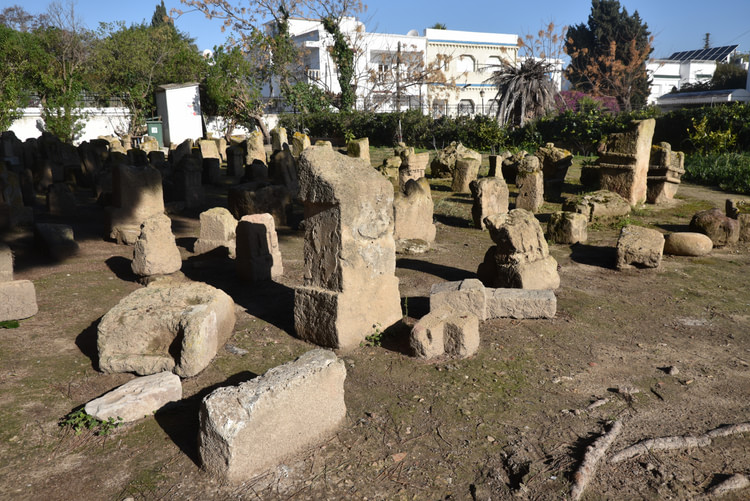 Carthage Tophet Carole Raddato (CC BY-SA) ](https://www.worldhistory.org/image/21024/carthage-tophet/ "Carthage Tophet")The fertile North African hinterland surrounding Carthage played a crucial role in the city's economic success, serving as the "granary of Rome" by supplying a large portion of the Empire's grain. Wealth flowed into the city, enabling the construction of monumental [architecture](https://www.worldhistory.org/disambiguation/architecture/), including large public buildings and residential quarters with luxurious villas. Carthage also emerged as an intellectual and religious centre, nurturing prominent Christian figures such as Tertullian and Cyprian, who contributed to the development of early Christian thought.
The archaeological remains of ancient Carthage offer a glimpse into the city's rich historical past, with remnants of [Punic](https://www.worldhistory.org/carthage/), Roman, and Byzantine civilisations. Among the most significant structures are the Antonine Baths, recognised as one of the largest bath complexes in the Roman Empire, stretching along the seafront and featuring vaulted halls and hot and cold chambers. Nearby, the cisterns of La Malga, fed by a branch of the Zaghouan [aqueduct](https://www.worldhistory.org/aqueduct/), form the largest surviving cisterns from the ancient world and were part of a sophisticated water management system that sustained the city.
[  Baths of Antoninus, Carthage Carole Raddato (CC BY-SA) ](https://www.worldhistory.org/image/21013/baths-of-antoninus-carthage/ "Baths of Antoninus, Carthage")[  Cisterns of La Malga Carole Raddato (CC BY-SA) ](https://www.worldhistory.org/image/21015/cisterns-of-la-malga/ "Cisterns of La Malga")On Byrsa Hill, overlooking the harbours that had once been the heart of Carthage's maritime Empire, lie the foundations of a Roman [temple](https://www.worldhistory.org/temple/), as well as remnants of Punic residential structures and fortifications. Under Punic rule, this area was the heart of the city and featured a temple dedicated to the Carthaginian [god](https://www.worldhistory.org/God/) Eshmun. Following the Roman [conquest](https://www.worldhistory.org/warfare/) and subsequent destruction of Carthage, the top of the hill was layered to facilitate the construction of the Capitol and Forum. Today, Byrsa Hill is occupied by the Saint Louis Cathedral and the Carthage Museum.
[  Roman Amphitheatre of Carthage Carole Raddato (CC BY-SA) ](https://www.worldhistory.org/image/21016/roman-amphitheatre-of-carthage/ "Roman Amphitheatre of Carthage")Other must-see sights include the ruins of the Roman [amphitheatre](https://www.worldhistory.org/amphitheatre/), the remains of Roman villas, and the Roman-era [theatre](https://www.worldhistory.org/disambiguation/theatre/), which features a small section composed of original 2nd-century CE stones.
### 2. Dougga (Thugga)
Set amidst rolling hills and olive groves, Dougga is often described as one of the best-preserved examples of a Roman town in North Africa. Originally a Numidian settlement, it became increasingly Romanised after the conquest, while still retaining traces of its pre-Roman heritage. Its bilingual inscriptions, in both Punic and Latin, reflect the blending of cultures that characterised Roman Africa.
[  Capitol of Dougga Carole Raddato (CC BY-SA) ](https://www.worldhistory.org/image/21033/capitol-of-dougga/ "Capitol of Dougga")The site is renowned for its good state of preservation and substantial remains. Among its most iconic structures is the Capitolium, a temple dedicated to the Roman gods [Jupiter](https://www.worldhistory.org/jupiter/), [Juno](https://www.worldhistory.org/Juno/), and [Minerva](https://www.worldhistory.org/Minerva/). Another highlight is the theatre, which could accommodate up to 3,500 spectators and is still used for performances today.
[  Roman Theatre of Dougga Carole Raddato (CC BY-SA) ](https://www.worldhistory.org/image/21032/roman-theatre-of-dougga/ "Roman Theatre of Dougga")[  Libyco-Punic Mausoleum of Dougga Carole Raddato (CC BY-NC-SA) ](https://www.worldhistory.org/image/21034/libyco-punic-mausoleum-of-dougga/ "Libyco-Punic Mausoleum of Dougga")There are also remains of public and private buildings, including baths, cisterns and houses. Finally, the Libyco-Punic Mausoleum, a towering structure that predates Roman rule, is a unique example of Numidian architecture, offering valuable insights into pre-Roman funerary traditions. Most of the mosaics and other artefacts from Dougga are on display at the Bardo Museum in Tunis.
### 3. Thysdrus (El Djem)
Dominating the modern town, the huge amphitheatre of El Djem is one of the most magnificent Roman structures in Roman Africa and an absolute must-see. Constructed in the 3rd century CE when ancient Thysdrus was at its peak of power, the monument could accommodate up to 35,000 spectators, a staggering number for a small provincial city. Its sheer size makes it one of the largest amphitheatres in the Roman world, comparable only to the [Colosseum](https://www.worldhistory.org/Colosseum/) in Rome and the arena of Capua.
[  Amphitheatre of El Djem Exterior Carole Raddato (CC BY-NC-SA) ](https://www.worldhistory.org/image/21114/amphitheatre-of-el-djem-exterior/ "Amphitheatre of El Djem Exterior")The architecture of the El Djem amphitheatre is an impressive engineering achievement, consisting of three tiers of arcades and underground passages designed to house animals and gladiators. Originally, the amphitheatre had a *velarium*, a retractable awning that provided shade from the intense summer sun. The amphitheatre hosted various public spectacles, including [gladiator](https://www.worldhistory.org/gladiator/) contests and animal hunts. Some of these spectacles feature on the mosaics found there.
[  Amphitheatre of El Djem Carole Raddato (CC BY-NC-SA) ](https://www.worldhistory.org/image/21113/amphitheatre-of-el-djem/ "Amphitheatre of El Djem")The archaeological museum is housed in one of Tunisia's best-preserved Roman villas, on the outskirts of El-Djem. It displays some magnificent mosaics found within the villa.
### 4. Sufetula (Sbeïtla)
Located in central Tunisia, Sufetula (present-day Sbeïtla) boasts one of the most intact Roman forums in the world. The site's defining feature is a trio of temples dedicated to Jupiter, Juno, and Minerva. Beyond the Forum stretches a grid of paved streets, triumphal arches, and public baths that showcase the prosperity of this inland town.
[  Capitoline Temples of Sufetula Carole Raddato (CC BY-SA) ](https://www.worldhistory.org/image/21035/capitoline-temples-of-sufetula/ "Capitoline Temples of Sufetula")[  Forum of Sufetula Carole Raddato (CC BY-SA) ](https://www.worldhistory.org/image/21037/forum-of-sufetula/ "Forum of Sufetula")Initially established as a *municipium*, a self-governing city with partial [Roman citizenship](https://www.worldhistory.org/article/859/roman-citizenship/), Sufetula was later elevated to the status of a Roman colony within the province of Africa Proconsularis. The town flourished during the 2nd and 3rd centuries CE, largely thanks to its thriving agricultural [economy](https://www.worldhistory.org/disambiguation/economy/), particularly in olive oil production, and its strategic position along trade routes. Because no modern settlement was built directly over ancient Sufetula, the Roman city plan remains exceptionally well-preserved.
The site is also remarkable for its late antique and Christian remains. Several basilicas, baptisteries, and a bishop's complex illustrate the transformation of Sbeïtla into a Christian stronghold by the 4th century CE. Don't miss the remarkably well-preserved baptistry inside the Basilica of St. Vitale, with an oval basin adorned with mosaics.
[  Sufetula Baptistery Carole Raddato (CC BY-SA) ](https://www.worldhistory.org/image/21036/sufetula-baptistery/ "Sufetula Baptistery")### 5. Thuburbo Majus
Thuburbo Majus is an ancient colony established by Augustus for retired soldiers. In 128 CE, following a visit from Emperor [Hadrian](https://www.worldhistory.org/hadrian/) (r. 117-138 CE), the town was granted the independent status of a *municipium* and became a colony a few decades later under Emperor [Commodus](https://www.worldhistory.org/commodus/) (r. 180-192 CE). The site is located in a beautiful valley surrounded by fertile land, just north of Zaghouan, and is one of the most important Roman remains in Tunisia. It boasts extensive ruins that are less frequently visited, allowing visitors to explore the area without encountering large crowds. Notable archaeological remains include the Forum, capitolium, amphitheatre, baths, and residential houses.
[  Forum of Thuburbo Majus Carole Raddato (CC BY-NC-SA) ](https://www.worldhistory.org/image/21066/forum-of-thuburbo-majus/ "Forum of Thuburbo Majus")The Forum is dominated by the Capitol temple, echoing the Capitoline triad at Sbeïtla, alongside the Temple of Peace, the Temple of Mercury and other shrines. Beyond the Forum lies the Summer Baths, covering an area of 2.8 square kilometres (1.1 square miles). These baths were once adorned with statues of [Asclepius](https://www.worldhistory.org/Asclepius/), [Hercules](https://www.worldhistory.org/hercules/), Mercury, and [Venus](https://www.worldhistory.org/venus/), as well as beautiful mosaics that can now be viewed in the Bardo Museum. Adjacent to the baths is the Palaestra of the Petronii, an exercise yard surrounded by Corinthian columns, named after the wealthy family that funded its construction.
[  Temple of Baalat in Thuburbo Majus Carole Raddato (CC BY-NC-SA) ](https://www.worldhistory.org/image/21067/temple-of-baalat-in-thuburbo-majus/ "Temple of Baalat in Thuburbo Majus")[  Winter Baths in Thuburbo Majus Carole Raddato (CC BY-NC-SA) ](https://www.worldhistory.org/image/21068/winter-baths-in-thuburbo-majus/ "Winter Baths in Thuburbo Majus")Higher up the hill, the Winter Baths are a well-preserved complex featuring a black and white [mosaic](https://www.worldhistory.org/Mosaic/) floor. The southern section of Thuburbo Majus features a temple dedicated to [Baal](https://www.worldhistory.org/baal/), featuring a design that reflects both Roman and Oriental influences. Additionally, it includes the sanctuary of Caelestis, which was later converted into a three-aisle church. The ruins of the amphitheatre are located on the outskirts of the site.
### 6. Bulla Regia
Bulla Regia, located in the northwestern part of the country, is one of North Africa's most remarkable ancient cities. It is renowned for its underground villas, which the Romans constructed in the 2nd and 3rd centuries CE to escape the intense heat of the Tunisian sun. The site features temples, baths, a fort, and a market square, but the villas are the main attraction.
[  House of the Hunt Subterranean Room Meryem Athimni (CC BY-NC-SA) ](https://www.worldhistory.org/image/21056/house-of-the-hunt-subterranean-room/ "House of the Hunt Subterranean Room")Bulla Regia originated as a Numidian city influenced by Carthage. In 202 BCE, the Roman general [Scipio Africanus](https://www.worldhistory.org/disambiguation/Scipio_Africanus/) (l. 236-183 BCE) captured the town, and it later became a royal residence for the Numidian king Massinissa. After the fall of Carthage, Bulla Regia was annexed to Africa Nova in 46 BCE following the defeat of Juba I. Under Roman rule, the city flourished, receiving municipal privileges from Julius Caesar and later becoming a colony under Hadrian, officially named Colonia Aelia Hadriana Augusta Bulla Regia.
[  Roman Theatre of Bulla Regia Carole Raddato (CC BY-NC-SA) ](https://www.worldhistory.org/image/21055/roman-theatre-of-bulla-regia/ "Roman Theatre of Bulla Regia")Bulla Regia's prosperity came from the fertile Great Plains, which supported wealthy elites who rose to equestrian and senatorial ranks. The city was richly adorned with monuments, statues, and mosaics, while its streets, drainage systems, and public spaces reflected Roman urban planning. Notably, its private houses featured underground rooms, which were adapted to the hot climate.
[  Mosaic of Venus and Ichthyocentaurs from Bulla Regia Carole Raddato (CC BY-NC-SA) ](https://www.worldhistory.org/image/21057/mosaic-of-venus-and-ichthyocentaurs-from-bulla-reg/ "Mosaic of Venus and Ichthyocentaurs from Bulla Regia")Many of these houses survive with their mosaics in situ, protected by the earth above them. Each villa is named after the mosaics found within it. While some of these beautiful mosaics remain in their original locations, others have been relocated to museums, such as the Bardo Museum in Tunis. Walking through the House of the Hunt or the House of [Amphitrite](https://www.worldhistory.org/Amphitrite/), visitors descend staircases into spacious rooms where the walls and floors still shine with mythological and geometric designs.
### 7 Uthina (Oudhna)
The site of Oudhna, ancient Uthina, a former Berber settlement, lies southwest of Tunis in the fertile Wadi Meliane plain. It was founded during the reign of Augustus, who granted the town and the surrounding land to the veterans of Legio XIII Gemina as a reward for their services.
[  Uthina Capitol Carole Raddato (CC BY-NC-SA) ](https://www.worldhistory.org/image/21128/uthina-capitol/ "Uthina Capitol")[  Uthina Amphitheatre Carole Raddato (CC BY-NC-SA) ](https://www.worldhistory.org/image/21129/uthina-amphitheatre/ "Uthina Amphitheatre")Uthina was granted the esteemed title of Colonia Iulia Tertiadecimanorum Uthina and thrived during the Antonine and Severan dynasties, which saw the construction of its main monuments, including an amphitheatre, Capitol, and large public baths.
### 8 Mactaris (Makthar)
The archaeological site of Makthar is located on a high plateau in central Tunisia. It was once a frontier zone where the Numidians constructed a fort to control local trade routes. After the fall of Carthage in 146 BCE, many Punic refugees settled in the area, as it was situated beyond the borders of Roman Africa. However, in 46 BCE, Mactaris was incorporated into a new Roman province. The Punic and Roman populations lived together peacefully.
[  New Forum of Mactaris Carole Raddato (CC BY-NC-SA) ](https://www.worldhistory.org/image/21110/new-forum-of-mactaris/ "New Forum of Mactaris")Romanisation was a slow process that took some 200 years to accomplish. Under [Trajan](https://www.worldhistory.org/trajan/) (r. 98–117 CE), the town became a full Roman settlement with civil buildings, eventually attaining the status of a colony under the reign of Emperor [Marcus Aurelius](https://www.worldhistory.org/Marcus_Aurelius/) (r. 161–180 CE).
At the heart of the city stands the Forum and a [triumphal arch](https://www.worldhistory.org/Triumphal_Arch/) that still bears a monumental inscription in honour of Trajan. In the surrounding area, there are several other buildings, the most notable of which include the remains of a market, a Christian church with a baptistry, and, further to the south, the large baths with their floors entirely covered in mosaics. The most striking monument is the Schola of the Juvenes, a meeting hall for the city's youth organisation.
[  Schola Juvenum in Mactaris Carole Raddato (CC BY-NC-SA) ](https://www.worldhistory.org/image/21109/schola-juvenum-in-mactaris/ "Schola Juvenum in Mactaris")Located near the entrance of the site is a small amphitheatre, as well as a church situated in a temple dedicated to [Saturn](https://www.worldhistory.org/Saturn/), the major deity of ancient Africa.
### 9 Ammaedara (Haïdra)
Ammaedara, near the Algerian border, was one of the earliest [Roman military](https://www.worldhistory.org/Roman_Army/) colonies in Africa. Founded in the 1st century CE, it guarded strategic routes through the highlands and became a centre of Romanisation in the region. Its military origins are still visible in the layout of its ruins.
[  Ruins at Ammaedara Carole Raddato (CC BY-NC-SA) ](https://www.worldhistory.org/image/21148/ruins-at-ammaedara/ "Ruins at Ammaedara")The triumphal arch of [Septimius Severus](https://www.worldhistory.org/Septimius_Severus/) (r. 193-211 CE) dominates the site. Nearby lie the remains of a large Byzantine fortress, with massive walls that once housed the Roman garrison. The town also developed civilian amenities, baths, a forum, and temples, as military settlement gave way to urban growth.
[  Byzantine Fortress of Ammaedara Carole Raddato (CC BY-NC-SA) ](https://www.worldhistory.org/image/21144/byzantine-fortress-of-ammaedara/ "Byzantine Fortress of Ammaedara")In late antiquity, Ammaedara became a Christian stronghold. Impressive basilicas, featuring elaborate baptisteries and mosaics, reflect their profound religious significance, while inscriptions record the names of bishops and the proceedings of church councils. The continuity of occupation into the Byzantine period makes Ammaedara a valuable witness to the long life of Roman towns in Africa.
Remote and little visited, Ammaedara offers a unique sense of solitude amidst its extensive ruins.
### 10 [Utica](https://www.worldhistory.org/Utica/)
Utica, one of Tunisia's oldest cities, originated as a Phoenician settlement between the 8th and 12th centuries BCE and later evolved into a Punic and then a Roman town. Rewarded for siding against Carthage in the Third Punic [War](https://www.worldhistory.org/disambiguation/War/), it briefly served as the first capital of the province of Africa Proconsularis.
[  Roman Insulae in Utica Carole Raddato (CC BY-NC-SA) ](https://www.worldhistory.org/image/21142/roman-insulae-in-utica/ "Roman Insulae in Utica")The city prospered as a Roman garrison and an elite residence area, rich in monuments and supported by a thriving port that exported agricultural products from its fertile hinterland. Over time, the silting of the Medjerda River caused Utica to be pushed inland. Like many Roman cities, it declined under [Vandal](https://www.worldhistory.org/Vandals/) and Byzantine rule before its final fall after the Arab conquest in the 7th century CE.
### Museums
An archaeological journey through Tunisia would not be complete without visiting its museums, which showcase the country's remarkable treasures and artefacts. The Bardo Museum in Tunis is home to one of the world's largest collections of [Roman mosaics](https://www.worldhistory.org/article/498/roman-mosaics/), as well as statues, inscriptions, and objects that highlight daily life in Africa Proconsularis.
[  Head of Oceanus Carole Raddato () ](https://www.worldhistory.org/image/17183/head-of-oceanus/ "Head of Oceanus")Further south, the Archaeological Museum of Sousse features another impressive collection, richly adorned with mosaics and artefacts from the city's Roman and early Christian periods.
#### Editorial Review
This human-authored article has been reviewed by our editorial team before publication to ensure accuracy, reliability and adherence to academic standards in accordance with our [editorial policy](https://www.worldhistory.org/static/editorial-policy/).
## Bibliography
- [Abed, Aïcha. *Tunisian Mosaics& Cultural Heritage).* Getty Conservation Institute, 2006.](https://www.worldhistory.org/books/0892368578/)
- [Davies, Ethel. *North Africa.* Bradt Travel Guides, 2009.](https://www.worldhistory.org/books/1841622877/)
- [Georges Fradier. *Mosaiques Romaines De Tunisie, Roman Mosaics of Tunisia.* Editions Ceres Productions, 1976.](https://www.worldhistory.org/books/9973700821/)
- [Hitchner, R. Bruce. *A Companion to North Africa in Antiquity.* Wiley-Blackwell, 2022.](https://www.worldhistory.org/books/1444350013/)
- [Scafidi, Oscar. *Tunisia.* Bradt Travel Guides, 2023.](https://www.worldhistory.org/books/178477751X/)
## About the Author
Carole maintains the popular ancient history photo-blog Following Hadrian, where she travels the ancient world in the footsteps of Emperor Hadrian.
- [Facebook Profile](https://www.facebook.com/FollowingHadrian)
- [X/Twitter Profile](https://twitter.com/carolemadge)
## External Links
- [The Tunisia Museum](http://www.bardomuseum.tn/index.php?option=com_content&view=article&id=64&Itemid=73&lang=en)
- [Archaeological Site of Carthage](https://whc.unesco.org/en/list/37/)
- [Utica in Tunisia - Archaeological Site and Museum](https://www.mosaicnorthafrica.com/utica-tunisia-coastal-archaeological-site/)
## Cite This Work
### APA
Raddato, C. (2025, October 27). Treasures of Roman Tunisia: 10 Key Sites Explored. *World History Encyclopedia*.
### Chicago
Raddato, Carole. "Treasures of Roman Tunisia: 10 Key Sites Explored." *World History Encyclopedia*, October 27, 2025. .
### MLA
Raddato, Carole. "Treasures of Roman Tunisia: 10 Key Sites Explored." *World History Encyclopedia*, 27 Oct 2025, .
## License & Copyright
Submitted by [Carole Raddato](https://www.worldhistory.org/user/FollowingHadrian/ "User Page: Carole Raddato"), published on 27 October 2025. The copyright holder has published this content under the following license: [Creative Commons Attribution-NonCommercial-ShareAlike](https://creativecommons.org/licenses/by-nc-sa/4.0/deed.en). This license lets others remix, tweak, and build upon this content non-commercially, as long as they credit the author and license their new creations under the identical terms. When republishing on the web a hyperlink back to the original content source URL must be included. Please note that content linked from this page may have different licensing terms.