---
title: Christian Celibate Martyrs
author: Rebecca Denova
source: https://www.worldhistory.org/article/2682/christian-celibate-martyrs/
format: machine-readable-alternate
license: Creative Commons Attribution-NonCommercial-ShareAlike (https://creativecommons.org/licenses/by-nc-sa/4.0/)
updated: 2025-04-08
---
# Christian Celibate Martyrs
_Authored by [Rebecca Denova](https://www.worldhistory.org/user/rdenova/)_
Martyrologies, a unique genre of Christian [literature](https://www.worldhistory.org/literature/), appeared from the 2nd century CE. A martyrology tells the story of the suffering and ordeals of a Christian [martyr](https://www.worldhistory.org/martyr/) and details their trial and execution. A shared element of martyrologies was the claim that all martyrs experienced cradle-to-[grave](https://www.worldhistory.org/burial/) virginity, untouched by the mundane pollution of sexual intercourse. procreation, and the sin of lust.
[ 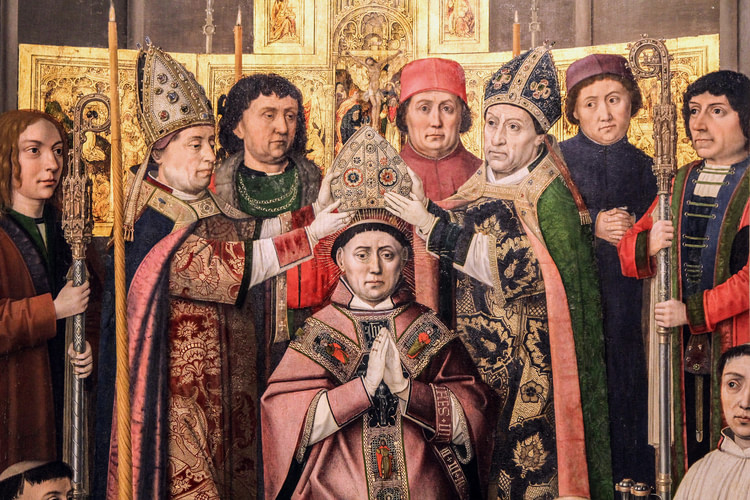 Saint Augustine Ordained a Bishop Fr Lawrence Lew, O.P. (CC BY-NC-ND) ](https://www.worldhistory.org/image/15543/saint-augustine-ordained-a-bishop/ "Saint Augustine Ordained a Bishop")### The Concept of Martyrdom
[Rome's response to the spread of Christianity](https://www.worldhistory.org/article/1671/romes-response-to-the-spread-of-christianity/) at the end of the 1st century included persecution, officially during the reign of the Emperor [Domitian](https://www.worldhistory.org/domitian/) (r. 81-96). Christians were charged with the crime of atheism, disbelief, and non-participation in the state cults of the [Roman Empire](https://www.worldhistory.org/Roman_Empire/). Non-participation was seen as angering the gods, which imperiled everyone, and so atheism meant that you did not want the [Empire](https://www.worldhistory.org/empire/) to prosper. This was equivalent to treason, which everywhere and always carried a [death](https://www.worldhistory.org/disambiguation/Death/) penalty. Thus, "Christians to the lions . . . "
The Christian response to persecution was to adopt the Jewish concept of martyrdom from the story of the persecution of Jews during the [Greek](https://www.worldhistory.org/disambiguation/greek/) occupation and the subsequent [Maccabean Revolt](https://www.worldhistory.org/article/827/the-maccabean-revolt/) against Greek rule (167 BCE). The term "martyr" meant "witness" in the sense of court testimony, "witnessing to the truth." Martyrdom became a sacrifice, offering one's life for one's religious convictions. The reward was resurrection in heaven after death.
The books of the Maccabees utilized earlier concepts from the books of Jewish prophets. The Assyrian [conquest](https://www.worldhistory.org/warfare/) of Northern [Israel](https://www.worldhistory.org/disambiguation/Israel/) (722 BCE) and the Babylonian conquest and destruction of the first [Temple in Jerusalem](https://www.worldhistory.org/article/852/the-temple-in-jerusalem/) (587 BCE) caused a theological crisis. Difficult questions had to be answered: Were the gods of the Assyrians and Babylonians greater than the [God](https://www.worldhistory.org/God/) of Israel? Why did God allow this to happen?
The prophets claimed that the God of Israel was still the mightiest, but utilized the other nations to punish Israel for their consistent lapses into idolatry, the worship of other gods. Polemically, idolatry led to the sexual immorality of non-Jews, Gentiles (the later pagans of [Christianity](https://www.worldhistory.org/christianity/)). Highlighted in the Maccabee literature, political oppression was equated with sexual immorality: "For the [temple](https://www.worldhistory.org/temple/) was filled with debauchery and reveling by the nations, who dallied with prostitutes and had intercourse with [women](https://www.worldhistory.org/disambiguation/women/) within the sacred precincts and besides brought in things for sacrifice that were unfit" (2 Maccabees 6:4). Jews created 'vice lists' of Gentile lifestyles. The [letters of Paul the Apostle to the Gentiles](https://www.worldhistory.org/article/1841/the-letters-of-paul-the-apostle-to-the-gentiles/) contain the same polemical vice lists against the dominant [culture](https://www.worldhistory.org/disambiguation/culture/) of the [Roman](https://www.worldhistory.org/disambiguation/Roman/) Empire.
### The Church Fathers
During the [separation of Christianity from Judaism](https://www.worldhistory.org/article/1785/the-separation-of-christianity-from-judaism/), most of our literature comes from the writings of a group retrospectively titled the Church Fathers of the 1st to the 4th centuries. As Christianity evolved and became institutionalized, these writers were later deemed experts in their views. They responded to the critiques of [early Christianity](https://www.worldhistory.org/article/1205/early-christianity/) from the dominant culture as well as debates among the various Christian communities. This literature contributed to what eventually became Christian dogma, or the official teachings and beliefs of the Church.
By this period, the majority of Christians were converted pagans and no longer held to the self-identity markers of [Judaism](https://www.worldhistory.org/disambiguation/judaism/), circumcision, or dietary laws. But they retained the basic elements of Judaism, arguing that Christianity fulfilled the prophets of Israel, with the coming of a messiah figure, [Jesus of Nazareth](https://www.worldhistory.org/Jesus_Christ/). The major contributions came from the writings of Justin Martyr (100-165), Irenaeus of Lyons (c. 130 to c. 202), Clement of [Alexandria](https://www.worldhistory.org/alexandria/) (c. 150- 215), and Tertullian (155-220).
[  Justin Martyr Theophanes the Cretan (Public Domain) ](https://www.worldhistory.org/image/19609/justin-martyr/ "Justin Martyr")This period saw the formation of church hierarchy, the election of bishops ("overseers") and deacons. Bishops and deacons became the administrators of the community. In a collection of letters known as the Pastorals (1 & 2 Timothy; [Titus](https://www.worldhistory.org/disambiguation/Titus/)), we have rules for the election of bishops that absorbed the social conventions of Roman society and the family:
> The saying is sure: whoever aspires to the office of bishop desires a noble task. Now a bishop must be above reproach, married only once, temperate, sensible, respectable, hospitable, an apt teacher, not a drunkard, not violent but gentle, not quarrelsome, and not a lover of money. He must manage his own household well, keeping his children submissive and respectful in every way— for if someone does not know how to manage his own household, how can he take care of God's church? He must not be a recent convert, or he may be puffed up with conceit and fall into the condemnation of the Devil. Moreover, he must be well thought of by outsiders, so that he may not fall into disgrace and the snare of the Devil.
> (1 Timothy 3:1-7)
A married bishop promoted the Christian claim that they adhered to the age-old concepts of the religious duty of the man as the head of the family to procreate and produce offspring for the good of the community.
### The Authority of Bishops
In communities of different ethnic identities (former Jews, pagans, and Christians), in theory, all are equal by receiving salvation, so why should a bishop have authority over the others? Christian leaders adopted the concepts of celibacy and chastity. Celibacy meant not legally entering into a marriage contract; chastity was not participating in sexual intercourse. This elevated the bishops above the masses; it provided an aura of holiness to their persons. Christians created the ritual of penance, where the bishop had the power to forgive sins on earth. This is when we see the emergence of the [Christian concept of human sexuality as sin](https://www.worldhistory.org/article/1815/the-christian-concept-of-human-sexuality-as-sin/); intercourse was only to be condoned for the procreation of children.
Simultaneously, we have the concept of living martyrs. In other words, a bishop did not have to die in the arenas to be a martyr. Their sacrifice was giving up the normal conventions of marriage and children, devoting themselves to God and the community. They received the same reward of existence in Heaven after death.
Retrospectively, Christians read back concepts of celibacy and chastity into the legends and martyrologies of the earliest Christians, beginning with the disciples of [Jesus](https://www.worldhistory.org/Jesus_Christ/). Virginity in the ancient world simply indicated the youthful state before puberty; there was no connotation of a theological concept. But the renunciation of normal sexual behavior became an ideal theological existence for Christians.
### [Acts of the Apostles](https://www.worldhistory.org/Acts_of_the_Apostles/)
Beyond [the gospels](https://www.worldhistory.org/The_Gospels/), we have little contemporary information about the original disciples of Jesus. The four canonical [gospels](https://www.worldhistory.org/The_Gospels/) were not assigned to a writer until the middle of the 2nd century. This is when [Mark](https://www.worldhistory.org/disambiguation/Mark/), Matthew, Luke, and John received their names, with rationales that provided a provenance of where they were written.
"Disciple" meant "student" or "follower." The Acts of the Apostles (attributed to the writer known as Luke) described the way in which the disciples began missions from [Jerusalem](https://www.worldhistory.org/jerusalem/) to the Eastern [cities](https://www.worldhistory.org/city/) of the empire. They are now described as "apostles," which meant a "herald," or someone who brings a message. The apostles, the [first Christian missionaries](https://www.worldhistory.org/article/1658/the-first-christian-missionaries/), brought the message of the 'good news' of the impending kingdom of God on earth.
[ 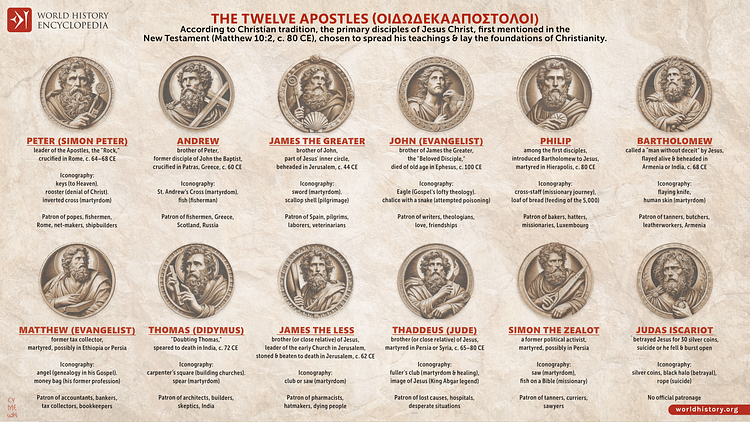 The Twelve Apostles of Christianity Simeon Netchev (CC BY-NC-ND) ](https://www.worldhistory.org/image/20015/the-twelve-apostles-of-christianity/ "The Twelve Apostles of Christianity")Then (as now), there was interest in the lives of the disciples, particularly what happened to them after Jesus ascended to heaven. Beginning in the 2nd century and beyond, apocryphal writings (meaning not eventually accepted into the canon of the [New Testament](https://www.worldhistory.org/New_Testament/)) and acts (deeds) of the apostles proliferated. They all shared two major themes: the stories claimed that the original apostles were celibate and chaste, and they all died as martyrs.
### Acts of Thomas
One of the original disciples, Thomas traveled from Jerusalem as far as [India](https://www.worldhistory.org/india/). Indian Christians claim him as their founder; his [tomb](https://www.worldhistory.org/tomb/) is in the Indian state of Goa. Along the way, he traveled through all the empires of the Middle East, converting people everywhere. The dominant theme of his story is highlighting celibacy and chastity.
In a typical Thomas story, he is invited (either by a local king or magistrate) to attend a wedding. Thomas pulls the couple aside and talks them out of consummating their marriage that night. Everywhere that Thomas visited, we have long speeches on celibacy and chastity. In one scene, Jesus appears sitting on the marriage bed of a couple, listing all the polluting things involved in sex and the risks of childbirth. The story ends with Thomas' martyrdom in India, pierced with spears because he had converted the king's wives, who then chose chastity.
### Acts of Peter
The Acts of Peter is one of the longest and fullest stories that has survived. Some of the information was obtained from the gospels and Acts, but other sources remain unknown. The first miracle described by Mark took place in the synagogue at Capernaum, and then Jesus and the disciples retired to Peter's house. We are told that Peter's mother-in-[law](https://www.worldhistory.org/disambiguation/law/) was ill, so Jesus cured her. She then got up and cooked for them. From our earliest evidence (the letters of [Paul](https://www.worldhistory.org/disambiguation/Paul/)), we know that some of the disciples had wives. As part of 1 Corinthians 9, Paul argued that he should have as much authority as the original disciples, who apparently received support from the communities: "Am I not free? Am I not an apostle? . . . Do we not have the right to our food and drink? Do we not have the right to be accompanied by a believing wife, as do the other apostles and the brothers of the Lord and Cephas?" But this is the last we hear of any wives of the apostles.
[  Saint Peter in Sinai Wikipedia (Public Domain) ](https://www.worldhistory.org/image/19807/saint-peter-in-sinai/ "Saint Peter in Sinai")By the 2nd century, Peter was described as a widower, which kept him celibate. We also learn that he had a daughter from his first marriage, who traveled everywhere with him and helped him with the mission. However, as she approached puberty, many men petitioned Peter for her hand in marriage. Peter was torn over what to do. He prayed to God (and/or Jesus) for guidance. His daughter was then struck with a lightning bolt and was crippled for life. This was understood as a divine miracle; no man wanted her after that. She was now free to continue her father's work as a virgin. We have her name, Petronilla, only in later traditions, and a claim that her tomb was in [Rome](https://www.worldhistory.org/Rome/). Peter died as a martyr during the alleged persecution under [Nero](https://www.worldhistory.org/Nero/) after the fire of Rome in 64.
### Greek Romance Novels
The writers of the stories of the apostles utilized a popular genre of storytelling, the Greek romance novel. This is a familiar genre because not only was it utilized by Christian writers but it was also eventually replicated over the centuries in fairy tales, Harlequin romance novels, soap operas, and popular movie versions known as rom-coms. They all contain the same pattern:
1. Boy meets girl, and they fall in love. Either they belong to the wrong classes or the parents disapprove for various reasons, so they are separated.
2. Girl gets kidnapped by pirates or falls under the sway of some evil villain.
3. Boy sets out to search for her.
4. Boy always has a best friend, a sidekick, who provides comic relief.
5. They both have adventures, usually a shipwreck or two, and the girl is always being threatened with rape or near rape, but her virginity remains intact. There is often a magistrate or high-status official who is in love with her and tries to force her into marriage.
6. Sometimes the gods intervene to save them in these adventures.
7. They finally reunite, get married, and live happily ever after.
The Acts of the Apostles utilized all of these elements as action-adventure romances, but with several Christian twists. Instead of encountering pirates, Christians suffer and are persecuted by governing authorities for their faith. Comic relief is shown in the muddled confusion of the persecutors when they attempt to execute martyrs. Divine winds always put out the fires when they attempt to burn them at the stake. In the *venatio* games ("wild animal hunts"), the animals refuse to eat them. Most often, the martyr has to take the initiative of killing himself/herself in a final act of devotion.
[  A Christian Dirce Franciszek Stolot (CC BY-SA) ](https://www.worldhistory.org/image/731/a-christian-dirce/ "A Christian Dirce")By the 2nd century, the belief was that if you had the spirit of God, you could not lead a normal life; it meant no sex. Instead of the typical living happily ever after as lovers, happily ever after was their success in miraculously converting pagans and being rewarded with heaven after death.
### Virgin Martyrs
Later martyrologies highlighted famous women martyrs as virgin martyrs. These stories follow a similar imposed pattern. The conditions of prisoners in holding cells was dire: dark, damp, and full of rats. The physiological conditions (little or no food) of impending martyrs as well as their emotional conditions (contemplating torture and death) often combined to produce visions.
Three examples are from the stories of Agatha of [Sicily](https://www.worldhistory.org/sicily/) (231-251), Agnes (291-304), and Catherine of Alexandria (287-305). Agatha and Agnes claimed visions and visitations of [Mary, mother of Jesus](https://www.worldhistory.org/Mary,_Mother_of_Jesus/), and her child. Someone from the nobility always claimed to fall in love with the women, but they refuse all attempts at seduction or marriage.
[  Saint Catherine, by Fernando Yáñez de la Almedina Fernando Yáñez de la Almedina / Museo del Prado (Copyright, fair use) ](https://www.worldhistory.org/image/17653/saint-catherine-by-fernando-yanez-de-la-almedina/ "Saint Catherine, by Fernando Yáñez de la Almedina")[Roman law](https://www.worldhistory.org/Roman_Law/) forbade the execution of a virgin; virgin girls had to be raped in their cells first. A common plot in these stories was having the accused sent to a brothel for forced rape and torture. Agatha had her breasts cut off, symbolic of rejecting sexuality and motherhood. But miracles often intervened. The men who attempted to rape Agnes were immediately struck blind.
As a young girl, Catherine of Alexandria claimed to have a vision of Mary and the Christ child who placed a ring on her finger, committing herself to a mystical marriage with Christ and shunning traditional marriage. When Emperor Maxentius permitted her to plead against the persecutions, he called in philosophers and orators for a debate, but the result was that they all converted to Christianity. Catherine was condemned to be tied to a torture device, a breaking wheel, but it broke. Modern rotating fireworks that incorporate multiple displays in [city](https://www.worldhistory.org/city/) festivals are called "Catherine wheel fireworks."
### From Councils to Canon Law
Although mandated in the 2nd century, it was apparent that many bishops continued to marry, adopt mistresses, and produce offspring. It would take several centuries (and several council meetings) to finalize Catholic clerical celibacy into canon law. One of the earliest references was the Council of Elvira (Spain, 306):
> Bishops, presbyters, deacons, and others with a position in the ministry are to abstain completely from sexual intercourse with their wives and from the procreation of children. If anyone disobeys, he shall be removed from the clerical office
> (Canon 33).
Emperor [Justinian I](https://www.worldhistory.org/Justinian_I/) (r. 527-565) declared that any such marriages were null and void and the offspring illegitimate.
The First Lateran Council (1123) forbade any association by priests, deacons, and monks with concubines (legal, second wives) or women who were not relatives. In the medieval period, scandals arose from clerics marrying themselves to women and the appointing of illegitimate sons to the clergy. The Borgia Pope [Alexander](https://www.worldhistory.org/disambiguation/Alexander/) VI (r. 1492-1503) made his illegitimate son, Cesare Borgia, a cardinal. Celibate clergy only became officially canonized in the Catholic Church under Pope Benedict XV in 1917.
#### Editorial Review
This human-authored article has been reviewed by our editorial team before publication to ensure accuracy, reliability and adherence to academic standards in accordance with our [editorial policy](https://www.worldhistory.org/static/editorial-policy/).
## Bibliography
- [Brown, Peter. *The Body and Society.* Columbia University Press, 2008.](https://www.worldhistory.org/books/0231144075/)
- [Cohick, Lynn H. & Hughes, Amy Brown. *Christian Women in the Patristic World.* Baker Academic, 2017.](https://www.worldhistory.org/books/B01MT90WO0/)
- [Streete, Gail P. C. *Redeemed Bodies.* Westminster John Knox Press, 2009.](https://www.worldhistory.org/books/0664233295/)
## About the Author
Rebecca I. Denova, Ph.D. is Emeritus Professor of Early Christianity in the Department of Religious Studies, University of Pittsburgh. She has recently completed a textbook, "The Origins of Christianity and the New Testament" (Wiley-Blackwell)
## Cite This Work
### APA
Denova, R. (2025, April 02). Christian Celibate Martyrs. *World History Encyclopedia*.
### Chicago
Denova, Rebecca. "Christian Celibate Martyrs." *World History Encyclopedia*, April 02, 2025. .
### MLA
Denova, Rebecca. "Christian Celibate Martyrs." *World History Encyclopedia*, 02 Apr 2025, .
## License & Copyright
Submitted by [Rebecca Denova](https://www.worldhistory.org/user/rdenova/ "User Page: Rebecca Denova"), published on 02 April 2025. The copyright holder has published this content under the following license: [Creative Commons Attribution-NonCommercial-ShareAlike](https://creativecommons.org/licenses/by-nc-sa/4.0/deed.en). This license lets others remix, tweak, and build upon this content non-commercially, as long as they credit the author and license their new creations under the identical terms. When republishing on the web a hyperlink back to the original content source URL must be included. Please note that content linked from this page may have different licensing terms.