---
title: Ten Great Slave Revolts in Colonial America and the United States
author: Joshua J. Mark
source: https://www.worldhistory.org/article/2677/ten-great-slave-revolts-in-colonial-america-and-th/
format: machine-readable-alternate
license: Creative Commons Attribution-NonCommercial-ShareAlike (https://creativecommons.org/licenses/by-nc-sa/4.0/)
updated: 2025-04-08
---
# Ten Great Slave Revolts in Colonial America and the United States
_Authored by [Joshua J. Mark](https://www.worldhistory.org/user/JPryst/)_
There were 250-311 slave revolts in Colonial America and the United States between c. 1663 and c. 1860 as defined by scholar Herbert Aptheker (l. 1915-2003), but, almost certainly, many more that were not reported, as news of an uprising was sometimes suppressed, or the event redefined, to prevent panic among slave-holding communities.
[  The Amistad Revolt John Warner Barber (Public Domain) ](https://www.worldhistory.org/image/20251/the-amistad-revolt/ "The Amistad Revolt")The first slave revolt in the Americas was the Santo Domingo Slave Revolt of Christmas Day 1521 in the Spanish colony of Santo Domingo (modern-day Dominican Republic) and the most successful revolt in world history is the Haitian Revolution (1791-1804), and between those two, there were many others and more to come, and yet slaveholders continually found ways to justify the institution and responded to uprisings with harsher slave laws, which they felt certain would address the problem.
When the next revolt occurred, the authorities would respond in the same way and, in some cases, simply redefine the uprising as "the work of brigands" (as in the case of the [1811 German Coast Uprising](https://www.worldhistory.org/1811_German_Coast_Uprising/)) or suppress any accounts of it, as with the St. Inigoes Slave Rebellion of [Easter](https://www.worldhistory.org/Easter/) Monday, 1817, in Maryland. Writer Rick Boyd, quoting the researcher Nancy Radcliffe, comments:
> Accounts of insurrections are not easily uncovered because the white planter class kept this news hidden and expressed their fear of rebellions only when rushing through more restrictive and retributive laws to control their slaves.
> (1)
The best-known slave revolts are those where the authorities were unable to control the narrative because of where they took place, how quickly word of an insurrection spread, and/or the measures taken to suppress them. Among these are:
- Gloucester County Conspiracy (1663)
- New York Slave Revolt (1712)
- [Stono Rebellion](https://www.worldhistory.org/Stono_Rebellion/) (1739)
- [Gabriel's Rebellion](https://www.worldhistory.org/Gabriel's_Rebellion/) (1800)
- Igbo Landing Rebellion (1803)
- 1811 German Coast Uprising
- [Denmark Vesey](https://www.worldhistory.org/Denmark_Vesey/)'s Conspiracy (1822)
- [Nat Turner's Rebellion](https://www.worldhistory.org/Nat_Turner's_Rebellion/) (1831)
- [Amistad Seizure](https://www.worldhistory.org/Amistad_Seizure/) (1839)
- [Creole Mutiny](https://www.worldhistory.org/Creole_Mutiny/)/Creole Rebellion (1841)
Even among these ten, events like the Igbo Rebellion and Creole Mutiny remain underreported, and the true story of the 1811 German Coast Uprising did not begin to emerge until over 100 years after the event. The following is only a brief treatment of these uprisings, and readers are encouraged to investigate them in greater depth.
### Gloucester County Conspiracy (1663)
The Gloucester County Conspiracy (also known as the Servant's Plot or Birkenhead's Rebellion, 1 September 1663) was an insurrection planned in Gloucester County, Colony of Virginia, involving indentured servants and slaves. Slavery had been institutionalized in Virginia in 1640 but planters still relied on the labor of indentured servants, many of whose lives were little better than those of the slaves.
On 1 September 1663, nine indentured servants and some slaves met to plan the revolt which would be launched on 6 September with the goal of forcing Virginia's governor, William Berkeley, to change the laws concerning indentured servants so they would be freed after one year of servitude instead of seven. How the plan would have benefited the slaves is unclear, and this was apparent to one slave at the meeting, John Birkenhead, who informed on his co-conspirators.
For his loyalty, Birkenhead was freed and given 5,000 pounds of either cotton or tobacco while the conspirators were hanged. The Gloucester County Conspiracy is sometimes cited as influencing [Bacon](https://www.worldhistory.org/disambiguation/Bacon/)'s Rebellion (1676), which also involved indentured servants and slaves and was the first full-scale armed insurrection in Colonial America.
### New York Slave Revolt (1712)
The buildings and roads of the British Province of New York were constructed using slave labor, and, by 1711, there was a [city](https://www.worldhistory.org/city/)-run slave market established on [Wall](https://www.worldhistory.org/wall/) Street which was regularly supplied by slave ships. The large slave population lived and worked alongside free Blacks, which bred resentment as they saw no reason why they should be enslaved when others, like them, were free.
On 6 April 1712, a group of around 23 slaves met in an orchard on Maiden Lane and set fire to a shed, then withdrew. As the White slaveholders arrived to put the fire out, the slaves attacked, killing nine and wounding another six, before escaping north.
[ 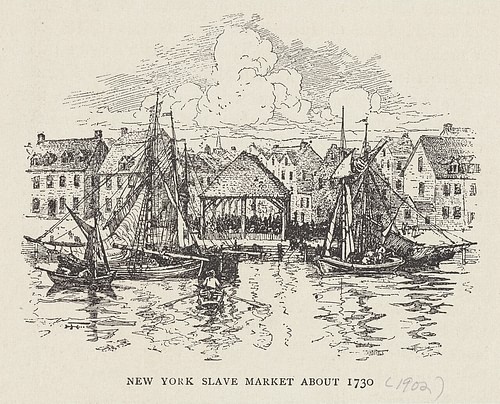 Slave Market in Wall Street, New York City, c. 1730 Harry Fenn (Public Domain) ](https://www.worldhistory.org/image/20252/slave-market-in-wall-street-new-york-city-c-1730/ "Slave Market in Wall Street, New York City, c. 1730")They were hunted down by the militia, and 21 were executed. Afterward, New York instituted harsher slave laws and sought to restrict the growth of the free Black population by making it harder for masters to free their slaves. This uprising is thought to have directly inspired the New York Conspiracy of 1741 (Slave Insurrection of 1741), an attempt to burn the city to the ground.
### Stono Rebellion (1739)
The Stono Rebellion was the largest slave revolt in the British Colonies of North America and took place in South Carolina. It was led by the educated slave Cato (also known as Jemmy) and so is also referenced as Cato's Conspiracy or Cato's Rebellion. On 9 September 1739, Cato gathered a group of 22 other slaves by the Stono River and began a march toward Spanish Florida, which granted slaves their freedom if they converted to Catholicism and served in the militia.
[  Fort Mose Historic State Park, St. Augustine, Florida, USA Ebyabe (CC BY-SA) ](https://www.worldhistory.org/image/20170/fort-mose-historic-state-park-st-augustine-florida/ "Fort Mose Historic State Park, St. Augustine, Florida, USA")Cato and (it is thought) many of the others were former soldiers from the [Kingdom of Kongo](https://www.worldhistory.org/Kingdom_of_Kongo/) and knew how to fight and evade pursuit. As they marched south, their numbers grew (to around 80), and they burned houses and plantations, killing 20 Whites before they were met by the local militia, which were better armed, and dispersed. Cato's fate is unknown; he may have been killed or may have made his way to Florida.
The Stono Rebellion led to the passage of the Negro Act of 1740, restricting slaves' lives, and the closure of the South Carolina ports at Charleston to slave ships for the next ten years.
### Gabriel's Rebellion (1800)
Gabriel's Rebellion was a well-planned and extensive conspiracy led by the literate slave and skilled blacksmith Gabriel (l. c. 1776-1800), who was owned by Thomas Prosser of Henrico County, Virginia and so is known as Gabriel Prosser (though historical records only refer to him as "Prosser's Gabriel"). Prosser hired Gabriel out to other plantations and businesses as a blacksmith, and he regularly crisscrossed the county without an escort.
As he traveled, he enlisted people in his plan to take the arsenal at Richmond, Virginia, and hold Governor [James Monroe](https://www.worldhistory.org/James_Monroe/) (l. 1758-1831) hostage until he freed Virginia's slaves. Once this was done, Gabriel planned to continue the effort and free all the slaves in the United States.
The revolt was planned for 30 August 1800, but a sudden heavy rain turned the roads into streams and washed out bridges. The success of the revolt depended on a swift march on Richmond, which was now impossible, and Gabriel hesitated in giving the signal. This pause gave two of the slaves involved time to reconsider, and they betrayed the plans to their master, who alerted Monroe, who then raised the alarm. Gabriel and his co-conspirators were hanged, a public guard was instituted to police the slave population, and harsher slave laws were established.
### Igbo Landing Rebellion (1803)
The Igbo Landing Rebellion (also known as the Igbo Landing Mass Suicide) took place at Dunbar Creek on St. Simons Island, Georgia. A slave-trading ship was carrying 75 enslaved people from Igbo (modern-day Nigeria) when the slaves slipped their chains below deck, took over the ship, and killed the crew. The ship grounded in Dunbar Creek, the slaves went ashore, and what happened next is unclear.
The accepted version of events is that an Igbo priest who was among the slaves exhorted the others to walk into the waters and, in drowning, release their spirits to return home. This was witnessed by one Roswell King, an overseer at a nearby plantation (who wrote the first known account). 13 bodies were later recovered. According to some accounts, not everyone went into the water, and some of these were recaptured, but what happened to the others is unknown.
[ 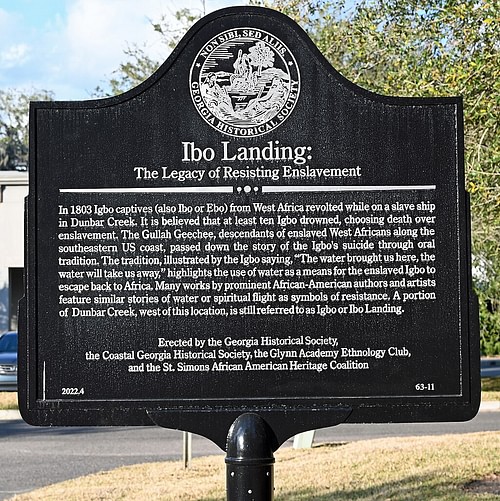 Historical Marker for Igbo Landing Jud McCranie (CC BY-SA) ](https://www.worldhistory.org/image/20253/historical-marker-for-igbo-landing/ "Historical Marker for Igbo Landing")The Igbo Landing Rebellion came to serve as an inspiration in Black oral history as it transformed into the legend of the Flying Africans who, rejecting enslavement in North America, grew wings and returned home. The event itself also served to inspire by the example of the Igbo who chose [death](https://www.worldhistory.org/disambiguation/Death/) over a life in bondage.
### 1811 German Coast Uprising (8-11 January 1811)
The 1811 German Coast Uprising was the largest slave rebellion in US history. It involved 300-500 enslaved and free Blacks of the parishes of St. [John the Baptist](https://www.worldhistory.org/John_the_Baptist/), St. Charles, and Jefferson in the Territory of Orleans (modern-day Louisiana). Although some historians claim that the Second Seminole [War](https://www.worldhistory.org/disambiguation/War/) (1835-1842) was the largest, this has been challenged on the grounds that the acts involved were a part of the larger conflict, not a "revolt" as that term is understood.
The German Coast Uprising was led by the literate slave Charles Deslondes (l. c. 1789-1811), who was an overseer at the Woodland Plantation of Colonel Manuel Andry (and so the revolt is also known as Andry's Rebellion). Deslondes led an attack on the Andry home, wounding Andry, and then taking uniforms and weapons from the house before beginning the march south. The plan was to take the city of New Orleans and establish a free Black community.
[  1811 German Coast Uprising Unknown Artist (Public Domain) ](https://www.worldhistory.org/image/20233/1811-german-coast-uprising/ "1811 German Coast Uprising")Andry, who had been left for dead, alerted the authorities and the militia was deployed along with regular troops from the US Army and Navy. On 10 January 1811, the slave army was met by the militia and troops and dispersed. Deslondes was captured on the 11th, tortured, and executed by being burned alive. At least 95 others were beheaded, and their heads placed on pikes for 60 miles (96 km) along River Road between New Orleans and the Andry Plantation. As usual, harsher slave laws followed the suppression of the revolt.
### Denmark Vesey's Conspiracy (1822)
The Vesey Conspiracy, like Gabriel's Rebellion, is the most famous slave revolt that never happened. Denmark Vesey (l. c. 1767-1822) was a free Black carpenter and former slave living in Charleston, South Carolina. He was one of the founders of the African Methodist Episcopal Church (AME), which advocated for the abolition of slavery and influenced [David Walker's Appeal to the Coloured Citizens of the World](https://www.worldhistory.org/article/2659/david-walkers-appeal-to-the-coloured-citizens-of-t/) (1829) as David Walker (l. c. 1796-1830) attended lectures there given by Vesey.
[ 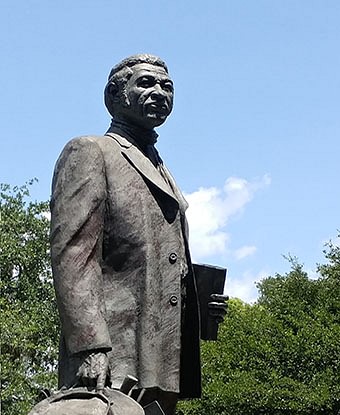 Denmark Vesey Monument NPS/Sobol (Public Domain) ](https://www.worldhistory.org/image/20109/denmark-vesey-monument/ "Denmark Vesey Monument")Vesey was literate and had read works on the [French Revolution](https://www.worldhistory.org/French_Revolution/) and Haitian Revolution. He planned to stage a major revolt on Bastille Day, 14 July 1822, in which slaves would rise up, kill their masters, fire buildings, and take control of Charleston after seizing the arsenal there. Once armed, and before the militia could respond, they would commandeer a vessel and sail to Haiti as free people.
The plans were betrayed by a slave who had been invited to join by one of Vesey's group and the authorities arrested 135 slaves and free Blacks, executing 35, including Vesey. Modern historians agree that, like Gabriel's Rebellion, Vesey's Conspiracy could have succeeded if it had not been betrayed. Authorities responded by instituting the Negro Seamen Act, which mandated free Black sailors arriving at Charleston be jailed while in port to prevent them from influencing slaves and, believing the AME was responsible, had the building destroyed and the congregation dispersed.
### Nat Turner's Rebellion (1831)
Also known as the Southampton Rebellion, Nat Turner's Rebellion is the best-known slave revolt in US history. It is also routinely defined as the deadliest US slave uprising, resulting in the deaths of at least 55 Whites and 120 Blacks. It was led by the educated slave, preacher, and mystic Nat Turner (l. 1800-1831) in Southampton County, Virginia, 21-23 August 1831. The plan, like Vesey's, called for an insurrection in the night, killing slaveowners and firing buildings, on a march to the county seat of [Jerusalem](https://www.worldhistory.org/jerusalem/), where they would take the arsenal and then (it is thought), once armed, establish themselves in the Dismal Swamp nearby, from which they could conduct a guerilla war.
It is unclear whether Turner was aware of how Gabriel Prosser and Denmark Vesey were betrayed, but it seems he could have been as he trusted his plan to only four men he knew he could trust and no others. On the morning of the 21st, these four brought three others, and, beginning at the home of Turner's master, Joseph Travis, they began what Turner later referred to as "the work of death", killing every White person they found, regardless of age or sex.
[ 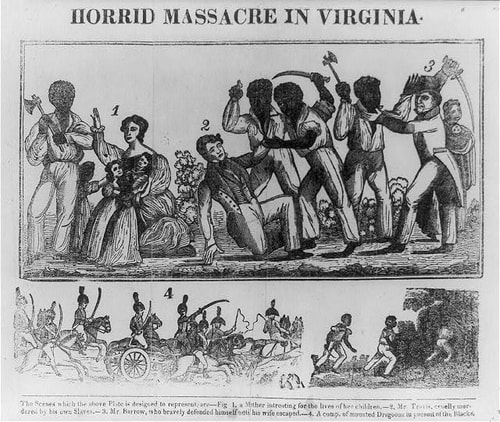 Nat Turner's Rebellion Unknown Artist (Public Domain) ](https://www.worldhistory.org/image/20138/nat-turners-rebellion/ "Nat Turner's Rebellion")Turner was certain, once the revolt began, that all the slaves and free Blacks of Southampton County would join him, but that did not happen. In fact, many slaves rescued their masters from Turner's band. By the 23rd, Turner had approximately 70 men under him when the local militia met them at the Belmont Plantation and dispersed them, killing many. Turner escaped and eluded capture until 30 October.
While in jail and awaiting execution, he related his plans to the lawyer T. R. Gray (l. c. 1800 to c. 1834) who published the narrative as *The [Confessions of Nat Turner](https://www.worldhistory.org/article/2663/the-confessions-of-nat-turner/)*, which became a bestseller. Turner was hanged, along with many others, and at least 120 Blacks in Southampton, many of whom had not been involved, were killed. As always, harsher slave laws were then instituted.
### Amistad Seizure (1839)
The Amistad Seizure, like Turner's rebellion, is among the best-known slave revolts in US history and led to the famous court case *United States v. The Amistad (1841)*. In 1839, Portuguese slave-catchers kidnapped a number of Mende people from their home in Mendeland (modern-day Sierra Leone, West [Africa](https://www.worldhistory.org/disambiguation/africa/)) and took them to Cuba (then a Spanish colony), where 53 of them were sold as slaves to two plantation owners, Montes and Ruiz, who loaded them on the ship *Amistad* bound for their estates in Puerto Principe.
A few days into the trip, one of the enslaved, Sengbe Pieh (better known as Joseph Cinque, l. c. 1814 to c. 1879), slipped his chains, freed the others, and, armed with knives, killed the ship's captain and cook and took control of the ship. They forced Montes and Ruiz to return them to Africa, but the Spaniards instead set a course for the United States. The *Amistad* was anchored off Long Island, NY, for provisions when it was boarded by the US Navy, who took the Mende in chains to Connecticut until it could be decided who they belonged to.
[ 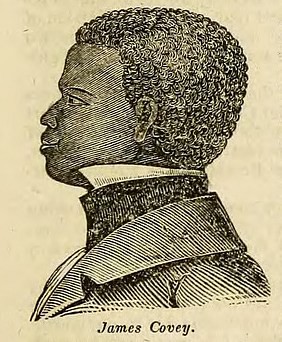 James Covey, Interpreter in Amistad Case John Warner Barber (Public Domain) ](https://www.worldhistory.org/image/20254/james-covey-interpreter-in-amistad-case/ "James Covey, Interpreter in Amistad Case")Spain wanted them returned to Cuba, but the US claimed they had been kidnapped and enslaved illegally. So far, the Mende prisoners, who spoke no English, had not been able to tell their side of the story, but James Covey (l. c. 1825-1850), who spoke Mende and English, was found by the abolitionist Josiah Gibbs and served as their interpreter. They were defended by former president [John Quincy Adams](https://www.worldhistory.org/John_Quincy_Adams/) (l. 1767-1848), who won the case, and after abolitionists had raised the funds, Pieh and the others were returned to Africa.
### Creole Mutiny/Creole Rebellion (1841)
Two years after the Amistad Seizure came what is considered the most successful slave revolt in US history: the Creole Mutiny of 1841. Although the US had abolished the international slave [trade](https://www.worldhistory.org/disambiguation/trade/) in 1807, it still allowed domestic trade in slaves. The *Creole* was transporting 135 slaves from Virginia to New Orleans when one of the enslaved, Madison Washington, led the others in a seizure of the ship and forced a course change to the Bahamas, which was then British territory. [Britain](https://www.worldhistory.org/disambiguation/Britain/) had abolished slavery in 1833, and so Washington knew if they could reach the Bahamas, they would be free.
Upon reaching the port of Nassau, the British authorities came aboard and told the enslaved they were free to go. The American [consul](https://www.worldhistory.org/Consul/), however, wanted the 19 who had seized the ship and killed one of the crew arrested. The American owners of the ship (and its human cargo) also protested and demanded their property back. British authorities determined, however, that no laws had been broken because those who had seized the ship had been illegally enslaved and had a right to use force to regain their freedom. Washington and 130 of the others went ashore as free people. Five of the enslaved remained on board for unknown reasons and were later sold back into slavery.
The Creole Mutiny caused significant tensions between the US and the United Kingdom as well as between US Northern abolitionists and Southern slaveholders. The United Kingdom, years later, paid a large amount to the United States in compensation for the slaves freed on the *Creole*, as well as other slave ships that found their way into British ports.
### Conclusion
There were many other slave revolts, before and after the Creole Mutiny, including the Cherokee Nation Slave Revolt of 1842 and the Charleston Workhouse Slave Revolt (1849). Fears of slave rebellions haunted slave-holding states and, in 1860, were the cause of the Texas Troubles (also known as the Texas Slave Insurrection Panic of 1860), during which White slaveholders murdered at least 100 Blacks and White abolitionists over rumors that the spate of fires that broke out in July at various locations were the work of slaves who were planning to launch a revolt like Turner's, Vesey's or Gabriel's.
Texan slaveholders, as well as those of other slave-holding states, blamed Northern abolitionists and other supporters of [Abraham](https://www.worldhistory.org/Abraham,_the_Patriarch/) Lincoln for this completely fictitious revolt as well as encouraging rebellion and insubordination among the enslaved populace. These tensions, which had been increasing for decades, finally resulted in the [American Civil War](https://www.worldhistory.org/American_Civil_War/) (1861-1865), which concluded with a Union victory and the abolition of slavery in the United States through the Thirteenth Amendment in 1865.
#### Editorial Review
This human-authored article has been reviewed by our editorial team before publication to ensure accuracy, reliability and adherence to academic standards in accordance with our [editorial policy](https://www.worldhistory.org/static/editorial-policy/).
## Bibliography
- [Aptheker, H. *American Negro Slave Revolts.* International Publishers Co, 2021.](https://www.worldhistory.org/books/0717806057/)
- Boyd, R. "Those Enslaved in Southern Maryland Resisted." *Southern Maryland News*, March 19 2025, pp. N/A.
- [Chadwick, B. *The Creole Rebellion: The Most Successful Slave Revolt in American History.* University of New Mexico Press, 2022.](https://www.worldhistory.org/books/0826363474/)
- [Egerton, D. R. *Gabriel's Rebellion: The Virginia Slave Conspiracies of 1800 and 1802.* The University of North Carolina Press, 1993.](https://www.worldhistory.org/books/0807844225/)
- [Genovese, E, D. *Roll, Jordan, Roll: The World the Slaves Made.* Vintage Books, 1976.](https://www.worldhistory.org/books/0394716523/)
- [Igbo Landing Mass Suicide (1803) by Samuel Momodu for BlackPast.org](https://www.blackpast.org/african-american-history/igbo-landing-mass-suicide-1803/ "Igbo Landing Mass Suicide (1803) by Samuel Momodu for BlackPast.org"), accessed 21 Mar 2025.
- [Oates, S. B. *The Fires of Jubilee: Nat Turner's Fierce Rebellion.* Harper Perennial, 2016.](https://www.worldhistory.org/books/0062656554/)
- [Rasmussen, D. *American Uprising: The Untold Story of America's Largest Slave Revolt.* Harper Perennial, 2012.](https://www.worldhistory.org/books/0061995223/)
- [Reiss, O. *Blacks in Colonial America.* McFarland & Company, 1970.](https://www.worldhistory.org/books/B019NS2CT6/)
- [Taylor, A. *American Colonies: The Settling of North America.* Penguin Books, 2002.](https://www.worldhistory.org/books/0142002100/)
- [Texas Troubles by Donald E. Reynolds](https://www.tshaonline.org/handbook/entries/texas-troubles "Texas Troubles by Donald E. Reynolds"), accessed 21 Mar 2025.
- [The Creole Case (1841) by Samuel Momodu for BlackPast.org](https://www.blackpast.org/african-american-history/creole-case-1841/ "The Creole Case (1841) by Samuel Momodu for BlackPast.org"), accessed 21 Mar 2025.
## About the Author
Joshua J. Mark is World History Encyclopedia's co-founder and Content Director. He was previously a professor at Marist College (NY) where he taught history, philosophy, literature, and writing. He has traveled extensively and lived in Greece and Germany.
- [Linkedin Profile](https://www.linkedin.com/pub/joshua-j-mark/38/614/339)
## Questions & Answers
### How many slave revolts were there in Colonial America and the United States?
There were 250-311 slave revolts in Colonial America and the United States between c. 1663 and c. 1860.
### What is the most famous slave revolt in the United States?
The most famous revolt in the United States is the Nat Turner Rebellion of 1831 in Southampton County, Virginia. It is also considered the deadliest.
### What was the largest slave revolt in the Thirteen Colonies of North America?
The largest slave revolt in the Thirteen Colonies was the Stono Rebellion of 1739.
### What was the most successful slave revolt in United States history?
The Creole Mutiny (Creole Rebellion) of 1841 is considered the most successful slave revolt in US history, resulting in the freedom of approximately 130 enslaved people.
## External Links
- [Gloucester County Conspiracy (1663) - Encyclopedia Virginia](https://encyclopediavirginia.org/entries/gloucester-county-conspiracy-1663/#:~:text=The%20Gloucester%20County%20Conspiracy%2C%20also,in%20Gloucester%20County%20in%201663.)
- [Africans in America: New York's Revolt of 1712](https://www.pbs.org/wgbh/aia/part1/1p285.html)
- [Slave Rebellions and Uprisings | American Battlefield Trust](https://www.battlefields.org/learn/articles/slave-rebellions-and-uprisings)
- [The Five Greatest Slave Rebellions in the United States | African American History Blog | The African Americans: Many Rivers to Cross](https://www.pbs.org/wnet/african-americans-many-rivers-to-cross/history/did-african-american-slaves-rebel/)
## Cite This Work
### APA
Mark, J. J. (2025, March 25). Ten Great Slave Revolts in Colonial America and the United States. *World History Encyclopedia*.
### Chicago
Mark, Joshua J.. "Ten Great Slave Revolts in Colonial America and the United States." *World History Encyclopedia*, March 25, 2025. .
### MLA
Mark, Joshua J.. "Ten Great Slave Revolts in Colonial America and the United States." *World History Encyclopedia*, 25 Mar 2025, .
## License & Copyright
Submitted by [Joshua J. Mark](https://www.worldhistory.org/user/JPryst/ "User Page: Joshua J. Mark"), published on 25 March 2025. The copyright holder has published this content under the following license: [Creative Commons Attribution-NonCommercial-ShareAlike](https://creativecommons.org/licenses/by-nc-sa/4.0/deed.en). This license lets others remix, tweak, and build upon this content non-commercially, as long as they credit the author and license their new creations under the identical terms. When republishing on the web a hyperlink back to the original content source URL must be included. Please note that content linked from this page may have different licensing terms.