---
title: Sermon on the Mount
author: Rebecca Denova
source: https://www.worldhistory.org/article/2547/sermon-on-the-mount/
format: machine-readable-alternate
license: Creative Commons Attribution-NonCommercial-ShareAlike (https://creativecommons.org/licenses/by-nc-sa/4.0/)
updated: 2024-10-30
---
# Sermon on the Mount
_Authored by [Rebecca Denova](https://www.worldhistory.org/user/rdenova/)_
The Sermon on the Mount in the Gospel of Matthew (chapters 5, 6, and 7) became a foundational element of the [religion](https://www.worldhistory.org/religion/) of [Christianity](https://www.worldhistory.org/christianity/). The sermon is based on the traditions of [Judaism](https://www.worldhistory.org/disambiguation/judaism/) and the [Law](https://www.worldhistory.org/disambiguation/law/) of [Moses](https://www.worldhistory.org/Moses/), but with added interpretations of the teachings of [Jesus of Nazareth](https://www.worldhistory.org/Jesus_Christ/). Matthew placed it at the beginning of [Jesus](https://www.worldhistory.org/Jesus_Christ/)' ministry, and its themes continued throughout the gospel.
[ 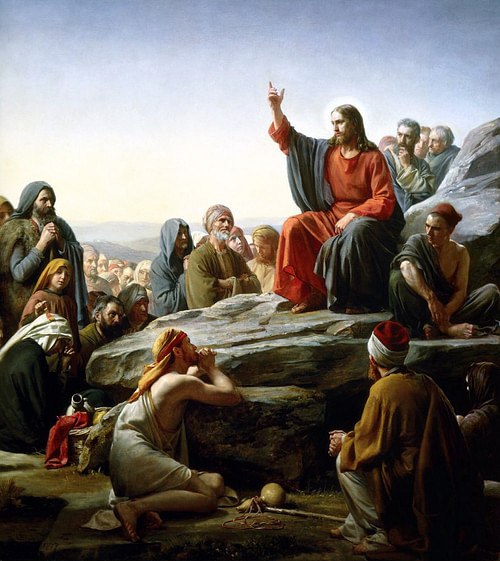 Sermon on the Mount Carl Bloch (Public Domain) ](https://www.worldhistory.org/image/19573/sermon-on-the-mount/ "Sermon on the Mount")### Background & Setting for Matthew
Like the other [gospels](https://www.worldhistory.org/The_Gospels/), there are no internal dates in Matthew. The 2nd-century Church Fathers placed Matthew as the first gospel in the [New Testament](https://www.worldhistory.org/New_Testament/), but we know that [Mark](https://www.worldhistory.org/disambiguation/Mark/) was the earliest, c. 70 CE or beyond. Matthew (c. 85 CE) and Luke (c. 95 CE) contained almost verbatim stories from Mark, so the consensus is that they had a written copy of Mark. The sermon is not in the Gospel of Mark. Scholars have concluded that Matthew and Luke had additional sources for Jesus beyond Mark, known as the "Q" source. It has not survived independently but was named "Q" for the German *Quelle* ("source") because German [Bible](https://www.worldhistory.org/bible/) scholars were the first to categorize these additional teachings. Luke had a similar version, in his Sermon on the Plain.
The provenance for Matthew is understood to be Galilee. This is derived from several factors, one of which is that the gospel ends with the resurrected Jesus telling the disciples to go to Galilee and meet him there. He then appeared and commissioned them "to make disciples of all nations", the Gentiles (Matthew 28:19).
When the Romans destroyed [Jerusalem](https://www.worldhistory.org/jerusalem/) and the [Temple](https://www.worldhistory.org/temple/) complex in 70 CE, some Jews, which may have included some [Pharisees](https://www.worldhistory.org/Pharisees/), survived by escaping the [city](https://www.worldhistory.org/city/) and establishing formalized schools for the study of their scriptures now that the sacrifices in the Temple cult were no longer possible. Some of these schools were located in Galilee and centered in the synagogues. This became the beginning of what is known as Rabbinic Judaism over the next centuries.
Throughout Matthew's gospel, the vitriol against the Jews increased. His Jesus consistently taught against doing things the way the Jews do it in their synagogues. We have an image that Christians may have literally moved out of the synagogues and established their own version, which became the early churches.
Christians claimed that Jesus was the messiah predicted by the prophets in the final days. [God](https://www.worldhistory.org/God/) would then establish his kingdom on earth. But as the decades passed, the kingdom was not manifest. [Early Christianity](https://www.worldhistory.org/article/1205/early-christianity/) rationalized this with the concept of *parousia*, or second appearance. Resurrected and exalted to heaven, at a future time, Jesus would return and fulfill everything the prophets had predicted. The overall purpose of the sermon was twofold:
1. to state that Christians have the correct understanding of the Laws of Moses as opposed to the Jews
2. to teach believers how to live in the interim while awaiting the return of Jesus.
### Matthew's New Moses
When Moses made his farewell speech to the people, he said that in the future, "The Lord your God will raise up for you a prophet like me from among your own people; you shall heed such a prophet'" (Deuteronomy 18:15). Matthew's portrait of Jesus presented him as this new Moses by alluding to Moses traditions in the story in Exodus in his [nativity of Jesus](https://www.worldhistory.org/article/2545/nativity-of-jesus/). Structurally, the gospel has a series of five teaching panels; *[torah](https://www.worldhistory.org/Torah/)* meant "teaching" (the teaching of Moses), reflecting the tradition that the first five books of the Scriptures were written by Moses.
[  Moses on Mount Sinai Jean-Léon Gérôme (Public Domain) ](https://www.worldhistory.org/image/5740/moses-on-mount-sinai/ "Moses on Mount Sinai")Matthew's sermon was presented as a major teaching panel. The sermon itself is divided into five discourses:
1. the discourse on discipleship
2. the discourse on parables
3. the discourse on the community of faith
4. the discourse on future events
5. a final conclusion on the meaning of the sermon.
Placing it on a mountaintop is symbolic of Moses on [Mount Sinai](https://www.worldhistory.org/Mount_Sinai/). The sermon remains popular as some of the best-known teachings of Jesus.
### The Beatitudes
The opening is categorized as "the Beatitudes" from the later Latin Vulgate Bible translation of the first words: *Beate* ("blessed are ...")
> When Jesus saw the crowds, he went up the mountain, and after he sat down, his disciples came to him. And he began to speak and taught them, saying: "Blessed are the poor in spirit, for theirs is the kingdom of heaven. Blessed are those who mourn, for they will be comforted. Blessed are the meek, for they will inherit the earth. Blessed are those who hunger and thirst for righteousness, for they will be filled. Blessed are the merciful, for they will receive mercy. Blessed are the pure in heart, for they will see God. Blessed are the peacemakers, for they will be called children of God. Blessed are those who are persecuted for the sake of righteousness, for theirs is the kingdom of heaven. Blessed are you when people revile you and persecute you and utter all kinds of evil against you falsely on my account. Rejoice and be glad, for your reward is great in heaven, for in the same way they persecuted the prophets who were before you."
> (Matthew 5:1-11)
Beatitudes were not a Christian innovation. We find the same elements in hymns and praises to God in the Hebrew Scriptures. Similar phrases were found in the [Dead Sea Scrolls](https://www.worldhistory.org/Dead_Sea_Scrolls/) (4Q525) of the Jewish sect of [Essenes](https://www.worldhistory.org/Essenes/) (c. 150 BCE to 68 CE).
The line "Blessed are you when people revile you and persecute you ... falsely on my account" continued the claim that the Jews persecuted Christians beginning with the [trial and crucifixion of Jesus of Nazareth](https://www.worldhistory.org/article/1570/the-trial--crucifixion-of-jesus-of-nazareth/). Ultimately, it became a reference for the [Roman](https://www.worldhistory.org/disambiguation/Roman/) persecution of Christians near the end of the 1st century CE.
[  Sermon on the Mount Fresco Franz Xaver Kirchebner (Public Domain) ](https://www.worldhistory.org/image/19574/sermon-on-the-mount-fresco/ "Sermon on the Mount Fresco")### The Law & the Prophets
> Do not think that I have come to abolish the Law or the prophets; I have come not to abolish but to fulfill. For truly I tell you, until Heaven and earth pass away, not one letter, not one stroke of a letter, will pass from the Law until all is accomplished. Therefore, whoever breaks one of the least of these commandments and teaches others to do the same will be called least in the kingdom of Heaven, but whoever does them and teaches them will be called great in the kingdom of Heaven. For I tell you, unless your righteousness exceeds that of the scribes and Pharisees, you will never enter the kingdom of Heaven.
> (Matthew 5:17-20)
"To fulfill" was Matthew's catchphrase that despite the delay of the kingdom, everything in the ministry did, in fact, follow the predictions of the prophets: the raising up of a messiah, the inclusion of Jewish and Gentile believers, the concept of a final judgment.
### The Antitheses of the Sermon
The sermon consists of antitheses in the structure of Matthew's arguments. Each section begins with "You have heard that it was said," a reference to what was written in the Law of Moses. This is followed by "But I say to you ...," which highlights the correct and proper understanding of the commandments.
**Anger**
> You have heard that it was said to those of ancient times, "You shall not murder," and "whoever murders shall be liable to judgment." But I say to you that if you are angry with a brother you will be liable to judgment, and if you insult a brother, you will be liable to the council, and if you say, "You fool," you will be liable to the Hell of fire. So when you are offering your gift at the altar, if you remember that your brother has something against you, leave your gift there before the altar and go; first be reconciled to your brother, and then come and offer your gift. Come to terms quickly with your accuser while you are on the way to court with him, or your accuser may hand you over to the judge and the judge to the guard, and you will be thrown into prison. Truly I tell you, you will never get out until you have paid the last penny.
> (Matthew 5:21-26)
Here, prison was an analogy for hell, Gehenna, the land of the dead.
**Adultery**
> You have heard that it was said, "You shall not commit adultery." But I say to you that everyone who looks at a woman with lust has already committed adultery with her in his heart. If your right eye causes you to sin, tear it out and throw it away; it is better for you to lose one of your members than for your whole body to be thrown into Hell. And if your right hand causes you to sin, cut it off and throw it away; it is better for you to lose one of your members than for your whole body to go into Hell.
> (Matthew 5:27-30)
**Divorce**
> It was also said, "Whoever divorces his wife, let him give her a certificate of divorce." But I say to you that anyone who divorces his wife, except on the ground of sexual immorality, causes her to commit adultery, and whoever marries a divorced woman commits adultery.
> (Matthew 5:31-32)
Moses permitted divorce. The issue in the earliest Christian communities was not divorce *per se*, but remarriage of divorcees, widows, and widowers in the interim before the return of Christ.
**Retaliation**
> You have heard that it was said, "An eye for an eye and a tooth for a tooth." But I say to you: Do not resist an evildoer. But if anyone strikes you on the right cheek, turn the other also, and if anyone wants to sue you and take your shirt, give your coat as well, and if anyone forces you to go one mile, go also the second mile. Give to the one who asks of you, and do not refuse anyone who wants to borrow from you.
> (Matthew 5:38-42)
This is one of the most misunderstood of the passages. In Christian tradition, it became described as the *lex talionis*, the law of retaliation. However, it was not literal. The law related the rules for limitations of compensation for damages: "Anyone who maims another shall suffer the same injury in return: fracture for fracture, eye for eye, tooth for tooth; the injury inflicted is the injury to be suffered" (Leviticus 24:19-20). If you were harmed by someone, the amount of compensation could not go beyond the value of what was damaged. In other words, if you lost an eye, you could not retaliate by taking off someone's head.
[  Sermon on the Mount, Sistine Chapel Cosimo Rosselli (Public Domain) ](https://www.worldhistory.org/image/19575/sermon-on-the-mount-sistine-chapel/ "Sermon on the Mount, Sistine Chapel")"If anyone strikes you on the right cheek, turn the other also ..." was also not literal. In context, it was preaching against seeking compensation for damages, a way of saying "stop suing each other." In the [Roman Empire](https://www.worldhistory.org/Roman_Empire/), people were embroiled in and obsessed with lawsuits. [Paul](https://www.worldhistory.org/disambiguation/Paul/) admonished his believers in [Corinth](https://www.worldhistory.org/corinth/) for the same problem. The overall understanding in Matthew was that when Jesus returned from heaven, God's kingdom would be manifest. At that time, God would rectify all perceived injustices and allot appropriate punishment for those who had caused damage.
In the provinces, the [Roman army](https://www.worldhistory.org/Roman_Army/) had the right to command locals to carry their gear, sometimes weighing up to 60 lbs (27 kg), but they could only do this for one mile. The teaching has "go the extra mile" and not complain. Again, all of this would be sorted out in the kingdom of God.
**Love of Enemies**
> You have heard that it was said, "You shall love your neighbor and hate your enemy." But I say to you: Love your enemies and pray for those who persecute you, so that you may be children of your father in Heaven.
> (Matthew 5:43-45)
There is no such line in the Scriptures, but it summarizes Matthew's comparison for relationships in the community.
For if you love those who love you, what reward do you have? Do not even the tax collectors do the same? And if you greet only your brothers, what more are you doing than others? Do not even the Gentiles do the same? Be perfect, therefore, as your Heavenly father is perfect. (Matthew 5:46-48)
**Charity, Prayer, & Fasting**
> Beware of practicing your righteousness before others in order to be seen by them, for then you have no reward from your father in Heaven. So whenever you give alms, do not sound a trumpet before you, as the hypocrites do in the synagogues and in the streets, so that they may be praised by others. Truly I tell you, they have received their reward. But when you give alms, do not let your left hand know what your right hand is doing, so that your alms may be done in secret, and your father who sees in secret will reward you.
> And whenever you pray, do not be like the hypocrites, for they love to stand and pray in the synagogues and at the street corners, so that they may be seen by others. Truly I tell you, they have received their reward. But whenever you pray, go into your room, and shut the door and pray to your father who is in secret, and your father who sees in secret will reward you. When you are praying, do not heap up empty phrases as the Gentiles do, for they think that they will be heard because of their many words. Do not be like them, for your father knows what you need before you ask him.
> (Matthew 6:1-8)
It is important to point out that we have no contemporary evidence for Matthew's polemic against the Jews as to their practices and behavior. But the influence of the sermon remains, in Merriam-Webster's definition of the word, "pharisaical," "marked by hypocritical censorious self-righteousness."
> Pray, then, in this way: Our father in Heaven, may your name be revered as holy. May your kingdom come. May your will be done on earth as it is in Heaven. Give us today our daily bread. And forgive us our debts, as we also have forgiven our debtors. And do not bring us to the time of trial, but rescue us from the evil one. For if you forgive others their trespasses, your Heavenly father will also forgive you, but if you do not forgive others, neither will your father forgive your trespasses.
> (Matthew 6:9-15)
We cannot determine the source for the prayer, but it reflects similar ideas in the *amidah* of the Temple and then the synagogue liturgy. In Hebrew, *amidah* means "standing," in respect when praising God. The later Rabbis codified it to continue the three times a day that it was recited in the Temple and remains central to Judaism. Recognizing God as the creator of the universe, it reflects the hope that his kingdom will be manifest with eventual justice for all. Known as the Lord's Prayer, it remains a summary prayer of Christianity.
[  Christ and the Twelve Apostles by Fra Angelico Frans Vandewalle (CC BY-NC) ](https://www.worldhistory.org/image/13325/christ-and-the-twelve-apostles-by-fra-angelico/ "Christ and the Twelve Apostles by Fra Angelico")Other admonitions include not wearing sackcloth and ashes, showing how much you suffer while fasting, but fasting in secret and not being anxious about food or clothing for each day. God knows your intention and will reward you, and God knows your needs, and if you are righteous, he will ultimately provide. "Do not judge, so that you may not be judged"; this is the prerogative of God and will be taken care of on the day of judgment (Matthew 7:1).
### The Kingdom of Heaven
Matthew's favorite phrase for ultimate salvation was the "kingdom of Heaven." This was a reference to God's original plan for humans in the [Garden of Eden](https://www.worldhistory.org/Garden_of_Eden/). Matthew did not eliminate the Law of Moses; he intensified the Law beyond deeds, not just condemning murder, but murderous thoughts, not just banning adultery, but even thoughts and sexual urges of the body. He summarized the purpose of the sermon: "Be perfect as your father in Heaven is perfect" (5:48). In other words, the "kingdom of Heaven" could be experienced proleptically, in anticipation, by striving for perfection during the interim in the community. Later Christians took the sermon as the rationalization that the kingdom could be manifest on earth in the Church.
In Christian theology, the sermon became the basis for claiming that Jesus rejected the Law of Moses and therefore all of Judaism through a reinterpretation of Moses. Matthew's interpretation of the Jewish Scriptures was part of the [separation of Christianity from Judaism](https://www.worldhistory.org/article/1785/the-separation-of-christianity-from-judaism/), but the inclusion of thoughts as well as deeds in the commandments would have found agreement among many Jews. At the same time, historians point out that the ideal perfection encouraged in the sermon has yet to be manifest in the mundane world that has fostered power politics and violence.
#### Editorial Review
This human-authored article has been reviewed by our editorial team before publication to ensure accuracy, reliability and adherence to academic standards in accordance with our [editorial policy](https://www.worldhistory.org/static/editorial-policy/).
## Bibliography
- [Carter, Warren. *What Are They Saying About Matthew's Sermon on the Mount?.* Paulist Pr, 1994.](https://www.worldhistory.org/books/080913473X/)
- [France, R. T. *The Gospel of Matthew.* Eerdmans, 2007.](https://www.worldhistory.org/books/080282501X/)
- [Kissinger, Warren S. *The Sermon on the Mount.* Scarecrow Pr, 1975.](https://www.worldhistory.org/books/0810808439/)
- [Levine, Amy-Jill. *Sermon on the Mount.* Abingdon Press, 2020.](https://www.worldhistory.org/books/1501899899/)
- [Lloyd-Jones, D. Martyn. *Studies in the Sermon on the Mount.* Eerdmans, 1971.](https://www.worldhistory.org/books/080280036X/)
## About the Author
Rebecca I. Denova, Ph.D. is Emeritus Professor of Early Christianity in the Department of Religious Studies, University of Pittsburgh. She has recently completed a textbook, "The Origins of Christianity and the New Testament" (Wiley-Blackwell)
## Cite This Work
### APA
Denova, R. (2024, October 17). Sermon on the Mount. *World History Encyclopedia*.
### Chicago
Denova, Rebecca. "Sermon on the Mount." *World History Encyclopedia*, October 17, 2024. .
### MLA
Denova, Rebecca. "Sermon on the Mount." *World History Encyclopedia*, 17 Oct 2024, .
## License & Copyright
Submitted by [Rebecca Denova](https://www.worldhistory.org/user/rdenova/ "User Page: Rebecca Denova"), published on 17 October 2024. The copyright holder has published this content under the following license: [Creative Commons Attribution-NonCommercial-ShareAlike](https://creativecommons.org/licenses/by-nc-sa/4.0/deed.en). This license lets others remix, tweak, and build upon this content non-commercially, as long as they credit the author and license their new creations under the identical terms. When republishing on the web a hyperlink back to the original content source URL must be included. Please note that content linked from this page may have different licensing terms.