---
title: The Civilian View of D-Day
author: Mark Cartwright
source: https://www.worldhistory.org/article/2476/the-civilian-view-of-d-day/
format: machine-readable-alternate
license: Creative Commons Attribution-NonCommercial-ShareAlike (https://creativecommons.org/licenses/by-nc-sa/4.0/)
updated: 2024-10-02
---
# The Civilian View of D-Day
_Authored by [Mark Cartwright](https://www.worldhistory.org/user/markzcartwright/)_
The [Normandy landings](https://www.worldhistory.org/collection/243/the-normandy-landings/) in France, which began on [D-Day](https://www.worldhistory.org/D-Day/), 6 June 1944, involved the largest troop movement in history, but in this article, we focus on the view from civilians directly involved in that momentous day when the Allies sought to liberate Western [Europe](https://www.worldhistory.org/europe/) from occupation by Nazi Germany and end the Second World [War](https://www.worldhistory.org/disambiguation/War/) (1939-45).
[ 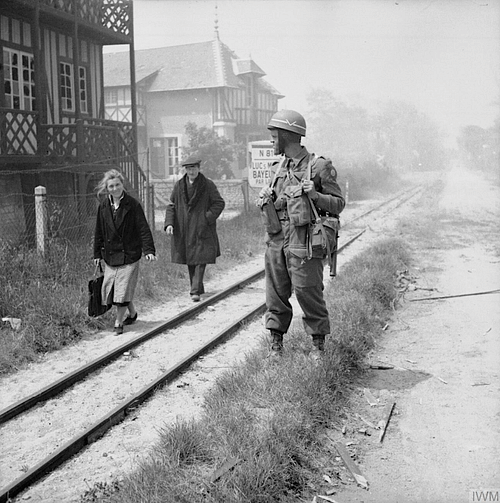 French Civilians & British Military Policeman, D-Day James Mapham - Imperial War Museums (CC BY-NC-SA) ](https://www.worldhistory.org/image/19045/french-civilians--british-military-policeman-d-day/ "French Civilians & British Military Policeman, D-Day")### D-Day Preparations
As the Allies built up their troops and resources for D-Day in the south of [England](https://www.worldhistory.org/disambiguation/england/), to maintain secrecy and provide areas where training exercises for the landings could be conducted, some civilians were required to temporarily move from their homes and such buildings as churches were locked and surrounded by barbed wire. Betty Tab from Slapton in Devon remembers telling her mother of the rumours about this:
> My sister heard the rumour in the shop when she went to get some groceries and she said to Mum that we were all going to have to move and of course Mum says, 'That's nonsense talking like that. Where we going to go?' And she says she heard in the shop. There was a meeting called then in the village hall and that confirmed that there was going to be an evacuation of the area for the American training.
> My parents just couldn't believe it. I mean, Mum just said, 'Well, no, it's not going to happen because it can't. What are we going to do? Where are we going to go?' But it had to be so. So, of course, everybody had to get their thinking caps on and think, 'Well, where *are* we going to go?' If you couldn't get anything yourself the authorities would help but they did want you to try and get yourself fixed up, if possible, because, as you can imagine, there were hundreds trying to move. Thousands, I suppose, really. Quite an area it was.
> (Bailey, 44)
Desmond O'Neill, an official cameraman for the British Army, describes his visit to a camp of troops readying themselves for the invasion:
> I remember going to one unit, I think it was the South Lancashire Regiment, and taking some film of their final preparations for D-Day…they were laagered down near Roland's Castle in Hampshire, in woods there, and I went into the camp – the whole area was actually one huge camp. Very strict all the way round.
> There was certainly a very excitable, tense atmosphere amongst those chaps. They'd been training presumably for a couple of years and they knew full well that they were going to be the spearhead troops and they knew therefore that there was a good chance of them getting shot. The atmosphere there was totally different to any other unit I'd ever been to. Discipline was strict but absolutely on a hairline. A very peculiar atmosphere. I know that the casualty figures had been given to them, the presumed casualty figures.
> We photographed the chaps being instructed as to what was going to happen on the morning of D-Day, where they were going in and the rest. It was all mocked up. I didn't do very much filming apart from taking pictures of these chaps in the camp. They liked it. First of all they'd never seen a cameraman before. Secondly, it was a great divertissement. You know, 'The Mrs is going to see me back in Wigan,' all this kind of thing. I think it was a welcome diversion.
> (Bailey, 66-7)
[ 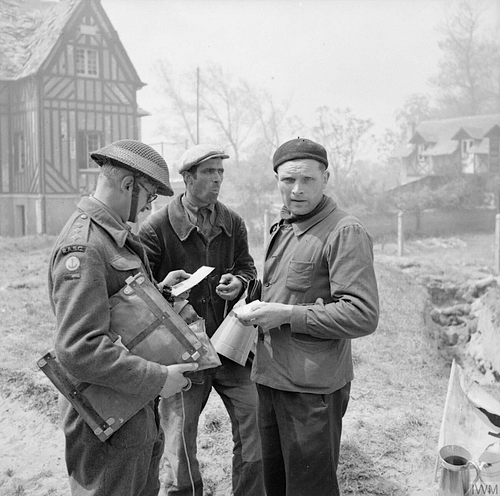 French Civilians & British Soldier, D-Day James Mapham - Imperial War Museums (CC BY-NC-SA) ](https://www.worldhistory.org/image/19046/french-civilians--british-soldier-d-day/ "French Civilians & British Soldier, D-Day")### The View From Normandy
The first units to land in France were paratroopers who, after an aerial bombardment, jumped at night in the early [hours](https://www.worldhistory.org/Horae/) of D-Day. Madame Thérèse Broher, a resident of St-Mère-Église, the first town to be liberated, describes her view of this first action of D-Day:
> It began the day before D-Day, it was in the evening of the 5th, about nine o'clock. We went at first to go to bed and we heard planes and they dropped lights. Many colours in the sky, it was wonderful. And we heard other planes coming so we set out for a shelter, but bombs dropped all round the house and we went under a table in the kitchen. We were frightened and we thought that will probably be it for us, and it lasted about one hour – we did not know exactly because all clocks stopped…And we heard crickets, funny noises, we did not dare to go out and then we saw two men with all kinds of weapons around their body and one of them came near us and he told us in French, 'We are Americans.' It was a very good, big surprise and we had at home a bottle of white wine that wasn't broken and my father was so happy he gave that bottle to the first American soldier he saw.
> (Holmes, 469)
Tom Treanor, a war correspondent, landed on [Utah Beach](https://www.worldhistory.org/Utah_Beach/) on D-Day:
> All up and down the broad beach as far as I could see, men, jeeps, bulldozers and other equipment were moving about like ants. A few columns of black greasy smoke marked equipment which had been hit by shellfire and set on fire. The German shelling continued steadily at various points up and down the beach but so far had not reached the area in which I was walking. It would work over an area, then move on to another. It was accurate, landing for the most part close to the water's edge, and I saw one small landing craft catch fire after taking a hit. Men came scurrying out of it into water waist-deep. From time to time there were huge concussions as the engineers set off demolitions. The ground would shake and the troops would throw themselves violently on the ground…I looked down the beach and the sea. Landing craft of all descriptions were sliding in through the low surf disgorging men who moved through the water with amazing alacrity….Destroyers were almost on the beach occasionally jolting out a salvo that was like a punch on the chin. Farther out, but still incredibly close to the beach, sat our huge [battle](https://www.worldhistory.org/disambiguation/battle/)-wagons and cruisers. Overhead, formations of fighters swept swiftly through the air with nothing to do. During this entire day I never saw a German plane or spoke to a man who had seen one.
> (Bailey, 291).
[ 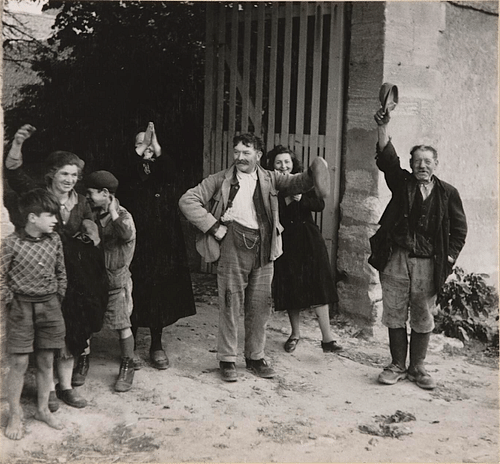 French Civilians, D-Day Imperial War Museums (CC BY-NC-SA) ](https://www.worldhistory.org/image/19047/french-civilians-d-day/ "French Civilians, D-Day")Michel de Valavielle, A French farmer who lived behind Utah Beach gives his account of D-Day:
> I was here in my farm when the landing happened. We were having in the farm a German battery of artillery with 88-millimetre guns and when the American people came we were afraid. We don't realise what has happened during the night, many, many, many planes, and I go to the farm and see an old woman who was just coming from the beach and told me the sea is dark with ships, and some time after a German soldier came here and he was having a prayer book on which it is wrote, Murphy, Michigan. He told us it was a prayer book of a paratrooper, so we realised it was the landing. The German obliged us to stay a long time in the house while they were fighting with the American soldier; the fight was during the beginning of the day until about twelve. At that time the American soldier began to approach the house. I go out first to tell him Germans were gone and there was nobody except French people in the house. He took me, I suppose, as a German soldier and so I was wounded by the American soldier. When they realised their mistake they took me immediately and I was the first Frenchman wounded on the beach in a hospital. So it was unforgettable view of the D-Day for me.
> (Holmes, 470)
On [Sword Beach](https://www.worldhistory.org/Sword_Beach/), local resident Jacqueline Noel found herself in the middle of the landing and ended up helping wounded Allied soldiers:
> I was on the beach for a silly reason. My twin sister had been killed in an air raid a fortnight before in Caen, and she had given me a bathing costume for my birthday, and I had left it on the beach, because we were allowed about once a week to remove the fences so we could pass to go swimming, and I had left the costume in a small hut on the beach, and I just wanted to go and pick it up. I didn't want anybody to take it. So I got on my bicycle and rode to the beach…my Red Cross armband evidently made them \[the German soldiers\] think it was OK. There was quite a bit of activity and I saw a few dead bodies. And of course once I got to the beach I couldn't go back, the English wouldn't let me. They were whistling at me, you know. But mostly they were surprised to see me. I mean, it was a ridiculous thing to do. So I stayed on the beach to help with the wounded. I didn't go back to the house until two days after. There was a lot to do….All the boats and planes. It was something which you just can't imagine if you have not seen it. It was boats, boats, boats and more boats, boats everywhere. If I had been a German, I would have looked at this, put my weapon down, and said, 'That's it. Finished.'
> (Ambrose, 558).
[  Pegasus Bridge, Normandy Landings Imperial War Museums (Public Domain) ](https://www.worldhistory.org/image/18978/pegasus-bridge-normandy-landings/ "Pegasus Bridge, Normandy Landings")The landings on [Juno Beach](https://www.worldhistory.org/Juno_Beach/) on D-Day and afterwards were observed by Mademoiselle Genget, a resident of St.-Côme-de-Fresné, who noted in her diary:
> Awakened this morning at 1 a.m. by a distant bombardment, we got dressed…We heard the big bombers coming in and constantly passing over our heads. Suddenly a big gun is fired from the sea and the smaller cannon of the Boches were answering…Everything in the house – doors, windows, and everything in the loft seem to be dancing. We had the impression that all sorts of things were falling in the court-yard. We were not feeling very brave!
> Is it all really true? We are at last liberated. The enormous strength that all this war material represents is fantastic, and the way it has been handled with such precision is marvellous…A group of Tommies pass and ask us for water. We fill their bottles, say a few words, and, having given [chocolate](https://www.worldhistory.org/disambiguation/Chocolate/) and sweets to the children, they continue on their way.
> (Ambrose, 518/530)
### Allied Success
News of the D-Day landings quickly spread to bring cheer across German-occupied Europe. The author Gertrude Stein (1874-1946) heard the news where she was then living, the village of Belley in eastern France, and she noted in her diary on 6 June:
> Well today is the landing and we heard Eisenhower tell us he was here they were here and just yesterday a man sold us ten packages of Camel cigarettes, glory be, and we are singing glory hallelujah, and feeling very nicely and everybody has been telephoning to us congratulatory messages upon my birthday which it isn't but we know what they mean.
Belley was liberated by US troops that autumn. Stein continues in her diary:
> How we talked that night, they just brought all America to us every bit of it, they came from Colorado, lovely Colorado, I do not know Colorado but that is the way I felt about it lovely Colorado…They have asked me to go with them to Voiron to broadcast with them to America and I am going and the war is over and this certainly is the last war to remember.
> (Ambrose, 506)
#### Editorial Review
This human-authored article has been reviewed by our editorial team before publication to ensure accuracy, reliability and adherence to academic standards in accordance with our [editorial policy](https://www.worldhistory.org/static/editorial-policy/).
## Bibliography
- [Ambrose, Stephen E. *D-Day.* Simon & Schuster, 2013.](https://www.worldhistory.org/books/B00AK78PA0/)
- [Bailey, Roderick. *Forgotten Voices of D-Day.* Ebury Digital, 2010.](https://www.worldhistory.org/books/B00352B446/)
- [Holmes, Richard. *The World at War.* Ebury Press, 2007.](https://www.worldhistory.org/books/0091917514/)
## About the Author
Mark is WHE’s Publishing Director and has an MA in Political Philosophy (University of York). He is a full-time researcher, writer, historian and editor. Special interests include art, architecture and discovering the ideas that all civilizations share.
## Questions & Answers
### How did D-Day impact civilians?
D-Day impacted civilians in many ways. Allied aerial and naval bombing inadvertently killed civilians and destroyed their property and farmland. Many civilians also suffered from looting.
### What happened to civilians on D-Day?
Civilians in Normandy on D-Day 6 June 1944 had to survive Allied bombing (aimed at German defences) and often found themselves in the middle of battles. Private property was destroyed and looted, but most civilians welcomed their liberators, giving them food and gifts.
## External Links
- [Lee Miller's Second World War - IWM](https://www.iwm.org.uk/history/lee-millers-second-world-war)
## Cite This Work
### APA
Cartwright, M. (2024, June 06). The Civilian View of D-Day. *World History Encyclopedia*.
### Chicago
Cartwright, Mark. "The Civilian View of D-Day." *World History Encyclopedia*, June 06, 2024. .
### MLA
Cartwright, Mark. "The Civilian View of D-Day." *World History Encyclopedia*, 06 Jun 2024, .
## License & Copyright
Submitted by [Mark Cartwright](https://www.worldhistory.org/user/markzcartwright/ "User Page: Mark Cartwright"), published on 06 June 2024. The copyright holder has published this content under the following license: [Creative Commons Attribution-NonCommercial-ShareAlike](https://creativecommons.org/licenses/by-nc-sa/4.0/deed.en). This license lets others remix, tweak, and build upon this content non-commercially, as long as they credit the author and license their new creations under the identical terms. When republishing on the web a hyperlink back to the original content source URL must be included. Please note that content linked from this page may have different licensing terms.