---
title: Firing Athenian black and red figure vases
author: Trustees of the British Museum
source: https://www.worldhistory.org/article/241/firing-athenian-black-and-red-figure-vases/
format: machine-readable-alternate
updated: 1970-01-01
---
# Firing Athenian black and red figure vases
_Authored by Trustees of the British Museum_
A distinctive red and black colour scheme characterises most of the painted [pottery](https://www.worldhistory.org/pottery/) of sixth- and fifth-century [Athens](https://www.worldhistory.org/Athens/). The colours result from the skilful exploitation of the high iron content of Athenian clay by an ingenious process of differential firing. The black areas of a black or red-figured pot were coated in a fine solution of the same clay that was used for the body of the vase. Before the vase was placed in the kiln, it would have been orange-red in colour, with the coated areas slightly deeper in tone.[ 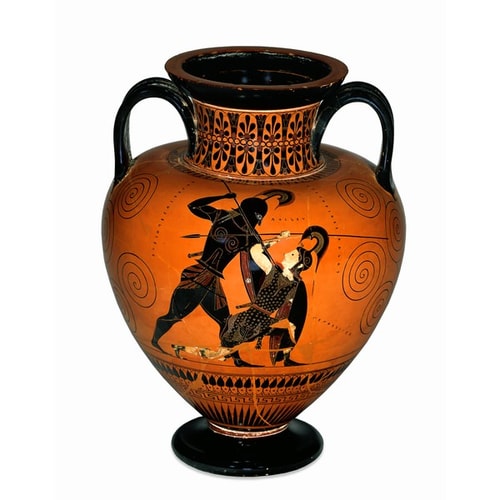 Black-figured amphora (wine-jar) signed by Exekias as potter and attributed to him as painter Trustees of the British Museum (Copyright) ](https://www.worldhistory.org/image/512/black-figured-amphora-wine-jar-signed-by-exekias-a/ "Black-figured amphora (wine-jar) signed by Exekias as potter and attributed to him as painter")
Once the kiln had been loaded, the a three-stage firing took place. In the first, oxidising, phase plenty of air was allowed into the kiln, and the temperature was gradually made to rise to around 800º C. At this point, the vase turned a bright orange-red, as the oxygen in the atmosphere combined with the iron in the clay to produce (red) ferric oxide.
When the potter judged that the required temperature had been reached, he stopped up the air vents and perhaps introduced damp material in the form of green wood or even bowls of water. This produced a reducing (oxygen-poor) atmosphere in the kiln and the red ferric oxide was converted to (black) ferrous oxide, so that the entire pot turned black. The temperature in the kiln continued to rise to around 945º C. The intense heat caused the fine particles of the clay of the coated areas of the pot to 'sinter', that is, to fuse together to form a hard, smooth, almost glassy surface.
In the third and final stage, the temperature was allowed to drop, and at about 900º C the ventilation holes were opened up, oxygen returned to the atmosphere of the kiln, and the ferrous oxide of the uncoated areas converted back to ferric oxide, so that as the kiln cooled down these parts turned orange-red again. The sealed surface of the sintered areas was impervious to the presence of the oxygen and so remained black.
#### Editorial Review
This human-authored article has been reviewed by our editorial team before publication to ensure accuracy, reliability and adherence to academic standards in accordance with our [editorial policy](https://www.worldhistory.org/static/editorial-policy/).
## Bibliography
- [British Museum - Firing Athenian black and red figure vases](http://www.britishmuseum.org/explore/highlights/article_index/f/firing_athenian_vases.aspx "British Museum - Firing Athenian black and red figure vases"), accessed 1 Dec 2016.
## Cite This Work
### APA
Museum, T. o. t. B. (2011, August 02). Firing Athenian black and red figure vases. *World History Encyclopedia*.
### Chicago
Museum, Trustees of the British. "Firing Athenian black and red figure vases." *World History Encyclopedia*, August 02, 2011. .
### MLA
Museum, Trustees of the British. "Firing Athenian black and red figure vases." *World History Encyclopedia*, 02 Aug 2011, .
## License & Copyright
© Trustees of the [British Museum](http://www.britishmuseum.org/). Republished under the British Museum [Standard Terms of Use](http://www.britishmuseum.org/about_this_site/terms_of_use.aspx) for non-profit educational purposes. Original article by **Trustees of the British Museum**. Submitted by [Jan van der Crabben](https://www.worldhistory.org/user/jvdc/ "User Page: Jan van der Crabben"), published on 02 August 2011. The copyright holder has published this content under the following license: [Copyright](http://en.wikipedia.org/wiki/Copyright). You cannot use, copy, distribute, or modify this item without explicit permission from the author. Please note that content linked from this page may have different licensing terms.