---
title: Mark Antony's Oration at Caesar's Funeral
author: Oxford University Press
source: https://www.worldhistory.org/article/2372/mark-antonys-oration-at-caesars-funeral/
format: machine-readable-alternate
updated: 2024-03-11
---
# Mark Antony's Oration at Caesar's Funeral
_Authored by [Oxford University Press](https://www.worldhistory.org/user/oxforduniversit/)_
Amid the chaos and strife following the [assassination of Julius Caesar](https://www.worldhistory.org/article/803/the-assassination-of-julius-caesar/) in 44 BCE, [Mark Antony](https://www.worldhistory.org/Mark_Antony/) (83-30 BCE), with the advice of [Cicero](https://www.worldhistory.org/Cicero/), persuaded the [Roman Senate](https://www.worldhistory.org/Roman_Senate/) to declare an amnesty which pardoned the Liberators and accepted the legitimacy of [Caesar](https://www.worldhistory.org/disambiguation/caesar/)'s dictatorship. A public funeral followed, at which [Antony](https://www.worldhistory.org/Mark_Antony/) delivered his famous funeral oration, a significant first step in his assertion of independent political authority in [Rome](https://www.worldhistory.org/Rome/).
[  Mark Antony's Oration over the Body of Caesar George Edward Robertson (Public Domain) ](https://www.worldhistory.org/image/18470/mark-antonys-oration-over-the-body-of-caesar/ "Mark Antony's Oration over the Body of Caesar")### Antony's Speech
Caesar's funeral took place on 20 March. It was a grand ceremony and the occasion for a funeral oration which, in accordance with tradition, celebrated the deceased's heritage but chiefly recounted the departed's illustrious deeds and their value to the republic. Speeches of this kind were usually delivered by a man's son or a close relation. But [Octavian](https://www.worldhistory.org/augustus/) was not yet in Rome – he was making his way from [Apollonia](https://www.worldhistory.org/disambiguation/Apollonia/) – and it appears Pedius and Pinarius, like Calpurnius Piso, were willing to yield their place to Antony, who seized the moment for himself. This was the most important speech of Antony's career, and it remains the most famous. Nevertheless, so divergent are our sources' treatment of it that no reconstruction can be accurate in its details. Cicero describes it as pathetic and deeply moving, not because he deemed it a bad speech but rather because he judged it an oration that was too affecting on behalf of the wrong cause.
Exactly what Antony said is now lost. He may have uttered a refrain of references to Caesar as 'an extraordinary man' and 'an illustrious man'. These were unremarkable expressions in a funeral oration, but it appears they were often repeated and soon became slogans recycled by anyone reproaching the Liberators. Antony's speech also showcased several striking features. He inserted documents, either by way of deploying a herald or by reading them out himself. The Senate's decrees honouring Caesar, especially the text of the oath obliging every senator to protect him, were recited. Into each recitation Antony intruded his personal observations, contrasting what actually took place on the Ides of March with the promises made by the Liberators and indeed the whole of the Senate. It was not only the conspirators, Antony made it clear, who ought to feel shame over Caesar's [death](https://www.worldhistory.org/disambiguation/Death/). Antony also staged several theatrical flourishes – at the very least he displayed Caesar's blood-stained toga – all designed to intensify the public's grief and stir its hostility against the conspirators. His performance was stunningly effective.
#### Book Excerpt
[  ](https://global.oup.com/academic/product/a-noble-ruin-9780197694909?utm_campaign=8692wc26d&utm_source=third%20party&utm_medium=referral&utm_content=web+banner+link&utm_term=world+history+encyclopedia "A Noble Ruin: Mark Antony, Civil War, and the Collapse of the Roman Republic")### A Noble Ruin: Mark Antony, Civil War, and the Collapse of the Roman Republic
by W. Jeffrey Tatum This major new biography of Mark Antony, the most complete in English, presents an informative account of the late Roman Republic alongside a story of personal tragedy. The book offers original interpretations of ancient sources and vividly illustrates the life of one of the most contentious and fascinating personalities from Roman history. [Learn More](https://global.oup.com/academic/product/a-noble-ruin-9780197694909?utm_campaign=8692wc26d&utm_source=third%20party&utm_medium=referral&utm_content=web+banner+link&utm_term=world+history+encyclopedia)
.sponsor.book img.key_art {
box-shadow: none !important;
}
.button_container {
margin-top: 1em;
}
.sponsor.book h3 {
text-transform: none;
margin-top: 0px;
margin-bottom: 15px;
font-family: "Libre Baskerville", "Palatino Linotype", "Book Antiqua", Palatino, serif;
}
.sponsor_message {
margin-left: 190px;
font-family: Karla, Arial, Helvetica, sans-serif;
line-height: 140%;
min-height: 200px;
}
.sponsor.book {
padding: 20px;
margin: 25px 0px;
background-color: #f3f3f3;
}
.sponsor.book .key_art {
margin-top: 0px;
margin-bottom: 10px;
float: left;
}
.sponsor h4 {
font-weight: bold;
text-transform: uppercase;
color: #000;
margin-bottom: 10px;
margin-top: 0px;
font-family: Karla,Arial,Helvetica,sans-serif;
font-size: 13px;
padding: 0;
}
.sponsor_book_author {
color: #999;
margin: -10px 0px 20px;
}
@media (max-width: 1199px) {
.sponsor.book .key_art {
float: none;
width: 100%;
}
.sponsor.book .sponsor_message {
margin-left: 0px;
}
.sponsor.book h3 {
margin-top: 20px;
margin-bottom: 10px;
}
}
@media (max-width: 767px) {
}
### Public Reaction
The Liberators were aware of the damage Caesar's state funeral was likely to inflict on their position. Consequently, they took precautions on that day by posting private guards to protect their houses. They were wise to do so: the public revulsion conjured by Antony's speech was nothing short of violent. Caesar's body was cremated in the Forum and angry mobs threw themselves against the houses of the Liberators. Antony, however, did not unleash an angry mob and leave its fury unconstrained. He and Lepidus, in order to prevent anything like the rioting and destruction of 52 BCE, stationed soldiers where they could protect the [city](https://www.worldhistory.org/city/)'s buildings. The crowd was allowed to express its rage, but only up to a point. Soon order was restored in the [Roman Forum](https://www.worldhistory.org/Roman_Forum/) and assaults on the houses of the Liberators were abandoned. The people, still moved, kept a solemn vigil at Caesar's pyre into the night.
[ 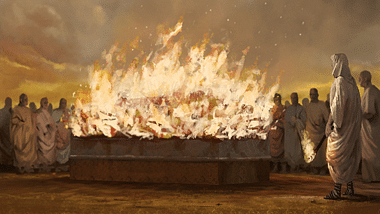 Roman Funeral The Creative Assembly (Copyright) ](https://www.worldhistory.org/image/18471/roman-funeral/ "Roman Funeral")Antony had made his point. He forcefully exhibited his devotion to Caesar's memory. At the same time, by containing and ultimately quelling the violence of the crowd, he displayed to everyone but certainly to the Liberators the very real extent of his personal authority. Antony's funeral oration was intended not only to praise Caesar but more importantly to render as targets of public outrage the men his amnesty had only recently rescued from catastrophe. Friction with Cassius had made clear the ungrateful posture of the Liberators. The perturbation and violence incited by Caesar's funeral now impressed upon all of them how deeply unpopular they were with the masses. The events of the day also made it obvious how dependent they remained on civic order, something that lay beyond their control and could be sustained only by Antony and his allies. If the Liberators and their friends, or even Antony's rivals among the old Caesarian circle, believed his statesmanship on 17 March stemmed from weakness or diffidence, they were now dramatically disabused of that misapprehension.
### Antony Threatens the Liberators
Antony did not wait long to reinforce for the Liberators the true nature of their vulnerability. This is something we can detect in a letter addressed to Brutus and Cassius by Decimus Brutus. Decimus tells them he has recently been visited by Hirtius, who made it clear that Antony was now unsure whether he could allow Decimus to take up his province. This uncertainty Decimus decries as treacherous bad faith and expects Cassius and Brutus to feel the same way. Hirtius, he further reports, explained to him that Antony, concerned by the public's agitation, was anxious over the Liberators' safety. This anxiety, presumably, constituted Antony's ostensible reason for reconsidering Decimus' governorship.
Decimus' consternation is understandable. The terms of the amnesty guaranteed the execution of Caesar's *acta*, and on 18 March, the Senate confirmed it would ratify Caesar's provincial appointments. Antony was probably not suggesting he would fail to execute the Senate's decree. But any Liberator who, like Decimus, was a *privatus*, a private citizen not holding a magistracy or promagistracy, required, in addition to the Senate's formal sanction, further enabling legislation, a l*ex curiata de imperio*, before he could take up his command as a provincial governor. In reality, nothing prevented Antony or Dolabella from providing Decimus with the required *lex*, but Antony, it appears, by exaggerating and exploiting Rome's changed atmosphere after Caesar's funeral and underlining the public's hostility against Decimus and men like him, was now expressing doubts over whether he could successfully assemble a Curiate Assembly. Would the urban plebs permit it?
[  Artistic Facial Reconstruction of Mark Antony Arienne King (CC BY-NC-SA) ](https://www.worldhistory.org/image/13877/artistic-facial-reconstruction-of-mark-antony/ "Artistic Facial Reconstruction of Mark Antony")Behind Antony's expressions of concern was an unmistakeable threat, which is why his conversation with Hirtius panicked Decimus. In his letter, Decimus tells his fellow Liberators that he fears it is only a matter of time before they are declared public enemies or condemned to exile. Although open to suggestion – Decimus informs Cassius and Brutus that he was urged by Hirtius to seek their views – his letter recommends fleeing to [Rhodes](https://www.worldhistory.org/Rhodes/) or anywhere out of Antony's reach. In the meantime, however, he has requested a public bodyguard for himself and all the Liberators. Very soon after this exchange, however, Decimus' crisis was resolved: in early April he was able to leave Rome to take up his province. In the interval, however, the Liberators were obliged to react both to Antony's pose of phoney concern over their unpopularity and to the fear it instilled in Decimus and others. They were also now obliged, as the weaker party, to negotiate with Antony by way of every expression of aristocratic courtesy and even deference. Which, for Antony, was the motive behind his hestitation over Decimus' province. It was not his purpose to violate the spirit or letter of the amnesty. But it was important for him to furnish everyone with a practical lesson in the reality of his clout and his determination to use it.
[ YouTube Follow us on YouTube!](https://link.worldhistory.org/youtube_intext)
#### Editorial Review
This human-authored article has been reviewed by our editorial team before publication to ensure accuracy, reliability and adherence to academic standards in accordance with our [editorial policy](https://www.worldhistory.org/static/editorial-policy/).
## About the Author
Oxford University Press is a department of the University of Oxford. It furthers the University's objective of excellence in research, scholarship, and education by publishing worldwide.
- [Facebook Profile](https://www.facebook.com/OUPAcademic)
- [X/Twitter Profile](https://twitter.com/oupacademic)
- [Linkedin Profile](https://www.linkedin.com/showcase/oup-academic/)
## External Links
- [The Rise Of Mark Antony â And His Defeat By Octavian](https://allthatsinteresting.com/mark-antony)
## Cite This Work
### APA
Press, O. U. (2024, February 12). Mark Antony's Oration at Caesar's Funeral. *World History Encyclopedia*.
### Chicago
Press, Oxford University. "Mark Antony's Oration at Caesar's Funeral." *World History Encyclopedia*, February 12, 2024. .
### MLA
Press, Oxford University. "Mark Antony's Oration at Caesar's Funeral." *World History Encyclopedia*, 12 Feb 2024, .
## License & Copyright
[](https://global.oup.com/)This content is provided by [Oxford University Press](https://global.oup.com/) and republished with permission. All Rights Reserved. Submitted by [Oxford University Press](https://www.worldhistory.org/user/oxforduniversit/ "User Page: Oxford University Press"), published on 12 February 2024. The copyright holder has published this content under the following license: [Copyright](http://en.wikipedia.org/wiki/Copyright). You cannot use, copy, distribute, or modify this item without explicit permission from the author. Please note that content linked from this page may have different licensing terms.