---
title: Government and Taxes under Diocletian and Constantine
author: Anthony Kaldellis
source: https://www.worldhistory.org/article/2295/government-and-taxes-under-diocletian-and-constant/
format: machine-readable-alternate
license: Creative Commons Attribution-NonCommercial-ShareAlike (https://creativecommons.org/licenses/by-nc-sa/4.0/)
updated: 2023-11-28
---
# Government and Taxes under Diocletian and Constantine
_Authored by Anthony Kaldellis_
The state created by [Diocletian](https://www.worldhistory.org/Diocletian/) and [Constantine](https://www.worldhistory.org/disambiguation/Constantine/) used to be described as despotic and oppressive, extracting higher taxes and threatening its subjects with punishments for non-compliance. Recent research, however, paints a different picture. The government strove to be responsive to the needs of its subjects, fair in the allocation of taxes, and to hold its official accountable for their misdeeds.
[ 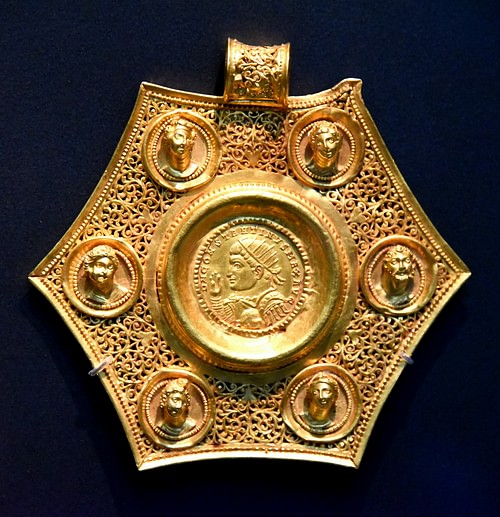 Gold Coin Pendant of Constantine Osama Shukir Muhammed Amin (Copyright) ](https://www.worldhistory.org/image/5756/gold-coin-pendant-of-constantine/ "Gold Coin Pendant of Constantine")### Government in the [Eastern Roman Empire](https://www.worldhistory.org/Byzantine_Empire/)
The government of the new [empire](https://www.worldhistory.org/empire/) has often been characterized as a totalitarian and theocratic dictatorship that suppressed the civic [culture](https://www.worldhistory.org/disambiguation/culture/) of the ancient world, eroded political freedom, and subordinated its subjects to a corrupt plutocracy and the intrigues of court eunuchs who encircled a quasi-divine monarch. Diocletian (r. 284-305) was allegedly the first to adopt a despotic style, adorning his robes and footwear with gems, requiring prostration, and being hailed as *dominus*, "lord." [Constantine I](https://www.worldhistory.org/Constantine_I/) (r. 306-337) extended the scope of capital punishment and threatened malefactors with the amputation of limbs or pouring molten lead down their throats. This image of oriental despotism was promoted by the thinkers of [the Enlightenment](https://www.worldhistory.org/The_Enlightenment/), but its persuasive power has now waned. It was a rhetorical construct that served the needs of the 18th century, but it fails as a description of the reformed [Roman government](https://www.worldhistory.org/Roman_Government/).
The new administration had to be more efficient at extracting revenue in order to pay for its own overhead – the salaries of new officials – as well as supply a large army. A hostile observer groused that there were more employees in Diocletian's government than there were taxpayers. While exaggerated, this complaint captured the unprecedented scale of the new empire's intrusion into
local society. Imperial bureaucracy on such a scale was massive by ancient standards. According to one estimate, the number of the central state's salaried officials rose from fewer than 1,000 to 35,000 or more. For a population of around 45 million, this is a low ratio by modern standards. Yet many of those officials were aided by attendants and slaves who did much of the actual work but did not show up on the books. The army and Church had their own managers, accountants, lawyers, and staff. Also, the imperial state was assisted locally by the apparatus of [city](https://www.worldhistory.org/city/) governments, that is the city councilors and their agents and slaves. Finally, we should not use modern standards to assess how effective this bureaucracy was at surveilling and regimenting the population, as the latter was relatively immobile and economically undiversified compared to its modern counterparts.
### Taxation
It is not clear that the tax burden rose much or at all. It was, however, more uniformly distributed and possibly more equitably too. The assessment, after all, was calculated on the basis of individual holdings: each *iugum* owed so much grain, wine, cash, etc. This curtailed the discretionary power of city councilors to allocate the tax burden. This equalization was intentional. Constantine declared in 324 that assessments on municipalities had to be based on the schedule published by the governor "so that the multitude of the lower classes may not be subjected to the arbitrariness and subordinated to the interests of the more powerful" (*Theodosian Code* 11.16.3-4.). This shifted power away from local authorities to surveyors and assessors appointed by the center.
#### Book Promotion
[  ](https://global.oup.com/academic/product/the-new-roman-empire-9780197549322?utm_campaign=8692uxaqm&utm_source=third%20party&utm_medium=referral&utm_content=web+banner+link&utm_term=world+history+encyclopedia "The New Roman Empire: A History of Byzantium")### The New Roman Empire: A History of Byzantium
by Anthony Kaldellis In the most comprehensive history of the Eastern Roman Empire to appear in over a generation, Kaldellis incorporates the findings of recent scholarship and presents well-known historical characters and events in a new light. The book presents the east Roman Orthodox culture as a dynamic field of creative tensions and debate and refutes the traditional image of the Byzantine state as despotic and oppressive. [Learn More](https://global.oup.com/academic/product/the-new-roman-empire-9780197549322?utm_campaign=8692uxaqm&utm_source=third%20party&utm_medium=referral&utm_content=web+banner+link&utm_term=world+history+encyclopedia)
.sponsor.book img.key_art {
box-shadow: none !important;
}
.button_container {
margin-top: 1em;
}
.sponsor.book h3 {
text-transform: none;
margin-top: 0px;
margin-bottom: 15px;
font-family: "Libre Baskerville", "Palatino Linotype", "Book Antiqua", Palatino, serif;
}
.sponsor_message {
margin-left: 190px;
font-family: Karla, Arial, Helvetica, sans-serif;
line-height: 140%;
min-height: 200px;
}
.sponsor.book {
padding: 20px;
margin: 25px 0px;
background-color: #f3f3f3;
}
.sponsor.book .key_art {
margin-top: 0px;
margin-bottom: 10px;
float: left;
}
.sponsor h4 {
font-weight: bold;
text-transform: uppercase;
color: #000;
margin-bottom: 10px;
margin-top: 0px;
font-family: Karla,Arial,Helvetica,sans-serif;
font-size: 13px;
padding: 0;
}
.sponsor_book_author {
color: #999;
margin: -10px 0px 20px;
}
@media (max-width: 1199px) {
.sponsor.book .key_art {
float: none;
width: 100%;
}
.sponsor.book .sponsor_message {
margin-left: 0px;
}
.sponsor.book h3 {
margin-top: 20px;
margin-bottom: 10px;
}
}
@media (max-width: 767px) {
}
Moreover, the bleak picture of an oppressed peasantry has been radically revised by [archaeology](https://www.worldhistory.org/Archaeology/). There is now mounting evidence for peasant prosperity in the 4th and 5th centuries. Settlements grew and acquired amenities that were previously limited to [cities](https://www.worldhistory.org/city/), and peasant households acquired goods that had previously been beyond reach. Some villages became 'urbanized.' Far from crushing small farmers, the new tax system may have spurred their economic productivity while shifting some of their prior tax burden to wealthier landowners, leading the latter to construct the familiar complaint of an oppressive state. It is more telling that there were no significant peasant rebellions in the history of the Eastern Empire. In periods when the East [Roman](https://www.worldhistory.org/disambiguation/Roman/) state had its way in the provinces, we see steady economic and demographic expansion. The emperors, moreover, for all their bejeweled robes and lofty titles, worked hard to persuade their subjects that they were laboring tirelessly on their behalf.
### New Imperial Policy
The imperial government itself, above and beyond the individual emperors, projected personality traits of its own. These included paternal solicitude for the welfare of all its subjects, even for 'the common happiness'; a striving for the rule of [law](https://www.worldhistory.org/disambiguation/law/) and fairness in its dealings with them; and responsiveness to their concerns. The emperors certainly did work hard. There were many years when Diocletian, Constantine, and Constantius could, had they so chosen, idled in the pleasures of [Rome](https://www.worldhistory.org/Rome/) rather than slogging through the mud of Danubian campaigns. And even while they marched along the frontiers, their courts and subordinates in the provinces were answering thousands of petitions from their subjects. The praise that emperors received doubled as a subtle reminder of their duties: "forget yourself and live for the people; observe which governors emulate your justice; receive messengers from every quarter; send out just as many dispatches; spend all your nights and days in perpetual concern for the safety of all" (*Panegyrici Latini* 10.3.3-4.)
[ 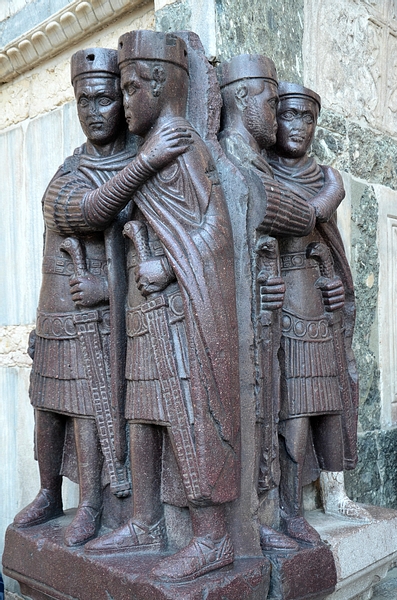 Portrait of the Four Tetrarchs Carole Raddato (CC BY-NC-SA) ](https://www.worldhistory.org/image/8240/portrait-of-the-four-tetrarchs/ "Portrait of the Four Tetrarchs")In their official pronouncements, emperors strove to explain why taxes were necessary: without them, citizens could not be protected from barbarian attack: "the taxes paid by our subjects are used and expended for their own benefit" (Justin II, *Novel* 149.2). This was understood at every level of society, as far down the social ladder as our texts allow us to see. A lowbrow provincial saint's life about a dragon who had squatted in the imperial treasury in [Constantinople](https://www.worldhistory.org/Constantinople/) explains how that cash cycle worked: "the taxes flow into the [palace](https://www.worldhistory.org/disambiguation/palace/) from all over the world and then the emperor uses the money to provide for the common needs of the republic" (*Life of Hypatios of Gangra* 8)
Provincial authors with even a modest grasp of history understood that the new empire was different from its predecessor: "what Rome once extorted from us at sword-point to satisfy her own extravagance, now she contributes with us for the good of the state we share" ([Orosius](https://www.worldhistory.org/Orosius/), *Seven Books of History against the Pagans* 5.1.13.). And the violence threatened by the emperors, which has earned them a reputation for 'savagery,' was directed mostly against their own corrupt officials. In fact, our knowledge of the various crimes that officials committed comes from laws issued against them. Emperors armed their subjects against their own officials, and throughout East Rome's history, we have evidence that common people used these laws to seek redress.
#### Editorial Review
This human-authored article has been reviewed by our editorial team before publication to ensure accuracy, reliability and adherence to academic standards in accordance with our [editorial policy](https://www.worldhistory.org/static/editorial-policy/).
## Cite This Work
### APA
Kaldellis, A. (2023, November 10). Government and Taxes under Diocletian and Constantine. *World History Encyclopedia*.
### Chicago
Kaldellis, Anthony. "Government and Taxes under Diocletian and Constantine." *World History Encyclopedia*, November 10, 2023. .
### MLA
Kaldellis, Anthony. "Government and Taxes under Diocletian and Constantine." *World History Encyclopedia*, 10 Nov 2023, .
## License & Copyright
Original article by **Anthony Kaldellis**. Submitted by [Oxford University Press](https://www.worldhistory.org/user/oxforduniversit/ "User Page: Oxford University Press"), published on 10 November 2023. The copyright holder has published this content under the following license: [Creative Commons Attribution-NonCommercial-ShareAlike](https://creativecommons.org/licenses/by-nc-sa/4.0/deed.en). This license lets others remix, tweak, and build upon this content non-commercially, as long as they credit the author and license their new creations under the identical terms. When republishing on the web a hyperlink back to the original content source URL must be included. Please note that content linked from this page may have different licensing terms.