---
title: The White Horse of Uffington
author: Brian Haughton
source: https://www.worldhistory.org/article/229/the-white-horse-of-uffington/
format: machine-readable-alternate
license: Creative Commons Attribution-NonCommercial-ShareAlike (https://creativecommons.org/licenses/by-nc-sa/4.0/)
updated: 1970-01-01
---
# The White Horse of Uffington
_Authored by [Brian Haughton](https://www.worldhistory.org/user/Brynrees/)_
The cutting of huge figures or geoglyphs into the turf of English hillsides has been going on for more than 3000 years. There are 56 hill figures scattered around [England](https://www.worldhistory.org/disambiguation/england/), with the vast majority on the chalk downlands of the southern part of the country. The figures include [giants](https://www.worldhistory.org/Giants/), horses, crosses and regimental badges. Though the majority of these glyphs date within the last three [hundred years](https://www.worldhistory.org/disambiguation/Hundred_Years/) or so there are one or two that are much older.
The most famous of these figures is perhaps also the most mysterious, the Uffington White Horse in Oxfordshire. The White Horse has recently been redated and shown to be even older than its previously assigned ancient pre-[Roman](https://www.worldhistory.org/disambiguation/Roman/) [Iron Age](https://www.worldhistory.org/disambiguation/Iron_Age/) date. More controversial are the Cerne Abbot [Giant](https://www.worldhistory.org/Giants/) in Dorset and the enigmatic Long Man of Wilmington in Sussex. What was the purpose of these giant figures, who carved them, and how have the oldest examples survived for perhaps thousands of years?
The method of cutting these huge figures was simply to remove the overlying turf to reveal the gleaming white chalk below. However, the grass would soon grow over the glyph again unless it was regularly cleaned or scoured by a fairly large team of men and [women](https://www.worldhistory.org/disambiguation/women/). One reason that the vast majority of hill figures have disappeared is that when the traditions associated with the figures faded, people no longer bothered or remembered to clear away the grass to expose the chalk outline. Furthermore, over hundreds of years the outlines would sometimes change due to the scourers not always cutting in exactly the same place, thus changing the shape of the original glyph.
The fact that any ancient hill figures survive at all in England today is testament to the strength and continuity of local customs and beliefs which, in one case at least, must stretch back over millennia.
### The White Horse of Uffington
The oldest and most famous hill figure in England is the 110 m long and 40 m high Uffington White Horse, located 2.5 km south of the village of Uffington on the Berkshire Downs, Oxfordshire. This unique stylized representation of a horse consists of a long sleek back, thin disjointed legs, a streaming tail, and bird-like beaked head. The elegant creature almost melts into a landscape rich in prehistoric sites. The Horse is situated on a steep escarpment, close to the Late [Bronze Age](https://www.worldhistory.org/disambiguation/Bronze_Age/) (c. 7th century BCE) hillfort of Uffington Castle and below a long distance [Neolithic](https://www.worldhistory.org/Neolithic/) Track called the Ridgeway.
[ 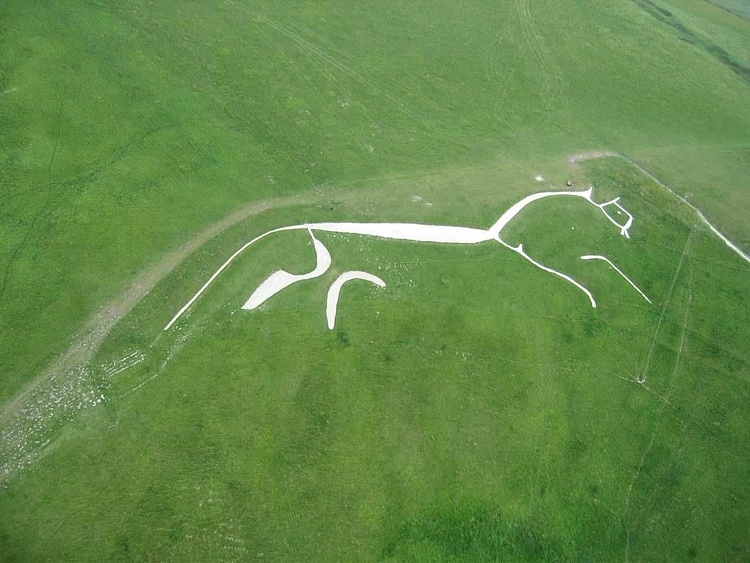 White Horse of Uffington superdove (CC BY-NC-SA) ](https://www.worldhistory.org/image/357/white-horse-of-uffington/ "White Horse of Uffington")The Uffington Horse is also surrounded by Neolithic and [Bronze](https://www.worldhistory.org/disambiguation/bronze/) Age [burial](https://www.worldhistory.org/burial/) mounds. It is only 1.6 km from the Neolithic Chambered [long barrow](https://www.worldhistory.org/Long_Barrow/) of Wayland's Smithy and not far from the Bronze Age cemetery of Lambourn Seven Barrows. The carving has been placed in such a way as to make it extremely difficult to see from close quarters, and like many geoglyphs it is best appreciated from the air. Nevertheless, there are certain areas of the Vale of the White Horse, the valley containing and named after the enigmatic creature, from which an adequate impression may be gained. Indeed on a clear day the carving can be seen from up to 30km away.
The earliest documentary reference to a Horse at Uffington is from the 1070's CE when 'White Horse Hill' is mentioned in Charters from the nearby Abbey of Abingdon, and the first reference to the Horse itself is soon after, in 1190 CE. However, the carving is believed to date back much further than that. Due to the similarity of the Uffington White Horse to the stylized depictions of horses on 1st century BCE [Celtic](https://www.worldhistory.org/celt/) coins, it had been thought that the creature must also date to that period.
### Scientific Dating of the Horse
However, in 1995 CE Optically Stimulated Luminescence (OSL) testing was carried out by the Oxford Archaeological Unit on soil sediments from two of the lower layers of the Horses body, and from another cut near the base. The result was a date for the Horse's construction somewhere between 1400 and 600 BCE, in other words it had a Late Bronze Age or Early Iron Age origin. The latter end of this date range would tie the carving of the Horse in with occupation of the adjacent Uffington hillfort, and may perhaps represent a tribal emblem or symbol marking the land of the inhabitants of the hillfort. Alternatively, the carving may have been created for ritual / religious purposes.
### Cult & [Mythology](https://www.worldhistory.org/mythology/)
Some researchers see the Horse as representing the Celtic horse goddess [Epona](https://www.worldhistory.org/article/153/epona/), who was worshipped as a protector of horses, and also had associations with fertility. However, the cult Epona was imported from [Gaul](https://www.worldhistory.org/gaul/) (France) probably in the first century CE, which is when we find the first depictions of the horse goddess. This date is at least six centuries after the Uffington horse was carved. Nevertheless, the horse was of great ritual and economic importance during the Bronze and Iron Ages, as attested by its depictions on jewellery, coins and other [metal](https://www.worldhistory.org/disambiguation/metal/) objects. Perhaps the carving represents a native British horse-goddess, such as Rhiannon, described in later Welsh mythology as a beautiful woman dressed in [gold](https://www.worldhistory.org/gold/) and riding a white horse.
Others, however, see the White Horse as connected with the worship of Belinos or Belinus, 'the shining one', a Celtic sun [god](https://www.worldhistory.org/God/) often associated with horses. Bronze and Iron Age sun chariots, mythological representations of the sun in a [chariot](https://www.worldhistory.org/chariot/), were shown as being pulled by horses, as can be seen from the 14th century BCE example from Trundholm in Denmark. If, as is now believed, the [Celts](https://www.worldhistory.org/celt/) were settled in [Britain](https://www.worldhistory.org/disambiguation/Britain/) at the latest by the end of the Bronze Age, then the White Horse could still be interpreted as a Celtic horse-goddess symbol.
### An Ancient Dragon?
There are some who believe that the great carving does not represent a horse at all but a dragon. A legend connected with Dragon Hill, a low natural flat-topped mound situated in the valley below the White Horse, suggests that the Horse depicts the mythical dragon slain by St. George on that hill. The blood of the dying dragon was supposed to have been spilled on Dragon Hill, leaving a bare white chalk scar where to this day no grass will grow. Perhaps the St. George connection with the White Horse is a confused memory of some strange prehistoric ritual performed on Dragon Hill by its creators, perhaps as long as three thousand years ago.
Up until the late 19th century CE the White Horse was scoured every year, as part of a two day Midsummer country fair, which also included traditional games and merrymaking. Nowadays the accompanying festival has gone and the task of maintaining the Horse is undertaken by English Heritage, the organisation responsible for the site, the last scouring taking place on June 24, 2000 CE.
### Why were Hill Figures Created?
The reasons for the creation of these hill figures are probably as varied as the figures represented. New archaeological and geological evidence is increasingly indicating a medieval date for the giant naked human figures, which some historians have argued were products of an age of civil [war](https://www.worldhistory.org/disambiguation/War/) and extreme political turmoil in England, when satire was sometimes the only weapon. Compared to the huge stone permanence of structures like the Avebury Monuments and [Stonehenge](https://www.worldhistory.org/stonehenge/), hill figures are much more transitory, ten or twenty years without scouring and the carving could be lost forever.
The fact that the figures could disappear so easily, along with their associated rituals and meaning, indicates that they were never intended to be anything more than temporary gestures, which have only survived either by accident, or in the case of the White Horse of Uffington, by the continued existence of extraordinary tenacious local tradition. But this does not lessen their importance. These giant carvings are a fascinating glimpse into the lives and minds of their creators and how they viewed the landscape in which they lived.
In June 2010 CE [vandals](https://www.worldhistory.org/Vandals/) sprayed part of the White Horse with purple paint. A banner that read 'fathers 4 justice stop the secret family courts' was recovered from the site by police, although the Fathers 4 Justice organization denied any connection with the senseless act. Fortunately, the monument was restored by National Trust workers soon afterwards, and at least one has the satisfaction of knowing that the White Horse will still be galloping across the Berkshire Downs long after those responsible for the vandalism are laid under the sod.
#### Editorial Review
This human-authored article has been reviewed by our editorial team before publication to ensure accuracy, reliability and adherence to academic standards in accordance with our [editorial policy](https://www.worldhistory.org/static/editorial-policy/).
## Bibliography
- James, P. & Thorpe, N. *Ancient Mysteries.* Ballantine Books, 1999
- [Jennifer. (Editor). Westwood. *THE ATLAS OF MYSTERIOUS PLACES.* Guild Publishing, 1989.](https://www.worldhistory.org/books/B000SEVJOE/)
- [Paul Newman. *Lost Gods of Albion.* The History Press, 2009.](https://www.worldhistory.org/books/0752449397/)
- [Rodney Castleden. *Ancient Hill Figures of Britain.* SB Publications, 1999.](https://www.worldhistory.org/books/1857701038/)
## About the Author
Author and researcher of books on ancient civilisations & monuments, sacred places and supernatural folklore. Qualified archaeologist with a BA (Hons) from the University of Nottingham and an MPhil in Greek Archaeology from the University of Birmingham.
- [Facebook Profile](https://www.facebook.com/BrianHaughtonauthor/)
- [X/Twitter Profile](https://twitter.com/BrianHaughton1)
## Cite This Work
### APA
Haughton, B. (2011, March 30). The White Horse of Uffington. *World History Encyclopedia*.
### Chicago
Haughton, Brian. "The White Horse of Uffington." *World History Encyclopedia*, March 30, 2011. .
### MLA
Haughton, Brian. "The White Horse of Uffington." *World History Encyclopedia*, 30 Mar 2011, .
## License & Copyright
Submitted by [Brian Haughton](https://www.worldhistory.org/user/Brynrees/ "User Page: Brian Haughton"), published on 30 March 2011. The copyright holder has published this content under the following license: [Creative Commons Attribution-NonCommercial-ShareAlike](https://creativecommons.org/licenses/by-nc-sa/4.0/deed.en). This license lets others remix, tweak, and build upon this content non-commercially, as long as they credit the author and license their new creations under the identical terms. When republishing on the web a hyperlink back to the original content source URL must be included. Please note that content linked from this page may have different licensing terms.