---
title: Life of Plato of Athens
author: Oxford University Press
source: https://www.worldhistory.org/article/2241/life-of-plato-of-athens/
format: machine-readable-alternate
updated: 2023-05-30
---
# Life of Plato of Athens
_Authored by [Oxford University Press](https://www.worldhistory.org/user/oxforduniversit/)_
[Plato](https://www.worldhistory.org/plato/) of [Athens](https://www.worldhistory.org/Athens/) (424 or 423 to 347 BCE) was an ancient [Greek](https://www.worldhistory.org/disambiguation/greek/) philosopher whose work is considered so important that he may be called the inventor of [philosophy](https://www.worldhistory.org/philosophy/) as we understand the term today. Some people would want to reserve that honor for his teacher, [Socrates](https://www.worldhistory.org/socrates/), but since Socrates wrote nothing himself for publication, we only have the quasi-fictional descriptions of him and his work by Plato and [Xenophon](https://www.worldhistory.org/xenophon/).
[  Statue of Plato Edgar Serrano (CC BY-NC-SA) ](https://www.worldhistory.org/image/12427/statue-of-plato/ "Statue of Plato")All that Plato says about Socrates, and especially all the philosophy ascribed to him in Plato's dialogues, is best attributed to Plato himself. Plato's homage to his teacher was to develop his lines of thought, not to parrot him. And the developments led him to invent or make important contributions to all fields of philosophy: metaphysics, epistemology, political theory, jurisprudence and penology, ethics, [science](https://www.worldhistory.org/science/), [religion](https://www.worldhistory.org/religion/), language, art and aesthetics, friendship, and love. The 20th-century British philosopher Alfred North Whitehead famously wrote: "The safest general characterization of the European philosophical tradition is that it consists of a series of footnotes to Plato" (39)
### Birth & Name
Plato was born into a wealthy Athenian family. He was born in 424 or 423 BCE, not 428/7, as is commonly stated. Another common misconception is that 'Plato' was originally a nickname that stuck, and that his birth name was Aristocles. This is false. Aristocles, as the name of his grandfather, would have been given, if to any grandchild, to the eldest; but Plato had two older brothers, Adeimantus and Glaucon (and an older sister, Potone). 'Plato' was a perfectly ordinary name in ancient Athens, and we know of one other famous Plato, a comic poet. The fact that the word sounds like the Greek *platus*, meaning "of stocky build" or possibly (as the ancient biographers preferred) "of capacious intellect," is irrelevant.
#### Book Promotion
[ 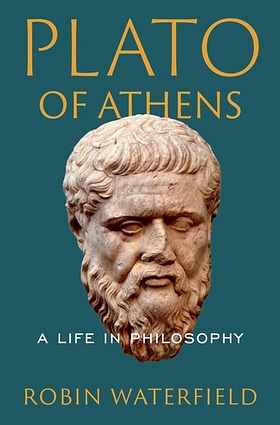 ](https://global.oup.com/academic/product/plato-of-athens-9780197564752?cc=us&lang=en "Plato of Athens: A Life in Philosophy")### Plato of Athens: A Life in Philosophy
by Robin Waterfield This first-ever full-length biography of Plato presents an accessible introduction to Plato's thought and provides a rich portrait of Athens at a time of great political and cultural change. [Learn More](https://global.oup.com/academic/product/plato-of-athens-9780197564752?cc=us&lang=en)
.sponsor.book img.key_art {
box-shadow: none !important;
}
.button_container {
margin-top: 1em;
}
.sponsor.book h3 {
text-transform: none;
margin-top: 0px;
margin-bottom: 15px;
font-family: "Libre Baskerville", "Palatino Linotype", "Book Antiqua", Palatino, serif;
}
.sponsor_message {
margin-left: 190px;
font-family: Karla, Arial, Helvetica, sans-serif;
line-height: 140%;
min-height: 200px;
}
.sponsor.book {
padding: 20px;
margin: 25px 0px;
background-color: #f3f3f3;
}
.sponsor.book .key_art {
margin-top: 0px;
margin-bottom: 10px;
float: left;
}
.sponsor h4 {
font-weight: bold;
text-transform: uppercase;
color: #000;
margin-bottom: 10px;
margin-top: 0px;
font-family: Karla,Arial,Helvetica,sans-serif;
font-size: 13px;
padding: 0;
}
.sponsor_book_author {
color: #999;
margin: -10px 0px 20px;
}
@media (max-width: 1199px) {
.sponsor.book .key_art {
float: none;
width: 100%;
}
.sponsor.book .sponsor_message {
margin-left: 0px;
}
.sponsor.book h3 {
margin-top: 20px;
margin-bottom: 10px;
}
}
@media (max-width: 767px) {
}
### Sources
The sources for Plato's thought are his written works, known as *Dialogues* because most of them brilliantly portray fictional conversations, usually featuring Socrates as the protagonist. It is a measure of how important Plato was considered to be even in ancient times that his complete works were preserved. We have every word he wrote, whereas the vast majority of ancient [Greek literature](https://www.worldhistory.org/Greek_Literature/) has perished because it was not thought to be worth preserving, in the days when the preservation of manuscripts was difficult and copying them time-consuming.
The sources for Plato's life are threefold. The dialogues themselves tell us almost nothing because it was Plato's style to efface himself, like a playwright. There are extant a few short biographies written between the 1st century BCE and the 6th century CE, but they are hardly reliable. Plato's great fame and importance meant that even during his lifetime he attracted both excessive praise and excessive calumny. For instance, he was said to be the son not of a mortal father, but of [Apollo](https://www.worldhistory.org/apollo/), the [god](https://www.worldhistory.org/God/) of intellectual enlightenment. Or, on the opposite side of the [coin](https://www.worldhistory.org/coinage/), Plato was said to be physically repulsive, morally corrupt, and intellectually dishonest. He was a pederast, a whoremonger, and a slave to tyrants, despite being hungry for political power. Many of the stories retailed in these biographies are sheer gossip or, worse, fantasy. It is easy to dismiss stories such as that Plato died of shame when he was unable to answer a riddle.
The final source for Plato's life is a series of letters written under his name. The authenticity of any or all of these letters is highly controversial, but it is likely that three of them, Letters 3, 7, and 8 are genuine. They provide us with a wealth of detail, especially about Plato's visits to [Syracuse](https://www.worldhistory.org/syracuse/).
### Politics
Plato grew up during a time of [war](https://www.worldhistory.org/disambiguation/War/). The so-called [Peloponnesian War](https://www.worldhistory.org/Peloponnesian_War/) between Athens (and its allies) and [Sparta](https://www.worldhistory.org/sparta/) (and its allies) lasted from 431 to 404 BCE. By the time Plato was in his early teens, it was clear that Athens had overreached itself and was going to lose the war. It was a gruesome war and a grim time to be a young boy.
At the end of the war in 404 BCE, the victorious Spartans abolished the famous [Athenian democracy](https://www.worldhistory.org/Athenian_Democracy/) and imposed an oligarchy of 30 men, whose viciousness soon earned them the name of [the Thirty Tyrants](https://www.worldhistory.org/The_Thirty_Tyrants/). Several members of the Socratic circle were involved in the oligarchy, including two of Plato's close relatives, [Critias](https://www.worldhistory.org/Critias/) (a first cousin of his mother Perictione) and Charmides (his mother's brother). Plato was at first attracted to their program of the moral rearmament of Athens – a turn away from the irresponsibility of the extreme democracy and a return to old-fashioned virtues. Like many young men of his class, Plato contemplated a career in politics, but the viciousness of the Thirty put him off. The regime of the Thirty did not last long, however. Perhaps Plato could pursue a political career under the restored democracy. But in 399 BCE, the democracy condemned his beloved teacher Socrates to [death](https://www.worldhistory.org/disambiguation/Death/), probably largely because of how many members of the Socratic circle were attracted to oligarchy. Plato turned away from practical politics and began his 50-year career as a writer.
[  The Death of Socrates Jacques-Louis David (1748-1825) (Public Domain) ](https://www.worldhistory.org/image/99/the-death-of-socrates/ "The Death of Socrates")However, many years later he returned to practical politics when the opportunity arose for him to influence Dionysius II of Syracuse, the most powerful monarch in [Europe](https://www.worldhistory.org/europe/) at the time. Plato was not so unrealistic as to think that he could turn Dionysius into a philosopher ruler along the lines sketched in his dialogue *Republic,* but he did hope to temper absolute monarchy in the direction of a blend of monarchy and democracy. Despite two attempts, in 366-365 BCE and 361-360 BCE, Plato eventually had to admit that Dionysius was not suitable material. His forays into practical politics were a failure, and he returned to teaching and [writing](https://www.worldhistory.org/writing/).
[ YouTube Follow us on YouTube!](https://link.worldhistory.org/youtube_intext)
### Teaching Career
Plato had been teaching since the 390s BCE. Philosophy was regarded by many young people in Athens as a way to hone their intellects and round off their education, so Plato was never short of students. But he also wanted to be surrounded by people who would take philosophy as he understood it, as a way of reforming character as well as of understanding the world. In 383 BCE, he founded his school known as the Academy, in a suburb of Athens. Before long it was attracting some of the greatest intellects of the day; most famously both [Aristotle](https://www.worldhistory.org/aristotle/) of Stagira and Eudoxus of Cnidus did much of their thinking and research within the Academy. The school went through many changes, but lasted until the 6th century CE, longer than any other such institution in Europe so far. It was named after the nearby shrine of the local hero Academus.
[  The School of Athens by Raphael Raphael (Public Domain) ](https://www.worldhistory.org/image/272/the-school-of-athens-by-raphael/ "The School of Athens by Raphael")So, apart from the visits to Syracuse, Plato's life was essentially the quiet life of a scholar, largely free of exciting incidents. He died in 347 BCE. We do not know what carried him off, but 76 was a ripe old age for the time. The earliest of the extant biographies says that he had a fever, but we do not know its nature. An epigram, possibly written by Speusippus, Plato's nephew and his successor as head of the Academy, reads:
> Although Earth here holds in her bosom the body of Plato,
> His soul is in the rank of the blessed, equal to that of the gods.
#### Editorial Review
This human-authored article has been reviewed by our editorial team before publication to ensure accuracy, reliability and adherence to academic standards in accordance with our [editorial policy](https://www.worldhistory.org/static/editorial-policy/).
## Bibliography
- [Annas, Julia. *Plato.* Oxford University Press, 2003.](https://www.worldhistory.org/books/019280216X/)
- [Boys-Stones, George & Rowe, Christopher. *The Circle of Socrates.* Hackett Publishing Company, Inc., 2013.](https://www.worldhistory.org/books/160384936X/)
- [Evans, J. D. G. *A Plato Primer.* Cornell University Press, 2010.](https://www.worldhistory.org/books/0801476836/)
- [Klosko, George. *The Development of Plato's Political Theory.* Oxford University Press, 2007.](https://www.worldhistory.org/books/0199279969/)
- [Mason, Andrew. *Plato .* University of California Press, 2010.](https://www.worldhistory.org/books/0520265416/)
- [Nails, Debra. *The People of Plato.* Hackett Publishing Company, Inc., 2002.](https://www.worldhistory.org/books/0872205649/)
- [Plato & John M. Cooper & D. S. Hutchinson. *Plato.* Hackett Publishing Co., 1997.](https://www.worldhistory.org/books/0872203492/)
- [Plato: The Academy | Internet Encyclopedia of Philosophy](https://iep.utm.edu/plato-academy/ "Plato: The Academy | Internet Encyclopedia of Philosophy"), accessed 25 May 2023.
- [Robin Waterfield. *Why Socrates Died.* W. W. Norton & Company, 2009.](https://www.worldhistory.org/books/0393065278/)
- [Waterfield, Robin. *Creators, Conquerors, and Citizens.* Oxford University Press, 2020.](https://www.worldhistory.org/books/0190095768/)
- [Waterfield, Robin. *Plato of Athens.* Oxford University Press, 2023.](https://www.worldhistory.org/books/0197564755/)
- [White, Stephen. *Diogenes Laertius.* Cambridge University Press, 2021.](https://www.worldhistory.org/books/0521883350/)
- [Whitehead, Alfred North. *Process and Reality .* Free Press, 1979.](https://www.worldhistory.org/books/0029345707/)
## About the Author
Oxford University Press is a department of the University of Oxford. It furthers the University's objective of excellence in research, scholarship, and education by publishing worldwide.
- [Facebook Profile](https://www.facebook.com/OUPAcademic)
- [X/Twitter Profile](https://twitter.com/oupacademic)
- [Linkedin Profile](https://www.linkedin.com/showcase/oup-academic/)
## Cite This Work
### APA
Press, O. U. (2023, May 30). Life of Plato of Athens. *World History Encyclopedia*.
### Chicago
Press, Oxford University. "Life of Plato of Athens." *World History Encyclopedia*, May 30, 2023. .
### MLA
Press, Oxford University. "Life of Plato of Athens." *World History Encyclopedia*, 30 May 2023, .
## License & Copyright
[](https://global.oup.com/)This content is provided by [Oxford University Press](https://global.oup.com/) and republished with permission. All Rights Reserved. Submitted by [Oxford University Press](https://www.worldhistory.org/user/oxforduniversit/ "User Page: Oxford University Press"), published on 30 May 2023. The copyright holder has published this content under the following license: [Copyright](http://en.wikipedia.org/wiki/Copyright). You cannot use, copy, distribute, or modify this item without explicit permission from the author. Please note that content linked from this page may have different licensing terms.