---
title: Beer in the Ancient World: The Drink of the Gods - For Some
author: Joshua J. Mark
source: https://www.worldhistory.org/article/223/beer-in-the-ancient-world/
format: machine-readable-alternate
license: Creative Commons Attribution-NonCommercial-ShareAlike (https://creativecommons.org/licenses/by-nc-sa/4.0/)
updated: 2026-04-10
---
# Beer in the Ancient World: The Drink of the Gods - For Some
_Authored by [Joshua J. Mark](https://www.worldhistory.org/user/JPryst/)_
The intoxicant known in English as *[beer](https://www.worldhistory.org/Beer/)* takes its name from the Latin *bibere* (by way of the German *bier*), meaning "to drink", and the Spanish word for beer, *cerveza*, comes from the Latin word *cerevisia* for "of beer", giving some indication of the long span human beings have been enjoying the drink.
Even so, beer brewing did not originate with the Romans but began thousands of years earlier. The Chinese brewed a type of beer, but the product which became the most popular is credited to the [Sumerians](https://www.worldhistory.org/Sumerians/) of [Mesopotamia](https://www.worldhistory.org/Mesopotamia/) and most likely began over 10,000 years ago. The site known as [Godin Tepe](https://www.worldhistory.org/Godin_Tepe/) (in modern-day Iran) has provided evidence of beer brewing circa 3500 BCE while sites excavated in [Sumer](https://www.worldhistory.org/sumer/) suggest an even earlier date based on ceramics considered the remains of beer jugs and residue found in other ancient containers. Even so, the date of circa 4000 BCE is usually given for the creation of beer.
#### Sponsorship
[  ](https://link.worldhistory.cloud/anciv.beer "The Drink of the Gods")### The Drink of the Gods
by Anciv Brewing Behind every great civilisation is a great brew. Inspired by the ingredients and methods of the world’s first breweries, Anciv Brewing’s beers offer a modern twist on our ancient past. [Learn More](https://link.worldhistory.cloud/anciv.beer)
.sponsor.book img.key_art {
box-shadow: none !important;
}
.button_container {
margin-top: 1em;
}
.sponsor.book h3 {
text-transform: none;
margin-top: 0px;
margin-bottom: 15px;
font-family: "Libre Baskerville", "Palatino Linotype", "Book Antiqua", Palatino, serif;
}
.sponsor_message {
margin-left: 190px;
font-family: Karla, Arial, Helvetica, sans-serif;
line-height: 140%;
min-height: 200px;
}
.sponsor.book {
padding: 20px;
margin: 25px 0px;
background-color: #f3f3f3;
}
.sponsor.book .key_art {
margin-top: 0px;
margin-bottom: 10px;
float: left;
}
.sponsor h4 {
font-weight: bold;
text-transform: uppercase;
color: #000;
margin-bottom: 10px;
margin-top: 0px;
font-family: Karla,Arial,Helvetica,sans-serif;
font-size: 13px;
padding: 0;
}
.sponsor_book_author {
color: #999;
margin: -10px 0px 20px;
}
@media (max-width: 1199px) {
.sponsor.book .key_art {
float: none;
width: 100%;
}
.sponsor.book .sponsor_message {
margin-left: 0px;
}
.sponsor.book h3 {
margin-top: 20px;
margin-bottom: 10px;
}
}
@media (max-width: 767px) {
}
The craft of beer brewing traveled to [Egypt](https://www.worldhistory.org/egypt/) through [trade](https://www.worldhistory.org/disambiguation/trade/), and the Egyptians improved upon the original process, creating a lighter product that enjoyed great popularity. Although beer was known afterwards to the Greeks and Romans, it never gained the same kind of following as those cultures preferred wine and thought of beer as a "barbarian" drink. One of the many peoples they regarded as "barbarians" - the Germans - perfected the art of brewing and created what is recognized today as beer. And so, to the ancient peoples, beer was considered the drink of the gods - but only by some - not by all.
### First Beer Brewing
The first beer in the world was brewed by the ancient Chinese around the year 7000 BCE (known as *kui*). In the west, however, the process now recognized as beer brewing began in Mesopotamia at the Godin Tepe settlement in modern-day Iran between 3500 - 3100 BCE. Evidence of beer manufacture has been confirmed between these dates, but it is probable that the brewing of beer in Sumer (southern Mesopotamia, modern-day Iraq) was in practice much earlier.
Some evidence has been interpreted, however, which sets the date of beer brewing at Godin Tepe as early as 10,000 BCE when [agriculture](https://www.worldhistory.org/disambiguation/Agriculture/) first developed in the region. While some scholars have contended that beer was discovered accidentally through grains used for bread-making which fermented, others claim that it preceded bread as a staple and that it was developed intentionally as an intoxicant. Scholar Max Nelson writes:
> Fruits often naturally ferment through the actions of wild yeast and the resultant alcoholic mixtures are often sought out and enjoyed by animals. Pre-agricultural humans in various areas from the [Neolithic Period](https://www.worldhistory.org/Neolithic/) on surely similarly sought out such fermenting fruits and probably even collected wild fruits in the hopes that they would have an interesting physical effect (that is, be intoxicating) if left in the open air. (9)
This theory of the intentional brewing of intoxicants, whether beer, wine, or other drink, is supported by the historical record, which strongly suggests that human beings, after taking care of their immediate needs of food, shelter, and rudimentary laws, will then pursue the creation of some type of intoxicant. Although beer, as it is recognized in the modern day, was developed in [Europe](https://www.worldhistory.org/europe/) (specifically in Germany), the brew was first enjoyed in ancient Mesopotamia.
### Beer in Mesopotamia
The people of ancient Mesopotamia enjoyed beer so much that it was a daily dietary staple. Paintings, poems, and myths depict both human beings and their gods enjoying beer, which was consumed through a straw to filter out pieces of bread or herbs in the drink. The brew was thick, of the consistency of modern-day porridge, and the straw was invented by the Sumerians or the Babylonians, it is thought, specifically for the purpose of drinking beer.
[  Mesopotamian Beer Rations Tablet Osama Shukir Muhammed Amin (Copyright) ](https://www.worldhistory.org/image/4849/mesopotamian-beer-rations-tablet/ "Mesopotamian Beer Rations Tablet")The famous poem *[Inanna](https://www.worldhistory.org/Inanna/) and the [God](https://www.worldhistory.org/God/) of Wisdom* describes the two deities drinking beer together and the god of wisdom, [Enki](https://www.worldhistory.org/Enki/), becoming so drunk that he gives away the sacred *meh* (laws of [civilization](https://www.worldhistory.org/civilization/)) to Inanna (thought to symbolize the transfer of power from [Eridu](https://www.worldhistory.org/eridu/), the [city](https://www.worldhistory.org/city/) of Enki, to [Uruk](https://www.worldhistory.org/uruk/), the city of Inanna). The [Sumerian](https://www.worldhistory.org/Sumerians/) poem *Hymn to Ninkasi* is both a song of praise to the goddess of beer, Ninkasi, and a recipe for beer, first written down around 1800 BCE.
In the Sumerian/Babylonian *The Epic of [Gilgamesh](https://www.worldhistory.org/gilgamesh/)*, the hero Enkidu becomes civilized through the ministrations of the [temple](https://www.worldhistory.org/temple/) harlot Shamhat who, among other things, teaches him to drink beer. Later in the story, the barmaid Siduri counsels Gilgamesh to give up his quest for the meaning of life and simply enjoy what it has to offer, including beer.
The Sumerians had many different words for beer, from *sikaru* to *dida* to *ebir* (which meant "beer mug") and regarded the drink as a gift from the gods to promote human happiness and well-being. The original brewers were [women](https://www.worldhistory.org/disambiguation/women/), the priestesses of Ninkasi, and women brewed beer regularly in the home as part of their preparation of meals. Beer was made from *bippar* (twice-baked barley bread), which was then fermented, and beer brewing was always associated with baking.
The famous Alulu beer receipt from the city of [Ur](https://www.worldhistory.org/ur/) in 2050 BCE, however, shows that beer brewing had become commercialized by that time. The tablet acknowledges receipt of 5 Silas of `the best beer' from the brewer Alulu (five Silas being approximately four and a half litres).
Under Babylonian rule, Mesopotamian beer production increased dramatically, became more commercialized, and laws were instituted concerning it, as paragraphs 108-110 of the [Code of Hammurabi](https://www.worldhistory.org/Code_of_Hammurabi/) make clear:
> 108
> If a tavern-keeper (feminine) does not accept grain according to gross weight in payment of drink, but takes money, and the price of the drink is less than that of the grain, she shall be convicted and thrown into the water.
> 109
> If conspirators meet in the house of a tavern-keeper, and these conspirators are not captured and delivered to the court, the tavern-keeper shall be put to [death](https://www.worldhistory.org/disambiguation/Death/).
> 110
> If a "sister of a god" open a tavern, or enter a tavern to drink, then shall this woman be burned to death.
[Law](https://www.worldhistory.org/disambiguation/law/) 108 had to do with those tavern keepers who poured "short measures" of beer in return for cash instead of grain (which could be weighed and held to a measure) to cheat their customers; they would be drowned if caught doing so. Beer was commonly used in barter, not for cash sale, and a daily ration of beer was provided for all citizens; the amount received depended on one's social status.
The second law concerns tavern keepers encouraging treason by allowing malcontents to gather in their establishment, and the third law cited concerns women who were consecrated to, or were priestesses of, a certain deity, opening a common drinking house or drinking in an already established tavern. The Babylonians had nothing against a priestess drinking beer (as, with the Sumerians, beer was considered a gift from the gods), but objected to one doing so in the same way as common women would.
The Babylonians brewed many different kinds of beer and classified them into 20 categories, which recorded their various characteristics. Beer became a regular commodity in foreign trade, especially with Egypt, where it was very popular.
[  Egyptian Model of Servant Brewing Beer Osama Shukir Muhammed Amin (Copyright) ](https://www.worldhistory.org/image/8366/egyptian-model-of-servant-brewing-beer/ "Egyptian Model of Servant Brewing Beer")### [Beer in Ancient Egypt](https://www.worldhistory.org/article/1033/beer-in-ancient-egypt/)
The [Egyptian](https://www.worldhistory.org/disambiguation/Egyptian/) goddess of beer was Tenenit (closely associated Meskhenet, goddess of childbirth and protector of the birthing house), whose name derives from *tenemu*, one of the Egyptian words for beer. The most popular beer in Egypt was *Heqet* (or *Hecht*), which was a honey-flavored brew and their word for beer in general was *zytum*. The workers at the [Giza](https://www.worldhistory.org/giza/) plateau received beer rations three times a day, and beer was often used throughout Egypt as compensation for labor.
The Egyptians believed that brewing was taught to human beings by the great god [Osiris](https://www.worldhistory.org/osiris/) himself, and in this and other regards, they viewed beer in much the same way as the Mesopotamians did. As in Mesopotamia, women were the chief brewers at first and brewed in their homes, the beer initially had the same thick, porridge-like consistency, and was brewed in much the same way.
Later, men took over the business of brewing and miniature carved figures found in the [tomb](https://www.worldhistory.org/tomb/) of Meketre (Prime Minister to the [pharaoh](https://www.worldhistory.org/pharaoh/) Mentuhotep II, 2050-2000 BCE) show an ancient brewery at work. According to the Metropolitan Museum of Art, describing the diorama, "The overseer with a baton sits inside the door. In the brewery two women grind flour, which another man works into dough. After a second man treads the dough into mash in a tall vat, it is put into tall crocks to ferment. After fermentation, it is poured off into round jugs with black clay stoppers" (1).
[  Ancient Egyptian Brewery and Bakery Keith Schengili-Roberts (CC BY-SA) ](https://www.worldhistory.org/image/573/ancient-egyptian-brewery-and-bakery/ "Ancient Egyptian Brewery and Bakery")Beer played an integral role in the very popular myth of the birth of the goddess [Hathor](https://www.worldhistory.org/Hathor/). According to the tale (which forms part of the text of the *[Book of the Heavenly Cow](https://www.worldhistory.org/Book_of_the_Heavenly_Cow/)* - a version of the Great Flood myth which pre-dates the biblical tale of the Flood in the biblical [book of Genesis](https://www.worldhistory.org/Book_of_Genesis/)), the god Ra, incensed at the evil and ingratitude of humanity who have rebelled against him, sends Hathor to earth to destroy his creation.
Hathor sets to work and falls into an intense bloodlust as she slaughters humanity, transforming herself into the goddess Sekhmet. Ra is at first pleased, but then repents of his decision as Sekhmet's bloodlust grows with the destruction of every town and city. He has a great quantity of beer dyed red and dropped at the city of Dendera, where Sekhmet, thinking it is a huge pool of blood, stops her rampage to drink. She gets drunk, falls asleep, and wakes again as the goddess Hathor, the benevolent deity of, among other things, [music](https://www.worldhistory.org/disambiguation/Music/), laughter, the sky and, especially, gratitude.
The association between gratitude, Hathor, and beer is highlighted by an inscription from 2200 BCE found at Dendera, Hathor's cult center: "The mouth of a perfectly contented man is filled with beer." Beer was enjoyed so regularly among the Egyptians that Queen [Cleopatra VII](https://www.worldhistory.org/Cleopatra_VII/) (circa 69-30 BCE) lost popularity toward the end of her reign more for implementing a tax on beer (the first ever) than for her wars with [Rome](https://www.worldhistory.org/Rome/), which the beer tax went to help pay for (although she claimed the tax was to deter public drunkeness). As beer was often prescribed for medicinal purposes (there were over 100 remedies using beer), the tax was considered unjust.
### Beer in Ancient [Greece](https://www.worldhistory.org/greece/) & Rome
Beer brewing traveled from Egypt to Greece (as we know from the [Greek](https://www.worldhistory.org/disambiguation/greek/) word for beer, *zythos,* from the Egyptian *zytum*), but did not find the same receptive climate there. The Greeks favored strong wine over beer, as did the Romans after them, and both cultures considered beer a low-class drink of barbarians. The Greek general and writer [Xenophon](https://www.worldhistory.org/xenophon/), in Book IV of his *Anabasis*, writes:
> There were stores within of wheat and barley and vegetables, and wine made from barley in great big bowls; the grains of barley malt lay floating in the beverage up to the lip of the vessel, and reeds lay in them, some longer, some shorter, without joints; when you were thirsty you must take one of these into your mouth, and suck. The beverage without admixture of water was very strong, and of a delicious flavour to certain palates, but the taste must be acquired. (26-27)
Clearly, beer was not to Xenophon's taste; nor was it any more popular with his countrymen. The playwright [Sophocles](https://www.worldhistory.org/sophocles/), among others, also refers to beer somewhat unfavorably and recommends moderation in its use. The [Roman](https://www.worldhistory.org/disambiguation/Roman/) historian, [Tacitus](https://www.worldhistory.org/tacitus/), [writing](https://www.worldhistory.org/writing/) of the Germans, says, "To drink, the Teutons have a horrible brew fermented from barley or wheat, a brew which has only a very far removed similarity to wine", and the Emperor Julian composed a poem claiming the scent of wine was of nectar while the smell of beer was that of a goat.
Even so, the Romans were brewing beer (*cerevisia*) quite early, as evidenced by the tomb of a beer brewer and merchant (a *Cerveserius*) in ancient Treveris (modern day Trier). Excavations of the [Roman military](https://www.worldhistory.org/Roman_Army/) encampment on the Danube, Castra Regina (modern day Regensburg), have unearthed evidence of beer brewing on a significant scale shortly after the community was built in 179 by [Marcus Aurelius](https://www.worldhistory.org/Marcus_Aurelius/).[ 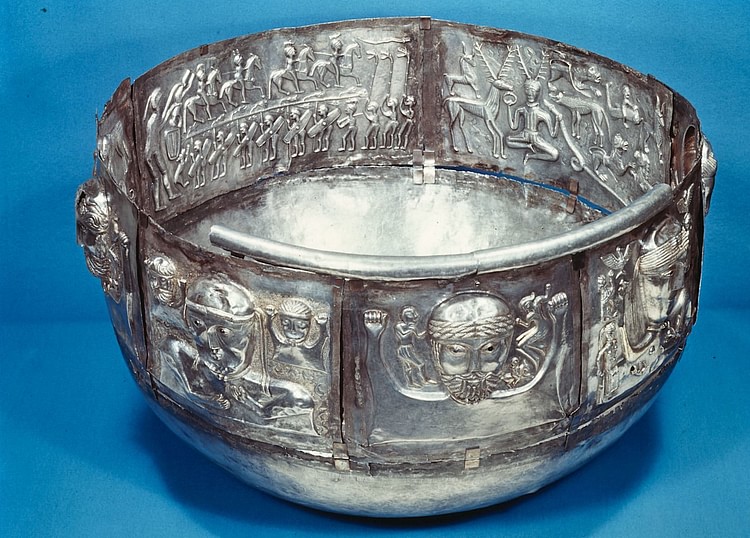 The Gundestrup Cauldron Nationalmuseet, Lennart Larsen (CC BY-SA) ](https://www.worldhistory.org/image/13405/the-gundestrup-cauldron/ "The Gundestrup Cauldron")
Still, beer was not as popular as wine among the [Celts](https://www.worldhistory.org/celt/), and this attitude was encouraged by the Romans, who had favored wine all along. The [Celtic](https://www.worldhistory.org/celt/) tribes paid enormous sums for wine provided by Italian merchants, and the people of [Gaul](https://www.worldhistory.org/gaul/) were famous for their love of Italian wines. Beer brewing continued to develop, however, in spite of the views of the elite that it was a low-class drink suitable only to barbarians and developed throughout Europe beginning in Germany.
### Beer in Northern Europe
The Germans were brewing beer (which they called *ol*, for "ale") as early as 800 BCE, as is known from great quantities of beer jugs, still containing evidence of the beer, in a tomb in the Village of Kasendorf in northern Bavaria, near Kulmbach. That the practice continued into the Christian era is evidenced by further archaeological finds and the written record. Early on, as it had been in Mesopotamia and Egypt, the craft of the brewer was the provenance of women, and the *Hausfrau* brewed her beer in the home to supplement the daily meals.
In time, however, the craft was taken over by Christian monks, primarily, and brewing became an integral part of the [daily life of medieval monks](https://www.worldhistory.org/article/1293/the-daily-life-of-medieval-monks/). The Kulmbacher Monchshof Kloster, a monastery founded in 1349 in Kulmbach, still produces their famous *Schwartzbier*, among other brews, today.
In 1516, the German *Reinheitsgebot* (purity law) was instituted, which regulated the ingredients which could legally be used in brewing beer (only water, barley, hops and, later, yeast) and, in so doing, continued the practice of legislation concerning beer which the Babylonians under [Hammurabi](https://www.worldhistory.org/hammurabi/) had done some 3,000 years earlier. The Germans, like those who preceded them, also instituted a daily beer ration and considered beer a necessary staple of their diet.
### Conclusion
From the Celtic lands (Germany through [Britain](https://www.worldhistory.org/disambiguation/Britain/), though which country brewed first is disputed), beer brewing spread, always following the same basic principles first instituted by the Sumerians: female brewers making beer in the home, use of fresh, hot water, and fermented grains. The Finnish [Saga](https://www.worldhistory.org/Saga/) of *Kalewala* (first written down in the 17th century from much older, pre-Christian, tales and consolidated in its present form in the 19th century) sings of the creation of beer at length, devoting more lines to the creation of beer than to the creation of the world.
The female brewer, Osmata, trying to make a great beer for a wedding feast, discovers the use of hops in brewing with the help of a bee she sends to gather the magical plant. The poem expresses an admiration for the effects of beer which any modern-day drinker would recognize:
> Great indeed the reputation
> Of the ancient beer of Kalew,
> Said to make the feeble hardy,
> Famed to dry the tears of women,
> Famed to cheer the broken-hearted,
> Make the aged young and supple,
> Make the timid brave and mighty,
> Make the brave men ever braver,
> Fill the heart with joy and gladness,
> Fill the mind with wisdom-sayings,
> Fill the tongue with ancient legends,
> Only makes the fool more foolish.
In the Finnish saga, as in the writings of the ancient Sumerians, beer was considered a magical brew from the gods, endowing the drinker with health, peace of mind, and happiness. This idea was cleverly phrased by the poet A.E. Houseman when he wrote, "Malt does more than Milton can to justify God's ways to man" (a reference to the English poet John Milton and his *Paradise Lost*). From ancient [Sumeria](https://www.worldhistory.org/Sumerians/) to the present day, Houseman's claim would go undisputed among those who have enjoyed the drink of the gods.
#### Editorial Review
This human-authored article has been reviewed by our editorial team before publication to ensure accuracy, reliability and adherence to academic standards in accordance with our [editorial policy](https://www.worldhistory.org/static/editorial-policy/).
## Bibliography
- [Bauer, S. W. *The History of the Ancient World.* W. W. Norton & Company, 2007.](https://www.worldhistory.org/books/039305974X/)
- [Bertman, S. *Handbook to Life in Ancient Mesopotamia.* Oxford University Press, 2005.](https://www.worldhistory.org/books/0195183649/)
- [Dalley, S. *Myths from Mesopotamia.* Oxford University Press, USA, 2009.](https://www.worldhistory.org/books/0199538360/)
- [Durant, W. *Our Oriental Heritage.* Simon & Schuster, 2005.](https://www.worldhistory.org/books/B00005WJGO/)
- [Ebrey, P. B. *The Cambridge Illustrated History of China.* Cambridge University Press, 2010.](https://www.worldhistory.org/books/0521124336/)
- [Egyptian Beer for the Living, the Dead..and the Gods](https://www.beeradvocate.com/archived-articles/629/ "Egyptian Beer for the Living, the Dead..and the Gods"), accessed 28 Mar 2026.
- [Free Online Library: World's Oldest Beer Receipt](https://www.thefreelibrary.com/Worlds-oldest-beer-receipt-a0141346971 "Free Online Library: World's Oldest Beer Receipt"), accessed 28 Mar 2026.
- [Kramer, S. N. *The Sumerians: Their History, Culture, and Character.* University of Chicago Press, 1971.](https://www.worldhistory.org/books/0226452387/)
- [Kriwaczek, P. *Babylon: Mesopotamia and the Birth of Civilization.* St. Martin's Griffin, 2012.](https://www.worldhistory.org/books/1250054168/)
- [Leick, G. *The A to Z of Mesopotamia.* Scarecrow Press, 2010.](https://www.worldhistory.org/books/0810875772/)
- [Nelson, M. *The Barbarian's Beverage.* Routledge, 2005.](https://www.worldhistory.org/books/0415311217/)
- [Oliver, G. *The Oxford Companion to Beer.* Oxford University Press, 2011.](https://www.worldhistory.org/books/0195367138/)
- [The Avalon Project : Code of Hammurabi](https://avalon.law.yale.edu/ancient/hamcode.asp "The Avalon Project : Code of Hammurabi"), accessed 28 Mar 2026.
- [The Kalevala – The Beginning of Beer in the Finnish Epic Saga by Damien Lawrie](https://notg.wordpress.com/2009/02/02/the-kalevala-the-beginning-of-beer-in-the-great-finnish-epic-saga/ "The Kalevala – The Beginning of Beer in the Finnish Epic Saga by Damien Lawrie"), accessed 28 Mar 2026.
- [Van De Mieroop, M. *A History of the Ancient Near East ca. 3000 - 323 BC, 2nd Edition.* Blackwell Publishing, 2003.](https://www.worldhistory.org/books/1405149116/)
- [Wilkinson,R. H. *The Complete Gods and Goddesses of Ancient Egypt.* Thames & Hudson, 2017.](https://www.worldhistory.org/books/0500284245/)
## About the Author
Joshua J. Mark is World History Encyclopedia's co-founder and Content Director. He was previously a professor at Marist College (NY) where he taught history, philosophy, literature, and writing. He has traveled extensively and lived in Greece and Germany.
- [Linkedin Profile](https://www.linkedin.com/pub/joshua-j-mark/38/614/339)
## Questions & Answers
### Where was beer first brewed?
Beer was first brewed in ancient China circa 7000 BCE.
### Where was the beer known today as "beer" first brewed?
Ancient beer, leading to the development of "modern beer" was first brewed in Mesopotamia circa 4000 BCE, was refined by the Egyptians, and was further refined by the Germans in circa 800 BCE, creating the drink known today.
### Did the Greeks and Romans like beer?
No. The Greeks and Romans preferred wine, but they still brewed beer.
### Who were the first brewers of beer?
The first brewers of beer were women in ancient Mesopotamia and this same paradigm was followed in Egypt and elsewhere until men realized how profitable it was to brew and sell beer and so took over its manufacture.
## External Links
- [Who Invented Beer? The Ancient Origins Of The Alcoholic Drink](https://allthatsinteresting.com/who-invented-beer)
- [Stewart Brewing/Ancient Beer: Fascinating History of Beer by Rosie Buckley](https://stewartbrewing.co.uk/blogs/news/ancient-beer-fascinating-history-of-beer-by-rosie-buckley?srsltid=AfmBOorGBLK89FM7EGNfBPGnnI1RA82L4uj3Hd2HxgjYVXBwje61LOoq)
- [Beer Institute/Beer & World History](https://www.beerinstitute.org/beer-culture/beer-world-history/)
- [NC State University/Accolades/Brewing Up Ancient Beer by Heather Moylan](https://web.ncsu.edu/accolades-magazine/2020/10/15/brewing-up-ancient-beer/index.html)
## Cite This Work
### APA
Mark, J. J. (2011, March 02). Beer in the Ancient World: The Drink of the Gods - For Some. *World History Encyclopedia*.
### Chicago
Mark, Joshua J.. "Beer in the Ancient World: The Drink of the Gods - For Some." *World History Encyclopedia*, March 02, 2011. .
### MLA
Mark, Joshua J.. "Beer in the Ancient World: The Drink of the Gods - For Some." *World History Encyclopedia*, 02 Mar 2011, .
## License & Copyright
Submitted by [Joshua J. Mark](https://www.worldhistory.org/user/JPryst/ "User Page: Joshua J. Mark"), published on 02 March 2011. The copyright holder has published this content under the following license: [Creative Commons Attribution-NonCommercial-ShareAlike](https://creativecommons.org/licenses/by-nc-sa/4.0/deed.en). This license lets others remix, tweak, and build upon this content non-commercially, as long as they credit the author and license their new creations under the identical terms. When republishing on the web a hyperlink back to the original content source URL must be included. Please note that content linked from this page may have different licensing terms.