---
title: Horace's Epistles
author: Donald L. Wasson
source: https://www.worldhistory.org/article/2170/horaces-epistles/
format: machine-readable-alternate
license: Creative Commons Attribution-NonCommercial-ShareAlike (https://creativecommons.org/licenses/by-nc-sa/4.0/)
updated: 2023-03-14
---
# Horace's Epistles
_Authored by [Donald L. Wasson](https://www.worldhistory.org/user/DWasson/)_
[Horace](https://www.worldhistory.org/Horace/)'s *Epistles* are a series of letters, providing sage advice to various friends. Quintus Horatius Flaccus, better known as Horace (65-8 BCE) wrote 20 letters around 20-19 BCE, collected in *Epistles I*, while *Epistles II*, most likely written at the end of his career, only contains two letters: one to Emperor [Augustus](https://www.worldhistory.org/augustus/) and one to [Julius](https://www.worldhistory.org/disambiguation/Julius/) Florus.
[  Horace Mark Cartwright (CC BY-NC-SA) ](https://www.worldhistory.org/image/6660/horace/ "Horace")### Horace
Quintus Horatius Flaccus was born in Venusia in the southeastern Italian province of Apulia on 8 December 65 BCE. His father, a freedman, worked as a public auctioneer and was allegedly enslaved when Venusia was captured by the Romans during the [Social War](https://www.worldhistory.org/Social_War/) of 91-87 BCE. Although the son of a freedman, Horace was able to attend the highly-respected school of Orbilius in [Rome](https://www.worldhistory.org/Rome/) and later study in [Athens](https://www.worldhistory.org/Athens/). In 43 BCE, while in Athens, he became acquainted with one of [the assassins](https://www.worldhistory.org/The_Assassins/) of [Julius Caesar](https://www.worldhistory.org/Julius_Caesar/), [Marcus Junius Brutus](https://www.worldhistory.org/Marcus_Junius_Brutus/). As a military [tribune](https://www.worldhistory.org/Tribune/) (*tribunus militum*), he fought alongside Brutus on the losing side at the [Battle](https://www.worldhistory.org/disambiguation/battle/) of [Philippi](https://www.worldhistory.org/Philippi/) in 42 BCE.
Upon returning to Rome, he discovered he had lost his father's estate. He described his time in Rome after Philippi in a letter to his close friend Julius Florus:
> …as soon as the battle of Philippi dismissed me in an abject condition with my wings clipped and destitute both of house and land, daring poverty urged me on to composition of verses. (*Epistles*, II-ii)
The young poet had a difficult time adjusting to his new life in Rome. Hamilton wrote that, when he returned from Philippi, he began to write, but these early writings display a "bitterness, even a brutality sometimes, which show how close he had come to the dangers of being permanently warped and stunted" (120-121). This, however, soon passed, and he was able to secure a position of a clerk to a *[quaestor](https://www.worldhistory.org/Quaestor/)* (*scriba quaestorus*).
In 38 BCE, through his acquaintance with the poets [Virgil](https://www.worldhistory.org/virgil/) (70-21 BCE) and Varius Rufus (74-14 BCE), he was introduced to Gaius Maecenas, a wealthy [Roman](https://www.worldhistory.org/disambiguation/Roman/) and patron of the arts who gathered around him a circle of young poets. Later, Maecenas would give the young poet a farm on the Sabine Hills at Tivoli where he would build a villa, which would be his sanctuary away from Rome. At the villa, Horace was able to pursue a leisurely existence away from the pressures of [city](https://www.worldhistory.org/city/) life.
Dedicating his life to poetry, Horace's friendship with Maecenas and Virgil brought him close to [Roman emperor](https://www.worldhistory.org/Roman_Emperor/) Augustus (r. 27 BCE to 14 CE), who, luckily for both poets (and [Ovid](https://www.worldhistory.org/ovid/)), was a patron of the arts. Despite his early allegiance to one of Caesar's assassins, Horace eventually became a close friend to the emperor. He offered Horace a position on the imperial staff, but he refused. However, in 17 BCE, he accepted the emperor's request to write a lyric poem: the *Carmen Saeculare,* or Secular Hymn, which celebrated the *Ludi saeculares,* the Secular Games.
### Works
Written over a period of 30 years, Horace's works include his *Satires*, *Epodes*, *Odes*, *Epistles,* and the lengthy *Ars Poetica*. Horace's poems demonstrate a joy for life and a love of nature. They not only speak of politics but also his admiration for the rural way of life. Horace's poetic style is considered to be rich, terse, and pointed. He wrote the semi-autobiographical *Satires* in 36-35 BCE, and many of the 17 poems of [Horace's Epodes](https://www.worldhistory.org/article/2192/horaces-epodes/) were written before his acquaintance with Maecenas but only published later, in 30-29 BCE. Lastly, the 88 *Odes* in 13 BCE were poems that celebrated the military and political achievements of Augustus, particularly the [Battle of Actium](https://www.worldhistory.org/Battle_of_Actium/). The letters of *Epistles I* were written around 20-19 BCE; however, the exact dates of the later *Epistles II* and *Ars Poetica* are unknown.
[  Odes of Horace Digital Collections at the University of Maryland (CC BY-NC-ND) ](https://www.worldhistory.org/image/7333/odes-of-horace/ "Odes of Horace")Along with the *Ars Poetica*, *Epistles II* represents the final chapter of the poet's career. The *Ars Poetica* – on the art of poetry – was the longest and the last of his works. According to author and translator Stephen Harrison, all three share a sense of Horace's "self-location" in [Roman literature](https://www.worldhistory.org/Roman_Literature/). They are concerned with a central theme: the usefulness of the poet, and Horace in particular, in the community of Rome. He was proud of what he had accomplished and his place in Roman poetry: "I was the original who set my free footsteps upon the vacant sod; I trod not in the steps of others." (*Epistles* I–xix) In *Epistles* I–xx, he also spoke of his last days and how he hoped to be remembered: "...you shall tell them that I was the son of a freedman and extended my wings beyond my nest ... I was in favor with the first man in the state, both in [war](https://www.worldhistory.org/disambiguation/War/) and peace ..."
### Epistles I
Like his *Satires* and *Odes*, in the *Epistles,* Horace tried to persuade his friends to live a thoughtful and moderate life, avoiding both stress and excess. This desire for a sensible life, together with his love for the solitude of his villa, is evidence of his time in Athens. For most of his adult life, Horace always held a deep respect and admiration for [Greek philosophy](https://www.worldhistory.org/Greek_Philosophy/), especially [Epicurus](https://www.worldhistory.org/Epicurus/) (341-270 BCE). In the letters of *Epistles* *I,* he renounced the frivolities of poetry for the serious concerns of [philosophy](https://www.worldhistory.org/philosophy/). In a letter to Julius Florus, Horace spoke of his transition to philosophy and attempted to persuade Florus to join him:
> What thyme are you busy hovering about? Your genius is not small ... If now you could quit the cold fomentations of care, whither some heavenly wisdom would lead you, you would go. Let us ... push forward in this work in this pursuit .
> (*Epistles* I-iii)
This desire to share his love of philosophy and persuade others to follow him can be seen in a letter to a young family friend, Lollius: "In everything you must read and consult the learned, by what means you may be included to pass your life in an agreeable manner" (*Epistles* I-viii). Horace's love of the [Greek](https://www.worldhistory.org/disambiguation/greek/) tradition is also evident in his admiration of the Greek poet, [Homer](https://www.worldhistory.org/homer/), preferring him as a moral writer. In an earlier letter to Lollius, he writes that he had "perused over again the writer of the [Trojan war](https://www.worldhistory.org/Trojan_War/); who teaches more clearly, and better than Chrysippus \[a Stoic\] and Crantor \[a Platonist\], what is honorable, what is shameful, what is profitable, what is not so…" (*Epistles* I-ii) After retelling the stories of [Troy](https://www.worldhistory.org/troy/), of Ulysses, of [Achilles](https://www.worldhistory.org/achilles/), Horace advises Lollius to "boldly undertake the study of true wisdom" and, while still young and with an untainted mind, to apply himself to be the master of morality (*Epistles* I-ii).
[  Horatius Reads before Maecenas Fyodor Bronnikov (Public Domain) ](https://www.worldhistory.org/image/17054/horatius-reads-before-maecenas/ "Horatius Reads before Maecenas")In one of the letters to Maecenas, Horace describes some of the significant changes in his life:
> My age is not the same, nor is my genius. ... I lay aside both verses and all sportive matters; my study and inquiry is after what is true and fitting, and I am wholly engaged in this: I lay up, and collect rules which I may be able hereafter to bring into use.
> (*Epistles* I-i)
Above all things Horace loved his villa on the Sabine Hills, preferring life in the country versus that of the city. In a letter to Aristius Fuscus, he praises one's life in the country: "If we must live suitably to nature and a plot of ground is to be sought to raise a house upon, do you know any place preferable to the blissful country?" (*Epistles* I-x) In a letter to his steward, he speaks of his reluctance to go to the city:
> When you were a drudge at everyone's beck, you tacitly prayed for the country, and now, being appointed my steward, you wish for the city, the shows, and the baths. You know I am consistent with myself, and loathe to go whenever disagreeable business drags me into Rome.
> (*Epistles*, I -xiv)
His letters and verses advocate being content with a person's lot in life and not worrying about what the future may bring. But in contrast to this, he remained keenly aware of the inevitability of [death](https://www.worldhistory.org/disambiguation/Death/). In a relatively short letter to Albert Tibrellus – a critic of Horace's works – the poet warns him that the gods have given him wealth and the ability to enjoy it but then reminds him of the possibility of death at any time: "In the midst of hope and care, in the midst of fears and disquietude think every day that shines upon you is the last." Horace ended the letter with a rather snide comment, "When you have a mind to laugh, you shall see me fat and sleek with good keeping a hog of Epicurus' herd," a subtle reference to the Greek philosopher who advocated a life of pleasure (*Epistles* I-iv).
To Quinctus, Horace again wrote on the subject of death: "For he who will be covetous will also be anxious: but he that lives in a state of anxiety will never in my estimation be free." (*Epistles* I-xvi). He added that an individual who is immersed in increasing his fortune has deserted the path of virtue. In the end, he tells Quinctus that "Death is the ultimate boundary of human matters" (*Epistles* I-xvi)
### Epistles II
Horace wrote during a transitional period in Roman history when the [Roman Republic](https://www.worldhistory.org/Roman_Republic/) was being replaced by an [empire](https://www.worldhistory.org/empire/) and an emperor. In a lengthy letter (*Epistles* II-i), he wrote to the emperor about the origins and character of poetry in both [Greece](https://www.worldhistory.org/greece/) and Rome. In the opening paragraph, he complimented Augustus on his role as emperor: "... in you alone support so many and such weighty concerns, defend [Italy](https://www.worldhistory.org/italy/) with your arms, adorn it by your virtue, reform it by your laws."
[ 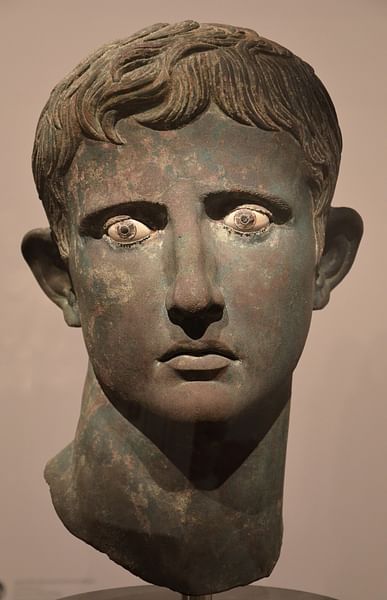 Bronze Head of Augustus Carole Raddato (CC BY-SA) ](https://www.worldhistory.org/image/2926/bronze-head-of-augustus/ "Bronze Head of Augustus")As time passed and his desire to write waned, he wrote to Florus: "The advancing years rob us of everything: they have taken away my mirth, my gallantry, my revelings and play; they are now proceeding to force poetry from me." (*Epistles* II-ii) Although he had renounced his own [writing](https://www.worldhistory.org/writing/) of verses, he had not lost his love of poetry; however, despite his own success and the respect of other poets, he appeared insecure and questioned his own position, unsure of his place in posterity. He wrote: "I had rather be esteemed a foolish and dull writer, while my faults please myself, or at least escape my notice than be wise and smart for it." (*Epistles* II -ii).
#### Editorial Review
This human-authored article has been reviewed by our editorial team before publication to ensure accuracy, reliability and adherence to academic standards in accordance with our [editorial policy](https://www.worldhistory.org/static/editorial-policy/).
## Bibliography
- [Beard, Mary. *SPQR.* Liveright, 2016.](https://www.worldhistory.org/books/1631492225/)
- [Edith Hamilton. *The Roman Way.* W. W. Norton, 1960.](https://www.worldhistory.org/books/0393354458/)
- [Flaccus, Quintus Horatius & Smart, Christopher. *The Complete Works of Horace.* Independently published, 2017.](https://www.worldhistory.org/books/1521560536/)
- [Horace & Harrison, Stephen. *How to Be Content.* Princeton University Press, 2020.](https://www.worldhistory.org/books/0691182523/)
- [Hornblower, Simon & Spawforth, Antony & Eidinow, Esther. *The Oxford Classical Dictionary.* Oxford University Press, 2012.](https://www.worldhistory.org/books/0199545561/)
- [Nigel Rodgers & Hazel Dodge. *Roman Empire.* Metro Books, 2023.](https://www.worldhistory.org/books/1435104552/)
- [Potter, David. *Emperors of Rome.* Metro Books, 2008.](https://www.worldhistory.org/books/1847240100/)
## About the Author
Donald has taught Ancient, Medieval and U.S. History at Lincoln College (Normal, Illinois)and has always been and will always be a student of history, ever since learning about Alexander the Great. He is eager to pass knowledge on to his students.
## Questions & Answers
### How many Epistles did Horace write?
Epistles I contains 20 letters, while Epistles II has only two.
### What subjects are covered in Horace's Epistles?
Horace writes about various topics, including the importance of philosophy, study, a poet's place in Rome, contentment in life, and the inevitability of death.
## Cite This Work
### APA
Wasson, D. L. (2023, February 14). Horace's Epistles. *World History Encyclopedia*.
### Chicago
Wasson, Donald L.. "Horace's Epistles." *World History Encyclopedia*, February 14, 2023. .
### MLA
Wasson, Donald L.. "Horace's Epistles." *World History Encyclopedia*, 14 Feb 2023, .
## License & Copyright
Submitted by [Donald L. Wasson](https://www.worldhistory.org/user/DWasson/ "User Page: Donald L. Wasson"), published on 14 February 2023. The copyright holder has published this content under the following license: [Creative Commons Attribution-NonCommercial-ShareAlike](https://creativecommons.org/licenses/by-nc-sa/4.0/deed.en). This license lets others remix, tweak, and build upon this content non-commercially, as long as they credit the author and license their new creations under the identical terms. When republishing on the web a hyperlink back to the original content source URL must be included. Please note that content linked from this page may have different licensing terms.