---
title: Cyrus the Great's Conquests
author: Matt Waters / Oxford University Press
source: https://www.worldhistory.org/article/2022/cyrus-the-greats-conquests/
format: machine-readable-alternate
updated: 2022-09-07
---
# Cyrus the Great's Conquests
_Authored by Matt Waters / Oxford University Press_
The estimated expanse of the [Achaemenid Empire](https://www.worldhistory.org/Achaemenid_Empire/) at its height c. 500 BCE was two million square miles. Most of this territory was conquered by [Cyrus the Great](https://www.worldhistory.org/Cyrus_the_Great/), the founder of the [Empire](https://www.worldhistory.org/empire/), who reigned from 559 to 530 BCE, the fourth king in his dynastic line as relayed in the opening quote from the [Cyrus Cylinder](https://www.worldhistory.org/article/166/the-cyrus-cylinder/), a foundational text for the study of [Cyrus](https://www.worldhistory.org/disambiguation/Cyrus/).
[  Cyrus the Great (Artist's Impression) Mohawk Games (Copyright) ](https://www.worldhistory.org/image/12931/cyrus-the-great-artists-impression/ "Cyrus the Great (Artist's Impression)")### The [Achaemenid](https://www.worldhistory.org/disambiguation/Achaemenid/) Empire
Cyrus' empire included terrain of all types and climes: mountains, plateaus, flood plains, wide rivers and seas, forbidding deserts, vast steppes, and thick forests. From its core in Parsa, the modern Iranian province of Fars, the Achaemenid Empire encompassed the known world from the western spurs of the Himalayas and modern Kazakhstan to the Sahara Desert and modern Libya and Sudan, from the [Indus Valley](https://www.worldhistory.org/Indus_Valley_Civilization/) to the Balkans. His conquests included the three major powers of his time: the [Medes](https://www.worldhistory.org/Medes/) in northern Iran, the kingdom of [Lydia](https://www.worldhistory.org/lydia/) in [Anatolia](https://www.worldhistory.org/Asia_Minor/), and the Babylonian Empire that encompassed [Mesopotamia](https://www.worldhistory.org/Mesopotamia/) as well as much of the [Levant](https://www.worldhistory.org/levant/).
#### Book Excerpt
[  ](https://global.oup.com/academic/product/king-of-the-world-9780190927172?utm_campaign=1433190041401686173&utm_source=third%20party&utm_medium=referral&utm_content=banner+link&utm_term=WHE "King of the World")### King of the World
by Matt Waters With an emphasis on primary sources, this most up-to-date biography of Cyrus the Great explains the king's influence among ancient Greeks and Macedonians, including Alexander the Great. [Learn More](https://global.oup.com/academic/product/king-of-the-world-9780190927172?utm_campaign=1433190041401686173&utm_source=third%20party&utm_medium=referral&utm_content=banner+link&utm_term=WHE)
.sponsor.book img.key_art {
box-shadow: none !important;
}
.button_container {
margin-top: 1em;
}
.sponsor.book h3 {
text-transform: none;
margin-top: 0px;
margin-bottom: 15px;
font-family: "Libre Baskerville", "Palatino Linotype", "Book Antiqua", Palatino, serif;
}
.sponsor_message {
margin-left: 190px;
font-family: Karla, Arial, Helvetica, sans-serif;
line-height: 140%;
min-height: 200px;
}
.sponsor.book {
padding: 20px;
margin: 25px 0px;
background-color: #f3f3f3;
}
.sponsor.book .key_art {
margin-top: 0px;
margin-bottom: 10px;
float: left;
}
.sponsor h4 {
font-weight: bold;
text-transform: uppercase;
color: #000;
margin-bottom: 10px;
margin-top: 0px;
font-family: Karla,Arial,Helvetica,sans-serif;
font-size: 13px;
padding: 0;
}
.sponsor_book_author {
color: #999;
margin: -10px 0px 20px;
}
@media (max-width: 1199px) {
.sponsor.book .key_art {
float: none;
width: 100%;
}
.sponsor.book .sponsor_message {
margin-left: 0px;
}
.sponsor.book h3 {
margin-top: 20px;
margin-bottom: 10px;
}
}
@media (max-width: 767px) {
}
Cyrus' military and organizational accomplishments were without rival in world history to that point, and one seldom surpassed since. The Achaemenid [Persian Empire](https://www.worldhistory.org/disambiguation/Persian_Empire/) as a geopolitical unit lasted from c. 550 to 330 BCE, from the reign of Cyrus the Great to [Darius](https://www.worldhistory.org/disambiguation/darius/) III, whose [death](https://www.worldhistory.org/disambiguation/Death/) in 330 BCE marked for all intents and purposes the formal passing of the throne to [Alexander](https://www.worldhistory.org/disambiguation/Alexander/) III (the Great) of [Macedon](https://www.worldhistory.org/macedon/). The word 'Achaemenid' is both a dynastic and a periodizing label. It stems from the name Achaemenes (Old Persian Haxāmaniš), the eponymous ancestor from whom [Darius I](https://www.worldhistory.org/Darius_I/) (r. 522-486 BCE) traced his lineage and to whom he also linked the lineage of the Empire's founder, Cyrus.
Cyrus the Great is one of the most pivotal, yet underappreciated, figures in history. He nonetheless remains an enigma in many ways, viewed through multiple traditions in which he still looms large. But before we consider Cyrus himself, attention is due to the milieu in which he lived, the influences upon him, those nations and peoples beyond his own with whom his forefathers interacted. This involves assessment of a broad range of documentary, archaeological, and art historical evidence, as well as their manifold problems of interpretation.
### Territorial Expanse
Cyrus' empire may be considered the culmination of 2,000 years of ancient history. His military and diplomatic acumen resulted in a unification of all the major kingdoms that encompassed the ancient [Near East](https://www.worldhistory.org/Near_East/): broadly defined, the widely diverse populations of Iran (ancient [Elam](https://www.worldhistory.org/elam/) and various Iranian kingdoms, including the Medes), of Anatolia (ancient [Urartu](https://www.worldhistory.org/Urartu_Civilization/), [Phrygia](https://www.worldhistory.org/phrygia/), and Lydia), and of Greater Mesopotamia and the Levant. The only exceptions to these sprawling conquests were northeastern [Africa](https://www.worldhistory.org/disambiguation/africa/) – the kingdom of [Egypt](https://www.worldhistory.org/egypt/) and territories stretching into Libya, the Sudan, and Ethiopia – and the Indus Valley; these were conquered by his son [Cambyses II](https://www.worldhistory.org/Cambyses_II/) (r. 530-522 BCE) and by his son-in-[law](https://www.worldhistory.org/disambiguation/law/) Darius I (r. 522-486 BCE) in the two decades after Cyrus' death in 530 BCE.
[ 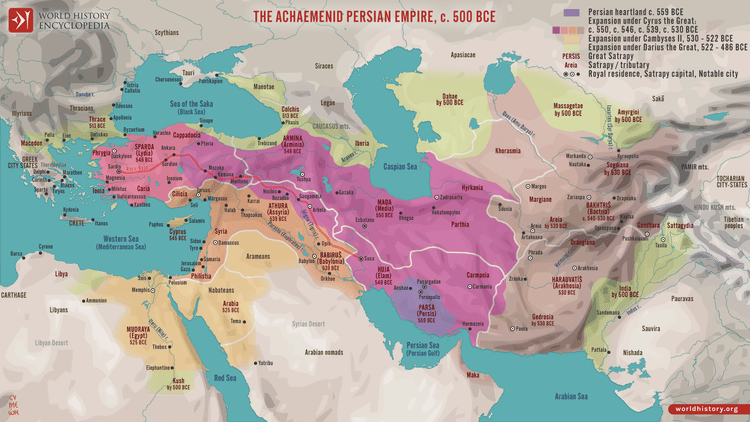 Map of the Achaemenid Persian Empire c. 500 BCE Simeon Netchev (CC BY-NC-ND) ](https://www.worldhistory.org/image/16107/map-of-the-achaemenid-persian-empire-c-500-bce/ "Map of the Achaemenid Persian Empire c. 500 BCE")Cyrus' conquests in Anatolia in the 540s BCE included several [Greek](https://www.worldhistory.org/disambiguation/greek/) [city](https://www.worldhistory.org/city/)-states, those Ionian and Dorian Greeks who had colonized several important [cities](https://www.worldhistory.org/city/) in the western part of what is now [Turkey](https://www.worldhistory.org/Asia_Minor/). Cyrus' extension of Persian power in these municipalities, separated by the [Aegean](https://www.worldhistory.org/aegean/) Sea but still closely linked to their mother cities in [Greece](https://www.worldhistory.org/greece/), laid the foundations for the so-called [Persian Wars](https://www.worldhistory.org/Persian_Wars/) fought by Darius I and [Xerxes I](https://www.worldhistory.org/Xerxes_I/) (r. 486-465 BCE) in the early 5th century BCE. To the Persians, of course, these were Greek wars, campaigns unto the far western fringes of their empire, the impetus for which was both retribution and imperialism, which brought Cyrus' grandson [Xerxes](https://www.worldhistory.org/Xerxes_I/) into [Europe](https://www.worldhistory.org/europe/) and the Greek peninsula. The infamous battles of [Thermopylae](https://www.worldhistory.org/thermopylae/) and [Salamis](https://www.worldhistory.org/disambiguation/Salamis/) are touchstones of the Western tradition, the tipping points of traditional, historical narratives that symbolize the epitome of a free people fighting to remain so. These battles remain such powerful symbols that they overshadow Xerxes' successful campaign in the sacking (twice!) of [Athens](https://www.worldhistory.org/Athens/) and the receipt of tribute from many city-states of Greece, itself symbolic of their inclusion in the Empire. That perspective frames the narrative from the Achaemenid point of view.
The extent of Cyrus' conquests, and the staying power of the Achaemenid Empire, can be difficult to grasp, especially considered in light of the previous era. For the periods before 500 BCE, detailed chronological tables organized by regions such as Mesopotamia, Egypt, Anatolia, and Iran usually indicate a distinct dynasty or kingdom for each region, occasionally one that overlaps its immediate geographic neighbors. Less frequently, a single power will fill multiple sections of the table, for example, Egypt in the 14th century BCE or [Assyria](https://www.worldhistory.org/assyria/) in the 8th and 7th centuries BCE. In the time of Cyrus and his successors, almost all the timeline's sections are subsumed under one power, Achaemenid [Persia](https://www.worldhistory.org/Persia/). The rapid pace and efficiency with which Cyrus spread Persian rule laid the foundations for an empire that endured for more than two centuries, one that left an indelible, if not always traceable, impact on its successors.
[  Cyrus the Great Siamax (CC BY-SA) ](https://www.worldhistory.org/image/8168/cyrus-the-great/ "Cyrus the Great")### Cultural Impact
To study Cyrus is also to study the Persian imperial impetus, the seminal, if often overlooked, impact of the Empire on many subject and peripheral peoples, not just Greeks. To take yet another example, within the biblical tradition, Cyrus was, literally, the anointed one, a messiah figure – termed as such in the Book of [Isaiah](https://www.worldhistory.org/Isaiah/). He was [Yahweh](https://www.worldhistory.org/Yahweh/)'s chosen one to unite the lands and to lay the foundations for the so-called Second [Temple](https://www.worldhistory.org/temple/) period of Judean history. [Jerusalem](https://www.worldhistory.org/jerusalem/) had been sacked, the Temple of [Solomon](https://www.worldhistory.org/solomon/) destroyed, and many of its people (including the royal house) removed to [Babylon](https://www.worldhistory.org/babylon/) by the Babylonian king [Nebuchadnezzar II](https://www.worldhistory.org/Nebuchadnezzar_II/) (r. 605/604-562 BCE) in 587-586. After Cyrus' [conquest](https://www.worldhistory.org/warfare/) of [Babylonia](https://www.worldhistory.org/babylon/) in 539 BCE, these Judean exiles were allowed to return home. This resulted in the reconstruction of the [Temple in Jerusalem](https://www.worldhistory.org/article/852/the-temple-in-jerusalem/) and inaugurated its renewal under Persian aegis. These returning exiles arrived bearing Cyrus' message of liberation and incorporated it into their own traditions…
He was more than a successful general and charismatic leader. He deserves a place in the reckoning of other famous leaders and conquerors in world history who came after him: from [Alexander the Great](https://www.worldhistory.org/Alexander_the_Great/) (r. 336-323 BCE), for whom Cyrus served in many ways as a model, to [Julius Caesar](https://www.worldhistory.org/Julius_Caesar/) (100-44 BCE) and beyond. In fact, it is not until the time of [Genghis Khan](https://www.worldhistory.org/Genghis_Khan/) (r. 1206-1227) that a comparable case may be fielded, one who, like Cyrus, built his empire from modest beginnings and, so it may seem to the present-day observer, exploded onto the world stage with little warning. That Cyrus was able to [conquer](https://www.worldhistory.org/warfare/) so much territory, and yet receive almost universally positive press as an individual and as a ruler in both contemporary and later sources – Babylonian, Hebrew, Greek, [Roman](https://www.worldhistory.org/disambiguation/Roman/), and Persian – is a stunning testimony to the man and to the king.
#### Editorial Review
This human-authored article has been reviewed by our editorial team before publication to ensure accuracy, reliability and adherence to academic standards in accordance with our [editorial policy](https://www.worldhistory.org/static/editorial-policy/).
## Cite This Work
### APA
Press, M. W. /. O. U. (2022, August 15). Cyrus the Great's Conquests. *World History Encyclopedia*.
### Chicago
Press, Matt Waters / Oxford University. "Cyrus the Great's Conquests." *World History Encyclopedia*, August 15, 2022. .
### MLA
Press, Matt Waters / Oxford University. "Cyrus the Great's Conquests." *World History Encyclopedia*, 15 Aug 2022, .
## License & Copyright
[](https://global.oup.com/)This content is provided by [Oxford University Press](https://global.oup.com/) and republished with permission. All Rights Reserved. Original article by [**Matt Waters / Oxford University Press**](https://global.oup.com/). Submitted by [Oxford University Press](https://www.worldhistory.org/user/oxforduniversit/ "User Page: Oxford University Press"), published on 15 August 2022. The copyright holder has published this content under the following license: [Copyright](http://en.wikipedia.org/wiki/Copyright). You cannot use, copy, distribute, or modify this item without explicit permission from the author. Please note that content linked from this page may have different licensing terms.