---
title: Legions of Mesopotamia, Cappadocia, & Arabia
author: Donald L. Wasson
source: https://www.worldhistory.org/article/1988/legions-of-mesopotamia-cappadocia--arabia/
format: machine-readable-alternate
license: Creative Commons Attribution-NonCommercial-ShareAlike (https://creativecommons.org/licenses/by-nc-sa/4.0/)
updated: 1970-01-01
---
# Legions of Mesopotamia, Cappadocia, & Arabia
_Authored by [Donald L. Wasson](https://www.worldhistory.org/user/DWasson/)_
As the [Roman Empire](https://www.worldhistory.org/Roman_Empire/) expanded further eastward, annexing territories that were once the domain of the Parthians, the legions of [Mesopotamia](https://www.worldhistory.org/Mesopotamia/), Cappadocia, and [Arabia](https://www.worldhistory.org/Arabia/) were called upon to safeguard these newly acquired territories. Mesopotamia had two permanent legions, I Parthica and III Parthica, Cappadocia was the home base of XII Fulminata and XV Apollinaris, while III Cyrenaica was stationed in Arabia.
[  Parthian Cataphract Simeon Netchev (CC BY-NC-ND) ](https://www.worldhistory.org/image/15254/parthian-cataphract/ "Parthian Cataphract")### Legions of Mesopotamia
The ancient territory of Mesopotamia lies between the Tigris and Euphrates Rivers, the old [Fertile Crescent](https://www.worldhistory.org/Fertile_Crescent/). Throughout the late [Roman Republic](https://www.worldhistory.org/Roman_Republic/) and the early [Roman](https://www.worldhistory.org/disambiguation/Roman/) [Empire](https://www.worldhistory.org/empire/), the region was controlled by the Parthians, containing several prosperous [cities](https://www.worldhistory.org/city/): [Edessa](https://www.worldhistory.org/edessa/), Carrhae, and Nisibis. The [Battle of Carrhae, 53 BCE](https://www.worldhistory.org/article/1406/battle-of-carrhae-53-bce/), showed how effective [Parthian warfare](https://www.worldhistory.org/Parthian_Warfare/) really was; it was one of the worse military disasters in Roman history. In 114 CE, [Roman emperor](https://www.worldhistory.org/Roman_Emperor/) [Trajan](https://www.worldhistory.org/trajan/) (r. 98-117 CE) successfully invaded [Armenia](https://www.worldhistory.org/armenia/) and Upper Mesopotamia, capturing the capital [city](https://www.worldhistory.org/city/) of [Ctesiphon](https://www.worldhistory.org/ctesiphon/) and annexing both territories. Although he had successfully annexed both, another Jewish uprising, declining troop morale, and illness forced him to withdraw. He died shortly afterwards. His successor, [Hadrian](https://www.worldhistory.org/hadrian/) (r. 117-138 CE), made peace with the Parthians and left the provinces in the hands of client kings.
Mesopotamia was finally annexed by Emperor [Septimius Severus](https://www.worldhistory.org/Septimius_Severus/) (r. 193-211 CE) during his Parthian campaign of 198 CE. He viewed the acquisition as a bulwark for the eastern provinces. Unlike other provinces, Mesopotamia had a governor appointed by the emperor, not the [Roman Senate](https://www.worldhistory.org/Roman_Senate/). Two legions were specifically created by Severus for its defense: Legio I Parthica and Legio III Parthica. Although some historians contend the legionaries were recruited in Macedonia and Thrace, others believe they were recruited in the East. After his failed assault on Hatra, Severus left the two legions to garrison Mesopotamia.
Legio I Parthica (emblem: [centaur](https://www.worldhistory.org/centaur/); birth sign: Capricorn) was based at Singara. Like the other legions of the campaign, it participated in the looting of Ctesiphon. Legio III Parthica (emblem: centaur; birth sign: Capricorn) was stationed at Rhesaina along the Khabur River. Although stationed outside [Rome](https://www.worldhistory.org/Rome/) for most of its existence, a third legion, Legio II Parthica, was also created and participated in the East. Little is known about the activities of I Parthica and III Parthica due to the lack of available literary evidence. I Parthica served the empire well, earning such titles as Severiana, Antoniniana Severiana, Alexandriana, and Philippiana. III Parthica participated notably in the wars of [Macrinus](https://www.worldhistory.org/Macrinus/) (r. 217- 218 CE) and [Gordian III](https://www.worldhistory.org/Gordian_Emperors/) (r. 238-244 CE).
The region remained a place of bitter contention between the Romans and Persians. In 260 CE, King [Shapur I](https://www.worldhistory.org/Shapur_I/) (r. 240-270 CE) of the [Sassanian Empire](https://www.worldhistory.org/Sasanian_Empire/) (224-651 CE) invaded the province, defeating and capturing the emperor [Valerian](https://www.worldhistory.org/valerian/) (r. 253-260 CE) near Edessa. Valerian had attempted to negotiate a peace settlement; however, he was captured and led away, later to be skinned and tanned. The emperor's son and co-emperor [Gallienus](https://www.worldhistory.org/Gallienus/) (r. 260-268 CE) assumed the throne.
[  Valerian Defeated by Shapur I Pierre Mertens (CC BY-NC-ND) ](https://www.worldhistory.org/image/7572/valerian-defeated-by-shapur-i/ "Valerian Defeated by Shapur I")A century later, in 360 CE, King [Shapur II](https://www.worldhistory.org/Shapur_II/) (r. 309-379 CE) laid siege to Singara, the base of I Parthica. After several days of siege, the walls of the city were breached, and Shapur entered. Historian Stephen Dando-Collins in his *Legions of Rome* contends that, after the fall of Singara, most of the men of I Parthica and I Flavia were captured and led away in chains to become slaves; however, some evidence shows that I Parthica was still in existence in the 4th century CE at Constantia. The Persians moved on to Bezabde, guarded by the Roman legions II Parthica, II Flavia, and II Armenia. III Parthica also fell to Shapur II and may have been destroyed; however, there is evidence it was later stationed at Apatna in Osrhoene. Emperor Jovian (r. 363-364 CE) agreed to the demands of the Persians and pulled out of Mesopotamia in 363 CE. Dando-Collins wrote that Jovian surrendered five provinces in Mesopotamia and southern Armenia to Shapur and relinquished 15 fortresses, including Nisibis and Singara.
### Legions of Cappadocia
The province of Cappadocia was located in east-central [Anatolia](https://www.worldhistory.org/Asia_Minor/) and was vital for its proximity to both the Black Sea and the Caucasus Mountains. Although an independent kingdom, it had been ruled by a Roman appointee since the time of [Mark Antony](https://www.worldhistory.org/Mark_Antony/) (83-30 BCE) and later [Augustus](https://www.worldhistory.org/augustus/) (r. 27 BCE to 14 CE) until he was deposed by Emperor [Tiberius](https://www.worldhistory.org/Tiberius/) (14-37 CE) in 17 CE when the region became a Roman province. There are those who question the exact date of annexation. Dando-Collins claims it was annexed by Vespasian (r. 69-79 CE) in 71 CE, not by Tiberius. The Roman historian [Suetonius](https://www.worldhistory.org/Suetonius/) (c. 69 to c. 130/140 CE) agrees with the date of Tiberius' annexation. In his *The Twelve Caesars,* he wrote that Tiberius disciplined foreign kings who he suspected of ill-will towards Rome: "Among them were Maroboduus the German, Rhascuporis the Thracian and [Archelaus](https://www.worldhistory.org/disambiguation/Archelaus/) the Cappadocian whose kingdom he reduced to a provincial status" (125).
The province's importance was demonstrated when it served as a base for the invasion of Armenia in 58-63 CE during Gnaeus Domitius Corbulo's Parthian campaign. Corbulo had served as the governor of both Cappadocia and [Galatia](https://www.worldhistory.org/galatia/). Legio XII Fulminata and Legio XV Apollinaris were placed in Cappadocia by Vespasian.
**Legio XII Fulminata**
Although its exact origins are in question, the legion XII Fulminata (emblem: thunderbolt; birth sign: Capricorn) may have been formed by [Julius Caesar](https://www.worldhistory.org/Julius_Caesar/) (100-44 BCE) for his campaign against the Helvetii in his Gallic Wars. Since legions of the [Roman army](https://www.worldhistory.org/Roman_Army/) during the time of [Caesar](https://www.worldhistory.org/disambiguation/caesar/) were known by a number, not a name, there were often more legions with the same number; both [Octavian](https://www.worldhistory.org/augustus/) and [Mark](https://www.worldhistory.org/disambiguation/Mark/) [Antony](https://www.worldhistory.org/Mark_Antony/) had a 12th legion. Octavian's legion was with him in [Egypt](https://www.worldhistory.org/egypt/) and was part of his standing army – many consider his legion to have been reconstituted from Caesar's old 12th legion. By the reign of Emperor [Claudius](https://www.worldhistory.org/claudius/) (r. 41-54 CE), the 12th was based in [Syria](https://www.worldhistory.org/syria/). Unfortunately, the legion had the misfortune to participate in two of Rome's major defeats: the over-confident Paetus' surrender in Armenia in 62 CE and Gallus' failed assault on [Jerusalem](https://www.worldhistory.org/jerusalem/).
[ 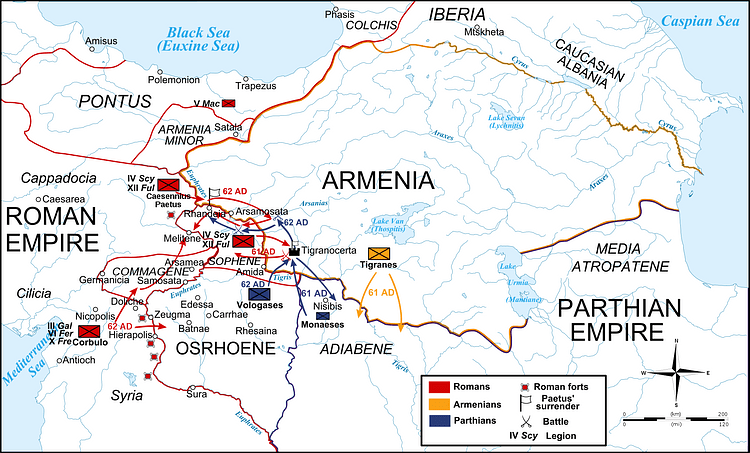 Map of the Roman-Parthian War, 61-63 CE Cplakidas (CC BY-SA) ](https://www.worldhistory.org/image/567/map-of-the-roman-parthian-war-61-63-ce/ "Map of the Roman-Parthian War, 61-63 CE")In 62 CE, Armenia was invaded by the Parthians. Claiming he would only need two legions in Armenia, the IV Scythica and XII Fulminata, the self-confident commander, Caesennius Paetus, entered Armenia and stationed his army at Rhandeia for the winter. Unfortunately for Paetus and his legions, the Parthian army surrounded the camp and began a siege. Receiving a plea from Paetus, Corbulo put together a relief force, but not before Paetus signed an embarrassing agreement with the Parthians that called for the Romans to exit Armenia. In his *Annals* [Tacitus](https://www.worldhistory.org/tacitus/) recounts the defeat"
> \[Leaving the 5th legion in Pontus\] The rest he had weakened by indiscriminate furloughs till it was heard that Vologases was approaching with a powerful force bent on [war](https://www.worldhistory.org/disambiguation/War/). He summoned the 12th legion and then was discovered the numerical feebleness of the source from which he had hoped for the repute of an augmented army. (*Annals* 15.10)
Adding V Macedonica and XV Apollinaris to his own legions, Corbulo was able to renegotiate a new treaty from a position of strength: [Parthia](https://www.worldhistory.org/disambiguation/Parthia/) would withdraw from Armenia.
Afterwards, the legion returned to Syria and was based at Raphanaea. Following the [Great Jewish Revolt of 66 CE](https://www.worldhistory.org/article/823/the-great-jewish-revolt-of-66-ce/), the governor of Syria, Cestius Gallus, advanced with the 12th on Jerusalem only to be forced to retreat. Due to its reduced numbers, Vespasian refused to use the legion; however, his son [Titus](https://www.worldhistory.org/disambiguation/Titus/) employed the 12th along with the III Cyrenaica, the X Fretensis, the V Macedonica, and the XV Apollinaris in his siege of Jerusalem.
Following the siege, the legion was sent to Melitene on the banks of the Euphrates. Sources claim the legion participated in the suppression of [the Bar-Kochba Revolt](https://www.worldhistory.org/The_Bar-Kochba_Revolt/) of 132-135 CE and later supported Septimius Severus against the claimant Pescennius Niger in 193 CE. Other sources place the legion fighting against Shapur I and his invasion of 252 CE capturing Satala. The legion remained at Melitene through the 4th century CE.
**Legion XV Apollinaris**
Like other legions, the origin of XV Apollinaris (emblem: griffin; birth sign: Capricorn) is a mystery. Historian Dando-Collins credits its foundation to [Julius](https://www.worldhistory.org/disambiguation/Julius/) Caesar in 54 BCE and his Gallic Wars. Octavian's 15th legion was possibly reconstituted from Caesar's old legion. The name 'Apollinaris' suggests it derives from Octavian's favorite [god](https://www.worldhistory.org/God/), [Apollo](https://www.worldhistory.org/apollo/). During the imperial period, the legion was stationed in Pannonia, participating in Rome's offensive during the Pannonian Revolt of 6-9 CE. In 14 CE, the 15th, along with L.egio VIII Augusta and [Legio IX Hispana](https://www.worldhistory.org/Legio_IX_Hispana/) staged a revolt, later to be suppressed by Tiberius' son Drusus (14 BCE to 23 CE). Tacitus wrote of the mutiny:
> Their only relief from misery was to quit an ill-omened and polluted camp and … to betake themselves again every one to his winter-quarters. First the eighth then the fifteenth legion returned … (*Annals* 1.30)
In 62-63 CE, the legion was transferred to the East. During the outbreak of the Jewish Revolt, Titus took the 15th to Syria where it joined the V Macedonica and X Fretensis. The legion participated in the invasion of Galilee and the attack on Jotapata. After Vespasian was acclaimed emperor, cohorts of the legion supported the Roman commander Macrinus in his march into [Italy](https://www.worldhistory.org/italy/). The remainder of the legion served on the march on Jerusalem.
[ 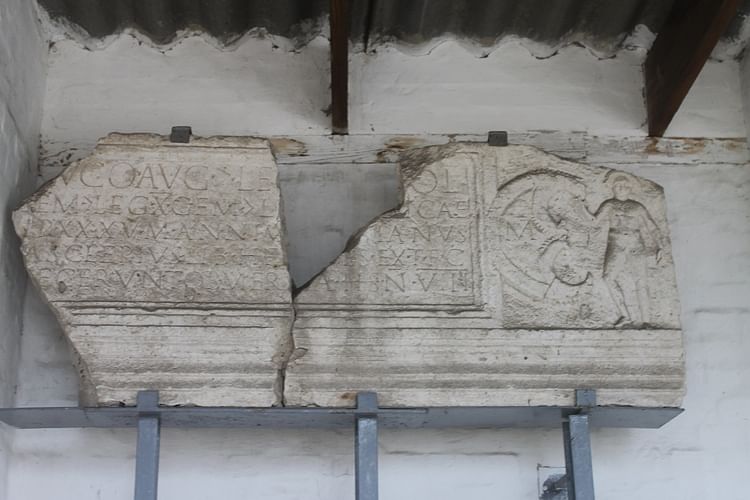 Funerary Monument of M. Annius Lucus AncientDigitalMaps (CC BY-NC) ](https://www.worldhistory.org/image/15142/funerary-monument-of-m-annius-lucus/ "Funerary Monument of M. Annius Lucus")Afterwards, the 15th returned to Pannonia, participating in Trajan's Dacian Wars of 115-116 CE and possibly his Parthian Wars. The legion was subsequently sent to Satala in Cappadocia, replacing the XVI Flavia. In 135 CE, at the end of the Second Jewish Revolt, warriors from the Alans and Sarmatians seized the opportunity and went on the march. Flavianus Arrianus ([Arrian](https://www.worldhistory.org/Arrian/)), governor of Cappadocia, repelled the invasion of Lower Armenia with the 15th and XII Fulminata. In 175 CE, the legion participated in Emperor [Marcus Aurelius](https://www.worldhistory.org/Marcus_Aurelius/)' (r. 161-180 CE) Danubian Wars and remained loyal to the emperor during the Avidius Cassius' revolt. The 15th remained at Satala through the 4th century CE.
### Legion of Arabia - III Cyrenaica
The Roman province of Arabia Petraea was annexed unopposed in 106 CE by the Syrian governor, Cornelius Palma. The new province comprised what is today [Jordan](https://www.worldhistory.org/Jordan/) and southern Syria and included the cities of Bostra (the capital), Gerasa, and Petra. Previously stationed in Egypt, Legio III Cyrenaica was transferred to Arabia, replacing VI Ferrata.
At the [Battle of Actium](https://www.worldhistory.org/Battle_of_Actium/) in 31 BCE, the III Cyrenaica (emblem: [Jupiter](https://www.worldhistory.org/jupiter/)?; birth sign: Capricorn?) was under the command of Lucius Pinarius Scarpus, an ally of Mark Antony. Its name indicates it was raised by Antony in Cyrenaica in Northern [Africa](https://www.worldhistory.org/disambiguation/africa/). Dando-Collins writes that the legion surrendered to Octavian at Actium. Afterwards, the legion became part of Octavian's 28 standing legions and was placed under Cornelius Gallus who used it to subdue Egypt, later stationing it at Nicopolis with the XXII Deiotariana. The legion was involved in the annexation of Arabia where it is believed many of its legionaries were recruited only to be returned to Egypt temporarily.
The 3rd was with Corbulo in 63 CE, and during the First Jewish War, it was involved in the siege of Jerusalem under the command of Titus. After having served as one of the [legions of the Parthian Wars](https://www.worldhistory.org/article/1764/legions-of-the-parthian-wars/) in Trajan's campaign of 113 -114 CE, by 140 CE, it was based permanently at Bostra. Like other legions of the region, it may have participated in the Roman offense against both Shapur I and Queen [Zenobia](https://www.worldhistory.org/zenobia/) of Palmyra. There is some evidence it was with Gallienus and his campaign against the [Alemanni](https://www.worldhistory.org/alemanni/) in 258 CE. It remained at Bostra into the 4th century CE.
#### Editorial Review
This human-authored article has been reviewed by our editorial team before publication to ensure accuracy, reliability and adherence to academic standards in accordance with our [editorial policy](https://www.worldhistory.org/static/editorial-policy/).
## Bibliography
- [Dando-Collins, Stephen. *Legions of Rome.* Thomas Dunne Books, 2012.](https://www.worldhistory.org/books/1250004713/)
- [Goldsworthy, Adrian Keith. *Pax Romana.* Yale University Press, 2016.](https://www.worldhistory.org/books/B01L7SSED8/)
- [Grant, Michael. *The Roman Emperors.* Barnes & Noble Books, 1997.](https://www.worldhistory.org/books/0760700915/)
- [Heather, Peter. *The Fall of the Roman Empire.* Oxford University Press, 2005.](https://www.worldhistory.org/books/B000SEI0JQ/)
- [Nigel Rodgers & Hazel Dodge. *Roman Empire.* Metro Books, 2013.](https://www.worldhistory.org/books/1435104552/)
- [Pollard, Nigel & Berry, Joanne. *The Complete Roman Legions.* Thames & Hudson, 2012.](https://www.worldhistory.org/books/0500251835/)
- [Suetonius. *The Twelve Caesars.* Penguin Classics, 2007.](https://www.worldhistory.org/books/0140455167/)
- [Tacitus, Publius Cornelius. *Delphi Complete Works of Tacitus .* Delphi Classics, 2014.](https://www.worldhistory.org/books/B00HTBUBQ6/)
## About the Author
Donald has taught Ancient, Medieval and U.S. History at Lincoln College (Normal, Illinois)and has always been and will always be a student of history, ever since learning about Alexander the Great. He is eager to pass knowledge on to his students.
## Questions & Answers
### Which legions served in Mesopotamia?
Mesopotamia was annexed by Emperor Septimius Severus (r. 193-211 CE) who left two legions in garrison there: I Parthica in Singara and III Parthica at Rhesaina along the Khabur River.
### Which legions served in Cappadocia?
Legio XII Fulminata and Legio XV Apollinaris were placed in Cappadocia by Vespasian (r. 69-79 CE).
## Cite This Work
### APA
Wasson, D. L. (2022, April 19). Legions of Mesopotamia, Cappadocia, & Arabia. *World History Encyclopedia*.
### Chicago
Wasson, Donald L.. "Legions of Mesopotamia, Cappadocia, & Arabia." *World History Encyclopedia*, April 19, 2022. .
### MLA
Wasson, Donald L.. "Legions of Mesopotamia, Cappadocia, & Arabia." *World History Encyclopedia*, 19 Apr 2022, .
## License & Copyright
Submitted by [Donald L. Wasson](https://www.worldhistory.org/user/DWasson/ "User Page: Donald L. Wasson"), published on 19 April 2022. The copyright holder has published this content under the following license: [Creative Commons Attribution-NonCommercial-ShareAlike](https://creativecommons.org/licenses/by-nc-sa/4.0/deed.en). This license lets others remix, tweak, and build upon this content non-commercially, as long as they credit the author and license their new creations under the identical terms. When republishing on the web a hyperlink back to the original content source URL must be included. Please note that content linked from this page may have different licensing terms.