---
title: Trade & Warfare in the Kievan Rus
author: James Hancock
source: https://www.worldhistory.org/article/1980/trade--warfare-in-the-kievan-rus/
format: machine-readable-alternate
license: Creative Commons Attribution-NonCommercial-ShareAlike (https://creativecommons.org/licenses/by-nc-sa/4.0/)
updated: 1970-01-01
---
# Trade & Warfare in the Kievan Rus
_Authored by [James Hancock](https://www.worldhistory.org/user/geneticsofberries/)_
Scandinavians from the island of Gotland began to spread throughout the Baltic region along the Russian rivers in the 700s. While the [Vikings](https://www.worldhistory.org/Vikings/) of Norway and Denmark from the 8th to 11th centuries are widely recognized as fearsome raiders and colonists, Gotlander traders were as much warriors as businessmen and advanced into new areas via fortified outposts.
[  Guests from Overseas Nicholas Roerich (Public Domain) ](https://www.worldhistory.org/image/15589/guests-from-overseas/ "Guests from Overseas")Once the local people were pacified, new settlers were recruited to create towns and trading [cities](https://www.worldhistory.org/city/). This process was repeated over and over as the Gotlanders moved further east until their sphere of influence touched the [Byzantine](https://www.worldhistory.org/disambiguation/Byzantine/) and Islamic worlds.
The Gotlanders came to be called Varangians, a name probably derived from the Old Norse word *var*, which means "union by promise". The Gotlandic merchants kept themselves together by making mutual oaths for defense and profit-sharing. The Varangians became wealthy by trading slaves, furs (beaver and black fox), and swords, and Arab dirhams became their favored medium of exchange.
### [Trade](https://www.worldhistory.org/disambiguation/trade/) with the Muslims & Byzantines
The Gotlandic merchants who settled in the East Slavic area of modern-day northern Russia were called al-Rus by the Arabs. *Rhos* (*Rus*) came from the old Norse word *ruotsi*, which meant "expedition of rowing boats". Over time, these Rus assimilated with the native Slavs along the rivers and lost their distinct Gotland identity.
In the second half of the 700s, Rus traders began moving south down the waterways of northern Central [Europe](https://www.worldhistory.org/europe/) and established two major trade routes:
1. down the Volga and across the Caspian Sea to the Muslim-held lands as far as Baghdad
2. across the Black Sea to the Christian [Byzantine Empire](https://www.worldhistory.org/Byzantine_Empire/)
Both these routes passed through the Jewish Khazar Kingdom where they were tithed.
The [city](https://www.worldhistory.org/city/) of Baghdad must have been an amazing sight to the Rus. Between 903 and 913, the Arab writer Ibn Rustah wrote an eyewitness account that recorded the Rus had "no villages, no cultivated fields" and that "their only occupation is trading in sable and squirrel and other kinds of skins, which they sell to those who will buy them" (Gabriel, 3). Baghdad was now the crown jewel of the [Islamic caliphates](https://www.worldhistory.org/Islamic_Caliphates/), a lavishly embellished city with expansive green parks and gardens, marble palaces, promenades, and finely built mosques.
[  Varangian Trade Routes Briangotts (CC BY-SA) ](https://www.worldhistory.org/image/15546/varangian-trade-routes/ "Varangian Trade Routes")The Rus traveled across their trade routes in pursuit of Arabic [silver](https://www.worldhistory.org/Silver/) coins and [silk](https://www.worldhistory.org/Silk/), spices, wine, jewelry, glass, and books from the Byzantine [Empire](https://www.worldhistory.org/empire/). In return, they traded captured Slavs from the Eurasian Steppe and offered fur, honey, wax, and timber. The silk trade can be traced from [Constantinople](https://www.worldhistory.org/Constantinople/), or Rayy in Iran, to Kiev and Novgorod, then into the Baltic and Scandinavia, and finally into [England](https://www.worldhistory.org/disambiguation/england/). Gotland has been pinpointed as the origin of this Eastern European trade network by the extraordinary amount of Islamic silver coins that have been uncovered there. The silver used to mint these coins came from mines within the Muslim-controlled provinces in Central Asia.
### Formation of the [Kievan Rus](https://www.worldhistory.org/Kievan_Rus/)
In the late 9th century, Prince Oleg (879-912) of the Rurikid Dynasty of Varangians formed a loose federation in Eastern and Northern Europe which came to be called the Kievan Rus. Oleg established the Rus in 862 began with Novgorod as his capital (160 km south of Saint Petersburg) and extended his control from Novgorod south along the Dnieper River valley and ultimately moved his capital south to the more strategic Kiev (Kyiv in today's Ukraine).
At its greatest extent, the Kievan Rus ruled an area stretching from the White Sea in the north to the Black Sea in the south and from the headwaters of the Vistula in the west to the Taman Peninsula in the east. The modern nations of Belarus, Russia, and Ukraine all have Kievan Rus as their cultural ancestors. The Kievan Rus ruled for 700 years until they were defeated by the [Mongols](https://www.worldhistory.org/Mongol_Empire/) between 1237-1242.
[  11th century CE Kievan Rus Territories SeikoEn (CC BY-SA) ](https://www.worldhistory.org/image/7773/11th-century-ce-kievan-rus-territories/ "11th century CE Kievan Rus Territories")Much is known about the Kievan Rus because of a manuscript called the *Russian Primary Chronicle* or *Tale of Bygone Years*, which gives a detailed account of the early Slavonic history from about 850 to 1110. A monk named Nestor is believed to have put it together in the court of Grand Prince Sviatapolk II of Kiev in 1113, using materials taken from other Byzantine chronicles, Slavonic literary sources, miscellaneous official documents, and oral sagas. The original manuscript is long gone, but several revisions still exist that were written centuries later; the earliest called the *Laurentian codex* from 1377 and a later one known as the *Hypatian codex* from the 1500s.
### Rus Attacks on the Islamic & Byzantine Worlds
While most interactions between the Rus and Baghdad, the Khazars, and the other Muslim lands were peaceful, there were some notable exceptions. The Rus were so fearless that they periodically raided Byzantine and Muslim strongholds. Records of these confrontations have been left to us in *The Russian Primary Chronicle* and by several medieval Arab chroniclers including Ibn al-Athu¯r, who wrote a comprehensive 11-volume history of the world c. 1231.
In the first major confrontation in 860, a fleet of about 200 Rus vessels sailed down the Bosporus and attacked the suburbs of Constantinople. The attack took the Greeks completely by surprise in what Saint Photios the Great of Constantinople called a thunderbolt from heaven. The city was largely undefended at the time, as the [Byzantine emperor](https://www.worldhistory.org/Byzantine_Emperor/), [Michael III](https://www.worldhistory.org/Michael_III/) (r. 842-867), was away fighting the [Abbasid Caliphate](https://www.worldhistory.org/Abbasid_Dynasty/), and his navy was confronting Arab [pirates of the Mediterranean](https://www.worldhistory.org/article/47/pirates-of-the-mediterranean/) Sea. After landing, the Rus went on a rampage, setting homes and churches on fire, as well as drowning and stabbing the residents. They subsequently retreated, for some unknown reason, after pillaging the suburbs.
[ 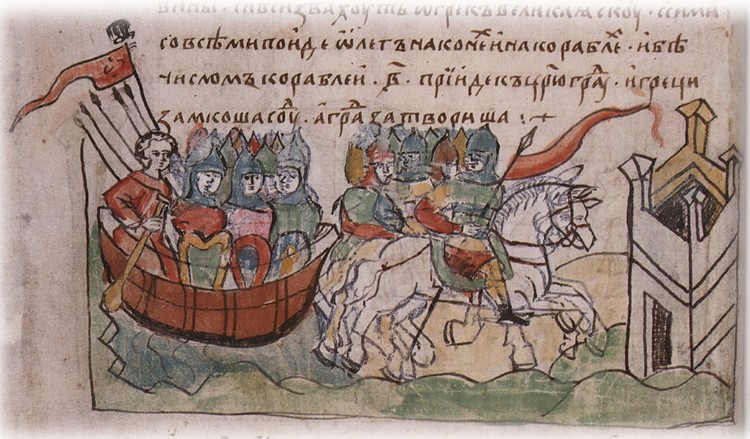 Rus Attack on Constantinople Unknown Artist (Public Domain) ](https://www.worldhistory.org/image/15590/rus-attack-on-constantinople/ "Rus Attack on Constantinople")The Rus launched another attack on Constantinople in 941, this time with disastrous consequences for them. They sent a massive fleet of 1000 ships to the city but were defeated by a small fleet of 15 old Byzantine warships fitted with [greek fire](https://www.worldhistory.org/Greek_Fire/) projectors that spewed burning chemicals at the invaders. A large number of Rus ships and soldiers were set ablaze, and any soldiers who jumped overboard to escape the flames drowned, weighed down by their armour.
The Rus also launched a number of raids across the Caspian Sea into Muslim lands. In the largest in 913, a fleet of 500 Rus ships attacked the Gorgan region, in the territory of what is now Iran, where they plundered goods and took [women](https://www.worldhistory.org/disambiguation/women/) and children as slaves. An army of enraged Khazars and some Christians eventually attacked and defeated them, leaving few survivors.
During another campaign in 943, a large Rus armada attacked the prosperous trading city of Barda on the south shore of the Caspian Sea. The local people fought them mightily by throwing stones and hurling abuse, but the Rus rounded them up and slaughtered 5000 of them. As described by the Arab chronicler Ibn al-Athīr’:
> After this lasted for a long time, they ordered the people of the town to depart and \[they said that\] they would not attack the townsmen for an interval of three days, and an individual was free to leave with whatever possessions he could carry. Most of the townsmen remained \[in Barda\] after the appointed time, and the Rus then killed many people, and they took some ten thousand souls captive. They gathered those who remained in the Friday Mosque, and they said to the remaining townsmen: "You can either ransom yourselves or we will kill you." A Christian came forth and settled on twenty dirhams for each man. But the Rus did not keep to their bargain, except for the sensible ones, after they realized that they would not receive anything for some townsmen. They massacred all of those \[for whom they could receive no ransom\], and only a few fled from the massacre. The Rus then took the valuables of the people and enslaving the remaining prisoners, and took the women and enjoyed them. (Watson, 434)
The Rus used Barda for several months as a base for plundering the adjacent areas, but eventually, they were forced to leave when they were greatly weakened by an outbreak of dysentery from tainted fruit and had become isolated for defense in the citadel of Barda. They left the fortress at night, carrying on their backs what they could of their plundered treasure, gems, and fineries.
### [Varangian Guard](https://www.worldhistory.org/Varangian_Guard/) & the Rise of Moscow
The Kievan Rus would form a tight bond with the Byzantines in 988 when their emperor Vladimir the Great (r. 980-1015) decided to lose his pagan ways and become an Orthodox Christian. He weighed his decision carefully, choosing the Orthodox [Christianity](https://www.worldhistory.org/christianity/) of the Byzantines over the [Judaism](https://www.worldhistory.org/disambiguation/judaism/) of the Kharzas, the Western Christianity of [Rome](https://www.worldhistory.org/Rome/), and the [Islam](https://www.worldhistory.org/islam/) of the Arabs, probably because it afforded him the most powerful alliance.
[  Vladimir I Converting to Christianity Viktor Mikhailovich Vasnetsov (Public Domain) ](https://www.worldhistory.org/image/9659/vladimir-i-converting-to-christianity/ "Vladimir I Converting to Christianity")In recognition of their fearlessness, the Rus were recruited by Byzantine Emperor [Basil II](https://www.worldhistory.org/Basil_II/) (r. 976-1025) to defend Constantinople. About 6000 Rus mercenaries were formed into the elite Varangian Guard to protect Constantinople and serve as the emperor's personal bodyguards. These mercenaries fought in every major Byzantine campaign from then until [1204: the sack of Constantinople](https://www.worldhistory.org/article/1188/1204-the-sack-of-constantinople/) by Crusaders.
When the Kievan Rus collapsed as a state after the [Mongol invasion of Europe](https://www.worldhistory.org/article/1453/the-mongol-invasion-of-europe/) in 1237-1242, Moscow was an insignificant trading outpost. Over time, a series of princes expanded its borders and Moscow took over as the political and cultural center of the northern Rus lands. Moscow's remote, forested location shielded it from [Mongol](https://www.worldhistory.org/Mongol_Empire/) occupation and attack, and it was located near several rivers that provided access to the Baltic and Black Seas and the whole Caucasus region. Moscow gradually united the northeastern and northwestern Russian principalities throughout the 15th century, and it overthrew Mongol rule in 1480. Ivan III the Great (r. 1462-1505) became the first Moscow ruler to adopt the title of [tsar](https://www.worldhistory.org/Tsar/) and called himself Ruler of all Rus.
#### Editorial Review
This human-authored article has been reviewed by our editorial team before publication to ensure accuracy, reliability and adherence to academic standards in accordance with our [editorial policy](https://www.worldhistory.org/static/editorial-policy/).
## Bibliography
- [Gabriel, J. - Among the Norse tribes: the remarkable account of Ibn Fadlan](https://archive.aramcoworld.com/issue/199906/among.the.norse.tribes-the.remarkable.account.of.ibn.fadlan.htm "Gabriel, J. - Among the Norse tribes: the remarkable account of Ibn Fadlan"), accessed 25 Mar 2022.
- [Gannholm, Tore. *Gotland .* Stavgard, 2022.](https://www.worldhistory.org/books/9187481057/)
- [Hancock PhD, James F. *Spices, Scents and Silk.* CABI, 2021.](https://www.worldhistory.org/books/1789249759/)
- [Hansen, Valerie. *The Year 1000―and Globalization Began.* Scribner, 2020.](https://www.worldhistory.org/books/1501194100/)
- [Noonan, Thomas S. *The Islamic World, Russia and the Vikings, 750–900.* Routledge, 1998.](https://www.worldhistory.org/books/0860786579/)
- Watson, W.E. "Ibn al-Athīr’s accounts of the Rus': a commentary and translation." *Canadian/American Slavic Studies* , 35, 2001, pp. 423–438.
## About the Author
James F. Hancock is a freelance writer and emeritus professor at Michigan State University. His special interests are crop evolution and the history of trade. His books include – Spices, Scents and Silk (CABI), and Plantation Crops (Routledge).
## Questions & Answers
### Who were the Varangians?
The Gotlanders (Scandinavians from the island of Gotland) came to be called Varangians, a name probably derived from the Old Norse word "var", which means "union by promise". They spread throughout the Baltic region along the Russian rivers in the 700s and became wealthy merchants.
### Were the Rus the ancestors of the Russians?
The modern nations of Belarus, Russia, and Ukraine all have Kievan Rus as their cultural ancestors.
## Cite This Work
### APA
Hancock, J. (2022, April 01). Trade & Warfare in the Kievan Rus. *World History Encyclopedia*.
### Chicago
Hancock, James. "Trade & Warfare in the Kievan Rus." *World History Encyclopedia*, April 01, 2022. .
### MLA
Hancock, James. "Trade & Warfare in the Kievan Rus." *World History Encyclopedia*, 01 Apr 2022, .
## License & Copyright
Submitted by [James Hancock](https://www.worldhistory.org/user/geneticsofberries/ "User Page: James Hancock"), published on 01 April 2022. The copyright holder has published this content under the following license: [Creative Commons Attribution-NonCommercial-ShareAlike](https://creativecommons.org/licenses/by-nc-sa/4.0/deed.en). This license lets others remix, tweak, and build upon this content non-commercially, as long as they credit the author and license their new creations under the identical terms. When republishing on the web a hyperlink back to the original content source URL must be included. Please note that content linked from this page may have different licensing terms.