---
title: Cleopatra & Antony
author: Brian Haughton
source: https://www.worldhistory.org/article/197/cleopatra--antony/
format: machine-readable-alternate
license: Creative Commons Attribution-NonCommercial-ShareAlike (https://creativecommons.org/licenses/by-nc-sa/4.0/)
updated: 2024-06-05
---
# Cleopatra & Antony
_Authored by [Brian Haughton](https://www.worldhistory.org/user/Brynrees/)_
Regarded by the Romans as "*fatale monstrum*" – a fatal omen – [Cleopatra](https://www.worldhistory.org/disambiguation/cleopatra/) is one of the ancient world's most popular, though elusive figures. The [Egyptian](https://www.worldhistory.org/disambiguation/Egyptian/) queen has been immortalized by numerous writers and filmmakers, most popularly by [William Shakespeare](https://www.worldhistory.org/William_Shakespeare/) in *[Antony](https://www.worldhistory.org/Mark_Antony/) and Cleopatra,* and by Hollywood in *Cleopatra* (1963), starring Elizabeth Taylor and Richard Burton. The latter work features the memorable image of the enticing young Cleopatra emerging gracefully from an unfurled carpet in front of [Roman](https://www.worldhistory.org/disambiguation/Roman/) general [Julius Caesar](https://www.worldhistory.org/Julius_Caesar/). But is Cleopatra to be regarded merely as the lover of [Julius](https://www.worldhistory.org/disambiguation/Julius/) [Caesar](https://www.worldhistory.org/disambiguation/caesar/) and [Mark Antony](https://www.worldhistory.org/Mark_Antony/)? Or did she play an important role not only in the history of [Egypt](https://www.worldhistory.org/egypt/) but also in that of the mighty [Roman Republic](https://www.worldhistory.org/Roman_Republic/)?
[ 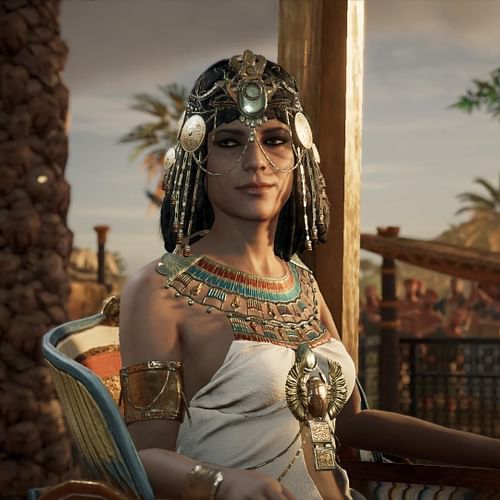 Cleopatra VII (Artist's Impression) Ubisoft (Copyright) ](https://www.worldhistory.org/image/14801/cleopatra-vii-artists-impression/ "Cleopatra VII (Artist's Impression)")[Cleopatra VII](https://www.worldhistory.org/Cleopatra_VII/) Philopator ('father-loving') was born in January 69 BCE in the [city](https://www.worldhistory.org/city/) of [Alexandria](https://www.worldhistory.org/alexandria/), Egypt, the daughter of [Ptolemy XII](https://www.worldhistory.org/Ptolemy_XII/) Auletes (117-51 BCE) and possibly Cleopatra V Tryphaena (c. 95 to c. 57 BCE). Cleopatra was to become the last monarch of the [Ptolemaic Dynasty](https://www.worldhistory.org/Ptolemaic_Dynasty/) (established in 323 BCE after the [death of Alexander the Great](https://www.worldhistory.org/article/2366/death-of-alexander-the-great/)), ruling Egypt from 51 BCE to 30 BCE. In 48 BCE, Cleopatra had become an ally and lover of Julius Caesar and remained so until his assassination in [Rome](https://www.worldhistory.org/Rome/) in March 44 BCE. The [assassination of Julius Caesar](https://www.worldhistory.org/article/803/the-assassination-of-julius-caesar/) threw Rome into turmoil, with various factions competing for control, the most important of these being the armies of [Mark](https://www.worldhistory.org/disambiguation/Mark/) Antony (83-30 BCE) and [Octavian](https://www.worldhistory.org/augustus/) (63 BCE to 14 CE), the former a supporter and loyal friend Caesar, the latter his adopted son.
### Cleopatra Meets Antony
In 41 BCE, Cleopatra was summoned to [Tarsus](https://www.worldhistory.org/Tarsus/) (in modern southern [Turkey](https://www.worldhistory.org/Asia_Minor/)) by Mark Antony. She is said to have entered the city by sailing up the Cydnus River in a decorated barge with purple sails, while dressed in the robes of the [Greek](https://www.worldhistory.org/disambiguation/greek/) goddess [Aphrodite](https://www.worldhistory.org/Aphrodite/). Antony, who equated himself with [Dionysus](https://www.worldhistory.org/Dionysos/), the [god](https://www.worldhistory.org/God/) of wine in [Greek mythology](https://www.worldhistory.org/Greek_Mythology/), was instantly won over. Much like the meeting between Cleopatra and Caesar, both sides saw something in the other that they needed. For Cleopatra, it was another opportunity to achieve power both in Egypt and in Rome; for Antony, the support of Rome's largest and wealthiest client states in his campaign against the might of the Parthians ([Parthia](https://www.worldhistory.org/disambiguation/Parthia/) was a region in modern north-eastern Iran) was highly desirable. At the meeting, Cleopatra allegedly requested that her half-sister Arsinoë, living in protection at the [Temple of Artemis at Ephesus](https://www.worldhistory.org/Temple_of_Artemis_at_Ephesus/), be executed to prevent any future attempts on her throne. Antony and Cleopatra soon became allies and lovers, and he returned with her to Alexandria in 40 BCE.
In Alexandria, Cleopatra and Antony formed a society of "inimitable livers", which some historians have interpreted as an excuse to lead a life of debauchery, though it was more likely to have been a group dedicated to the cult of the mystical god Dionysus. In that year, Cleopatra bore Antony the twins [Alexander Helios](https://www.worldhistory.org/Alexander_Helios/) (the Sun) and [Cleopatra Selene II](https://www.worldhistory.org/Cleopatra_Selene_II/) (the Moon).
### Octavian & Rome
The political situation in Rome compelled Antony to return to [Italy](https://www.worldhistory.org/italy/) where he was forced to conclude a temporary settlement with Octavian, part of which was that he married Octavian's sister, [Octavia](https://www.worldhistory.org/disambiguation/Octavia/). It was to be three years before he and Cleopatra were to meet again, at the city of [Antioch](https://www.worldhistory.org/Antiochia/) (near the modern Turkey / [Syria](https://www.worldhistory.org/syria/) border) under the shadow of the Octavian's growing military power in the West. One result of this meeting was that Cleopatra became pregnant with her third child by Antony (the future [Ptolemy](https://www.worldhistory.org/disambiguation/Ptolemy/) Philadelphus); another was that parts of Rome's eastern possessions came under Cleopatra's control.
### Celebrations in Alexandria
In 34 BCE, despite the fact that [Mark Antony's Parthian campaign](https://www.worldhistory.org/article/2373/mark-antonys-parthian-campaign/) had been an extravagant failure, Antony and Cleopatra celebrated a mock [Roman triumph](https://www.worldhistory.org/Roman_Triumph/) in the streets of Alexandria. Crowds flocked to the [gymnasium](https://www.worldhistory.org/Gymnasium/) to see the couple seated on golden thrones surrounded by their children, and Antony made a proclamation known today as the 'Donations of Alexandria'. In this declaration, Antony distributed lands held by Rome and Parthia amongst Cleopatra and their children and proclaimed [Caesarion](https://www.worldhistory.org/caesarion/) as Caesar's legitimate son. Not surprisingly, the 'Donations of Alexandria' caused outrage in Rome, where the rumour began to spread that Antony intended to transfer the capital from Rome to Alexandria. In 32 BCE, Octavian had the [Roman Senate](https://www.worldhistory.org/Roman_Senate/) deprive Antony of his powers and declare [war](https://www.worldhistory.org/disambiguation/War/) against Cleopatra, calling her a whore and a drunken Oriental. To avoid another civil war, Antony was not mentioned in the declaration, but this was to no avail and Antony decided to join the war on Cleopatra's side.
[  Silver Tetradrachm Portraying Antony and Cleopatra Sailko (CC BY) ](https://www.worldhistory.org/image/8292/silver-tetradrachm-portraying-antony-and-cleopatra/ "Silver Tetradrachm Portraying Antony and Cleopatra")### [Battle of Actium](https://www.worldhistory.org/Battle_of_Actium/) & Invasion of Egypt
The culmination of the war came at the naval [Battle](https://www.worldhistory.org/disambiguation/battle/) of Actium, which took place near the town of Preveza in northwestern [Greece](https://www.worldhistory.org/greece/), on 2 September 31 BCE. Here, Mark Antony and Cleopatra's combined force of 230 vessels and 50,000 sailors was defeated by Octavian's navy commanded by [Marcus Agrippa](https://www.worldhistory.org/Marcus_Agrippa/), effectively handing control of the Roman world over to Octavian. In 30 BCE, Octavian invaded Egypt and laid siege to Alexandria. Hopelessly outnumbered, Antony's forces surrendered, and in the honourable Roman tradition, Antony committed suicide by falling on his sword.
### The [Death](https://www.worldhistory.org/disambiguation/Death/) of Cleopatra
After Antony's death, Cleopatra was taken to Octavian, who informed her that she would be brought to Rome and paraded in the streets as part of his [triumph](https://www.worldhistory.org/Roman_Triumph/). Perhaps unable to bear the thought of this humiliation, on 12 August 30 BCE, Cleopatra dressed in her royal robes and lay upon a golden couch with a diadem on her brow. According to tradition (found in ancient historian [Plutarch](https://www.worldhistory.org/plutarch/), for example) she had an asp (an Egyptian cobra), brought to her concealed in a basket of figs, and died from the bite. Two of her female servants also died with her. The asp was a symbol of divine royalty to the Egyptians, so by allowing the asp to bite her, Cleopatra became immortal. Other historians (including Joyce Tyldesley) believe that Cleopatra used either a poisonous ointment or a vial of poison to commit suicide.
Cleopatra had lived 39 years, for 22 of which she had reigned as queen, and for 14 she had been Antony's partner. After her death, her son Caesarion was declared [pharaoh](https://www.worldhistory.org/pharaoh/), but he was soon executed on Octavian's orders. Her other children were sent to Rome to be raised by Antony's wife, Octavia. Cleopatra represented the last significant threat to Roman authority, and her death also marked the end of the [Ptolemaic Kingdom](https://www.worldhistory.org/Ptolemaic_Egypt/). The vast treasures of Egypt were plundered by Octavian, and Egypt itself became a new Roman province. Within a few years, the Senate named Octavian *[Augustus](https://www.worldhistory.org/augustus/)* and he became the first [Roman emperor](https://www.worldhistory.org/Roman_Emperor/), consolidating the western and eastern halves of the Republic into a [Roman Empire](https://www.worldhistory.org/Roman_Empire/).
[  Cleopatra's Death Reginald Arthur (Public Domain) ](https://www.worldhistory.org/image/3135/cleopatras-death/ "Cleopatra's Death")Octavian later published his biography, in which he stripped Cleopatra of her political ability and portrayed her as an immoral foreigner, a temptress of upright Roman men. A number of Roman historians and writers (the poets [Horace](https://www.worldhistory.org/Horace/) and Lucan for example) reinforced the image of Cleopatra as an incestuous, adulterous whore who used sex to try and emasculate the Roman [Empire](https://www.worldhistory.org/empire/). The [propaganda of Octavian and Mark Antony's civil war](https://www.worldhistory.org/article/1474/the-propaganda-of-octavian-and-mark-antonys-civil/) has had a profound influence on the image of Cleopatra that has been passed down into Western [culture](https://www.worldhistory.org/disambiguation/culture/). The real Cleopatra was highly skilled in politics (though ruthless with her enemies), popular with her subjects, spoke seven languages, and was said to be the only Ptolemy who could read and speak Egyptian. It is also a sobering thought to remember how different the history of Western [civilization](https://www.worldhistory.org/civilization/) might have been if Cleopatra had managed to create an eastern empire to rival the increasing might of Rome, which she very nearly succeeded in doing.
Recent archaeological work has cast some interesting but controversial light on the possible location of Cleopatra's [tomb](https://www.worldhistory.org/tomb/). Plutarch wrote that Antony and Cleopatra were buried together, and, in 2008, archaeologists from the Egyptian Supreme Council of Antiquities and from the Dominican Republic, working at the [Temple](https://www.worldhistory.org/temple/) of Taposiris Magna, 28 miles (45 km) west of Alexandria, reported that one of the chambers in the building probably contained the bodies of Cleopatra and Mark Antony. The team has so far discovered 22 [bronze](https://www.worldhistory.org/disambiguation/bronze/) coins inscribed with Cleopatra's name and bearing her image, a bust of Cleopatra, and an alabaster mask believed to represent Mark Antony. Work at the site is ongoing, and only time will tell if the archaeologists are correct in their theory that the great couple were interred at such a distance from Alexandria.
#### Editorial Review
This human-authored article has been reviewed by our editorial team before publication to ensure accuracy, reliability and adherence to academic standards in accordance with our [editorial policy](https://www.worldhistory.org/static/editorial-policy/).
## Bibliography
- [Bradford, Ernle. *Cleopatra.* Lume Books, 2015.](https://www.worldhistory.org/books/B017XO5RV2/)
- [Haughton, Brian. *History's Mysteries.* Weiser, 2010, 225-232.](https://www.worldhistory.org/books/1601631073/)
- [Joyc Tyldsly. *Cleopatra Last Queen of Egypt - 2008 publication.* Basic Books,2008, 2011.](https://www.worldhistory.org/books/B003ZOLMQ4/)
- [Susan Walker, Peter Higgs. *Cleopatra of Egypt, From History to Myth.* 2001, 2011.](https://www.worldhistory.org/books/B000IBNKDK/)
## About the Author
Author and researcher of books on ancient civilisations & monuments, sacred places and supernatural folklore. Qualified archaeologist with a BA (Hons) from the University of Nottingham and an MPhil in Greek Archaeology from the University of Birmingham.
- [Facebook Profile](https://www.facebook.com/BrianHaughtonauthor/)
- [X/Twitter Profile](https://twitter.com/BrianHaughton1)
## External Links
- [How Did Cleopatra Die? The 'Snake Bite' Suicide Of Egypt's Queen](https://allthatsinteresting.com/how-did-cleopatra-die)
## Cite This Work
### APA
Haughton, B. (2011, January 10). Cleopatra & Antony. *World History Encyclopedia*.
### Chicago
Haughton, Brian. "Cleopatra & Antony." *World History Encyclopedia*, January 10, 2011. .
### MLA
Haughton, Brian. "Cleopatra & Antony." *World History Encyclopedia*, 10 Jan 2011, .
## License & Copyright
Submitted by [Brian Haughton](https://www.worldhistory.org/user/Brynrees/ "User Page: Brian Haughton"), published on 10 January 2011. The copyright holder has published this content under the following license: [Creative Commons Attribution-NonCommercial-ShareAlike](https://creativecommons.org/licenses/by-nc-sa/4.0/deed.en). This license lets others remix, tweak, and build upon this content non-commercially, as long as they credit the author and license their new creations under the identical terms. When republishing on the web a hyperlink back to the original content source URL must be included. Please note that content linked from this page may have different licensing terms.