---
title: Diasporic Communities in the Mediterranean & Beyond
author: Rebecca Denova
source: https://www.worldhistory.org/article/1942/diasporic-communities-in-the-mediterranean--beyond/
format: machine-readable-alternate
license: Creative Commons Attribution-NonCommercial-ShareAlike (https://creativecommons.org/licenses/by-nc-sa/4.0/)
updated: 1970-01-01
---
# Diasporic Communities in the Mediterranean & Beyond
_Authored by [Rebecca Denova](https://www.worldhistory.org/user/rdenova/)_
A diaspora is a large group of people with a similar heritage or homeland who have since moved from their original homelands to another country. In terms of ethnicity, they share a common language, worldviews, myths, religious concepts and rituals, social customs, and food. The [Greek](https://www.worldhistory.org/disambiguation/greek/) term *dia speiro* ("to sow over" or "to scatter about") indicates a transplanting of a [culture](https://www.worldhistory.org/disambiguation/culture/) from one area to another.
[  Map of Diaspora Synagogues (1st - 2nd centuries CE) Simeon Netchev (CC BY-NC-ND) ](https://www.worldhistory.org/image/4141/map-of-diaspora-synagogues-1st---2nd-centuries-ce/ "Map of Diaspora Synagogues (1st - 2nd centuries CE)")### [Bronze Age Collapse](https://www.worldhistory.org/Bronze_Age_Collapse/)
Then as now, the migration of peoples occurred for many reasons. Hunter-gatherers relocated following herds of animals or in search of new grazing lands. With the introduction of [agriculture](https://www.worldhistory.org/disambiguation/Agriculture/), movement expanded when small plots no longer produced enough surplus for [trade](https://www.worldhistory.org/disambiguation/trade/). The establishment of urban centers provided movement from the countryside, especially with the evolution of technology and [crafts](https://www.worldhistory.org/crafts/) that became part of the larger [economy](https://www.worldhistory.org/disambiguation/economy/).
In the Western tradition, we first began seeing a reference to the concept of diaspora in the region of the Eastern Mediterranean Basin. At the end of the [Bronze Age](https://www.worldhistory.org/disambiguation/Bronze_Age/), the region was collectively invaded by a group known as the [Sea Peoples](https://www.worldhistory.org/Sea_Peoples/) who established colonies and [cities](https://www.worldhistory.org/city/). Great sea traders and merchants, they are the [Philistines](https://www.worldhistory.org/Philistines/) of the [Bible](https://www.worldhistory.org/bible/). Their origin remains unknown, but the prevailing theories indicate an origin in and around the Mediterranean. This is the beginning of the [Iron Age](https://www.worldhistory.org/disambiguation/Iron_Age/), with the introduction of new weapons and tools.
The [Phoenicians](https://www.worldhistory.org/phoenicia/) came to prominence at this time, collectively categorized as older Canaanite tribes of the [Levant](https://www.worldhistory.org/levant/) region. Also great seafarers and traders, they established colonies from [Cyprus](https://www.worldhistory.org/cyprus/) to the Iberian Peninsula and North [Africa](https://www.worldhistory.org/disambiguation/africa/). The Greek term for these people (*phoenix*) became "[Punic](https://www.worldhistory.org/carthage/)" in Latin (thus the [Punic Wars](https://www.worldhistory.org/Punic_Wars/) of [Rome](https://www.worldhistory.org/Rome/) against [Carthage](https://www.worldhistory.org/carthage/)). The Phoenicians are now credited with the introduction of their [alphabet](https://www.worldhistory.org/alphabet/) for Hebrew, Greek, Arabic, and Cyrillic systems.
### Greek Expansion
In the 8th and 7th centuries BCE, [Greece](https://www.worldhistory.org/greece/) began establishing colonies throughout the Mediterranean Basin. Factors such as periodic famines, plagues, wars between the [city](https://www.worldhistory.org/city/)-states, and the need for larger commercial outlets contributed to these migrations. They settled around the Black Sea, [Anatolia](https://www.worldhistory.org/Asia_Minor/) ([Turkey](https://www.worldhistory.org/Asia_Minor/)), Southern France, Southern [Italy](https://www.worldhistory.org/italy/), and [Sicily](https://www.worldhistory.org/sicily/). The area of Greek settlement in Italy was called [Magna Graecia](https://www.worldhistory.org/Magna_Graecia/) ("Greater Greece"). This [Hellenic](https://www.worldhistory.org/greece/) culture was fused with the indigenous tribes of Italy and greatly influenced the emerging culture of Rome. Rome conquered the Greek city of Neapolis in 327 BCE, followed by other conquests and eventually conquered Sicily.
[  Map of the Trade Networks of the Ancient Mediterranean World Simeon Netchev (CC BY-NC-ND) ](https://www.worldhistory.org/image/14421/map-of-the-trade-networks-of-the-ancient-mediterra/ "Map of the Trade Networks of the Ancient Mediterranean World")### [Alexander the Great](https://www.worldhistory.org/Alexander_the_Great/)
[Alexander](https://www.worldhistory.org/disambiguation/Alexander/) the Great (356-323 BCE) was proud of his Greek heritage; he had been tutored by [Aristotle](https://www.worldhistory.org/aristotle/) (384-322 BCE). Everywhere he conquered, he introduced [Greek philosophy](https://www.worldhistory.org/Greek_Philosophy/), language, governance, [religion](https://www.worldhistory.org/religion/), and education. After the conquests, Alexander settled his veterans in colonies throughout the Middle East, where they mixed with the local cultures. This resulted in what scholars term syncretism.
As a conqueror, Alexander could have demolished all local cult centers. Instead, he layered older traditions with his own. For example, when entering a [temple](https://www.worldhistory.org/temple/), he simply added a lightning bolt and hyphenated the name of [Zeus](https://www.worldhistory.org/zeus/) to the older [god](https://www.worldhistory.org/God/). The locals were happy to keep their older gods but could now add Zeus. Zeus must have been a great god because he was the god of Alexander.
Syncretism can result in a broader, expanded worldview (old and new) or sometimes can form the basis of a new culture or a new religion. Syncretism became associated with understanding diaspora communities, which maintained their own traditions while simultaneously adopting elements of the new settlement as well as influencing the local culture.
### Ancient [Judaism](https://www.worldhistory.org/disambiguation/judaism/)
Like all ancient cultures, the Jews experienced migration patterns. The first traditional migration took place with the call of [Abraham](https://www.worldhistory.org/Abraham,_the_Patriarch/) to leave his homeland (at the head of the Persian Gulf) with his family and settled in [Canaan](https://www.worldhistory.org/canaan/). According to the book of Exodus, a second major migration took place when there was famine in [Israel](https://www.worldhistory.org/disambiguation/Israel/), and the Jews migrated to [Egypt](https://www.worldhistory.org/egypt/) and established a large community.
[  Moses & the Parting of the Red Sea Providence Lithograph Company (Public Domain) ](https://www.worldhistory.org/image/5739/moses--the-parting-of-the-red-sea/ "Moses & the Parting of the Red Sea")But the descriptive Greek term 'diaspora' came into use after the Assyrian destruction of the Northern [Kingdom of Israel](https://www.worldhistory.org/Kingdom_of_Israel/) in 722 BCE and the Babylonian destruction of the [Temple in Jerusalem](https://www.worldhistory.org/article/852/the-temple-in-jerusalem/) in 587 BCE. Both conquerors had a program of population exchanges. Of the [twelve tribes of Israel](https://www.worldhistory.org/article/1822/the-twelve-tribes-of-israel/), the ten Northern tribes were taken to [Assyria](https://www.worldhistory.org/assyria/) and became 'lost' to history. The Jews of [Jerusalem](https://www.worldhistory.org/jerusalem/) were taken to the capital city of [Babylon](https://www.worldhistory.org/babylon/); the period became known as the Babylonian Exile.
[Cyrus the Great](https://www.worldhistory.org/Cyrus_the_Great/) (r. c. 550-530 BCE) conquered the Babylonians. He granted the Jews funds to return to Jerusalem to rebuild the city and rebuild the Temple. However, life in the [Achaemenid Empire](https://www.worldhistory.org/Achaemenid_Empire/) led to the prosperity of the Jewish community, and many decided to stay. This is when the term diaspora (often translated into the English "dispersion") was utilized to describe communities living outside of the land. Jews established synagogue communities throughout the [Roman Empire](https://www.worldhistory.org/Roman_Empire/) and beyond.
### Diaspora Studies
The study of diaspora communities only became popular after the introduction of the disciplines of the social sciences into academia in the 1900s. Studies analyze cultural adaptations in both conceptual thinking, socialization, and behavior. These factors help to categorize the differences between migration and what can be understood as a diaspora community. For example, in [Europe](https://www.worldhistory.org/europe/), during Late Antiquity, major migrations of tribes of [Goths](https://www.worldhistory.org/Goths/), [Visigoths](https://www.worldhistory.org/visigoth/), [Vandals](https://www.worldhistory.org/Vandals/), [Huns](https://www.worldhistory.org/Huns/), and the later [Viking](https://www.worldhistory.org/Vikings/) raids, did not result in the formation of unique ethnic and cultural communities; they were absorbed into the cultural traditions of Europe. Outside of the Western tradition, migration communities from [China](https://www.worldhistory.org/china/), [Korea](https://www.worldhistory.org/Korea/), [Japan](https://www.worldhistory.org/disambiguation/Japan/), and [India](https://www.worldhistory.org/india/) to the South Pacific and beyond are analyzed. African migrations (including the forced migrations of slavery to the New World) are also the subject of study.
[ 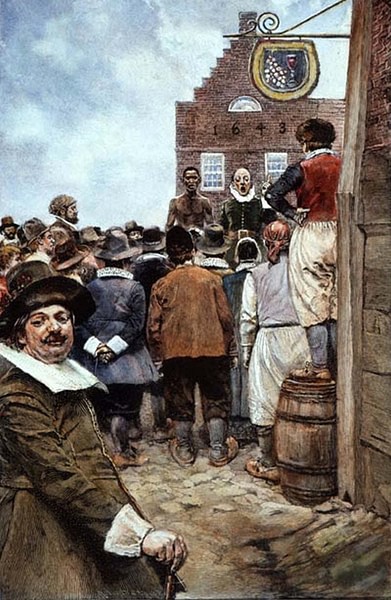 First Slave Auction in New Amsterdam, 1655 CE Howard Pyle (Public Domain) ](https://www.worldhistory.org/image/13741/first-slave-auction-in-new-amsterdam-1655-ce/ "First Slave Auction in New Amsterdam, 1655 CE")Comparative analyses of common factors that both motivate migration as well as adaptability are of renewed interest in the postcolonial world. Many diaspora communities share a common history of persecution and/or expulsion from their original homelands. This has resulted in the politicization of diaspora ideology. In some countries, diaspora communities present themselves as oppositional nation-states against the continuing tyranny of their homelands (governments-in-exile). After World [War](https://www.worldhistory.org/disambiguation/War/) II (1939-1945), dozens of countries in the French and British Empires sought independence. Embroiled now in civil wars, many groups migrated to the original host countries, rejecting the imposition of some of the new systems. This period saw a globalization of diaspora communities throughout the world.
Other scholars focus on the problem of unequal resources, unemployment, and lack of educational opportunities for the motivating elements of migrant communities. At times, the host country can stimulate migration for economic reasons. For example, the United States began importing Chinese workers in great numbers to work on the construction of railroads in the western states in the 19th century.
### The Politics of Diaspora
A common feature of diaspora communities is that they maintain a relationship and loyalty to their home country and traditional customs. However, during a geopolitical crisis or war, this loyalty can be construed as a threat. Although the FBI investigated German and Italian Americans, the Japanese communities on the West Coast were relocated to internment camps after the attack on Pearl Harbor, from 1942 to 1945. This included American citizens and their children. Now viewed as a black stain in American history and a violation of constitutional rights, a similar reaction occurred against Muslim Americans after the terrorist attacks on 9/11.
The Armenian people were absorbed into the [Ottoman Empire](https://www.worldhistory.org/Ottoman_Empire/). Fearing an internal rebellion, the Ottoman government ordered the mass slaughter and deportation of Armenians during World War I (1914-1918). From then until now, Armenian communities have protested the current Turkish government's refusal to label this a genocide in the history of this period. As of 2021, 31 countries have recognized the event as genocide.
[ 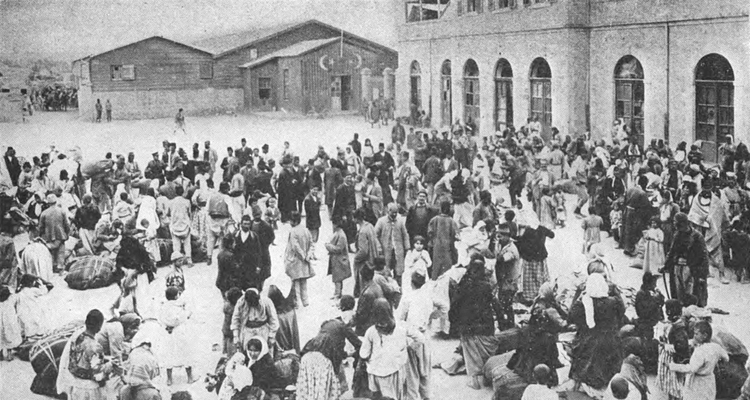 Armenian Genocide Aurora Mardiganian (Public Domain) ](https://www.worldhistory.org/image/15281/armenian-genocide/ "Armenian Genocide")### [Science](https://www.worldhistory.org/science/)
The popular interest in diaspora communities utilizes the sciences of DNA studies and genome tracking to analyze both the origin of a people as well as their integration into host communities. This is particularly important in archaeological excavations of tombs and cemeteries, where DNA analysis of the skeletons can provide ancestral lineages of mixed populations to determine the degree of integration. Genome studies have been conducted in the communities along the ancient [Silk Road](https://www.worldhistory.org/Silk_Road/) in Asia as an effort to trace the lost tribes of Israel.
An estimated 10% of the world's population currently live in diaspora communities. We are gradually learning to appreciate the positive benefits of these communities in the sharing of knowledge, technology, and the continuing diversity of cultural and religious views and customs.
#### Editorial Review
This human-authored article has been reviewed by our editorial team before publication to ensure accuracy, reliability and adherence to academic standards in accordance with our [editorial policy](https://www.worldhistory.org/static/editorial-policy/).
## Bibliography
- [Cohen, Robin. *Global Diasporas.* Routledge, 2008.](https://www.worldhistory.org/books/041543551X/)
- [Stierstorfer, Klaus & Wilson, Janet. *The Routledge Diaspora Studies Reader .* Routledge, 2017.](https://www.worldhistory.org/books/113878320X/)
## About the Author
Rebecca I. Denova, Ph.D. is Emeritus Professor of Early Christianity in the Department of Religious Studies, University of Pittsburgh. She has recently completed a textbook, "The Origins of Christianity and the New Testament" (Wiley-Blackwell)
## Cite This Work
### APA
Denova, R. (2022, February 24). Diasporic Communities in the Mediterranean & Beyond. *World History Encyclopedia*.
### Chicago
Denova, Rebecca. "Diasporic Communities in the Mediterranean & Beyond." *World History Encyclopedia*, February 24, 2022. .
### MLA
Denova, Rebecca. "Diasporic Communities in the Mediterranean & Beyond." *World History Encyclopedia*, 24 Feb 2022, .
## License & Copyright
Submitted by [Rebecca Denova](https://www.worldhistory.org/user/rdenova/ "User Page: Rebecca Denova"), published on 24 February 2022. The copyright holder has published this content under the following license: [Creative Commons Attribution-NonCommercial-ShareAlike](https://creativecommons.org/licenses/by-nc-sa/4.0/deed.en). This license lets others remix, tweak, and build upon this content non-commercially, as long as they credit the author and license their new creations under the identical terms. When republishing on the web a hyperlink back to the original content source URL must be included. Please note that content linked from this page may have different licensing terms.