---
title: 50 Biblical Phrases, Idioms, & Metaphors
author: Rebecca Denova
source: https://www.worldhistory.org/article/1941/50-biblical-phrases-idioms--metaphors/
format: machine-readable-alternate
license: Creative Commons Attribution-NonCommercial-ShareAlike (https://creativecommons.org/licenses/by-nc-sa/4.0/)
updated: 1970-01-01
---
# 50 Biblical Phrases, Idioms, & Metaphors
_Authored by [Rebecca Denova](https://www.worldhistory.org/user/rdenova/)_
In the Western tradition, many phrases and terms from the [Bible](https://www.worldhistory.org/bible/) are utilized as allegory, metaphors, idioms, or simply to describe the characteristics of a known person or event. They have become an essential element of [literature](https://www.worldhistory.org/literature/) and descriptions of everyday life situations. Here is a list of the more popular references.
[  Tyndale Bible Steve Bennett (CC BY-SA) ](https://www.worldhistory.org/image/12463/tyndale-bible/ "Tyndale Bible")### Let There Be Light
> And [God](https://www.worldhistory.org/God/) said, 'Let there be light,' and there was light. (Genesis 1:3)
The term is used most often in an explanation of discovery, understanding, or enlightenment. It is also used to indicate "let the facts become known."
### Forbidden Fruit
> And the Lord God commanded the man, "You are free to eat from any tree in the garden; but you must not eat from the tree of the knowledge of good and evil, for when you eat from it you will certainly die." (Genesis 2:16-17)
'Forbidden fruit' is something that is greatly desired but forbidden. In this sense, it can have negative results.
### Fall from Grace
The phrase comes from the story of the disobedience of Adam and Eve in Genesis 3, which resulted in their fall from immortality in the [Garden of Eden](https://www.worldhistory.org/Garden_of_Eden/) into mortality. It is repeated in the letters of [Paul the Apostle](https://www.worldhistory.org/Paul_the_Apostle/):
> You who are trying to be justified by the [law](https://www.worldhistory.org/disambiguation/law/) have been alienated from Christ; you have fallen away from grace. (Galatians 5:4)
It is utilized most often to describe a high-status individual who has fallen on hard times or is now subject to social anathema.
[  Temptation & Expulsion from Paradise, Sistine Chapel Michelangelo (Public Domain) ](https://www.worldhistory.org/image/12754/temptation--expulsion-from-paradise-sistine-chapel/ "Temptation & Expulsion from Paradise, Sistine Chapel")### By the Sweat of Your Brow & Ashes to Ashes, Dust to Dust
Part of Adam's punishment was to work the ground, which would always be a hardship.
> By the sweat of your brow you will eat your food until you return to the ground, since from it you were taken; for dust you are and to dust you will return (Genesis 3:19).
Most often part of funeral rituals, "ashes to ashes" is the cycle of life.
### My Brother's Keeper
> Then the Lord said to Cain, "Where is your brother Abel?" "I don't know," he replied. "Am I my brother's keeper?" (Genesis 4:9)
This is a rhetorical question from the story of [Cain and Abel](https://www.worldhistory.org/article/1831/cain--abel/), where the implied answer is yes. We are responsible for our actions toward others.
[  Cain Slaying Abel Peter Paul Rubens (Public Domain) ](https://www.worldhistory.org/image/14613/cain-slaying-abel/ "Cain Slaying Abel")### As Old as Methuselah
Methuselah lived 969 years. In the genealogies of Genesis, it may be understood that the Patriarchs had longevity before God limited the age of humans to 120 years. To be as old as Methuselah is to be very old.
### Fire & Brimstone
This is what God rained down on the [cities](https://www.worldhistory.org/city/) of Sodom and Gomorrah for their sins. It is symbolic of the appearance of the landscape in the Dead Sea area as if it had been wiped out by God, and it is used as a metaphor for impending disaster.
### Land of Milk & Honey
This is the description of the land of [Canaan](https://www.worldhistory.org/canaan/) promised to [Abraham](https://www.worldhistory.org/Abraham,_the_Patriarch/) and a continuing promise to the Jews for their faithfulness.
> Hear, [Israel](https://www.worldhistory.org/disambiguation/Israel/), and be careful to obey so that it may go well with you and that you may increase greatly in a land flowing with milk and honey, just as the Lord, the God of your ancestors, promised you. (Deuteronomy 6:3)
Milk and honey are references to good grazing for cattle and the ancient source of sugar.
### The Golden Calf
While [Moses](https://www.worldhistory.org/Moses/) was obtaining the [ten commandments](https://www.worldhistory.org/Ten_Commandments/) on [Mount Sinai](https://www.worldhistory.org/Mount_Sinai/), the people convinced Aaron to fashion a golden calf from the [gold](https://www.worldhistory.org/gold/) they had looted when leaving [Egypt](https://www.worldhistory.org/egypt/). The golden calf has come to represent both idolatry (false worship) and love of gold.
> These are your gods, Israel, who brought you up out of Egypt (Exodus 32:4).
### An Eye for an Eye, a Tooth for a Tooth
This phrase is often misunderstood, as it came into the tradition as the Lex Talionis, the law of retaliation.
> Anyone who injures their neighbor is to be injured in the same manner: fracture for fracture, eye for eye, tooth for tooth. The one who has inflicted the injury must suffer the same injury. (Leviticus 24:19-20)
However, it was never understood literally. In the gospel of Matthew, it was repeated by [Jesus](https://www.worldhistory.org/Jesus_Christ/) during the [Sermon on the Mount](https://www.worldhistory.org/article/2547/sermon-on-the-mount/):
> You have heard that it was said, "Eye for eye, and tooth for tooth." But I tell you, do not resist an evil person. If anyone slaps you on the right cheek, turn to them the other cheek also. (Matthew 5:38-39)
In this case, the lesson of the sermon was not to seek compensation in lawsuits; when Jesus returned, all claims of harm or injustice would be rectified by God.
### Manna from Heaven & Man Does Not Live on Bread Alone
During the wilderness years, God often sent food to help the Israelites survive. Manna was a wafer-like substance that appeared on plants with the morning dew. Manna from Heaven indicates a divine intervention or an unearned gift from God.
God reminded the Israelites that life is more than mere survival, but that the soul should be nourished as well:
> He humbled you, causing you to hunger and then feeding you with manna, which neither you nor your ancestors had known, to teach you that man does not live on bread alone but on every word that comes from the mouth of the Lord. (Deuteronomy 8:3)
This was repeated by [Jesus Christ](https://www.worldhistory.org/Jesus_Christ/) when tempted by the Devil to turn stones into bread:
> It is written: "Man shall not live on bread alone, but on every word that comes from the mouth of God." (Matthew 4:4)
[  Temptation of Jesus Lawrence OP (CC BY-NC-ND) ](https://www.worldhistory.org/image/13455/temptation-of-jesus/ "Temptation of Jesus")### Scapegoat
The process of blaming another for one's mistakes. The ritual of the scapegoat was performed by the high priest. Two goats were chosen; one was slaughtered, and the other sent to the wilderness. This was done as a collective atonement for the sins of the people which were carried by the goat to the demon Azazel.
### A Man after My Own Heart
The first king of Israel, Saul, turned out to be a bad king. God had [Samuel](https://www.worldhistory.org/samuel/) anoint [King David](https://www.worldhistory.org/King_David/) to replace him.
> But now your kingdom will not endure; the Lord has sought out a man after his own heart and appointed him ruler of his people, because you have not kept the Lord's command. (1 Samuel 13:14).
It has come to mean someone who shares the same opinions or interests, a kindred spirit.
### How the Mighty Have Fallen
King Saul and his son Jonathan were both killed in a [battle](https://www.worldhistory.org/disambiguation/battle/) against the [Philistines](https://www.worldhistory.org/Philistines/). This is part of a lament that even those who were raised up to the heights are nevertheless subject to fate (or God's will).
### To Put Words in Someone's Mouth
It is Joab's attempt to bring the rebellion of David's son Absalom to David's attention. He finds a widow and tells her to concoct a story about a loss of land compensation. "And Joab put the words in her mouth" (2 Samuel 14:3). It has come to mean a misunderstanding or literal interpretation of someone's original intent.
### Feet of Clay
> Your Majesty looked, and there before you stood a large statue—an enormous, dazzling statue, awesome in appearance. The head of the statue was made of pure gold, its chest and arms of [silver](https://www.worldhistory.org/Silver/), its belly and thighs of [bronze](https://www.worldhistory.org/disambiguation/bronze/), its legs of iron, its feet partly of iron and partly of baked clay (Daniel 2:31-33).
'Feet of clay' refers to a hidden character flaw or weakness in a person that could tumble the whole edifice.
### The [Writing](https://www.worldhistory.org/writing/) Is on the [Wall](https://www.worldhistory.org/wall/)
> Suddenly the fingers of a human hand appeared and wrote on the plaster of the wall, near the lampstand in the royal [palace](https://www.worldhistory.org/disambiguation/palace/). The king watched the hand as it wrote. His face turned pale and he was so frightened that his legs became weak and his knees were knocking. (Daniel 5:5-6)
The writing on the wall is an indication of imminent danger if one can only understand its meaning.
### [Jezebel](https://www.worldhistory.org/jezebel/) & Delilah
Jezebel was responsible for the downfall of Ahab, the king of Northern Israel. She contended against the prophet Elijah.
> He not only considered it trivial to commit the sins of Jeroboam son of Nebat, but he \[Ahab\] also married Jezebel daughter of Ethbaal king of the Sidonians, and began to serve [Baal](https://www.worldhistory.org/baal/) and worship him.
> (1 Kings 16:31)
[ 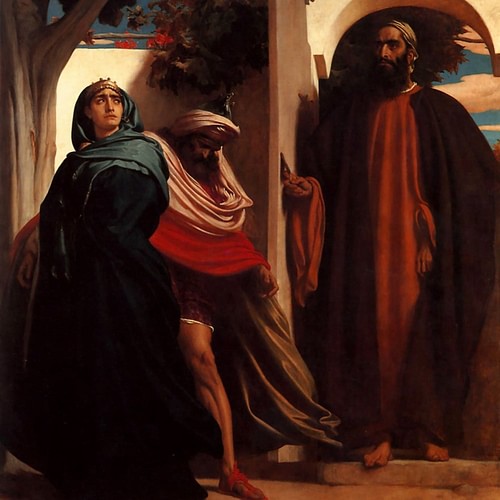 Jezebel & Ahab Scarborough Art Gallery (Public Domain) ](https://www.worldhistory.org/image/11970/jezebel--ahab/ "Jezebel & Ahab")Delilah was the paramour of [Samson](https://www.worldhistory.org/Samson/) and brought about his capture by the Philistines (Judges 13-16). Both names have become synonymous with harlots and wanton [women](https://www.worldhistory.org/disambiguation/women/). However, they are condemned in the Bible because of their idolatry, and not their sexual immorality.
### Skin and Bones & Skin of My Teeth
In the [book of Job](https://www.worldhistory.org/Book_of_Job/), Job suffers relentlessly as a test of his faithfulness to God.
I am nothing but skin and bones; I have escaped only by the skin of my teeth. (Job 19:20)
'Skin and bones' refers to the bare essentials of life, while 'skin of my teeth' indicates a very narrow margin for something to happen.
### Weighed in the Balance
When Job's friends claim that he must have sinned to account for his suffering, Job responded:
> ... let God weigh me in honest scales and he will know that I am blameless. (Job 31:6)
It has come to mean giving equal consideration to two opposing views. Also, in Daniel 5:27: "You have been weighed on the scales and found wanting."
### Bite the Dust
> May desert tribes bow down before him and his enemies lick the dust. (Psalm 72:9)
It means to die.
### At Wits' End
An exhausted state of worry or despair.
> They reeled and staggered like drunkards; they were at their wits' end. (Psalm 107:27)
### Spare the Rod, Spoil the Child
> Whoever spares the rod hates their children, but the one who loves their children is careful to discipline them (Proverbs 13:24).
Children will only learn through discipline.
### Pride Goes before a Fall
> Pride goes before destruction, a haughty spirit before a fall (Proverbs 16:18).
Too much pride or confidence in oneself can lead to mistakes or even disaster.
### There Is Nothing New under the Sun
Sometimes applied to the monotony of life, it also reflects the idea that the bumps in life should not set us back.
> What has been will be again, what has been done will be done again; there is nothing new under the sun. (Ecclesiastes 1:9)
### For Everything There Is a Season
There is a right time for everything that happens; context can help to keep things in perspective.
> There is a time for everything, and a season for every activity under the heavens. (Ecclesiastes 3:1)
[  January, Les Tres Riches Heures Limbourg Brothers (Public Domain) ](https://www.worldhistory.org/image/9580/january-les-tres-riches-heures/ "January, Les Tres Riches Heures")### Eat, Drink, & Be Merry
Make the most of life now. The implication from the text is that we are all going to die anyway.
> So I commend the enjoyment of life, because there is nothing better for a person under the sun than to eat and drink and be glad. Then joy will accompany them in their toil all the days of the life God has given them under the sun. (Ecclesiastes 8:15).
### A Fly in the Ointment
An imperfection or flaw can diminish the status and standing of a person.
> As dead flies give perfume a bad smell, so a little folly outweighs wisdom and honor. (Ecclesiastes 10:1).
### A Drop in a Bucket
> Surely the nations are like a drop in a bucket; they are regarded as dust on the scales; he weighs the islands as though they were fine dust ([Isaiah](https://www.worldhistory.org/Isaiah/) 40:15).
It indicates little or no significance in an event.
### No Rest for the Wicked
An indication that though the wicked may prosper now, God's justice will weigh them in the end.
> "There is no peace," says the Lord, "for the wicked." (Isaiah 48:22).
### Like a Lamb to the Slaughter
This is from the suffering servant passages of Isaiah and utilized in [the gospels](https://www.worldhistory.org/The_Gospels/) telling the story of the [trial and crucifixion of Jesus of Nazareth](https://www.worldhistory.org/article/1570/the-trial--crucifixion-of-jesus-of-nazareth/). It is often used in the sense that an innocent has no idea what is going to happen to them.
> He was oppressed and afflicted, yet he did not open his mouth; he was led like a lamb to the slaughter, and as a sheep before its shearers is silent, so he did not open his mouth. (Isaiah 53:7)
### Baptism of Fire
It refers to a difficult, first experience of something.
> John answered them all, "I baptize you with water. But one who is more powerful than I will come, the straps of whose sandals I am not worthy to untie. He will baptize you with the Holy Spirit and fire." (Luke 3:16).
### Head on a Platter
A warning of harsh punishment. It was Salome's request as her gift for dancing for Herod Antipas' guests.
> I want you to give me right now the head of [John the Baptist](https://www.worldhistory.org/John_the_Baptist/) on a platter. ([Mark](https://www.worldhistory.org/disambiguation/Mark/) 6:25).
[  Salome with the Head of Saint John the Baptist Andrea Solario (Copyright) ](https://www.worldhistory.org/image/13588/salome-with-the-head-of-saint-john-the-baptist/ "Salome with the Head of Saint John the Baptist")### Go the Extra Mile
> If anyone forces you to go one mile, go with them two miles. (Matthew 5:41).
In context, this was a reference to [Roman law](https://www.worldhistory.org/Roman_Law/) that civilians could be forced to carry a legionary's equipment up to one mile. The saying is that you should go above and beyond what is required or necessary.
### To Cast Pearls before Swine
> Do not give dogs what is sacred; do not throw your pearls to pigs. If you do, they may trample them under their feet, and turn and tear you to pieces. (Matthew 7:6).
'Casting pearls before swine' is to provide something prized or valuable to someone who does not appreciate it.
### Wolves in Sheep's Clothing
Those who appear harmless often cannot be trusted.
> Watch out for false prophets. They come to you in sheep's clothing, but inwardly they are ferocious wolves. (Matthew 7:15)
### A House Divided against Itself Cannot Stand
> Jesus knew their thoughts and said to them, "Every kingdom divided against itself will be ruined and every [city](https://www.worldhistory.org/city/) or household divided against itself will not stand." (Matthew 12:25)
Disagreements in a group will lead to its downfall. The line was famously used by Abraham Lincoln in an anti-slavery speech in 1858.
### The Blind Leading the Blind
> Every plant that my heavenly father has not planted will be pulled up by the roots. Leave them, they are blind guides. If the blind lead the blind, both will fall into a pit. (Matthew 15:13-14)
Put your faith and confidence in those who know the truth, not those who are ignorant.
### To Move Mountains
A teaching that faith can [conquer](https://www.worldhistory.org/warfare/) all.
> Truly I tell you, if you have faith as small as a mustard seed, you can say to this mountain, "Move from here to there," and it will move. Nothing will be impossible for you. (Matthew 17:20)
### The Eleventh Hour
In the Parable of the Tenants in Matthew 20, they workmen who heeded the call got paid as much as the ones who were there earlier. The phrase came to mean that even at the eleventh hour, if someone repents, salvation is possible.
### Kiss of [Death](https://www.worldhistory.org/disambiguation/Death/)
Often used as irony, the final act that leads to disaster or failure.
> Now the betrayer had arranged a signal with them: "The one I kiss is the man; arrest him." (Matthew 26:48)
[  Kiss of Judas by Giotto Giotto (Public Domain) ](https://www.worldhistory.org/image/12690/kiss-of-judas-by-giotto/ "Kiss of Judas by Giotto")### Wash One's Hands of the Matter
It indicates that one has no further use for something or is not culpable in a decision. The gospel account blamed the Jews for the death of Jesus and not Pilate.
> When Pilate saw that he was getting nowhere, but that instead an uproar was starting, he took water and washed his hands in front of the crowd. "I am innocent of this man's blood," he said. "It is your responsibility!" (Matthew 27:24).
### Good Samaritan
> But a Samaritan, as he traveled, came where the man was; and when he saw him, he took pity on him. (Luke 10:33)
[Samaritans](https://www.worldhistory.org/Samaritans/) were enemies of Jews in [Jerusalem](https://www.worldhistory.org/jerusalem/). Luke used it as a model of contrast; a person who helps someone, especially a stranger.
### Throw the First Stone
The Sanhedrin was ready to stone a woman caught in adultery. Jesus challenged them:
> Let any one of you who is without sin be the first to throw a stone at her. (John 8:7)
In other words, look at yourself first before you condemn someone.
### Better to Give than Receive
It is morally more fulfilling to give than to receive something.
> In everything I did, I showed you that by this kind of hard work we must help the weak, remembering the words the Lord Jesus himself said: "It is more blessed to give than to receive." (Acts 20:35)
### Struck on the Road to Damascus
This is the story of [Paul](https://www.worldhistory.org/disambiguation/Paul/) the Apostle's conversion from a persecutor of Christians to a believer in Acts 9. It indicates a divine revelation or enlightenment that totally changes one's life.
[  Apostle Paul Mosaic Edgar Serrano (CC BY-NC-SA) ](https://www.worldhistory.org/image/12428/apostle-paul-mosaic/ "Apostle Paul Mosaic")### The Love of Money is the Root of All Evil
The love of money above all other considerations eventually leads to downfall.
> For the love of money is a root of all kinds of evil. Some people, eager for money, have wandered from the faith and pierced themselves with many griefs. (1 Timothy 6:10)
### The Four Horsemen of the Apocalypse
In the [Book of Revelation](https://www.worldhistory.org/Book_of_Revelation/) (6:1-8), angels open sealed documents, and four riders issue forth as an indication of the coming wrath of God before he institutes his kingdom on earth. The scrolls reveal white, red, black, and pale horses. They indicate [war](https://www.worldhistory.org/disambiguation/War/), famine, inflation, and death. In times of crises, people look to these indicators to determine if they are omens for social or economic collapse.
### Armageddon
> "Then they gathered the kings together to the place that in Hebrew is called Armageddon" (Revelation 16:16).
This is where the nations gather to make the move south to Jerusalem for the final battle of John of Patmos' prediction. From the Hebrew *har* ("mountain"), *har-Megiddo* means the mountain of Megiddo in the Jezreel Valley. Armageddon is often used as a final battle that has already taken place in [science](https://www.worldhistory.org/science/)-fiction films, where society must readjust to survive.
### The Whore of [Babylon](https://www.worldhistory.org/babylon/)
> The name written on her forehead was a mystery: Babylon the great the mother of prostitutes and of the abominations of the earth. (Revelation 17:5)
Babylon was the great evil enemy who destroyed Jerusalem and the [Temple](https://www.worldhistory.org/temple/) of [Solomon](https://www.worldhistory.org/solomon/) in 587 BCE. It is used in Revelation as symbolic of [Rome](https://www.worldhistory.org/Rome/). The whore of Babylon is utilized as a critique of oppressive governments and perceived persecution.
#### Editorial Review
This human-authored article has been reviewed by our editorial team before publication to ensure accuracy, reliability and adherence to academic standards in accordance with our [editorial policy](https://www.worldhistory.org/static/editorial-policy/).
## About the Author
Rebecca I. Denova, Ph.D. is Emeritus Professor of Early Christianity in the Department of Religious Studies, University of Pittsburgh. She has recently completed a textbook, "The Origins of Christianity and the New Testament" (Wiley-Blackwell)
## Cite This Work
### APA
Denova, R. (2022, February 16). 50 Biblical Phrases, Idioms, & Metaphors. *World History Encyclopedia*.
### Chicago
Denova, Rebecca. "50 Biblical Phrases, Idioms, & Metaphors." *World History Encyclopedia*, February 16, 2022. .
### MLA
Denova, Rebecca. "50 Biblical Phrases, Idioms, & Metaphors." *World History Encyclopedia*, 16 Feb 2022, .
## License & Copyright
Submitted by [Rebecca Denova](https://www.worldhistory.org/user/rdenova/ "User Page: Rebecca Denova"), published on 16 February 2022. The copyright holder has published this content under the following license: [Creative Commons Attribution-NonCommercial-ShareAlike](https://creativecommons.org/licenses/by-nc-sa/4.0/deed.en). This license lets others remix, tweak, and build upon this content non-commercially, as long as they credit the author and license their new creations under the identical terms. When republishing on the web a hyperlink back to the original content source URL must be included. Please note that content linked from this page may have different licensing terms.