---
title: Legions of Syria
author: Donald L. Wasson
source: https://www.worldhistory.org/article/1921/legions-of-syria/
format: machine-readable-alternate
license: Creative Commons Attribution-NonCommercial-ShareAlike (https://creativecommons.org/licenses/by-nc-sa/4.0/)
updated: 2025-09-19
---
# Legions of Syria
_Authored by [Donald L. Wasson](https://www.worldhistory.org/user/DWasson/)_
The [Roman](https://www.worldhistory.org/disambiguation/Roman/) legions of [Syria](https://www.worldhistory.org/syria/) served as a buffer, protecting the [Roman Empire](https://www.worldhistory.org/Roman_Empire/) not only externally from such threats as [Parthia](https://www.worldhistory.org/disambiguation/Parthia/) and the [Sasanian Empire](https://www.worldhistory.org/Sasanian_Empire/) but also internally during the [Great Jewish Revolt of 66 CE](https://www.worldhistory.org/article/823/the-great-jewish-revolt-of-66-ce/) and [the Bar-Kochba Revolt](https://www.worldhistory.org/The_Bar-Kochba_Revolt/) (132-135 CE). Located south of Cappadocia and west of [Mesopotamia](https://www.worldhistory.org/Mesopotamia/), Syria became a Roman province in 64 BCE. For the 1st and 2nd centuries CE, it was a single province, with only one legion stationed there most of that time. However, [Roman emperor](https://www.worldhistory.org/Roman_Emperor/) [Septimius Severus](https://www.worldhistory.org/Septimius_Severus/) (r. 193-211 CE) divided it into two: Coele Syria with Legio IV Scythica and Legio XVI Flavia Firma and Syria Phoenice with Legio III Gallica.
[ 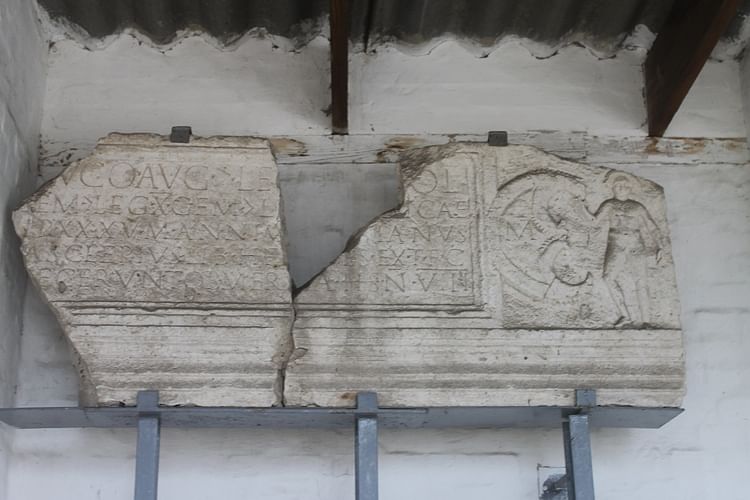 Funerary Monument of M. Annius Lucus AncientDigitalMaps (CC BY-NC) ](https://www.worldhistory.org/image/15142/funerary-monument-of-m-annius-lucus/ "Funerary Monument of M. Annius Lucus")### Legio III Gallica
Legio III Gallica (emblem: three bulls; birth sign: Capricorn) was the third legion raised by [Julius Caesar](https://www.worldhistory.org/Julius_Caesar/) (100-44 BCE) around 49 BCE and served with him in [Gaul](https://www.worldhistory.org/gaul/). Since legions of that era were known by a number, not a name, confusion about a legion's activities exists. Aside from [Caesar](https://www.worldhistory.org/disambiguation/caesar/)'s Third, there was also a 3rd legion that fought for [Pompey the Great](https://www.worldhistory.org/pompey/) (106-48 BCE) against Caesar at the [Battle of Pharsalus](https://www.worldhistory.org/article/697/the-battle-of-pharsalus/) in 48 BCE. Some historians believe Caesar's legion received the name Gallica because most of its legionaries were recruited in Gaul, and to distinguish it from [Pompey](https://www.worldhistory.org/pompey/)'s legion.
After his [death](https://www.worldhistory.org/disambiguation/Death/), Caesar's 3rd legion was reformed by [Mark Antony](https://www.worldhistory.org/Mark_Antony/) (83-30 BCE) and was one of the 16 legions that served with him in the East. Filled with recruits from Syria, the legion participated in the commander's unsuccessful attack on the Parthian capital of Phraata in 36 BCE. Although having success initially in the campaign, [Roman siege warfare](https://www.worldhistory.org/Roman_Siege_Warfare/) was no match for the tactics of [Parthian warfare](https://www.worldhistory.org/Parthian_Warfare/), forcing an ignoble retreat. Harassed by the Parthian cavalry and infantry, the 3rd, in a counterattack under [Antony](https://www.worldhistory.org/Mark_Antony/)'s leadership, prevented the destruction of the Roman line of march. Even so, [Mark](https://www.worldhistory.org/disambiguation/Mark/) Antony lost one-third of the [Roman army](https://www.worldhistory.org/Roman_Army/) during the retreat. Remaining with Antony, the legion may or may not have been at the [Battle of Actium](https://www.worldhistory.org/Battle_of_Actium/) in 31 BCE. In 30 BCE, the legion became part of [Octavian](https://www.worldhistory.org/augustus/)'s standing army and would thereafter be stationed in Syria.
Years later, as the III Gallica faced the forces of [Vitellius](https://www.worldhistory.org/Vitellius/) (r. 69 CE) prior to the Second [Battle](https://www.worldhistory.org/disambiguation/battle/) of Bedriacum, the Roman commander Marcus Primus spoke before the gathered legions and reminded the 3rd, in particular, of its time under Antony. [Tacitus](https://www.worldhistory.org/tacitus/) wrote of the commander's speech:
> The third legion he addressed at greater length, reminding them of old and recent achievements, how under [Marcus Antonius](https://www.worldhistory.org/Mark_Antony/) they had defeated the Parthians, under Corbulo the Armenians, and lately discomfited the Sarmatians. ... A shout was raised on all sides, and the soldiers of the third legion saluted, as is the custom in Syria, the rising sun. (*Histories*, 3.24)
In 4 BCE, the III Gallica helped suppress unrest in Judea after the death of [Herod the Great](https://www.worldhistory.org/Herod_the_Great/) (c. 75 to 4 BCE). Later, during the reign of Emperor [Nero](https://www.worldhistory.org/Nero/) (54-68 CE), the legion assisted in the defeat of another rebellion by the Parthians. Under the leadership of its camp prefect Capito, six cohorts of the Third marched northward in 59 CE to Cappadocia and were part of Gnaeus Corbulo's army that captured Artaxata and [Tigranocerta](https://www.worldhistory.org/Tigranocerta/) in [Armenia](https://www.worldhistory.org/armenia/). The legion was also with Corbulo in 62 CE when his army relieved Caesennius Paetus after his disastrous fray against the Parthians. While Paetus commanded the fourth, twelfth, and fifth, "the third, sixth and tenth legions and the old soldiery of Syria remained with Corbulo" (Tacitus, *Annals*, 15.6)
In the Jewish Revolt of 66 CE, the legion provided cohorts to aid in the capture of Jerusalem and suffered heavy casualties in the fight. The legion was assaulted while guarding the Antonia Fortress. 250 legionaries were overwhelmed and wiped out. Later, at a fortress at Cypros near Jericho, legionaries of the 3rd were caught off guard and killed. In the end, 1,500 men of the 3rd had died. Whether or not the legion remained in Judea and was with [Vespasian](https://www.worldhistory.org/Vespasian/) (r. 69-79 CE) in Galilee is uncertain. With depleted numbers, [Rome](https://www.worldhistory.org/Rome/) transferred the legion to Moesia.
[  The Siege and Destruction of Jerusalem David Roberts (1796-1864) (Public Domain) ](https://www.worldhistory.org/image/4032/the-siege-and-destruction-of-jerusalem/ "The Siege and Destruction of Jerusalem")In 68 CE, the [city](https://www.worldhistory.org/city/) of Rome was in disarray. Nero had committed suicide and four Roman commanders vied for the throne. During this hectic time, the Roxolani, Sarmatian nomads, took advantage of the situation and crossed the Danube into Roman territory. After some initial success, the nomads became more concerned with plunder and less with fighting. Despite being depleted, the Legio III took advantage and went on the offensive. According to Tacitus "… they were dispersed and off their guard, when the third legion together with some auxiliaries attacked them. The Romans had everything ready for battle, the Sarmatians were scattered…" (*Histories*, 1.79).
[Titus](https://www.worldhistory.org/disambiguation/Titus/) Flavius Vespasianus (Vespasian) was proclaimed emperor by his troops – the III Gallica was among them, helping gain support from the [legions of Moesia](https://www.worldhistory.org/article/1853/legions-of-moesia/). The 3rd legion was part of Marcus Primus' army that invaded [Italy](https://www.worldhistory.org/italy/) and fought against Vitellius' forces at Bedriacum and Cremona. Tacitus wrote that "the fiercest struggle was maintained by the third and seventh legions" and, while Legio VII tried to gain entry into the city of Cremona, "the third broke down the gate with axes and swords. All authors are agreed that Caius Volusius, a soldier of the third legion, entered the city first" (*Histories*, 3.29). Wintering at Capua, the legion returned to Syria, replacing XII Fulminata at Raphanaea on the Orontes. The years that followed brought the legion into constant [war](https://www.worldhistory.org/disambiguation/War/) in the Jewish Revolt as well as against further incursions from the Parthians.
In 218 CE, the legion supported the claimant [Elagabalus](https://www.worldhistory.org/Elagabalus/) (r. 218-222 CE) for the Roman throne after the assassination of Marcus [Macrinus](https://www.worldhistory.org/Macrinus/) (r. 217-218 CE). On 16 May 218 CE, the 14-year-old Elagabalus was sneaked into the camp of the legion and proclaimed emperor. However, the reign of the young emperor was one of uprisings and rebellions. The 3rd and 7th who had supported him turned against Elagabalus but failed in their attempts to overthrow him. On 13 March 222 CE, while at the [Praetorian Guard](https://www.worldhistory.org/Praetorian_Guard/) camp, Elagabalus and his mother were executed, beheaded, dragged through the streets of Rome, and dumped into the Tiber. He was replaced by [Severus Alexander](https://www.worldhistory.org/Alexander_Severus/) (222-235 CE). During the period known as the [Crisis of the Third Century](https://www.worldhistory.org/Crisis_of_the_Third_Century/), Legio III fought alongside Emperor [Aurelian](https://www.worldhistory.org/Aurelian/) (r. 270-275 CE) against Queen [Zenobia](https://www.worldhistory.org/zenobia/) of the Palmyrene [Empire](https://www.worldhistory.org/empire/). Afterwards, the activities of the 3rd are unclear. The legion remained in Syria for the remainder of its existence.
[  Queen Zenobia before Emperor Aurelianus Giovanni Battista Tiepolo (Public Domain) ](https://www.worldhistory.org/image/3008/queen-zenobia-before-emperor-aurelianus/ "Queen Zenobia before Emperor Aurelianus")### Legio IV Scythica
The origin of Legio IV or IIII Scythica (emblem: bull; birth Sign: Capricorn) is unclear. Like with III Gallica, there is some confusion because there were two 4th legions – IV Scythica and IV Macedonica – the latter was stationed in Spain and possibly served with Pompey, fighting against Caesar and surrendering to him in 49 BCE. The IV Scythica was part of Mark Antony's army, reformed by [Augustus](https://www.worldhistory.org/augustus/) (r. 27 BCE to 14 CE), spending its first few years in Macedonia. Some contend the reformed legion was from Pompey's legion and not Antony's.
The IV Scythica served with Marcus [Crassus](https://www.worldhistory.org/Marcus_Licinius_Crassus/) (115-53 BCE) during his [conquest](https://www.worldhistory.org/warfare/) of the territory that would become Moesia. The defeat of the Bastarnae, a tribe of the [Scythians](https://www.worldhistory.org/Scythians/), gave the legion its name. Although sources are uncertain, it may have participated in suppressing the Pannonian Revolt of 6-9 CE. The legion was transferred to Syria, possibly to aid in Corbulo's campaign in Armenia. Tacitus wrote of a legion arriving from Germany with auxiliary, cavalry, and light infantry, and he referred to the 4th serving under Caesennius Paetus:
> And indeed he \[Paetus\] had now arrived and the army was divided: the fourth and twelfth legion with the fifth … the auxiliaries from Pontus, [Galatia](https://www.worldhistory.org/galatia/) and Cappadocia, were under the command of Paetus…. (*Annals*, 15.6)
While the legion played only a minor role in the first Jewish Revolt in 66 CE, it supplied cohorts in the unsuccessful attack on Jerusalem. The legion was transferred to Zeugma, replacing X Fretensis. Like other legions of the East, Legio IV declared for Vespasian when he was proclaimed emperor. In 70 CE, the legion was with Titus (r. 79-81 CE) at Jerusalem. Later, the legion participated in the suppression of the Second Jewish Revolt, too.
Although the Fourth supported Septimius Severus' rival Pescennius Niger for the Roman throne in 193 CE, the IV Scythica was one of the [legions of the Parthian Wars](https://www.worldhistory.org/article/1764/legions-of-the-parthian-wars/) under Septimius Severus. It also served in [Caracalla](https://www.worldhistory.org/Caracalla/)'s Parthian War of 216-217 CE and Severus [Alexander](https://www.worldhistory.org/disambiguation/Alexander/)'s Persian War of 231-233 CE against the Sasanians. The legion remained in Syria at Sura for the remainder of its existence.
[  Parthian Camel Cataphracts The Creative Assembly (Copyright) ](https://www.worldhistory.org/image/2309/parthian-camel-cataphracts/ "Parthian Camel Cataphracts")### Legio XVI Flavia Firma
Legio XVI Flavia Firma (emblem: lion; birth sign: unknown) was formed by Vespasian in 70 CE and received his family name. The legion's emblem, the lion, is associated with the emperor's favorite deity, [Hercules](https://www.worldhistory.org/hercules/). The 16th was formed to replace the disgraced XVI Gallica who had supported Gaius Civilis in the [Batavian Revolt](https://www.worldhistory.org/article/286/the-batavian-revolt/) of 69 CE. The legion was sent to the East and was stationed in Cappadocia with the XII Fulminata to guard against any possible incursions. According to the historian [Suetonius](https://www.worldhistory.org/Suetonius/) (c. 69 to c. 130/140 CE), Vespasian "garrisoned Cappadocia as a precaution against the frequent barbarian raids …" (*Twelve Caesars*, 281)
Later, the legion was sent to Samosata in [Commagene](https://www.worldhistory.org/Commagene/) on the Euphrates. It participated in the [Persian Wars](https://www.worldhistory.org/Persian_Wars/) throughout the 2nd and 3rd centuries CE, fighting with [Trajan](https://www.worldhistory.org/trajan/) in his Parthian campaign of 115-116 CE and in the Roman-Parthian War under [Lucius Verus](https://www.worldhistory.org/Lucius_Verus/) (r. 161-169 CE). It remained stationed at Samosata until Emperor Septimius Severus' reign when some sources claim it returned to Syria.
#### Editorial Review
This human-authored article has been reviewed by our editorial team before publication to ensure accuracy, reliability and adherence to academic standards in accordance with our [editorial policy](https://www.worldhistory.org/static/editorial-policy/).
## Bibliography
- [Dando-Collins, Stephen. *Legions of Rome.* Thomas Dunne Books, 2012.](https://www.worldhistory.org/books/1250004713/)
- [Hornblower, Simon & Spawforth, Antony & Eidinow, Esther. *The Oxford Classical Dictionary.* Oxford University Press, 2012.](https://www.worldhistory.org/books/0199545561/)
- [Pollard, Nigel & Berry, Joanne. *The Complete Roman Legions.* Thames & Hudson, 2012.](https://www.worldhistory.org/books/0500251835/)
- [Scarre, Chris. *Chronicle of the Roman Emperors.* Thames & Hudson, 1995.](https://www.worldhistory.org/books/0500289891/)
- [Strauss, Barry. *Ten Caesars.* Simon & Schuster, 2019.](https://www.worldhistory.org/books/145166883X/)
- [Suetonius. *The Twelve Caesars .* Penguin Books.](https://www.worldhistory.org/books/1774761300/)
- [Tacitus, Cornelius. *The Complete Works of Tacitus.* Modern Library.](https://www.worldhistory.org/books/1420947141/)
## About the Author
Donald has taught Ancient, Medieval and U.S. History at Lincoln College (Normal, Illinois)and has always been and will always be a student of history, ever since learning about Alexander the Great. He is eager to pass knowledge on to his students.
## Cite This Work
### APA
Wasson, D. L. (2022, January 17). Legions of Syria. *World History Encyclopedia*.
### Chicago
Wasson, Donald L.. "Legions of Syria." *World History Encyclopedia*, January 17, 2022. .
### MLA
Wasson, Donald L.. "Legions of Syria." *World History Encyclopedia*, 17 Jan 2022, .
## License & Copyright
Submitted by [Donald L. Wasson](https://www.worldhistory.org/user/DWasson/ "User Page: Donald L. Wasson"), published on 17 January 2022. The copyright holder has published this content under the following license: [Creative Commons Attribution-NonCommercial-ShareAlike](https://creativecommons.org/licenses/by-nc-sa/4.0/deed.en). This license lets others remix, tweak, and build upon this content non-commercially, as long as they credit the author and license their new creations under the identical terms. When republishing on the web a hyperlink back to the original content source URL must be included. Please note that content linked from this page may have different licensing terms.