---
title: The Punic Necropolis of Mahdia
author: Njim Adel
source: https://www.worldhistory.org/article/1888/the-punic-necropolis-of-mahdia/
format: machine-readable-alternate
license: Creative Commons Attribution-NonCommercial-ShareAlike (https://creativecommons.org/licenses/by-nc-sa/4.0/)
updated: 1970-01-01
---
# The Punic Necropolis of Mahdia
_Authored by [Njim Adel](https://www.worldhistory.org/user/njimadel/)_
The [Punic](https://www.worldhistory.org/carthage/) funerary remains of Mahdia, a series of tombs carved into the rock, date back to a period between the 5th and the 2nd century BCE and are located in the northeast of Tunisia. These tombs are useful for us to understand the acculturation between the local populations known as Libyans and the [Phoenicians](https://www.worldhistory.org/phoenicia/) of eastern origin.
[  Punic Necropolis, Mahdia Njim Adel (CC BY-NC-SA) ](https://www.worldhistory.org/image/14911/punic-necropolis-mahdia/ "Punic Necropolis, Mahdia")### Mahdia
Mahdia is one of the major [cities](https://www.worldhistory.org/city/) of the ancient Byzacene region and one of the main coastal settlements of the region. The [city](https://www.worldhistory.org/city/) enjoys exceptional geography and is located on a rock bathed by the sea. This peninsula, about 1.5 kilometres (0.9 mi) long and 400 metres (1300 ft) wide, is attached to the mainland by a narrow sandy strip of land about 170 metres (560 ft) wide.
Mahdia has had many different names throughout its history. It was called Aphrodisium, Alipota, Gummi (the most enduring name), and probably Pharos. Gummi seems to have continued in the Arabised form of Jemma, a place now located in the vicinity. During the Islamic period, the city took its current name of Mahdia. This name is derived from the name of the founder of the Fatimid Dynasty Al-Mahdi (r. 909-934) who settled there and made it the capital of his kingdom from about 920.
The exact location of ancient Mahdia is unknown. The existence of Punic necropolises leads us to believe that there was indeed a Punic settlement corresponding to these necropolises, but we still do not know where exactly. If we examine the relationship between the city of the living and the city of the dead in the Phoenician-Punic world, we could consider locating these necropolises at the periphery of the city. Nothing indicates that the Punic city occupied the same location as the Fatimid city on the Mahdia peninsula; in fact, the name Gummi would correspond to the modern Jemma, which refers to a place outside the walls of the Fatimid city. The Punic tombs, on the other hand, were indeed located on the peninsula.
### The Punic Necropolis
The Punic funerary remains have been the subject of numerous studies by European archaeologists, particularly French, throughout the 19th and early 20th centuries. Tunisian archaeologists then took over, and it was in the early 1980s that Mr Ben Younes devoted himself to the excavations of the necropolis.
In the necropolises of Mahdia, there are two distinct areas:
- **The peninsula:** The first funerary complex is concentrated in the peninsula. A large number of tombs, essentially superficial troughs, can be found here. However, an underground [grave](https://www.worldhistory.org/burial/) was also reported.
- **The Jebel**: The second substantial group is located in the area called the Jebel. This group is oriented north-south and extends for about 12 km (7.5 mi) west of Mahdia. The tombs occupy the hills running north to south of the settlements of Hiboun, Borj Arif, Ezzahra, Zghena, and Rajiche.
Apart from its undeniable scientific importance, the Punic necropolis of Mahdia is also very interesting for its size. The archaeologists who have excavated this necropolis provide us with astonishing figures which are highly significant since they are close to those of the Punic necropolis of [Carthage](https://www.worldhistory.org/carthage/). This shows the geographical importance of this necropolis and obviously its implication on the Punic settlement in this region.
The Punic tombs are extremely diverse, but they can be divided essentially into two types: shallow troughs dug on the surface and pit graves. The first type is often very simple and does not have much morphological variety. The second type is characterised by a great morphological variety in the staircases, the [burial](https://www.worldhistory.org/burial/) chamber and the grave goods. These pit graves have many possible points of comparison with the funerary monuments of the Libyan tradition known as *haouanets*. Indeed, recent research shows that such rock-cut tombs existed at Mahdia, which reinforces the idea of a mutual influence between these remains and the Punic tombs.
[ 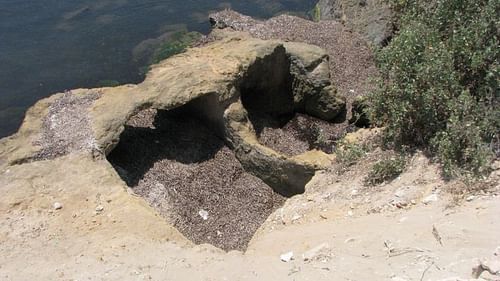 Punic Tombs at Mahdia Njim Adel (CC BY-NC-SA) ](https://www.worldhistory.org/image/14909/punic-tombs-at-mahdia/ "Punic Tombs at Mahdia")The Punic necropolis cannot be precisely dated, but it has been suggested that the necropolis was probably in use between the 5th century and the end of the 2nd century BCE. What we do know is that a [tomb](https://www.worldhistory.org/tomb/) in the Ezzahra area can be dated to the 3rd century BCE and that the surface sherds from the Jbal Rajiche and Douira area date to the 2nd century BCE.
### Importance of the Necropolises
The Punic necropolises of Mahdia are interesting in many ways, especially as archaeological evidence relating to the world of the living is rarer and less documented. The necropolises constitute a document of choice for the study of the settlement of this [civilisation](https://www.worldhistory.org/civilization/). The size of the Punic necropolises of Mahdia is close to that of the necropolises of the Punic metropolis Carthage. The synthesis of archaeological data confirms the importance and continuity of Punic presence not only in Mahdia but all along the Sahelian coast. Indeed, the Punic remains constitute an almost uninterrupted string of sites. Such data are interesting for understanding the demographic and cultural identity of this region. These conclusions can be compared with studies carried out on other large regions of Punic presence in Tunisia such as Carthage or Cap Bon.
The Punic tombs of Mahdia are useful for studying the acculturation between the Phoenician [civilization](https://www.worldhistory.org/civilization/) and the local populations known as Libyans. First of all, it should be remembered that a good part of the region was occupied by Libyan populations whose funerary monuments of the *haouanet* type are still present. In Mahdia, the remains of traditional Libyan tombs were discovered alongside the Punic ones. The Punic people thus mixed with the Libyan populations. This is why the funerary [architecture](https://www.worldhistory.org/disambiguation/architecture/) of the population of Mahdia and even of the whole Sahel is similar to Libyan architecture even if the Phoenician influence is never absent. Epigraphic evidence from Thpasus expresses this cultural duality; there is an engraved inscription in a tomb in which the father bears a Libyan name while the son bears a Phoenician name, a clear testimony of this Libyan-Punic cultural osmosis.
[ 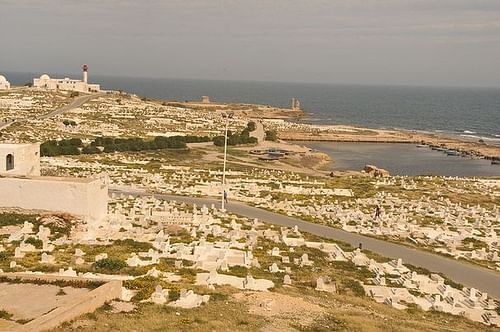 Mahdia Njim Adel (CC BY-NC-SA) ](https://www.worldhistory.org/image/14910/mahdia/ "Mahdia")The study of the Punic funerary heritage of Mahdia also informs us about Punic beliefs. The funerary offerings are able to reveal the religious conception of the populations of this period. The archaeological evidence in the necropolises of the Sahel, including those of Mahdia, shows that food offerings and libations were often placed next to the buried corpses. Such offerings near cremations allow us to conclude that the offering was not intended to feed the body of the deceased but his soul, thus revealing the deep beliefs and the degree of spirituality of the Sahelian populations. The decoration of the necropolises allows us a glimpse into the Punic [culture](https://www.worldhistory.org/disambiguation/culture/). Indeed, the walls of the Punic burial chambers of Mahdia, like the Sahelian Punic tombs, contain a red decoration that is both linear and floral. A tomb at Ezzahra, for example, is decorated with two parallel bands painted on the upper part of the four walls. This decoration is also concentrated around the niches. Sometimes the pediment of the triangular niches is painted as well as the base of the niche, which is highlighted by touches of the same colour. The floral decorations are closely linked to the niches. In a tomb in Jebel Rajiche, a niche is framed on its three sides by two parallel bands. On either side of the niche, there are lotus flowers of different sizes.
### The Future of the Site
The future of archaeological sites is a growing concern in Tunisia, whether they are prestigious sites such as Carthage or less famous ones such as the necropolises of Mahdia. The area of the Mahdia quarries, which merges with the Punic necropolises, has been the subject of a Tunisian-Canadian rehabilitation project. The Punic funerary remains of Mahdia are little known by the general public despite their great scientific and cultural importance. However, the documentation of the Punic necropolises of Mahdia could lead to the creation of a digital map of these remains and a virtual restitution of this heritage, which today offers little more than a desolate appearance. The successful implementation of a project for the effective enhancement of the necropolises and quarries of Mahdia could become a textbook case from which other cities in the Sahel could draw inspiration.
#### Editorial Review
This human-authored article has been reviewed by our editorial team before publication to ensure accuracy, reliability and adherence to academic standards in accordance with our [editorial policy](https://www.worldhistory.org/static/editorial-policy/).
## Bibliography
- H. Benichou-Safar. "Tombes." *Dictionnaire de la civilisation phénicienne et punique*, edited by E. Lipinski (Directeur). Paris-Bruxelles, 1992, p. 457-461.
- Ben Guith Hmissa. *Les monuments funéraires de tradition libyque dans le Sahel.* Diplôme d’études approfondies, Tunis, 2000
- H. Ben Younes. *La présence punique au Sahel d’après les données littéraires et archéologiques .* Thèse de troisième cycle, 1981
- H. Benichou-Safar. "Nécropoles." *Dictionnaire de la civilisation phénicienne et punique*, edited by E. Lipinski (Directeur). Paris-Bruxelles, 1992, p. 311-313.
- H. Slim, P. Trousset, R.Paskoff et A. Oueslati. *Le littoral de la Tunisie étude géoarchéologique et historique.* CNRS éditions, Paris, 2004
- M. Dubuisson-E. Lipinski. "Byzacène." *E. Lipinski (Directreur)*, edited by Dictionnaire de la civilisation phénicienne et punique. Paris-Bruxelles, 1992, p. 85.
- P. Poullaouec-Gonidec. *Invention paysagère des carrières de Mahdia.* Montréal, 2008, p 62-67.
## About the Author
Doctor in archaeology who teaches at the University of Sfax in Tunisia, author of a large number of papers and articles of a historical nature including "Relire l'Afrique du Nord Antique" published in 2020.
## Cite This Work
### APA
Adel, N. (2021, November 25). The Punic Necropolis of Mahdia. *World History Encyclopedia*.
### Chicago
Adel, Njim. "The Punic Necropolis of Mahdia." *World History Encyclopedia*, November 25, 2021. .
### MLA
Adel, Njim. "The Punic Necropolis of Mahdia." *World History Encyclopedia*, 25 Nov 2021, .
## License & Copyright
Submitted by [Njim Adel](https://www.worldhistory.org/user/njimadel/ "User Page: Njim Adel"), published on 25 November 2021. The copyright holder has published this content under the following license: [Creative Commons Attribution-NonCommercial-ShareAlike](https://creativecommons.org/licenses/by-nc-sa/4.0/deed.en). This license lets others remix, tweak, and build upon this content non-commercially, as long as they credit the author and license their new creations under the identical terms. When republishing on the web a hyperlink back to the original content source URL must be included. Please note that content linked from this page may have different licensing terms.