---
title: Hipponax & Misogyny in Ancient Greece
author: Lauren Hawkins
source: https://www.worldhistory.org/article/188/hipponax--misogyny-in-ancient-greece/
format: machine-readable-alternate
license: Creative Commons Attribution-NonCommercial-ShareAlike (https://creativecommons.org/licenses/by-nc-sa/4.0/)
updated: 1970-01-01
---
# Hipponax & Misogyny in Ancient Greece
_Authored by [Lauren Hawkins](https://www.worldhistory.org/user/leh0328/)_
It has always been recognized that [women in the ancient world](https://www.worldhistory.org/collection/31/women-in-the-ancient-world/) were considered only a little higher in value than the man's cattle or plow and, sometimes, not even accorded that kind of respect. Examples of misogynistic attitudes toward [women](https://www.worldhistory.org/disambiguation/women/) can be seen in certain works from [Mesopotamia](https://www.worldhistory.org/Mesopotamia/) or [Egypt](https://www.worldhistory.org/egypt/) but, in these cultures, women were generally respected and even enjoyed a degree of equal rights. In the work of the [Greek](https://www.worldhistory.org/disambiguation/greek/) poet Hipponax of [Ephesus](https://www.worldhistory.org/ephesos/), however, misogyny reaches heights unequaled in any other [writing](https://www.worldhistory.org/writing/).
Hipponax (c. 540 BCE) is known as a satirist with a “malicious disposition” but, if his work on women is supposed to be in any way funny, it misses the [mark](https://www.worldhistory.org/disambiguation/Mark/) completely. It is little wonder that he was exiled from his hometown of [Ephesus](https://www.worldhistory.org/ephesos/) and finally died in poverty.
[ 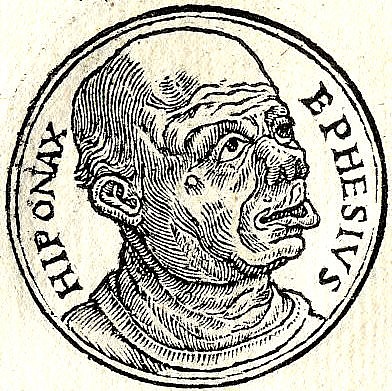 Hipponax of Ephesus Unknown Artist (Public Domain) ](https://www.worldhistory.org/image/6107/hipponax-of-ephesus/ "Hipponax of Ephesus")D. Brendan Nagle and Stanley M. Burnstein in their work The Ancient World: Readings in Social and Cultural History, include in their section, *Husbands, Wives and Slaves: The Domestic Foundations of the [Polis](https://www.worldhistory.org/Polis/)*, Hipponax's piece, “If Only We Could Reproduce Without Woman…!” which clearly demonstrates the misogynistic attitude of the time and makes women seem unappreciated and worthless. There is not a single point in the piece where women are talked about positively. As stated, women were typically only seen valuable for their ability to reproduce and to maintain a household, but a modern reader cannot fully realize how poorly women were regarded until experiencing this piece of writing.
The poet Hipponax wrote, “Two days are sweetest for a woman, the day a man marries her and the day he carries her out dead”. This statement is extremely degrading, especially because these ideas and beliefs were kept for so long, even if they were not believed to the extent that Hipponax represents. Even to this day some men still do not believe in the equality between males and females.
Some modern readers may believe that this idea of the unimportance of [women in ancient Greece](https://www.worldhistory.org/article/927/women-in-ancient-greece/) is not that degrading because, in today's society, most people do not think this way. Such readers also may actually believe that the way women are described in the text is a good representation of the characteristics of women. The stereotypes of women may be correct to some extent, but they are extravagantly cruel and, further, anyone could think of plenty male attributes and relate them coarsely to the characteristics of animals representing men.
A break down of the female characteristics that are represented in the text is quite interesting. First the pig is used to represent women. Hipponax is describing a woman as a slob that has no respect for herself and her self-appearance. Then comes the fox, which is described as being sly and unpredictable and then, most offensive, is the dog, also known as the bitch. The dog is supposed to reproduce over and over again and is annoying because she is in everyone's business and always wants to be heard. Nobody can shut the woman up whether she is treated nicely or beaten.
Hipponax's depiction of woman as the sea is the most accurate representation of women, because a woman's moods and temperaments do tend to change quite frequently. This is the only representation that a modern reader might actually agree with. Yet this reasonable pause is brief and the list continues on describing a woman as the ass, weasel, horse, and the ape until reaching the conclusion that “Zeus made this the greatest pain of all: Woman”. The nicest `type' of woman this poet can manage is the bee but cannot help but say, “Good luck in finding such a woman” as he goes on to describe a woman who is only a “loving wife beside her loving man” who will bear “illustrious and handsome children”. For most people, however, the bee is synonymous with a sting.
However, thanks to the grim contrivances of [Zeus](https://www.worldhistory.org/zeus/), women are here to stay by man's side forever, no matter what, and Hipponax and those like him will simply have to deal with that.
#### Editorial Review
This human-authored article has been reviewed by our editorial team before publication to ensure accuracy, reliability and adherence to academic standards in accordance with our [editorial policy](https://www.worldhistory.org/static/editorial-policy/).
## Bibliography
- [D. Brendan Nagle and Stanley M. Burnstein. *The Ancient World Readings in Social & Cultural History 4th EDITION.* Prentice Hall, New Jersey, 2010.](https://www.worldhistory.org/books/B0044KTCIS/)
## Cite This Work
### APA
Hawkins, L. (2012, January 18). Hipponax & Misogyny in Ancient Greece. *World History Encyclopedia*.
### Chicago
Hawkins, Lauren. "Hipponax & Misogyny in Ancient Greece." *World History Encyclopedia*, January 18, 2012. .
### MLA
Hawkins, Lauren. "Hipponax & Misogyny in Ancient Greece." *World History Encyclopedia*, 18 Jan 2012, .
## License & Copyright
Submitted by [Lauren Hawkins](https://www.worldhistory.org/user/leh0328/ "User Page: Lauren Hawkins"), published on 18 January 2012. The copyright holder has published this content under the following license: [Creative Commons Attribution-NonCommercial-ShareAlike](https://creativecommons.org/licenses/by-nc-sa/4.0/deed.en). This license lets others remix, tweak, and build upon this content non-commercially, as long as they credit the author and license their new creations under the identical terms. When republishing on the web a hyperlink back to the original content source URL must be included. Please note that content linked from this page may have different licensing terms.