---
title: Treasure Hoards in Ancient Literature
author: Frank Holt / Oxford University Press
source: https://www.worldhistory.org/article/1873/treasure-hoards-in-ancient-literature/
format: machine-readable-alternate
updated: 2022-09-07
---
# Treasure Hoards in Ancient Literature
_Authored by Frank Holt / Oxford University Press_
[Aristophanes](https://www.worldhistory.org/Aristophanes/) wrote in the 5th century BCE about [coin](https://www.worldhistory.org/coinage/) hoards in [Athens](https://www.worldhistory.org/Athens/). He joked about the common saying, "No one knows but the birds where I hid my money," which led buffoons in his play to follow birds around with a shovel, hoping to excavate a treasure.
[ 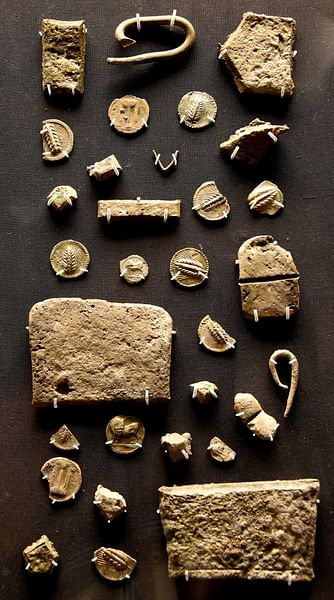 The Taranto Hoard Osama Shukir Muhammed Amin (Copyright) ](https://www.worldhistory.org/image/5945/the-taranto-hoard/ "The Taranto Hoard")### Hoards in [Greek Comedy](https://www.worldhistory.org/Greek_Comedy/)
In [Plautus](https://www.worldhistory.org/plautus/)' *Aulularia* (*The Pot of [Gold](https://www.worldhistory.org/gold/)*), a crass fellow buries a valuable hoard beneath his hearth. He entrusts the hoard to the household [god](https://www.worldhistory.org/God/), who relates to the audience:
> He prayed that I would guard the pot of gold for him. When he died, being of such an avaricious nature, he never disclosed the hoard to his own son, preferring to leave the boy poor than to show him the coins. . . . The son was even less attentive to me, so I let him die clueless and destitute. His heir turned out to be just like the father and grandfather, but he has an only daughter who is mindful of me. Out of regard for her, I have allowed her father to find the hoard, in order that he might more readily provide her a dowry.
In another of Plautus' plays, titled *Trinummus* (*A Day's Wage*), the character Charmides also buries his coins within his house. Here Plautus reprises Philemon's New Comedy play *Thesauros* (*The Hoard*). Other comedies with the same title were produced by the [Greek](https://www.worldhistory.org/disambiguation/greek/) playwright Menander and the [Roman](https://www.worldhistory.org/disambiguation/Roman/) Luscius Lanuvinus. In his play, Lanuvinus devises a neat literary trick by having the hoarder leave an explanatory note hidden with the treasure. The modern novelist Jack Whyte does the same thing in *The Skystone*, his popular historical fiction about [Roman Britain](https://www.worldhistory.org/Roman_Britain/). The note informs the new owner about earlier iterations of the hoard, such as where it had first been found and for whom it was next intended.
#### Book Excerpt
[  ](https://global.oup.com/academic/product/when-money-talks-9780197517659?utm_campaign=oupac-campaign:1364360070327667057&utm_source=third%20party&utm_medium=referral&utm_content=web+banner+link&utm_term=world+history+encyclopedia "When Money Talks")### When Money Talks
by Frank L. Holt For 2600 years, poets, economists, philosophers, historians, and theologians have pondered the mysteries of money. Who invented coins, and why? Does coinage function beyond our control as if it had a mind of its own? How has it changed world history and culture? Frank L. Holt takes us on a lively journey through the history of numismatics, the study of coins--one of the oldest and most important contributions to world history. [Learn More](https://global.oup.com/academic/product/when-money-talks-9780197517659?utm_campaign=oupac-campaign:1364360070327667057&utm_source=third%20party&utm_medium=referral&utm_content=web+banner+link&utm_term=world+history+encyclopedia)
.sponsor.book img.key_art {
box-shadow: none !important;
}
.button_container {
margin-top: 1em;
}
.sponsor.book h3 {
text-transform: none;
margin-top: 0px;
margin-bottom: 15px;
font-family: "Libre Baskerville", "Palatino Linotype", "Book Antiqua", Palatino, serif;
}
.sponsor_message {
margin-left: 190px;
font-family: Karla, Arial, Helvetica, sans-serif;
line-height: 140%;
min-height: 200px;
}
.sponsor.book {
padding: 20px;
margin: 25px 0px;
background-color: #f3f3f3;
}
.sponsor.book .key_art {
margin-top: 0px;
margin-bottom: 10px;
float: left;
}
.sponsor h4 {
font-weight: bold;
text-transform: uppercase;
color: #000;
margin-bottom: 10px;
margin-top: 0px;
font-family: Karla,Arial,Helvetica,sans-serif;
font-size: 13px;
padding: 0;
}
.sponsor_book_author {
color: #999;
margin: -10px 0px 20px;
}
@media (max-width: 1199px) {
.sponsor.book .key_art {
float: none;
width: 100%;
}
.sponsor.book .sponsor_message {
margin-left: 0px;
}
.sponsor.book h3 {
margin-top: 20px;
margin-bottom: 10px;
}
}
@media (max-width: 767px) {
}
### Ethical & Legal Considerations
Hoards and hoarders are to be found outside comedy as well. They appear in the [New Testament](https://www.worldhistory.org/New_Testament/) as parables. In one instance, a servant is chastised for burying his master's money in the ground instead of investing it. The Greek writer [Xenophon](https://www.worldhistory.org/xenophon/) commented centuries earlier about this unprofitable impulse to hoard: "When a man accumulates a huge amount of [silver](https://www.worldhistory.org/Silver/), he takes as much pleasure in burying the surplus as in using it."
In another parable, [Jesus](https://www.worldhistory.org/Jesus_Christ/) seems to commend a person who finds a hoard in a field, conceals his discovery, then sells all his possessions in order to buy the property. Is this shrewd business or unethical behavior? According to [Roman law](https://www.worldhistory.org/Roman_Law/), for instance, anyone discovering a hoard on his own property was entitled to keep it; if found on someone else's land, the treasure had to be shared evenly with the property owner. The man in Jesus' parable would be cheating the owner of his portion by hiding the discovery, yet he is apparently entitled to prosper.
The Greek writer Philostratus tells the story of a bankrupt businessman who prays to Mother Earth, keeper of hoards, to guide him to a treasure – the ancient equivalent of winning the lottery. A miracle worker offers to help, negotiating on the man's behalf the purchase of some land from a wicked owner. The businessman then finds on his new property a huge hoard and, wealthy again, sings the praises of the sage who guided him to the purchase. The suggestion here seems to be that the middleman divined the hoard's existence all along, but that it was ethical to cheat the seller because the bankrupt businessman was more deserving of the gold. Elsewhere, Philostratus describes a lawsuit in which a person buys land that later, when plowed, reveals a buried hoard. The seller of the field sues for the treasure since he would never have sold the land if he had known of the windfall. The buyer in this case practiced no duplicity and was awarded the judgment. Clearly, hoard discoveries gave rise to many legal disputes and moral quandaries.
### Criminal Cases
Some cases were blatantly criminal. The Roman orator [Cicero](https://www.worldhistory.org/Cicero/) reports a circumstance of murder and robbery surrounding a savings hoard:
> The renowned physician [Strato](https://www.worldhistory.org/disambiguation/Strato/) committed murder to conceal a theft in his own house where the family kept a chest full of coins and gold. One night he murdered two slaves while they were asleep and hid their bodies in a fish pond. Then he cut out the bottom of the chest and took away the coins and five pounds of gold.
[  Treasure Chest leigh49137 (CC BY-ND) ](https://www.worldhistory.org/image/14661/treasure-chest/ "Treasure Chest")The Greek orator Lysias describes a trial centuries earlier occasioned by murder and the robbery of a money-chest stuffed with silverware and hundreds of Greek and Persian coins. [Egyptian](https://www.worldhistory.org/disambiguation/Egyptian/) papyri preserve police records concerning stolen coin hoards of the Graeco-Roman period. For example, in 28 CE a villager named Orsenouphis filed a report with the local police chief, complaining that a worker renovating his house had found and stolen an old hoard hidden in the walls. Orsenouphis claims to know the contents of the pilfered box down to the exact weight of each item of jewelry in it, alongside 60 silver drachmas, even though the hoard had been hidden 42 years earlier by his mother when the complainant was only eight years old. In another case dated 140 years earlier, some Greek cavalrymen broke into the room of a complainant's mother and carried off a jar containing a hoard of 1,600 [copper](https://www.worldhistory.org/copper/) drachmas.
### Hoards in [Warfare](https://www.worldhistory.org/warfare/)
Hoards feature prominently in accounts of ancient warfare. [Plutarch](https://www.worldhistory.org/plutarch/) records a few instances involving famous generals such as [Alexander](https://www.worldhistory.org/disambiguation/Alexander/) at [Thebes](https://www.worldhistory.org/disambiguation/Thebes/) and [Pompey](https://www.worldhistory.org/pompey/) at [Carthage](https://www.worldhistory.org/carthage/). Appian tells a tale about Cassius at [Rhodes](https://www.worldhistory.org/Rhodes/):
> He ordered private citizens owning any money to bring it to him, proclaiming [death](https://www.worldhistory.org/disambiguation/Death/) to those who tried to conceal it, together with a reward of one-tenth for free informers or emancipation for slaves. At first, many Rhodians hid what they had, hoping that in the end the threat would not be carried out, but when they saw the rewards paid and those who had been informed against killed, they became alarmed. . . . Some of them dug their money out of the ground, others drew it out of wells, and others brought it from tombs and surrendered it to Cassius.
Athenaeus describes how a group of [Phoenicians](https://www.worldhistory.org/phoenicia/), forced to abandon their [city](https://www.worldhistory.org/city/) after a siege, buried all their money in secretly marked hiding places in case they could ever come back. According to [Josephus](https://www.worldhistory.org/Flavius_Josephus/), the practice of smuggling hoards out of a besieged city by swallowing them had a horrendous outcome when 2,000 Jewish refugees were disemboweled by their greedy captors searching for the coins.
[ 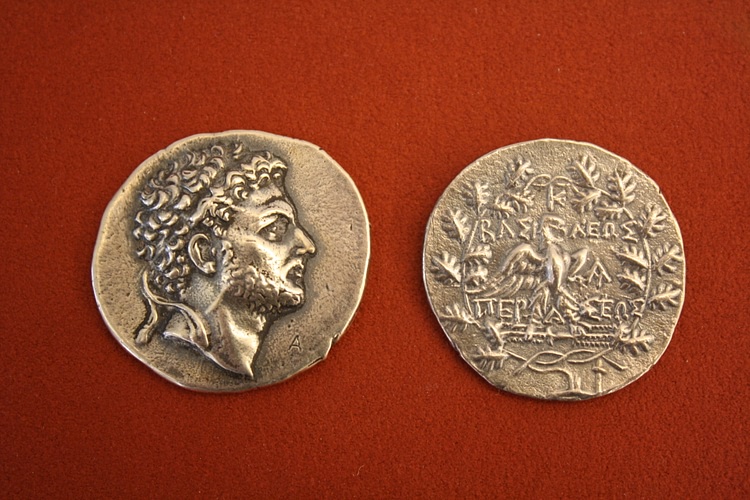 Perseus, Macedonian Silver Tetradrachm Mark Cartwright (CC BY-NC-SA) ](https://www.worldhistory.org/image/844/perseus-macedonian-silver-tetradrachm/ "Perseus, Macedonian Silver Tetradrachm")When defeated by [Rome](https://www.worldhistory.org/Rome/), King [Perseus](https://www.worldhistory.org/Perseus/) of Macedonia allegedly left his heirs a treasure map marking the locations of two hoards, one under a road at [Amphipolis](https://www.worldhistory.org/Amphipolis/) containing 900,000 drachmas and another at Thessalonike with 420,000 drachmas. [Cassius Dio](https://www.worldhistory.org/Cassius_Dio/) informs us of another royal hoard allegedly hidden from the invading Romans in about 100 CE:
> The treasures of [Decebalus](https://www.worldhistory.org/Decebalus/) were discovered hidden beneath the river Sargetia. Decebalus had forced some captives to divert the course of the river, which ran past his [palace](https://www.worldhistory.org/disambiguation/palace/), in order to bury the hoard in its bed. Stones were piled over the treasure and the river redirected back into its original channel.
Divers were able to recover the Decebalus treasure, a dangerous profession extending back as far as the 5th century BCE when the Greek salvagers Scyllias and his daughter Hydna attained fame. Accidents aside, sometimes salvage divers were killed to keep them quiet after successfully rescuing hoards. To assist in potential salvage operations, some individuals took clever precautions. In 56 BCE, Cato Uticensis amassed nearly 199 tons of plundered silver that he wanted shipped to Rome. In case of misfortune, he prudently divided the treasure into separate chests and attached to each one a long rope with a huge cork at the end so that the money could be located if the ship went down.
#### Editorial Review
This human-authored article has been reviewed by our editorial team before publication to ensure accuracy, reliability and adherence to academic standards in accordance with our [editorial policy](https://www.worldhistory.org/static/editorial-policy/).
## Bibliography
- Appian. *Civil Wars.*
- Aristophanes. *The Birds.*
- Hunt and Edgar. *Select Papyri II.* Harvard University Press, 1934
- Justinian. *Digest.* , 41.1.31.
- Justinian. *Institutes.* , 2.1.39.
- [Lewis, Naphtali. *Greeks in Ptolemaic Egypt .* American Society of Papyrologists, 2001.](https://www.worldhistory.org/books/0970059124/)
- Philostratus. *Life of Apollonius.*
- Plutarch. *Alexander.*
- Xenophon. *Ways and Means.*
## Cite This Work
### APA
Press, F. H. /. O. U. (2021, December 13). Treasure Hoards in Ancient Literature. *World History Encyclopedia*.
### Chicago
Press, Frank Holt / Oxford University. "Treasure Hoards in Ancient Literature." *World History Encyclopedia*, December 13, 2021. .
### MLA
Press, Frank Holt / Oxford University. "Treasure Hoards in Ancient Literature." *World History Encyclopedia*, 13 Dec 2021, .
## License & Copyright
[](https://global.oup.com/)This content is provided by [Oxford University Press](https://global.oup.com/) and republished with permission. All Rights Reserved. Original article by [**Frank Holt / Oxford University Press**](https://global.oup.com/). Submitted by [Oxford University Press](https://www.worldhistory.org/user/oxforduniversit/ "User Page: Oxford University Press"), published on 13 December 2021. The copyright holder has published this content under the following license: [Copyright](http://en.wikipedia.org/wiki/Copyright). You cannot use, copy, distribute, or modify this item without explicit permission from the author. Please note that content linked from this page may have different licensing terms.