---
title: Legions of Moesia
author: Donald L. Wasson
source: https://www.worldhistory.org/article/1853/legions-of-moesia/
format: machine-readable-alternate
license: Creative Commons Attribution-NonCommercial-ShareAlike (https://creativecommons.org/licenses/by-nc-sa/4.0/)
updated: 1970-01-01
---
# Legions of Moesia
_Authored by [Donald L. Wasson](https://www.worldhistory.org/user/DWasson/)_
The province of Moesia was vital to the [Roman military](https://www.worldhistory.org/Roman_Army/)’s protection of the Balkans. Subdued by the [Roman](https://www.worldhistory.org/disambiguation/Roman/) commander [Marcus Licinius Crassus](https://www.worldhistory.org/Marcus_Licinius_Crassus/) in 29 BCE, it was initially part of Macedonia. Due to its location along the Danube, it became essential during the Dacian Wars of both emperors [Domitian](https://www.worldhistory.org/domitian/) (r. 81-96 CE) and [Trajan](https://www.worldhistory.org/trajan/) (r. 98-117 CE).
[ 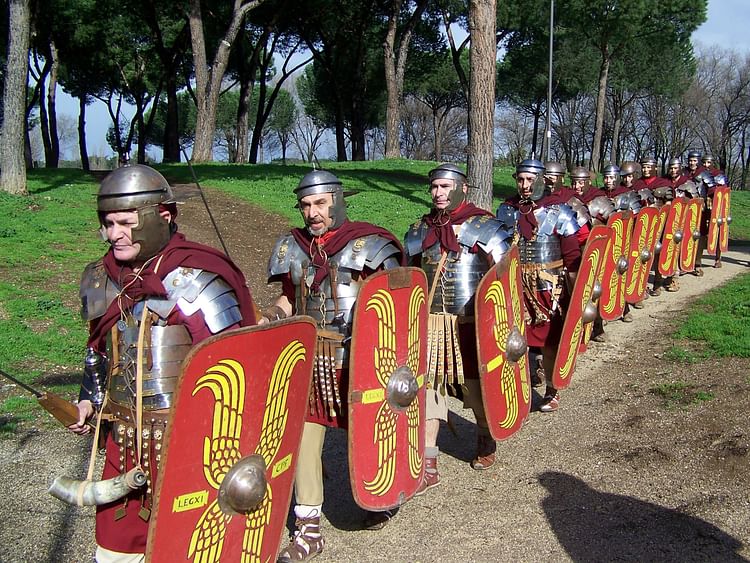 Legio XI Claudia Stefano Petroni (CC BY-NC-ND) ](https://www.worldhistory.org/image/14706/legio-xi-claudia/ "Legio XI Claudia")### Dacians Invade Moesia
Except for brief raids into Moesia, the territory of [Dacia](https://www.worldhistory.org/dacia/) had never been a place of contention for [Rome](https://www.worldhistory.org/Rome/). However, in the years following the [death](https://www.worldhistory.org/disambiguation/Death/) of [Roman emperor](https://www.worldhistory.org/Roman_Emperor/) [Nero](https://www.worldhistory.org/Nero/) (r. 54-68 CE), the [Roman Empire](https://www.worldhistory.org/Roman_Empire/) was in turmoil. It was, in the words of the historian [Tacitus](https://www.worldhistory.org/tacitus/) (c. 56 - c. 118 CE), divided against itself. Among the German tribes who seized the opportunity to challenge Roman authority during these trying times were the Dacians. In his *Histories* Tacitus wrote, "The Dacians were in motion, a people which never can be trusted, and which, now that our legions were withdrawn from Moesia, had nothing to fear" (3.46) This abrupt change in the Dacian disposition was due to the arrival of a new king, [Decebalus](https://www.worldhistory.org/Decebalus/) (r. c. 87-106 CE, who invaded Moesia in 85 CE.
In quick response, the Moesian governor Oppius Sabinus and his Legio V Macedonica countered. In the end, the governor was killed and the legion almost decimated. Quickly dispatched, the Legio IV Flavia arrived too late. Emperor Domitian organized his response and marched into Moesia in 86 CE. As he waited safely elsewhere, the prefect of the [Praetorian Guard](https://www.worldhistory.org/Praetorian_Guard/) Cornelius Fuscus led a [Roman army](https://www.worldhistory.org/Roman_Army/) across the Danube and faced Decebalus. Unfortunately, the prefect met the same fate as Sabinus, and the [Legio V Alaudae](https://www.worldhistory.org/Legio_V_Alaudae/) was wiped out. However, Rome’s luck would soon change. In 88 CE, the Roman commander Tettius Julianus led his legions - VII Claudia, I Italica, IV Flavia Felix, and II Adiutrix - across the Danube, marched into central Dacia, and defeated the Dacian forces at Tapae, camping there for the winter.
In 89 CE, the Sarmatians, thinking the Roman legions were focused on the revolt of Saturninus along the Rhine, marched into Moesia, sacking towns and farms. Still camped in central Dacia where he was preparing to march on the capital [city](https://www.worldhistory.org/city/) of Sarmizegetusa, Julianus learned that Decebalus and his army were on the way to defend their capital. Concerned that he and his army would be surrounded by Dacian and Sarmatian forces, Julianus returned to Moesia and joined Domitian. Not wanting to face both armies, the Sarmatians crossed the Danube and withdrew from Moesia. When a peace treaty was offered to Domitian, he accepted.
[  Map of Roman Dacia Andrei nacu (CC BY-SA) ](https://www.worldhistory.org/image/331/map-of-roman-dacia/ "Map of Roman Dacia")Although Decebalus agreed to withdraw his army from Moesia, the terms which included a yearly payment of [gold](https://www.worldhistory.org/gold/) to the Dacians were deemed unacceptable by the [Roman Senate](https://www.worldhistory.org/Roman_Senate/). The [war](https://www.worldhistory.org/disambiguation/War/) was over, at least for the moment. Afterwards, Domitian divided the province into two: Moesia Inferior and Moesia Superior. Four legions were stationed to Moesia, with another four in Pannonia. In his *The Twelve Caesars* historian [Suetonius](https://www.worldhistory.org/Suetonius/) (c. 69 - c. 130/140 CE) wrote how the emperor celebrated a double [triumph](https://www.worldhistory.org/Roman_Triumph/) with his victories over the Chatti (83 CE) and Dacians, avoiding any mention of the lost legion.
### Trajan's Dacian Wars
A decade later, Trajan and his legions returned to Moesia when Decebalus resumed the war, attacking Moesia. Most of what is known of the emperor’s time in Dacia comes from [Trajan's Column](https://www.worldhistory.org/Trajans_Column/), a spiral relief of 155 scenes located in the [Roman Forum](https://www.worldhistory.org/Roman_Forum/). Already displeased with the terms of Domitian’s treaty, Trajan prepared his legions to counter. Again, Moesia served as a battleground for a war with the Dacians.
In 101 CE, the four legions of Moesia - I Italica, IV Flavia Felix, V Macedonica, and VII Claudia - were in preparation to cross the Danube, and legions from across [Europe](https://www.worldhistory.org/europe/) were on the march to Moesia. The [legions of the Dacian wars](https://www.worldhistory.org/article/1772/legions-of-the-dacian-wars/) were victorious at the Second [Battle](https://www.worldhistory.org/disambiguation/battle/) of Tapae and the Battle of the Carts. The Sarmatians succumbed to defeat at the hands of the Moesian legions at the Battle of Adamclisi. An attack on the Dacian capital brought Decebalus, in person, to discuss terms of surrender. Trajan celebrated his [Roman triumph](https://www.worldhistory.org/Roman_Triumph/) over the Dacians, and in appreciation, the Senate awarded him the title of Dacius. Realizing that a second war was inevitable, Trajan ordered a permanent bridge built over the Danube.
[  Decebalus Byron Howes (CC BY-ND) ](https://www.worldhistory.org/image/8869/decebalus/ "Decebalus")In the Second Dacian War (105-106 CE), Trajan entered Dacia with twelve legions. Decebalus was defeated again, and to avoid capture, the Dacian king committed suicide. His head was taken back to Rome and put on display. Dacia became a Roman province, and five legions were assigned to Moesia: XIII Gemina, I Italica, V Macedonica, VII Claudia, and XI Claudia. Later, XIII Gemina and V Macedonica were reassigned to Dacia. According to Nigel Pollard in *The Complete Roman Legions*, four legions would call Moesia home: VII Claudia, XI Claudia, I Italica, and IV Flavia Felix.
### Legio VII Claudia Pia Fidelis
Legio VII Claudia (emblem: bull; birth sign: Leo) was raised by [Julius Caesar](https://www.worldhistory.org/Julius_Caesar/) (100-44 BCE) for his campaign in [Gaul](https://www.worldhistory.org/gaul/). However, there are some historians who claim a 7th legion was founded by [Pompey](https://www.worldhistory.org/pompey/) in 55 BCE. Regardless, a 7th legion fought with [Caesar](https://www.worldhistory.org/disambiguation/caesar/) against the Helvetii in the Gallic Wars in 58 BCE, singlehandedly capturing Aquitaine. Considered to be one of his best, the legion accompanied Caesar on his invasion of [Britain](https://www.worldhistory.org/disambiguation/Britain/) and fought with him against Pompey in the Civil Wars. In 52 BCE, the 7th was under [Titus](https://www.worldhistory.org/disambiguation/Titus/) Labienus' command and defeated a Gallic force led by Camulogenus at Grenelle.
In 45 BCE, the 7th was sent to [Italy](https://www.worldhistory.org/italy/), supposedly to be disbanded, but was called upon by [Octavian](https://www.worldhistory.org/augustus/), along with the 8th legion, to fight against [Mark Antony](https://www.worldhistory.org/Mark_Antony/) at the Battle of Mutina in 43 BCE, at the Battle of Phillippi in 42 BCE, and at the siege of Perusia in 41 BCE. Although sources are uncertain, it may have been with Octavian at the [Battle of Actium](https://www.worldhistory.org/Battle_of_Actium/) in 31 BCE. In 6 CE, the legion was one of five legions called to Pannonia at the outbreak of the Pannonian Revolt. At the war’s end in 9 CE, the 7th was stationed in Dalmatia.
In 42 CE, during the reign of Emperor [Claudius](https://www.worldhistory.org/claudius/) (r. 41-54 CE), the VII Claudia and XII Claudia were ordered by the Dalmatian governor Furius Scribonianus to march to Rome and help depose the emperor, but both legions quickly reconsidered their decision and turned against the governor, killing him and his fellow supporters. Claudius rewarded the two legions with the title Claudia Pia Fidelis (loyal and faithful to Claudius). Afterwards, the 7th was transferred to Moesia, replacing the IV Scythica.
During the [Year of the Four Emperors](https://www.worldhistory.org/Year_of_the_Four_Emperors/) (69 CE), the legion sided with Emperor [Otho](https://www.worldhistory.org/Otho/) against the claimant [Vitellius](https://www.worldhistory.org/Vitellius/). Unfortunately, the legion arrived too late to be of any assistance at the First Battle of Bedriacum. Returning to Moesia, the 7th sided with future emperor [Vespasian](https://www.worldhistory.org/Vespasian/) (r. 69-79), helping his army defeat Vitellius at the Second Battle of Bedriacum and Cremona. Afterwards, the 7th returned to its base in Moesia. In Domitian’s war against the Dacians, the legion helped defeat Decebalus at Tapae. Under Trajan’s war against Decebalus, the legion’s base at Viminacium served as the emperor’s headquarters.
Later, the legion was with Trajan in his Parthian campaign, and with Emperor [Hadrian](https://www.worldhistory.org/hadrian/) (r. 117-138 CE) during [the Bar-Kochba Revolt](https://www.worldhistory.org/The_Bar-Kochba_Revolt/). Evidence indicates it served with Verus (r. 161-169 CE) in his Parthian campaign and with [Marcus Aurelius](https://www.worldhistory.org/Marcus_Aurelius/) (161-180 CE) against the Marcomanni. The legion supported [Septimius Severus](https://www.worldhistory.org/Septimius_Severus/)’ (r. 193-211 CE) claim to the throne and fought against Pescennius Niger and Clodius Albinus. The legion remained at its base at Viminacium through the 4th century CE.
### Legio XI Claudia Pia Fidelis
The Legio XI Claudia (emblem: [Neptune](https://www.worldhistory.org/Neptune/); birth sign: Gemini) was formed by [Julius](https://www.worldhistory.org/disambiguation/Julius/) Caesar in 58 BCE and fought with him against the Helvetii in the Gallic Wars and against Pompey in the Civil Wars. Like the 7th, it was temporarily disbanded in 45 BCE but reconstituted by Octavian in 42 BCE, fighting with him at Phillippi, Perusia, and Actium. After the [Battle of Teutoburg Forest](https://www.worldhistory.org/article/1010/battle-of-teutoburg-forest/) where [Publius Quinctilius Varus](https://www.worldhistory.org/Publius_Quinctilius_Varus/) lost three legions in 9 CE, the legion was transferred to Dalmatia at Burnum. Like the 7th, the 11th initially obeyed the orders of the Dalmatian governor Scribonianus to overthrow Emperor Claudius; however, it soon reconsidered and turned against the governor, receiving the title Claudia Pia Fidelis for ending the revolt.
[ 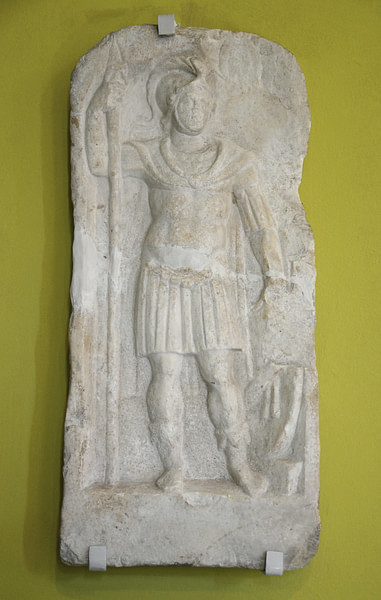 Roman Legionary from Legio XI Claudia Carole Raddato (CC BY-SA) ](https://www.worldhistory.org/image/14707/roman-legionary-from-legio-xi-claudia/ "Roman Legionary from Legio XI Claudia")Like its sister legion, the 11th supported Otho but arrived too late to be of assistance at the First Battle of Bedriacum. After returning to Dalmatia, the legion supported Vespasian but did not fight in the Second Battle of Bedriacum. Although there is some dispute, the legion may have hesitated and only after the success of Vespasian’s forces at Bedriacum and Cremona did the XI Claudia march on Rome. Shortly afterwards, the legion was sent to assist the Roman commander Petillius Cerialis against Civilis and the [Batavian Revolt](https://www.worldhistory.org/article/286/the-batavian-revolt/).
In 83 CE, Legio XI was part of Domitian’s successful campaign against the Chatti. In 101 CE, it served under Trajan in his Dacian Wars. Afterwards, it was transferred to Lower Moesia at Durosturum (modern-day Bulgaria). The next few years are unclear. It may have fought with Marcus Aurelius against the Marcomanni. There is evidence it supported Septimius Severus’ claim to the throne and fought against the claimant Pescennius Niger, participating in the siege of [Byzantium](https://www.worldhistory.org/Byzantium/) and the [Battle of Issus](https://www.worldhistory.org/Battle_of_Issus/). The legion remained at Durosturum for the remainder of its existence.
### Legio I Italica
The Legio I Italica (emblem: bear; birth sign: Capricorn) was formed by Emperor Nero around 66 CE for his aborted campaign in [Parthia](https://www.worldhistory.org/disambiguation/Parthia/). Because the legion was to be equipped in the manner of a Macedonian phalanx, he referred to it as the "Phalanx of [Alexander](https://www.worldhistory.org/disambiguation/Alexander/)." In 67 CE, he sent it to Lugdunum (modern Lyon) in Gaul to face the governor Gaius Vindex’s failed rebellion, but it arrived too late to be of any assistance. In 69 CE, the legion was at the First Battle of Bedriacum and joined [Legio XXI Rapax](https://www.worldhistory.org/Legio_XXI_Rapax/), V Alaudae, and XXII Primigenia in Vitellius’ march on Rome. At the Second Battle of Bedriacum, I Italica again supported Vitellius against the forces of Vespasian only to meet defeat. Tacitus spoke of the legions’ march on Cremona to occupy the city: "It was followed by the veteran troops of the 4th, 10th, and 16th legion, by the 5th and 22nd, and the rear was brought up by the 21st (the Rapax) and the first Italian legion…" (*Histories*, 2.100).
[ 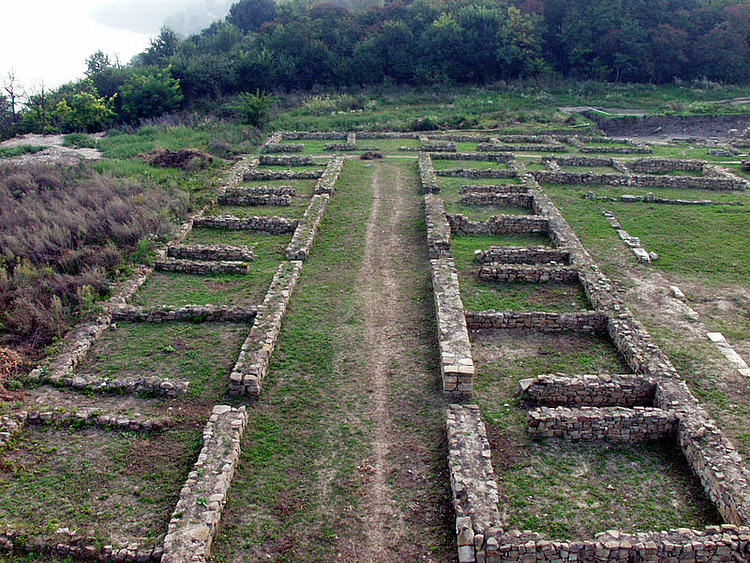 Roman Military Hospital, Novae Janusz Recław (CC BY-NC-SA) ](https://www.worldhistory.org/image/10479/roman-military-hospital-novae/ "Roman Military Hospital, Novae")Afterwards, the I Italica was sent to Moesia along with V Alaudae, VII Claudia and V Macedonica where they fought against the Sarmatians and their invasion of Moesia. The legion made its base at Novae. Like the other Moesian legions, the I Italica fought in the Dacian Wars of both Domitian and Trajan. After joining Trajan in his Parthian campaign, the remainder of its existence was spent at Novae.
### Legio IV Flavia Felix
The Legio Flavia Felix (emblem: lion; birth sign: Capricorn) was founded by Vespasian from soldiers of Legio IV Macedonica who had been disgraced during the Batavian Revolt. It was stationed at the capital city of Burnum in Dalmatia where it replaced XI Claudia. In 88 CE, the legion was part of the Roman victory at Tapae. After the Dacian campaign of Domitian, the legion was transferred to Upper Moesia at Singidunum (modern Belgrade). The legion was part of Trajan’s campaign in Dacia. Briefly stationed at Sarmizegetusa, the 4th returned to its base at Singidunum for the remainder of its existence. Its activities after the Dacian Wars are not known, although it may have supported Septimius Severus’ claim to the throne and participated in his Parthian campaign.
#### Editorial Review
This human-authored article has been reviewed by our editorial team before publication to ensure accuracy, reliability and adherence to academic standards in accordance with our [editorial policy](https://www.worldhistory.org/static/editorial-policy/).
## Bibliography
- [Dando-Collins, Stephen. *Legions of Rome.* Thomas Dunne Books, 2012.](https://www.worldhistory.org/books/1250004713/)
- [Hornblower, Simon & Spawforth, Antony & Eidinow, Esther. *The Oxford Classical Dictionary.* Oxford University Press, 2012.](https://www.worldhistory.org/books/0199545561/)
- [Pollard, Nigel & Berry, Joanne. *The Complete Roman Legions.* Thames & Hudson, 2012.](https://www.worldhistory.org/books/0500251835/)
- [Scarre, Chris. *Chronicle of the Roman Emperors.* Thames & Hudson, 2012.](https://www.worldhistory.org/books/0500289891/)
- [Strauss, Barry. *Ten Caesars.* Simon & Schuster, 2019.](https://www.worldhistory.org/books/145166883X/)
- [Suetonius. *The Twelve Caesars .* Penguin Books.](https://www.worldhistory.org/books/1774761300/)
- [Tacitus, Cornelius. *The Complete Works of Tacitus.* Modern Library.](https://www.worldhistory.org/books/1420947141/)
## About the Author
Donald has taught Ancient, Medieval and U.S. History at Lincoln College (Normal, Illinois)and has always been and will always be a student of history, ever since learning about Alexander the Great. He is eager to pass knowledge on to his students.
## Cite This Work
### APA
Wasson, D. L. (2021, October 12). Legions of Moesia. *World History Encyclopedia*.
### Chicago
Wasson, Donald L.. "Legions of Moesia." *World History Encyclopedia*, October 12, 2021. .
### MLA
Wasson, Donald L.. "Legions of Moesia." *World History Encyclopedia*, 12 Oct 2021, .
## License & Copyright
Submitted by [Donald L. Wasson](https://www.worldhistory.org/user/DWasson/ "User Page: Donald L. Wasson"), published on 12 October 2021. The copyright holder has published this content under the following license: [Creative Commons Attribution-NonCommercial-ShareAlike](https://creativecommons.org/licenses/by-nc-sa/4.0/deed.en). This license lets others remix, tweak, and build upon this content non-commercially, as long as they credit the author and license their new creations under the identical terms. When republishing on the web a hyperlink back to the original content source URL must be included. Please note that content linked from this page may have different licensing terms.