---
title: Ruth & Naomi
author: Rebecca Denova
source: https://www.worldhistory.org/article/1845/ruth--naomi/
format: machine-readable-alternate
license: Creative Commons Attribution-NonCommercial-ShareAlike (https://creativecommons.org/licenses/by-nc-sa/4.0/)
updated: 1970-01-01
---
# Ruth & Naomi
_Authored by [Rebecca Denova](https://www.worldhistory.org/user/rdenova/)_
The story of Ruth and Naomi is found in the book of Ruth in the Jewish Scriptures. The Scriptures are traditionally divided into three sections: [Torah](https://www.worldhistory.org/Torah/) (the first five books assigned to [Moses](https://www.worldhistory.org/Moses/)), the Prophets (Nevi’im), and Writings (Ketuvim, where we find Ruth). Chronologically, the book falls within the period of the Book of Judges and 1 [Samuel](https://www.worldhistory.org/samuel/), books which relate the settlement of the [twelve tribes of Israel](https://www.worldhistory.org/article/1822/the-twelve-tribes-of-israel/) in the land of [Canaan](https://www.worldhistory.org/canaan/) after their escape from [Egypt](https://www.worldhistory.org/egypt/) (Exodus). Although placed within this timeframe, scholars consider the creation of the book in the period of the 6th-4th centuries BCE.
[  Ruth Swearing her Allegiance to Naomi Jan Victors (Public Domain) ](https://www.worldhistory.org/image/14683/ruth-swearing-her-allegiance-to-naomi/ "Ruth Swearing her Allegiance to Naomi")### The Story
The book of Ruth tells the story of Naomi, a woman from Bethlehem, who was married to Elimelech, with whom she had two sons, Mahlon and Chilion. The family emigrated to the neighboring territory of Moab (for reasons not stated, but most likely either famine or work opportunities). While living in Moab, the two sons married local [women](https://www.worldhistory.org/disambiguation/women/), Ruth and Orpah. Elimelech then died.
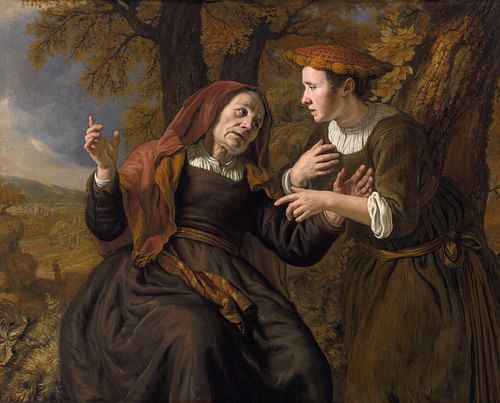
Naomi wanted to return to her home village, where, as a widow, she could rely upon relatives to help keep her. She advised the daughters-in-[law](https://www.worldhistory.org/disambiguation/law/) to return to their own families. Oprah did so. Ruth, however, replied:
> Don’t urge me to leave you or to turn back from you. Where you go I will go, and where you stay I will stay. Your people will be my people and your [God](https://www.worldhistory.org/God/) my God. Where you die I will die, and there I will be buried. May the Lord deal with me, be it ever so severely, if even [death](https://www.worldhistory.org/disambiguation/Death/) separates you and me. (Ruth 1:16-17)
The two returned to Bethlehem near the time of the barley harvest. Naomi and Ruth went and "gleaned" in the fields. 'Gleaning' ("to draw") is a concept found in the book of Leviticus as a means of charity:
> When you reap the harvest of your land, do not reap to the very edges of your field or gather the gleanings of your harvest. Do not go over your vineyard a second time or pick up the grapes that have fallen. Leave them for the poor and the foreigner. I am the Lord your God. (19:9-10)
The field was owned by Boaz, a relative of Naomi’s husband Elimelech. Boaz noticed Ruth and made sure enough grain was left to feed her and Naomi. The story highlights a concept known as Levirate marriage. For the bloodline not to be broken, a dead man’s brother or close relative was to marry the widow:
> If brothers are living together and one of them dies without a son, his widow must not marry outside the family. Her husband’s brother shall take her and marry her and fulfill the duty of a brother-in-law to her. The first son she bears shall carry on the name of the dead brother so that his name will not be blotted out from [Israel](https://www.worldhistory.org/disambiguation/Israel/). However, if a man does not want to marry his brother’s wife, she shall go to the elders at the town gate and say, "My husband’s brother refuses to carry on his brother’s name in Israel. He will not fulfill the duty of a brother-in-law to me." Then the elders of his town shall summon him and talk to him. If he persists in saying, "I do not want to marry her," his brother’s widow shall go up to him in the presence of the elders, take off one of his sandals, spit in his face and say, "This is what is done to the man who will not build up his brother’s family line." That man’s line shall be known in Israel as The Family of the Unsandaled. (Deuteronomy 25:5-10)
[ 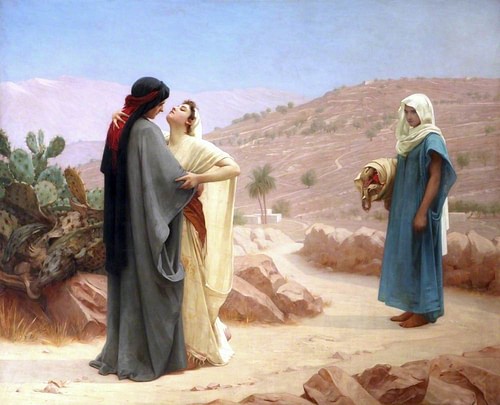 Ruth & Naomi Philip Hermogenes Calderon (CC BY-NC) ](https://www.worldhistory.org/image/14685/ruth--naomi/ "Ruth & Naomi")> One day Ruth’s mother-in-law Naomi said to her, "My daughter, I must find a home for you, where you will be well provided for. Now Boaz, with whose women you have worked, is a relative of ours. Tonight he will be winnowing barley on the threshing floor. Wash, put on perfume, and get dressed in your best clothes. Then go down to the threshing floor, but don’t let him know you are there until he has finished eating and drinking. When he lies down, note the place where he is lying. Then go and uncover his feet and lie down. He will tell you what to do." "I will do whatever you say," Ruth answered. (Ruth 3:1-5)
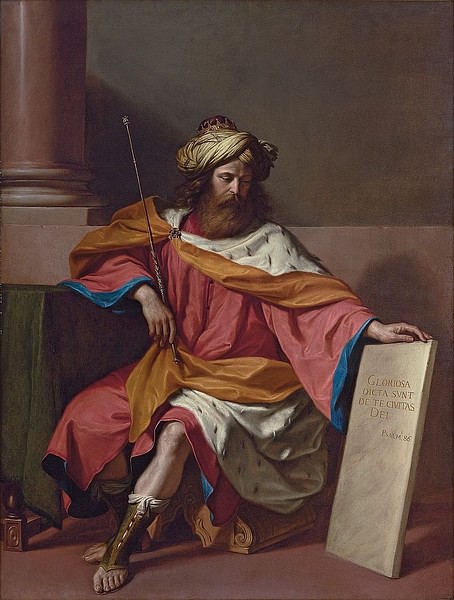
To "uncover the feet" was a biblical euphemism for sexual intercourse. However, Boaz informed Ruth that there was a closer kinsman. The next morning, he met the kinsman in front of the elders at the [city](https://www.worldhistory.org/city/) gate for a resolution. The kinsman did not want to jeopardize his own estates, so he conceded to Boaz by taking off his sandal and handing it over. The story concludes with the birth of the son of Ruth and Boaz, Obed. We learn that Obed became the father of Jesse, the father of [King David](https://www.worldhistory.org/King_David/).
### The Purpose of the Book of Ruth
In addition to providing a window on the [culture](https://www.worldhistory.org/disambiguation/culture/) and practices of ancient Israel, the book of Ruth highlights two Jewish concepts: redemption, and chesed or "loving kindness." Redemption meant being saved from sin or error. It also included the idea of regaining something in exchange for a debt or ownership. In this case, both Naomi and Ruth were redeemed by Boaz’s actions so that they would survive and generate offspring. Chesed was both the loving kindness of God to Israel as well as the kindness that is to be shared among humans in works of charity. It was also understood as loyalty either to God or persons. Ruth’s devotion to her mother-in-law was extended to Naomi’s God as well.
While placed during the time of Judges (c. 1100 BCE), the consensus of scholars has the composition of the book during the time of the return of the Jewish exiles to [Jerusalem](https://www.worldhistory.org/jerusalem/) under the auspices of [Cyrus the Great](https://www.worldhistory.org/Cyrus_the_Great/) (r. c. 550-530), the king of the Persian [Achaemenid Empire](https://www.worldhistory.org/Achaemenid_Empire/) (539 BCE). The community was guided by two priestly individuals, Nehemiah and Ezra, who were in charge of the rebuilding of the [Temple](https://www.worldhistory.org/temple/).
The Prophets of Israel had blamed the disaster of the Babylonian destruction of Jerusalem (586 BCE) on the sins of Israel, particularly the sin of idolatry. The books of Nehemiah and Ezra outline their attempts to make sure that this would never happen again. Believing that intermarriage with non-Jews would lead to idolatrous practices, they banned intermarriage:
> On that day the Book of Moses was read aloud in the hearing of the people and there it was found written that no Ammonite or Moabite should ever be admitted into the assembly of God, because they had not met the Israelites with food and water but had hired Balaam to call a curse down on them. (Our God, however, turned the curse into a blessing.) When the people heard this law, they excluded from Israel all who were of foreign descent. (Nehemiah 13:1-3)
The book of Ruth may have been written as a reaction against this ban. It demonstrates that non-Jewish foreigners could become ideal exemplars of Jewish tradition and practices, even the Moabites. Not only were Naomi and Ruth good Jews, but Ruth became the ancestor of Israel’s greatest king, David.
[  King David Writing Psalms Giovanni Francesco Barbieri (Public Domain) ](https://www.worldhistory.org/image/6700/king-david-writing-psalms/ "King David Writing Psalms")### Modern Interpretations
The story of Naomi and Ruth is often called upon in scholarly analyses of the study of [women in the Old Testament](https://www.worldhistory.org/article/1812/women-in-the-old-testament/) and gender roles in ancient [Judaism](https://www.worldhistory.org/disambiguation/judaism/). Feminists continue to argue both sides. Some denounce the story for exploiting the evils of patriarchy as women are only valued for their procreation, while others praise the resourcefulness of Naomi and Ruth to survive. In the Western tradition, Ruth’s speech to Naomi is often utilized in marriage vows.
In Jewish synagogues, the Book of Ruth is read during the holiday of Shavuot. Originally an ancient grain festival that celebrated the early harvest of some grains in the spring, it occurs seven weeks after the second Seder of Passover. By tradition, this was also a celebration of when Moses received the Law on [Mount Sinai](https://www.worldhistory.org/Mount_Sinai/). This story combines harvesting and obedience to the Law of Moses.
#### Editorial Review
This human-authored article has been reviewed by our editorial team before publication to ensure accuracy, reliability and adherence to academic standards in accordance with our [editorial policy](https://www.worldhistory.org/static/editorial-policy/).
## Bibliography
- [Blaine, J Ainsley. *The Book of Ruth.* Christian Faith Publishing, Inc, 2021.](https://www.worldhistory.org/books/1098084403/)
- [Grabbe, Lester L. *A History of the Jews and Judaism in the Second Temple Period .* T&T Clark, 2006.](https://www.worldhistory.org/books/0567043525/)
## About the Author
Rebecca I. Denova, Ph.D. is Emeritus Professor of Early Christianity in the Department of Religious Studies, University of Pittsburgh. She has recently completed a textbook, "The Origins of Christianity and the New Testament" (Wiley-Blackwell)
## Cite This Work
### APA
Denova, R. (2021, October 04). Ruth & Naomi. *World History Encyclopedia*.
### Chicago
Denova, Rebecca. "Ruth & Naomi." *World History Encyclopedia*, October 04, 2021. .
### MLA
Denova, Rebecca. "Ruth & Naomi." *World History Encyclopedia*, 04 Oct 2021, .
## License & Copyright
Submitted by [Rebecca Denova](https://www.worldhistory.org/user/rdenova/ "User Page: Rebecca Denova"), published on 04 October 2021. The copyright holder has published this content under the following license: [Creative Commons Attribution-NonCommercial-ShareAlike](https://creativecommons.org/licenses/by-nc-sa/4.0/deed.en). This license lets others remix, tweak, and build upon this content non-commercially, as long as they credit the author and license their new creations under the identical terms. When republishing on the web a hyperlink back to the original content source URL must be included. Please note that content linked from this page may have different licensing terms.