---
title: David & Goliath
author: Rebecca Denova
source: https://www.worldhistory.org/article/1816/david--goliath/
format: machine-readable-alternate
license: Creative Commons Attribution-NonCommercial-ShareAlike (https://creativecommons.org/licenses/by-nc-sa/4.0/)
updated: 1970-01-01
---
# David & Goliath
_Authored by [Rebecca Denova](https://www.worldhistory.org/user/rdenova/)_
As a youngster, David (the later king of [Israel](https://www.worldhistory.org/disambiguation/Israel/)), slew Goliath, a [giant](https://www.worldhistory.org/Giants/), who was the champion of Israel’s enemy, the [Philistines](https://www.worldhistory.org/Philistines/). "David and Goliath" became a metaphor for an underdog who nevertheless is victorious over a more powerful opponent and is particularly applied to sports stories and to larger corporate entities raiding smaller ones in takeover bids; sometimes the latter successfully resist incorporation.
[  David with the Head of Goliath Caravaggio (Public Domain) ](https://www.worldhistory.org/image/7338/david-with-the-head-of-goliath/ "David with the Head of Goliath")### Historical & Literary Context
The story of the rise of David is found in the biblical books of 1 and 2 [Samuel](https://www.worldhistory.org/samuel/). These books narrate the stories of the Israelite settlement in the land of [Canaan](https://www.worldhistory.org/canaan/). The material establishes the setting for the rise of two institutions in Israel: the Prophets and kingship. According to the biblical chronology, when the Israelites escaped [Egypt](https://www.worldhistory.org/egypt/) (in the book of Exodus), they invaded and settled in Canaan, the original 'promised land' of [Abraham](https://www.worldhistory.org/Abraham,_the_Patriarch/). In terms of governance, this period was when the inhabitants were ruled by a tribal confederation consisting of the twelve tribes, the sons of [Jacob](https://www.worldhistory.org/Jacob/). Each of the twelve tribes was allotted a territory. Within the territories were shrines where the tent of meeting was kept. This was the portable shrine containing the [Ark of the Covenant](https://www.worldhistory.org/Ark_of_the_Covenant/) with the tablets of the [Law](https://www.worldhistory.org/disambiguation/law/) of [Moses](https://www.worldhistory.org/Moses/), received at [Mount Sinai](https://www.worldhistory.org/Mount_Sinai/). This portable shrine rotated among the tribes to avoid jealousy or attempts at domination of one tribe over another.
Samuel was a priest, a circuit judge, and became one of the first traditional Prophets. The Prophets of Israel served as the Jewish equivalent to oracles in the ancient world. Oracles were the way in which people communicated with their gods. An oracle was both a person and a place. In the process known as divination, a person usually went into a trance, and then was possessed by the [god](https://www.worldhistory.org/God/) or goddess. The words of the deity were then expressed, sometimes in a secret or unknown language, which meant that priests had to interpret them. This was the process at the most famous oracle site, [Delphi](https://www.worldhistory.org/delphi/) in [Greece](https://www.worldhistory.org/greece/).
Each of the Prophets of Israel was 'called by God', in receiving a divine intervention that ordered them to proclaim God’s will or to address injustices by the people. In the books of the Jewish Prophets, the words of God are easily distinguished. Each oracle opens with "Thus says the Lord," and then the passage is indented, like poetry.
The Philistines established five major cities along the southern coast of Israel. One of the names, Gaza, became the name for the region between Israel and the Sinai (the Gaza Strip). The name came into Latin as Palestina, our modern word for [Palestine](https://www.worldhistory.org/palestine/). Their dominance was established in the 12th century BCE and was finally absorbed into the Babylonian [conquest](https://www.worldhistory.org/warfare/) of the region in 604 BCE. Biblical polemic against the Philistines has resulted in the modern definition of a [philistine](https://www.worldhistory.org/Philistines/): "a person who is guided by materialism and is usually disdainful of intellectual or artistic values " (Merriam-Webster Dictionary). However, modern excavations at these cities reveal a highly cultured and artistic people in their [architecture](https://www.worldhistory.org/disambiguation/architecture/) and [pottery](https://www.worldhistory.org/pottery/).
[  Philistine Pottery Sherd Osama Shukir Muhammed Amin (Copyright) ](https://www.worldhistory.org/image/7212/philistine-pottery-sherd/ "Philistine Pottery Sherd")Multiple theories abound on the origin of the Philistines. They may have originated from various tribes in Canaan. A popular theory is to equate them with the [Sea Peoples](https://www.worldhistory.org/Sea_Peoples/) who invaded the Eastern [Mediterranean](https://www.worldhistory.org/disambiguation/mediterranean/) at the time of the [Bronze Age Collapse](https://www.worldhistory.org/Bronze_Age_Collapse/) (c. 1200 BCE). We cannot ultimately verify where the Sea Peoples came from, but they are also attested in Egypt. This period marks the beginning of the [Iron Age](https://www.worldhistory.org/disambiguation/Iron_Age/). If the Philistines had the knowledge of making iron weapons, this may be one of the reasons why they dominated the Israelites. Throughout the books of Samuel, the Philistines are consistently a problem.
### The First King: Saul
In the ancient Middle East, kings were often depicted as divine; either the son of a god and human mother or directly descended from a god. This validated their rule on earth. Israel was uniquely different in the fact that the God of Israel had no consort, and that they were told at Sinai that they were not to be as the other nations. God was their king. The situation with the Philistines was so bad, that the people approached Samuel to "appoint a king to lead us, such as all the other nations have" (1 Samuel 8:5). Samuel did it but warned them of the ways of kings; kings would take daughters to serve them and recruit men for the armies. Throughout the history of this period (as told in the books of 1 & 2 Kings), there was always a Prophet at the court of each king. The king was to make sure everyone obeyed the Law of Moses, and the Prophet was to keep tabs on the king.
The first king was Saul, of the tribe of Benjamin. Although Saul was a good warrior, he often misinterpreted Samuel’s advice and at times even ignored it. The book of Joshua introduced the concept of 'holy [war](https://www.worldhistory.org/disambiguation/War/)'. Certain battles were declared by God to be devoted to him, which meant no spoils of war. 'Devoted' here meant destroyed; all crops and food stores were to be burnt as a sacrifice to God. This included no prisoners of war; they were to be killed. Saul apparently saw this as a waste and did not carry it out.
[  David & Saul by Rembrandt Rembrandt (Public Domain) ](https://www.worldhistory.org/image/7453/david--saul-by-rembrandt/ "David & Saul by Rembrandt")This is the background to introduce a new king. God told Samuel to go to the village of Bethlehem and find a son of Jessie. Jessie had many sons, the eldest of whom were away fighting in Saul’s army. David, the youngest was left at home to tend to the sheep. Samuel took a jar of oil and poured it over the head of David. The Hebrew term was *meshiach*, "rubbing on" or "anointing", "messiah" in English. This anointing of monarchs became part of the ritual of coronation.
### The Philistine Challenge
Armies were often organized by private means; soldiers brought their own horse and armor and relied upon family and friends to provide them with food. David was chosen to take supplies to his brothers in Saul’s army. The army was stationed in the valley of Elah, while the Philistines camped nearby. If you have seen the movie *[Troy](https://www.worldhistory.org/troy/),* you will recall that it opens with the [Greek](https://www.worldhistory.org/disambiguation/greek/) armies sending their champion, [Achilles](https://www.worldhistory.org/achilles/), to take on the champion of the enemy. The Philistines proposed a similar solution:
> A champion named Goliath, who was from Gath, came out of the Philistine camp. His height was six cubits and a span \[9 feet 9 inches or 3 meters\]. He had a [bronze](https://www.worldhistory.org/disambiguation/bronze/) helmet on his head and wore a coat of scale armor of bronze weighing five thousand shekels; on his legs he wore bronze greaves, and a bronze javelin was slung on his back. His spear shaft was like a weaver’s rod, and its iron point weighed six hundred shekels. His shield bearer went ahead of him. Goliath stood and shouted to the ranks of Israel, "Why do you come out and line up for [battle](https://www.worldhistory.org/disambiguation/battle/)? Am I not a Philistine, and are you not the servants of Saul? Choose a man and have him come down to me. If he is able to fight and kill me, we will become your subjects; but if I overcome him and kill him, you will become our subjects and serve us." Then the Philistine said, "This day I defy the armies of Israel! Give me a man and let us fight each other." On hearing the Philistine’s words, Saul and all the Israelites were dismayed and terrified . . . For forty days the Philistine came forward every morning and evening and took his stand. (1 Samuel 17:4-16)
David is appalled by the fact that no one would go against Goliath: "Who is this uncircumcised Philistine that he should defy the armies of the living God?" (1 Samuel 17:26). His older brother chastised him for leaving the flock and his conceit at questioning the army. Saul heard about this and sent for David and reminded him that he was only a shepherd. David told him how he killed lions and bears that attacked his flocks: "The Lord who rescued me from the paw of the lion and the paw of the bear will recuse me from the hand of this Philistine." (1 Samuel 17:37) Saul then permitted him to dress in his armor and helmet, which did not fit. David took them off and choose five stones from a stream for his sling. Slingers were a separate unit in the armies using long strips of leather with a cup on the end to hold stones which were then whirled around and slung at the enemy.
> And David said to the Philistine, "You come against me with sword and spear and javelin, but I come against you in the name of the Lord almighty, the God of the armies of Israel, whom you have defied. This day the Lord will deliver you into my hands, and I’ll strike you down and cut off your head. This very day I will give the carcasses of the Philistine army to the birds and the wild animals, and the whole world will know that there is a God in Israel. All those gathered here will know that it is not by sword or spear that the Lord saves; for the battle is the Lord’s and he will give all of you into our hands." (1 Samuel 17:45-47)
David aimed his stone at the forehead of Goliath which made him fall to the ground. Using Goliath’s sword, he cut off his head.
[ 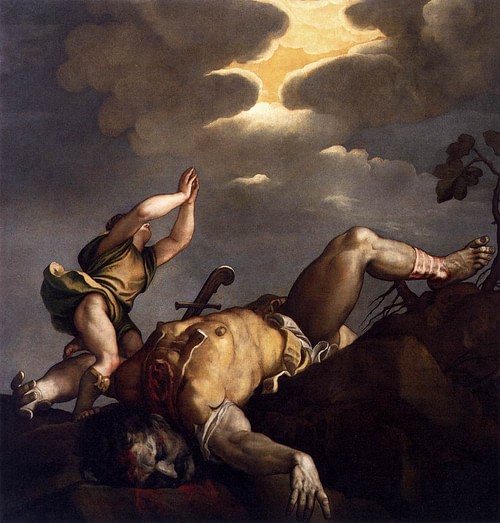 David and Goliath Titian (Public Domain) ](https://www.worldhistory.org/image/14512/david-and-goliath/ "David and Goliath")The Philistines tried to run, but the Israelites, now encouraged, chased them down. Saul then gave David a high position in the army where he won every battle. This sets up Saul’s jealousy of David:
> When the men were returning home after David had killed the Philistine, the [women](https://www.worldhistory.org/disambiguation/women/) came out from all the towns of Israel to meet King Saul with singing and dancing, with joyful songs and with timbrels and lyres. As they danced, they sang, "Saul has slain his thousands, and David his tens of thousands." (1 Samuel 18:6-7)
From this point in the narrative, Saul turned against David and began to place him in further battles against the Philistines so that they would kill him. "Saul was afraid of David because the Lord was with David but had departed from Saul." (1 Samuel 18:12)
The rest of 1 Samuel relates how David and his band of followers took to guerilla [warfare](https://www.worldhistory.org/warfare/) against the Philistines, but always avoided any harm to Saul and his armies. After the Philistines killed Saul and his sons at Mount Gilboa (1 Samuel 31), the tribes appealed to David to become the next king. David organized the tribes into what became known as the united monarchy and made [Jerusalem](https://www.worldhistory.org/jerusalem/) the capital [city](https://www.worldhistory.org/city/). [King David](https://www.worldhistory.org/King_David/) remains one of the greatest kings of Israel and his rule is considered as a golden age.
### [Giants](https://www.worldhistory.org/Giants/) in the Ancient World
Almost from inception, the story of David and Goliath was scrutinized for authenticity. This is because different texts have different descriptions of his height. In the writings of the 1st-century CE Jewish historian [Josephus](https://www.worldhistory.org/Flavius_Josephus/) and the Greek version of the Jewish Scriptures (the Septuagint), he is "four cubits and a span" or 6 feet nine inches (205 cm). At the same time, there were several ways in which to measure a cubit, most often by the royal cubit, from the length of the elbow to the middle finger.
We find stories throughout ancient [literature](https://www.worldhistory.org/literature/) about giants. Every [culture](https://www.worldhistory.org/disambiguation/culture/) included such stories in what we deem folklore. Giants always belonged in the distant past, some good, some evil. Genesis 6 claimed that angels bred with human women to produce "the heroes of old". Genesis blamed these giants for instituting all the evil on earth which had to be washed clean by God sending the flood. In the [Roman](https://www.worldhistory.org/disambiguation/Roman/) period, people accidentally discovered dinosaur bones and declared them as proof of the existence of ancient giants.
Modern scholars and archaeologists continue to debate this story through scientific analysis of ancient skeletal remains. Ancient Jews averaged anywhere from 5’ to 5’9 (152-175 cm). It could be that anyone with an unusual height from the average could be deemed a 'giant'.
### The Composition of the Books of Samuel
1 & 2 Samuel, along with Joshua, Judges, and 1 & 2 Kings, are collectively known as the Deuteronomistic History. This is when the first compositions that became the Jewish Scriptures underwent their final editing during the period of the Babylonian exile (596-529 BCE). (It should be noted that the description of Goliath’s armor is closer to Greek armor in the 6th century BCE than in the 10th century BCE.) Looking back on their earlier violent history, some of these editors blamed the rise of kingship as the root of their disasters. This may be the period when stories of David were promoted as a model of good kingship in opposition to Saul's unenlightened kingship.
[ 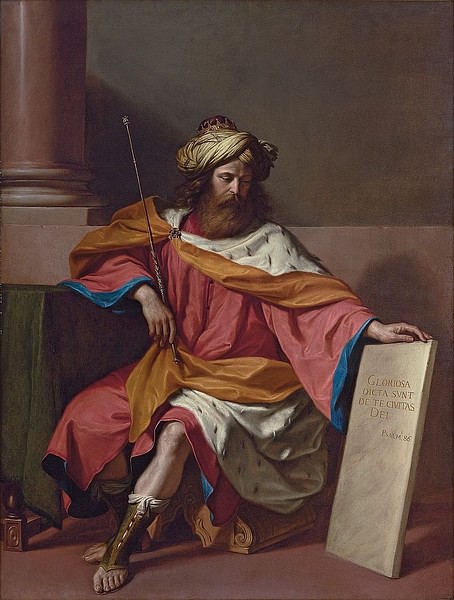 King David Writing Psalms Giovanni Francesco Barbieri (Public Domain) ](https://www.worldhistory.org/image/6700/king-david-writing-psalms/ "King David Writing Psalms")The story of David and Goliath represents several themes found throughout the rest of the Jewish Scriptures. Despite Israel's smaller size, its people should have the courage to maintain their ethnic identity and beliefs in light of invading empires and oppression. The various covenants with the God of Israel promised protection if they would follow his commandments. David was symbolic for this loyalty to God; the details of the armor and weapons of Goliath stood for people having faith in material elements. One of the purposes of the story was to oppose the traditional understanding that war and the weapons of war will always bring success. Rather, the story suggests that strength will come to even the underdog, as long as faith rules one’s life.
Although it is not in the text, traditional Hollywood versions of this story show David reciting Psalm 23 as he approaches Goliath. By tradition, David is the author of the Book of Psalms:
> Even though I walk
> through the darkest valley,
> I will fear no evil,
> for you are with me;
> your rod and your staff,
> they comfort me.
> You prepare a table before me
> in the presence of my enemies.
> You anoint my head with oil;
> my cup overflows.
> Surely your goodness and love will follow me
> all the days of my life,
> and I will dwell in the house of the Lord
> forever.
#### Editorial Review
This human-authored article has been reviewed by our editorial team before publication to ensure accuracy, reliability and adherence to academic standards in accordance with our [editorial policy](https://www.worldhistory.org/static/editorial-policy/).
## Bibliography
- [Charles River Editors. *The Philistines.* CreateSpace Independent Publishing Platform, 2015.](https://www.worldhistory.org/books/1514105594/)
- [Finkelstein, Israel & Silberman, Neil Asher. *David and Solomon.* Free Press, 2007.](https://www.worldhistory.org/books/0743243633/)
## About the Author
Rebecca I. Denova, Ph.D. is Emeritus Professor of Early Christianity in the Department of Religious Studies, University of Pittsburgh. She has recently completed a textbook, "The Origins of Christianity and the New Testament" (Wiley-Blackwell)
## Cite This Work
### APA
Denova, R. (2021, August 25). David & Goliath. *World History Encyclopedia*.
### Chicago
Denova, Rebecca. "David & Goliath." *World History Encyclopedia*, August 25, 2021. .
### MLA
Denova, Rebecca. "David & Goliath." *World History Encyclopedia*, 25 Aug 2021, .
## License & Copyright
Submitted by [Rebecca Denova](https://www.worldhistory.org/user/rdenova/ "User Page: Rebecca Denova"), published on 25 August 2021. The copyright holder has published this content under the following license: [Creative Commons Attribution-NonCommercial-ShareAlike](https://creativecommons.org/licenses/by-nc-sa/4.0/deed.en). This license lets others remix, tweak, and build upon this content non-commercially, as long as they credit the author and license their new creations under the identical terms. When republishing on the web a hyperlink back to the original content source URL must be included. Please note that content linked from this page may have different licensing terms.