---
title: Prostitution in the Ancient Mediterranean
author: Rebecca Denova
source: https://www.worldhistory.org/article/1797/prostitution-in-the-ancient-mediterranean/
format: machine-readable-alternate
license: Creative Commons Attribution-NonCommercial-ShareAlike (https://creativecommons.org/licenses/by-nc-sa/4.0/)
updated: 2022-08-15
---
# Prostitution in the Ancient Mediterranean
_Authored by [Rebecca Denova](https://www.worldhistory.org/user/rdenova/)_
Prostitution in the ancient world usually referred to a classification of [women](https://www.worldhistory.org/disambiguation/women/) and men who offered their sexual services outside the parameters of [law](https://www.worldhistory.org/disambiguation/law/) codes for ancient society. The word 'prostitute' derives from the Latin *prostituere* ("to expose publicly"). This was a reference to the way in which [Roman](https://www.worldhistory.org/disambiguation/Roman/) prostitutes advertised so as not to be confused with decent matrons (see below). Depending upon the context and translation of an ancient text, sometimes the English words "harlot" or "whore" are used.
[  Ancient Lovers Mohawk Games (Copyright) ](https://www.worldhistory.org/image/14287/ancient-lovers/ "Ancient Lovers")### Sacred Prostitution
The dominating religious theme of all [ancient societies](https://www.worldhistory.org/collection/62/ancient-societies/) was that of fertility; of crops, herds, and people. The divine powers who ruled the universe occurred in male and female pairs, and so could be approached for the benefits of fertility for humans. This was particularly relevant to the creation and worship of the various mother goddesses in the region: [Inanna](https://www.worldhistory.org/Inanna/) ([Sumer](https://www.worldhistory.org/sumer/)), [Ishtar](https://www.worldhistory.org/ishtar/) ([Mesopotamia](https://www.worldhistory.org/Mesopotamia/)), [Hathor](https://www.worldhistory.org/Hathor/) and [Isis](https://www.worldhistory.org/isis/) ([Egypt](https://www.worldhistory.org/egypt/)), [Cybele](https://www.worldhistory.org/Cybele/) ([Anatolia](https://www.worldhistory.org/Asia_Minor/)), [Astarte](https://www.worldhistory.org/astarte/) ([Canaan](https://www.worldhistory.org/canaan/)), [Demeter](https://www.worldhistory.org/demeter/) ([Greece](https://www.worldhistory.org/greece/)), [Aphrodite](https://www.worldhistory.org/Aphrodite/) (Greece), and [Venus](https://www.worldhistory.org/venus/) ([Rome](https://www.worldhistory.org/Rome/)). All these goddesses ruled human sexuality, the erotic uses of the body, birth, and children.
Scholars debate the ways in which worship of these fertility deities was instituted, in a concept known as sacred prostitution or [temple](https://www.worldhistory.org/temple/) prostitution. There are references to this in the ancient cultures of Sumer and Mesopotamia, and the ideas spread throughout the [Mediterranean](https://www.worldhistory.org/disambiguation/mediterranean/) Basin. The term 'temple prostitution' is a modern one (post-Enlightenment) and is a misnomer. Scholars equated temple servants (both men and women) in these fertility cults with prostitution *per se*, which was not the same thing.
In ancient Sumer, the king (sometimes a semi-divine being) performed an annual religious ritual known as *hieros gamos*, or sacred marriage. This marriage assured fertility for the community. Hymns from the period refer to the king "running races" on the same day which reflected his virility. What remains debatable is whether these religious rituals were literal or symbolic.
The evolution of religious ritual resulted in both ancient drama and dance. [Athens](https://www.worldhistory.org/Athens/) developed and produced plays in conjunction with the festivals of Demeter and Dionysius. The chorus danced and reenacted the myth of these deities. An acting out of fertility roles by the actors may have predated [Greek drama](https://www.worldhistory.org/Greek_Theatre/) and makes logical sense in relation to religious rituals. Rituals could physically demonstrate the anticipated outcome of the ritual. In this case, fertility.
The modern depiction of these temple servants was influenced by [Herodotus](https://www.worldhistory.org/herodotus/) (c. 484 - c. 425 BCE), the "father of history [writing](https://www.worldhistory.org/writing/)." In his travels to [Babylonia](https://www.worldhistory.org/babylon/), he wrote:
> The foulest Babylonian custom is that which compels every woman of the land to sit in the temple of Aphrodite and have intercourse with some stranger once in her life . . . It does not matter what sum the money is; the woman will never refuse, for that would be a sin, the money being by this act made sacred. After their intercourse, having discharged her sacred duty to the goddess, she goes away to her home. (*Histories*, 1.199)
Temples to Aphrodite in [Crete](https://www.worldhistory.org/crete/) and [Corinth](https://www.worldhistory.org/corinth/) were also known for this practice, although much of the criticism of "oriental rituals" is found in [Roman literature](https://www.worldhistory.org/Roman_Literature/). Strabo (2 BCE, VIII.6.20), mentioned "thousands" of these women in Corinth, although the temple complex there could not have accommodated so many.
### Ancient Egypt
We know very little about prostitution in ancient Egypt. What we do have are pictures of female entertainers at banquets (dancers and singers), but no indication of their status. In terms of the attractions of make-up, we have numerous examples: variations in wigs, face and eye make-up, sheer linen dresses that emphasized the delights of the body, and tattoos. Compared to their neighbors, [women in ancient Egypt](https://www.worldhistory.org/article/623/women-in-ancient-egypt/) had far more legal rights and could work in various trades. There was no marriage ceremony in Egypt; couples simply moved in together. However, monogamy was expected and encouraged.
[  Ancient Egyptian Music and Dancing Jan van der Crabben (CC BY-NC-SA) ](https://www.worldhistory.org/image/3028/ancient-egyptian-music-and-dancing/ "Ancient Egyptian Music and Dancing")### Ancient [Judaism](https://www.worldhistory.org/disambiguation/judaism/)
Prostitution in ancient [Israel](https://www.worldhistory.org/disambiguation/Israel/) was not deemed a sin. The legislation in the Law of [Moses](https://www.worldhistory.org/Moses/) that was directed to marriage and divorce utilized the concept of women as property. Women were the property of their fathers, then handed over in a marriage contract to a husband. Adultery was related to these unions; adultery meant the violation of another man’s property. In a world without DNA tests, it was crucial that the bloodlines remained clear.
Prostitutes were not under contract in a legal marriage, so sex with a prostitute was not in violation of the social codes. This does not mean that prostitutes were a favored commodity. They were at the bottom of the social ladder. The ancients did not know that semen regenerates; a man should not waste his semen outside the marriage contract.
Surprisingly, the Jewish Scriptures relate stories of prostitutes in what is termed a literary type as "the righteous harlot." These are stories of usually Canaanite women (non-Jews), who nevertheless believe in the [God](https://www.worldhistory.org/God/) of Israel. When Joshua sent spies into Jericho, the madam of the brothel, Rahab, hid them because she knew that God would give the victory to the Israelites. Judah’s Canaanite daughter-in-law, Tamar, disguised herself as a harlot by the side of the road, to seduce Judah so that his line would not die out.
The Hebrew word for 'prostitute' was *zonah*, but we also find the word *kedeshah*, which means "set apart" or "consecrated". It usually appears in descriptions of non-Jewish women who served as servants in the fertility temples. There are references to male prostitutes, also termed *[kadesh](https://www.worldhistory.org/Kadesh/)*, or "set apart". Depending upon the context, they are referred to as "sodomites".
> None of the daughters of Israel shall be a kedeshah, nor shall any of the sons of Israel be a kadesh. You shall not bring the hire of a prostitute (zonah) or the wages of a dog (kelev) into the house of the Lord your God to pay a vow, for both are an abomination to the lord your God. (Deuteronomy 23:17-18)
With the connection to fertility deities, the Prophets of Israel utilized marriage and sexual metaphors to condemn the great sin of idolatry in the land. God was presented as the bridegroom and Israel the bride, who then committed adultery by turning to other gods. In the book of the Prophet [Hosea](https://www.worldhistory.org/Hosea/) (8th century BCE), he was ordered to marry Gomer, a prostitute as symbolic of the sins of Israel. The Book of [Ezekiel](https://www.worldhistory.org/Ezekiel/) emphasizes the metaphors throughout:
> Woe to you, declares the sovereign Lord. ... At every street corner you built your lofty shrines and degraded your beauty, spreading your legs with increasing promiscuity to anyone who passed by ... You engaged in prostitution with the Assyrians too, because you were insatiable; and even after that, you still were not satisfied. Then you increased your promiscuity to include Babylonia, a land of merchants, but even with this you were not satisfied. I am filled with fury against you, declares the Lord, when you do all these things, acting like a brazen prostitute! (16: 23-35).
### Ancient Rome
[Prostitution in ancient Athens](https://www.worldhistory.org/article/28/prostitution-in-ancient-athens/) was legal; one could find *pornai,* many of whom were slaves, in brothels, taverns, and street corners, or hire a high-class courtesan, a *[hetaira](https://www.worldhistory.org/Hetaira/)*. Rome followed many of the same concepts as Greece in relation to prostitution. Much like *hetairai* at a [Greek](https://www.worldhistory.org/disambiguation/greek/) *[symposium](https://www.worldhistory.org/Symposium/)*, upper-level prostitutes also acted as entertainers at dinner parties in Rome. Volumna Cytheris (1st century BCE) was an actress and companion of both [Mark](https://www.worldhistory.org/disambiguation/Mark/) Anthony and Brutus. Praecia (70s BCE) was a companion for several influential politicians, including [Pompey](https://www.worldhistory.org/pompey/). She was well-known for her influence in Roman politics.
However, many of the women working as ordinary prostitutes were slaves or ex-slaves, which meant that they were categorized as *infames*, those with no social standing or rights and privileges of citizens. Slaves were first and foremost property. Sex with slaves was not adultery, and there was an acceptance of sexual activity with both male and female slaves. As property, there were rules about the transference of property. Rome had a *ne serva* law, which said that the new owner was forbidden to hire out the slave as a prostitute. As with [Greek comedy](https://www.worldhistory.org/Greek_Comedy/), Roman comedy ([Plautus](https://www.worldhistory.org/plautus/)) and satirical treatises used the prostitute as a stock character ([Horace](https://www.worldhistory.org/Horace/), [Ovid](https://www.worldhistory.org/ovid/), Petronius’ *Satyricon*, [Juvenal](https://www.worldhistory.org/Juvenal/)).
[ 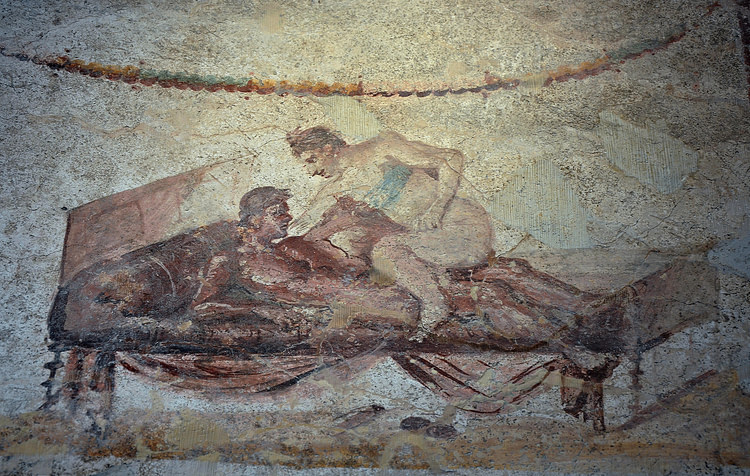 Erotic Fresco in the Lupanar of Pompeii Carole Raddato (CC BY-NC-SA) ](https://www.worldhistory.org/image/11265/erotic-fresco-in-the-lupanar-of-pompeii/ "Erotic Fresco in the Lupanar of Pompeii")Prostitutes worked the streets on their own, or they could rent a room, usually above a tavern. The women who worked as waitresses in taverns were always associated with prostitution. Prostitutes had to be registered with the *aediles*. An *[aedile](https://www.worldhistory.org/Aedile/)* was a magistrate elected each year to oversee commercial activities, and the maintenance and public health of registered brothels and [Roman baths](https://www.worldhistory.org/Roman_Baths/). The public baths were areas where prostitutes also plied their [trade](https://www.worldhistory.org/disambiguation/trade/). From the 30s CE, prostitutes had to pay an imperial tax. Some of the [literature](https://www.worldhistory.org/literature/) suggests that Roman prostitutes wore a brightly-colored toga (white was for citizen males) but with no tunic underneath. Speculation remains that this was a [Roman government](https://www.worldhistory.org/Roman_Government/) edict or simply done by choice to distinguish them from other women. Nudity is often mentioned, but the slave markets also exhibited people in the nude.
Roman prostitutes always turned out for the many religious festivals in the [Roman Empire](https://www.worldhistory.org/Roman_Empire/). As people came to the [cities](https://www.worldhistory.org/city/) from the countryside, these were occasions to make extra profits. The *ludi* (games) of Rome were offered in combination with religious festivals that also included plays throughout the [city](https://www.worldhistory.org/city/) and the ever-popular [chariot](https://www.worldhistory.org/chariot/) races. Prostitutes awaited the crowds leaving the amphitheater each evening. They performed under the arches, and from the Latin *fornix* ("arches") we have the word 'fornication'. Prostitutes often were incorporated into the religious festivals, chiefly among the goddesses associated with fertility and sexual love. Many of these were festivals to Venus or Flora and were noted with temporary upending of social conventions where women celebrated, drank wine, and class status was set aside.
[  The Lupanar, Pompeii Carole Raddato (CC BY-SA) ](https://www.worldhistory.org/image/14221/the-lupanar-pompeii/ "The Lupanar, Pompeii")The term for a brothel, *lupanar*, derived from the Latin *lupa* ("she-wolf"). The most famous *lupanar* is now found in the ruins of the city of [Pompeii](https://www.worldhistory.org/pompeii/). On one side of a street, the brothel has individual cells for activity, with pictures demonstrating various sexual positions. The assumption was that this is how the brothel advertised its various services. However, the public baths in Pompeii has similar pictures in their locker room, above each cubicle. This may have been just an amusing way in which to remember where you stored your clothes while at the bath.
### Prostitution in [Early Christianity](https://www.worldhistory.org/article/1205/early-christianity/)
The common terms for prostitutes do not appear in the letters of [Paul](https://www.worldhistory.org/disambiguation/Paul/) or [the gospels](https://www.worldhistory.org/The_Gospels/). Paul included common Jewish vice-lists against the dominant [culture](https://www.worldhistory.org/disambiguation/culture/), often including "sexual immorality" (Greek: *pornea*, or "illicit sexual unions"). As the basis for the English word pornography, it became associated with prostitution. The only time Paul addressed prostitution *per se* is in 1 Corinthians 6:12-20:
> The body, however, is not meant for sexual immorality but for the Lord, and the Lord for the body. . . Do you not know that your bodies are members of Christ himself? Shall I then take the members of Christ and unite them with a prostitute? Never! Do you not know that he who unites himself with a prostitute is one with her in body? For it is said, "The two will become one flesh." But whoever is united with the Lord is one with him in spirit. Flee from sexual immorality. All other sins a person commits are outside the body, but whoever sins sexually, sins against their own body. Do you not know that your bodies are temples of the Holy Spirit, who is in you, whom you have received from God? You are not your own; you were bought at a price. Therefore, honor God with your bodies.
In 1 Corinthians 11, in addressing behavior issues, Paul admonished women who prophesy or speak in tongues to "cover their hair" when doing so. This mandate is related to the way in which ancient prostitutes often advertised their services. Decent matrons outside of the home had their hair pinned up and covered with a veil. Prostitutes had uncovered heads, with hair flowing down the back.
Scholars have long noted the many women that [Jesus](https://www.worldhistory.org/Jesus_Christ/) encountered in his ministry. One of the interpretive problems is that some women are simply described as sinners without detail in the [gospels](https://www.worldhistory.org/The_Gospels/):
> While Jesus was having dinner at Matthew’s house, many tax collectors and sinners came and ate with him and his disciples. When the [Pharisees](https://www.worldhistory.org/Pharisees/) saw this, they asked his disciples, "Why does your teacher eat with tax collectors and sinners?" On hearing this, Jesus said, "It is not the healthy who need a doctor, but the sick." (Matthew 9:10-12).
Meals were served while people lay on couches. Some interpreters of this passage claim that Jesus openly defied the social conventions by literally sharing his couch with sinners. The "sinners" in this case are understood as prostitutes. Inherent in this interpretation is a later saying in Matthew: "Truly I tell you, the tax collectors and the prostitutes are entering the kingdom of God ahead of you \[the Pharisees\]" (Matthew 21:31).
Luke related the story of a "sinful woman" who anointed Jesus:
> A woman in that town who lived a sinful life learned that Jesus was eating at the Pharisee’s house, so she came there with an alabaster jar of perfume ... When the Pharisee saw this, he said to himself, "If this man were a prophet, he would know who is touching him and what kind of woman she is—that she is a sinner." Jesus turned toward the woman and said to Simon, "Do you see this woman? I came into your house. You did not give me any water for my feet, but she wet my feet with her tears and wiped them with her hair ... Therefore, I tell you, her many sins have been forgiven ... Then Jesus said to her, "Your sins are forgiven." (7:36-50)
In the Western tradition, Mary Magdalene is the most famous (reformed) prostitute. And yet, she is never identified as such in the gospels. She is not named a disciple, but the Greek cognate for "follower" implies the same understanding. Only Luke provided any detail: "Mary, called Magdalene, from whom seven demons had gone out, and Joanna, the wife of Herod’s steward Chuza, and Susanna, and many others, who provided for them out of their resources" (Luke 8:2-3). In other words, these were women of means who contributed to the daily needs of the disciples. Mary Magdalene is mentioned in all four gospels as among the first witnesses to the resurrection.
[  Saint Mary Magdalene Jan van der Crabben (CC BY-NC-SA) ](https://www.worldhistory.org/image/10522/saint-mary-magdalene/ "Saint Mary Magdalene")All Hollywood versions of the life of Jesus include a story only found in much-later manuscripts of Luke and John, that of Jesus rescuing a woman from being stoned for her sin. All depictions place Mary Magdalene in this scene. However, prostitution was not a sin. It was Pope Gregory I (540-604), who associated Mary Magdalene with the sinful woman who anointed Jesus and the story of the woman caught in adultery. However, Eastern Orthodox churches do not make this association.
In the 2nd century CE, Christian leaders were drawn from Gentile backgrounds, educated in [Greek philosophy](https://www.worldhistory.org/Greek_Philosophy/). The concept of asceticism ("discipline") taught in philosophical schools, encouraged moderation in uses and abuses of the body. This included eating, drinking, and particularly sexual activity. It is in the writings of these Church Fathers that we find the Christian innovation of human sexuality as a sin. It was a necessary sin, to fulfill the command to "be fruitful and multiply", in this case, to grow the Church. However, all forms of human sexuality that did not lead to procreation were banned. Sexual intercourse for any other reason was the sin of lust. This included homosexuality of either sex. Without addressing prostitution *per se,* they utilized the books of the Prophets for their metaphors of “sexual immorality” connected to idolatry in the dominant culture.
### Late Antiquity & the Middle Ages
After [Constantine](https://www.worldhistory.org/disambiguation/Constantine/)'s conversion to [Christianity](https://www.worldhistory.org/christianity/) in 312 CE, his biographer, Eusebius claimed that he closed both brothels and the temples to Venus and other fertility goddesses. He made the point that force was not used, but that the [Roman emperor](https://www.worldhistory.org/Roman_Emperor/) wrote to the cities with the temples and encouraged the cessation of their rituals. However, it should be noted that in the later descriptions of [Constantinople](https://www.worldhistory.org/Constantinople/) (now the capital of the [Byzantine Empire](https://www.worldhistory.org/Byzantine_Empire/)), there are consistent references to the plethora of brothels in the city.
There are stories that during the reign of Theodosius I (379-395 CE), prostitutes were burned alive (Evagrius, *Ecclesiastical History* 3.39-41). In 529 CE, [Byzantine emperor](https://www.worldhistory.org/Byzantine_Emperor/) [Justinian I](https://www.worldhistory.org/Justinian_I/) (r. 527-565 CE) penalized all trade in child prostitution. Some interesting literature in this period recounts the involvement of monks in prostitution. Typical stories have a monk visiting the baths or a brothel, and then being stricken with a sexual disease (Palladius, *Lausiac History*, 26).
Saint [Augustine of Hippo](https://www.worldhistory.org/Augustine_of_Hippo/) (350-430 CE), explained why God permitted evil to exist:
> Remove prostitutes from human affairs, and you will unsettle everything because of lusts; place them in the position of matrons, and you will dishonor these latter by disgrace and ignominy. (Letter to Trygetius, 386)
In other words, without prostitution, men would treat their wives like prostitutes, vitiating the command to procreate. The medieval Augustinian monk Saint [Thomas Aquinas](https://www.worldhistory.org/Thomas_Aquinas/) (1225-1274) paraphrased [Augustine](https://www.worldhistory.org/disambiguation/Augustine/), claiming that removing prostitution would be like removing the sewers from a [palace](https://www.worldhistory.org/disambiguation/palace/); both would soon fill with corruption. The [medieval Church](https://www.worldhistory.org/Medieval_Church/) legalized brothels and prostitution, and prostitutes now joined in Catholic religious festivals.
#### Editorial Review
This human-authored article has been reviewed by our editorial team before publication to ensure accuracy, reliability and adherence to academic standards in accordance with our [editorial policy](https://www.worldhistory.org/static/editorial-policy/).
## Bibliography
- [Ben Witherington III. *Women in the Ministry of Jesus.* Cambridge University Press, 1987.](https://www.worldhistory.org/books/0521347815/)
- [Budin, Stephanie Lynn. *The Myth of Sacred Prostitution in Antiquity.* Cambridge University Press, 2009.](https://www.worldhistory.org/books/0521178045/)
- [Pomeroy, Sarah. *Goddesses, Whores, Wives, and Slaves.* Schocken, 1995.](https://www.worldhistory.org/books/080521030X/)
## About the Author
Rebecca I. Denova, Ph.D. is Emeritus Professor of Early Christianity in the Department of Religious Studies, University of Pittsburgh. She has recently completed a textbook, "The Origins of Christianity and the New Testament" (Wiley-Blackwell)
## Cite This Work
### APA
Denova, R. (2021, July 19). Prostitution in the Ancient Mediterranean. *World History Encyclopedia*.
### Chicago
Denova, Rebecca. "Prostitution in the Ancient Mediterranean." *World History Encyclopedia*, July 19, 2021. .
### MLA
Denova, Rebecca. "Prostitution in the Ancient Mediterranean." *World History Encyclopedia*, 19 Jul 2021, .
## License & Copyright
Submitted by [Rebecca Denova](https://www.worldhistory.org/user/rdenova/ "User Page: Rebecca Denova"), published on 19 July 2021. The copyright holder has published this content under the following license: [Creative Commons Attribution-NonCommercial-ShareAlike](https://creativecommons.org/licenses/by-nc-sa/4.0/deed.en). This license lets others remix, tweak, and build upon this content non-commercially, as long as they credit the author and license their new creations under the identical terms. When republishing on the web a hyperlink back to the original content source URL must be included. Please note that content linked from this page may have different licensing terms.