---
title: Exploring Classical Pula, Croatia
author: Carole Raddato
source: https://www.worldhistory.org/article/1787/exploring-classical-pula-croatia/
format: machine-readable-alternate
license: Creative Commons Attribution-NonCommercial-ShareAlike (https://creativecommons.org/licenses/by-nc-sa/4.0/)
updated: 2023-11-07
---
# Exploring Classical Pula, Croatia
_Authored by [Carole Raddato](https://www.worldhistory.org/user/FollowingHadrian/)_
Located at the southern tip of the Istrian peninsula, Croatia’s westernmost outcrop, Pula is a town of extraordinary beauty with a 3000-year history. This important Istrian port boasts a rich and varied cultural heritage and has some of the best-preserved [Roman](https://www.worldhistory.org/disambiguation/Roman/) monuments in Croatia, including the impressive Roman [amphitheatre](https://www.worldhistory.org/amphitheatre/), the Pula Arena, which dominates the [city](https://www.worldhistory.org/city/)’s landscape.
[ 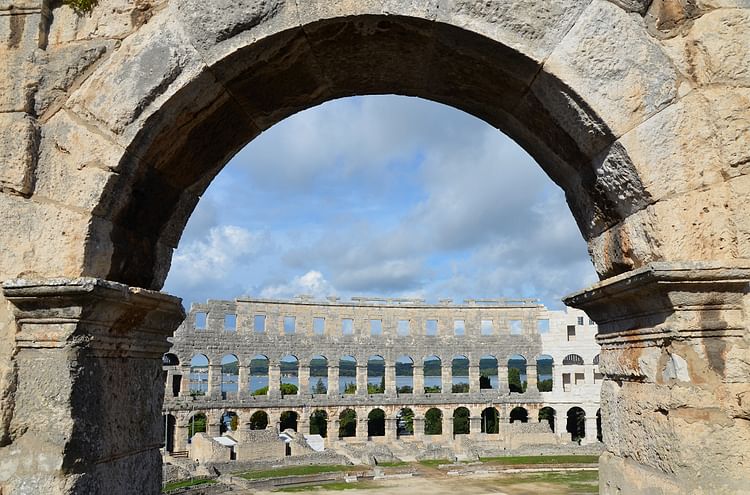 Pula Arena Carole Raddato (CC BY-NC-SA) ](https://www.worldhistory.org/image/14318/pula-arena/ "Pula Arena")The formation of the town of Pula is connected to the story of Jason, [Medea](https://www.worldhistory.org/Medea/), and the Argonauts from [Greek mythology](https://www.worldhistory.org/Greek_Mythology/). Jason stole the [Golden Fleece](https://www.worldhistory.org/Golden_Fleece/) from the Colchians for the Thessalian king, Pelias. A passage from an elegy by Callimachus (c. 305-240 BCE), a [Greek](https://www.worldhistory.org/disambiguation/greek/) poet, [writing](https://www.worldhistory.org/writing/) in [Alexandria](https://www.worldhistory.org/alexandria/) in the 3rd century BCE, describes how the Colchians, led by Medea’s brother Apsyrtos, chased the Argonauts into the northern Adriatic by sailing upstream along the Danube (the ancient Ister). Unable to catch them, the Colchians settled in a place they called Polae, signifying “city of fugitives”. That city was identified as Pula in the classical tradition of Roman historiography and geography in the works of [Pliny the Elder](https://www.worldhistory.org/Pliny_the_Elder/) (23/24-79 CE) and Strabo (c. 64 BCE - c. 24 CE).
> “On the Illyrian river they rested their oars, / By the tombstone of the blond Harmony-Serpent, / And founded a city: a Greek would say a ‘City of Fugitives’, / But in their tongue they called it Pula.” – [Callimachus of Cyrene](https://www.worldhistory.org/Callimachus_of_Cyrene/)
### A 3,000-year-old History
Since the beginning of the [Iron Age](https://www.worldhistory.org/disambiguation/Iron_Age/), Istria was inhabited by the Histri, a tribe of [Indo-European](https://www.worldhistory.org/Indo-European_Languages/) origin for whom the peninsula is named. The Histri built numerous hillfort settlements in the territory of Pula and controlled the sea of southern Istria. They were engaged in pirating, and ancient written sources refer to them as a dangerous people. The Romans conquered the local Histri in 177 BCE, but it took them two military campaigns and a two-year siege of the Histrian capital of Nesactium to subdue them and defeat their king who, according to Roman writer [Livy](https://www.worldhistory.org/livy/) (59 BCE - 17 CE), chose suicide rather than slavery to the Romans. The fall of Nesactium marked the end of the independence of the Histrians and the beginning of the Romanisation of Istria.
The Romans introduced a network of military stations along the coast to control the coastal sea route, and a small [Roman army](https://www.worldhistory.org/Roman_Army/) garrison was stationed at Pula. A civil settlement developed at Pula, which rose to prominence at the expense of nearby Nesactium. Pula, known as Pola in Roman times, was elevated to colonial rank (a self-governed municipal community of Roman citizens) during [Julius Caesar](https://www.worldhistory.org/Julius_Caesar/)’s dictatorship, between 46 and 45 BCE.
#### Magazine Syndication
[](https://www.karwansaraypublishers.com/pages/ancient-history?tap_a=88561-7cbe2d&tap_s=1481998-1eac29 "Ancient History Magazine")### Ancient History Magazine
FREE SHIPPING WORLDWIDE This article was first published in Ancient History Magazine and republished with permission. Ancient History looks at every aspect of the ancient world: you'll find articles covering politics, society, literature, language, religion, economics, and art - all in one magazine! [Get the Magazine](https://www.karwansaraypublishers.com/pages/ancient-history?tap_a=88561-7cbe2d&tap_s=1481998-1eac29)
.button_container {
margin-top: 1em;
}
.sponsor.book h3 {
text-transform: none;
margin-top: 0px;
margin-bottom: 15px;
font-family: "Libre Baskerville", "Palatino Linotype", "Book Antiqua", Palatino, serif;
}
.sponsor_message {
margin-left: 190px;
font-family: Karla, Arial, Helvetica, sans-serif;
line-height: 140%;
min-height: 200px;
}
.sponsor.book {
padding: 10px 0px 25px 0px;
margin: 25px 0px;
border-top: 1px dotted #dadada;
border-bottom: 1px dotted #dadada;
}
.sponsor.book .key_art {
margin-top: 0px;
margin-bottom: 10px;
float: left;
border: 1px solid #f3f3f3;
}
.sponsor h4 {
font-weight: normal;
text-transform: uppercase;
color: silver;
margin-bottom: 10px;
margin-top: 0px;
font-family: Karla,Arial,Helvetica,sans-serif;
font-size: 13px;
padding: 0;
}
.sponsor_book_author {
color: silver;
margin: -10px 0px 20px;
}
@media (max-width: 1199px) {
.sponsor.book .key_art {
float: none;
width: 100%;
}
.sponsor.book .sponsor_message {
margin-left: 0px;
}
.sponsor.book h3 {
margin-top: 20px;
margin-bottom: 10px;
}
}
@media (max-width: 767px) {
}
During the civil [war](https://www.worldhistory.org/disambiguation/War/) that followed [Caesar](https://www.worldhistory.org/disambiguation/caesar/)’s assassination in 44 BCE, Pula sided with Brutus and Cassius, and it was razed to the ground by the forces of [Octavian](https://www.worldhistory.org/augustus/) (Caesar [Augustus](https://www.worldhistory.org/augustus/)) after his victory at the [Battle of Actium](https://www.worldhistory.org/Battle_of_Actium/) in 31 BCE. Augustus (r. 27 BCE - 14 CE) rebuilt the city at the request of his daughter Julia (39 BCE - 14 CE) and renamed it *Colonia Pietas Iulia Pola*.
In the 2nd century CE, it was known as *Colonia Pietas Iulia Pola Pollentia Herculanea*, which may indicate that [Hercules](https://www.worldhistory.org/hercules/) was the city’s patron and protector. Within a few years, its population grew to about 5,000, and the town became a significant Roman port and commercial centre. Together with the rest of Istria, Pula was annexed to the 10th Italic region, *Venetia et Histri*, and was transformed into an imperial city where some of the best examples of Roman [architecture](https://www.worldhistory.org/disambiguation/architecture/) were built. Like most Roman towns, Pula had a [Roman forum](https://www.worldhistory.org/Roman_Forum/), an amphitheatre, temples, and theatres and was serviced by a water supply and sewage system.
[ 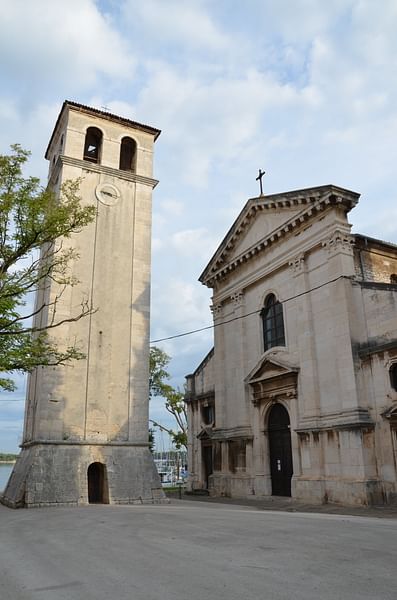 Pula Cathedral Carole Raddato (CC BY-NC-SA) ](https://www.worldhistory.org/image/14337/pula-cathedral/ "Pula Cathedral")After the [fall of the Western Roman Empire](https://www.worldhistory.org/article/835/fall-of-the-western-roman-empire/) at the end of the 5th century CE, Pula (and the surrounding region) was devastated by the [Ostrogoths](https://www.worldhistory.org/ostrogoth/). Their rule ended after 60 years when Pula became part of the Exarchate of Ravenna. Pula developed during that period and became the main harbour of the [Byzantine](https://www.worldhistory.org/disambiguation/Byzantine/) navy.
### Archaeological Highlights
Pula is to Croatia what [Rome](https://www.worldhistory.org/Rome/) is to [Italy](https://www.worldhistory.org/italy/). A stroll through the streets of the ancient town takes visitors past remarkable ancient Roman buildings that testify to the magnificence of Pula during the Roman period. The main sites are concentrated within a relatively small area and can be explored on foot. The most famous and imposing classical monument is the amphitheatre, locally known as the Pula Arena. Many other urban monuments are preserved, including the city walls and gates, the Forum, two temples, a Roman [theatre](https://www.worldhistory.org/disambiguation/theatre/), and an honorary arch.
### The Amphitheatre
At 133 m (436 ft) long, 105 m (344 ft) wide, and 32 m (104 ft) high, the Arena of Pula is one of the six largest Roman amphitheatres in existence today and one of the best-preserved. It is also the only remaining amphitheatre to have four side towers that stand on the external [wall](https://www.worldhistory.org/wall/). Inside each of them was a wooden staircase, which led to the top rows and a water reservoir. The reservoirs were filled with collected rainwater, which fed a fountain that once sprinkled scented water on the spectators to cool them, and on the arena to cover the smell of blood.
[  Pula Arena Interior Carole Raddato (CC BY-SA) ](https://www.worldhistory.org/image/2432/pula-arena-interior/ "Pula Arena Interior")Originally a small wooden structure built at the beginning of the 1st century CE, the ampitheatre was enlarged during the reign of [Roman emperor](https://www.worldhistory.org/Roman_Emperor/) [Vespasian](https://www.worldhistory.org/Vespasian/) in 79 CE. It could hold approximately 23,000 spectators and had about 20 entrances. It was built of local limestone on the slope of a small hill facing towards the sea, approximately 200 metres (650 ft) outside the city walls. Its exterior wall is remarkably well-preserved. It consisted of 72 arches on the first two floors and 64 large rectangular openings on the second floor.
It had three storeys on the side facing the sea and two on the opposite side. Shows of every kind were performed there, including [gladiator](https://www.worldhistory.org/gladiator/) fights, hunting spectacles, and naval battles.
[ 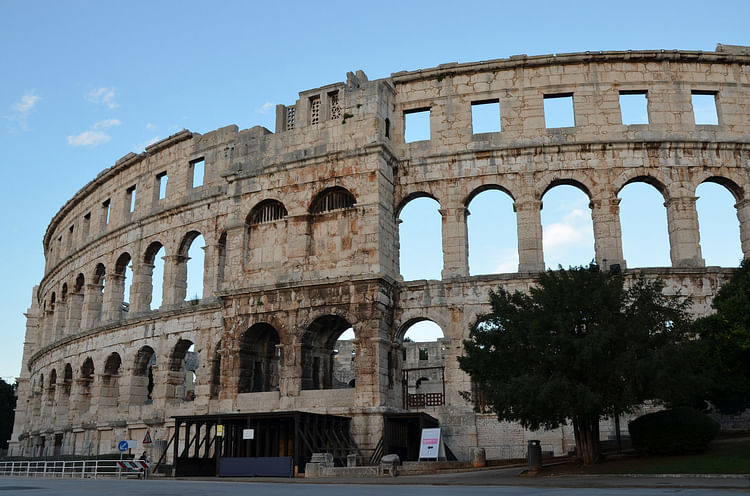 Pula Arena Exterior Carole Raddato (CC BY-SA) ](https://www.worldhistory.org/image/2433/pula-arena-exterior/ "Pula Arena Exterior")Many archaeological finds from the amphitheatre and other Roman buildings are kept in the underground passages, where an exhibition devoted to the cultivation of olive trees and viticulture is on permanent display. The Roman amphitheatre remained intact until the 15th century when some of the stones were used to construct the castle and other buildings in the city. Today, the building can accommodate 5,000 spectators and is a venue for concerts and film festivals.
### The City Walls & Gates
The ancient city of Pula was fortified by walls and was entered through one of its twelve gates, two of which still remain in *Carrarina* *ulica* (a street) along the north end of the walls. The oldest city gate is the so-called Gate of Hercules. Architecturally modest, it stands as a single-arched stone gate. At the top is a worn carving relief of the head of Hercules with his club. The gate also has an inscription containing the names of two [Roman government](https://www.worldhistory.org/Roman_Government/) officials, Lucius Calpurnius Piso Caesoninus (48 BCE - 32 CE) and Quintus Cassius Longinus (d. 47 BCE).
Calpurnius was the father-in-[law](https://www.worldhistory.org/disambiguation/law/) of [Julius](https://www.worldhistory.org/disambiguation/Julius/) Caesar (100-44 BCE) through his daughter Calpurnia. Cassius was the brother and namesake of Cassius Longinus (c. 86-42 BCE) who took part in the [assassination of Julius Caesar](https://www.worldhistory.org/article/803/the-assassination-of-julius-caesar/). This suggests that the city walls and the Gate of Hercules were built during the founding of the city by the two *duoviri* (joint magistrates) in 47-44 BCE.
[ 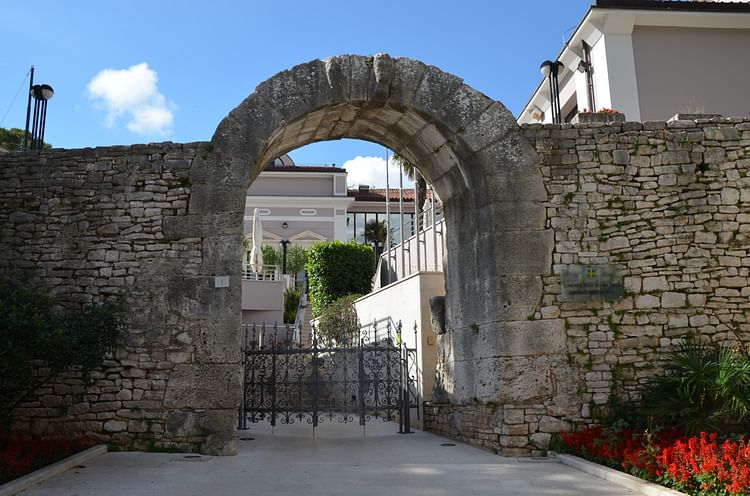 Gate of Hercules, Pula Carole Raddato (CC BY-NC-SA) ](https://www.worldhistory.org/image/14319/gate-of-hercules-pula/ "Gate of Hercules, Pula")The other remaining city gate stands on the same street and is the so-called Twin Gates, with two vaulted passages. It was constructed at the end of the second century over the remains of an older gate and used to be part of the main road leading to the ancient theatre, located on the east slope of the central city hill. Today, it leads to the archaeological museum. The gate is decorated with three half-columns surmounted by composite capitals, an architrave without decoration, and a richly decorated frieze.
### The Arch of the Sergii
One of the most valued and beautiful monuments of Roman Pula is the Arch of the Sergii (also known as the Golden Gate), an honorary arch erected between 30 and 10 BCE by Salvia Postuma from the wealthy [patrician](https://www.worldhistory.org/Patrician/) family of the Sergii in honour of three male members of her family. One of them, Lucius Sergius Lepidus (fl. 27 BCE), was a [tribune](https://www.worldhistory.org/Tribune/) serving in the 29th Legion that participated in the [Battle](https://www.worldhistory.org/disambiguation/battle/) of Actium.
[ 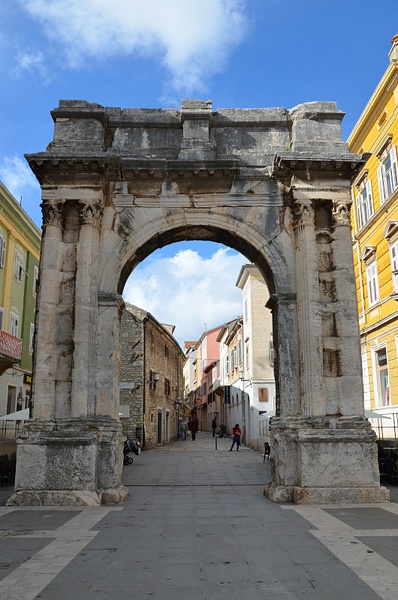 Arch of the Sergii, Pula Carole Raddato (CC BY-NC-SA) ](https://www.worldhistory.org/image/2434/arch-of-the-sergii-pula/ "Arch of the Sergii, Pula")The arch is lavishly decorated with fluted columns, Corinthian capitals, [erotes](https://www.worldhistory.org/Eros/), garlands, and winged victories symbolising military success in [Roman warfare](https://www.worldhistory.org/Roman_Warfare/). On the top above the frieze, an attic divided into three parts held statues of the three members of the Sergii family to whose memory the arch was erected. In the centre of the frieze, an inscription reads SALVIA POSTVMA SERGI(a) DE SVA PECVNIA, which means “Salvia Postuma, the wife of Sergius, (made this) with her own money."
[ 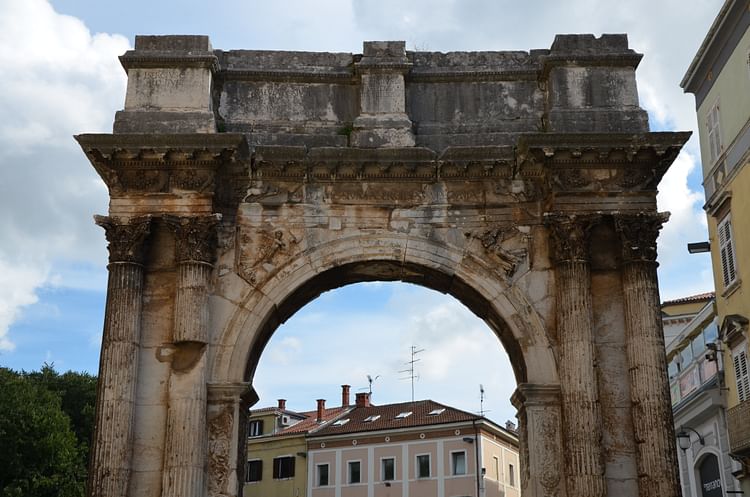 The Arch of the Sergii, Pula Carole Raddato (CC BY-NC-SA) ](https://www.worldhistory.org/image/14332/the-arch-of-the-sergii-pula/ "The Arch of the Sergii, Pula")This arch has inspired and attracted the attention of many artists, most notably [Michelangelo](https://www.worldhistory.org/Michelangelo/) (1475-1564 CE), who made a drawing of it during his visit to Pula. Today, numerous cultural performances, theatrical and musical, are held in the square next to the arch.
### The Forum
The main square in the Old City of Pula (Republic Square) was once the site of the Roman Forum and has been Pula’s most important public meeting place for 2,000 years. Situated in the central part of the lower town near the sea, the Forum was the principal gathering place and nucleus of the Roman city. It was constructed during the reign of Augustus between 2 BCE and 14 CE. On the northern part of the Forum, two twin temples stood, along with a central one dedicated to [Jupiter](https://www.worldhistory.org/jupiter/), [Juno](https://www.worldhistory.org/Juno/), and [Minerva](https://www.worldhistory.org/Minerva/).
[ 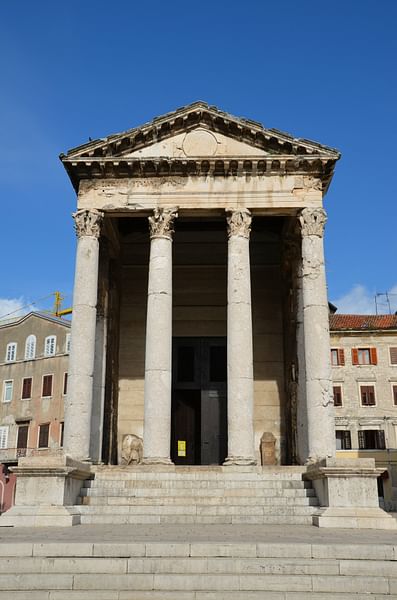 The Temple of Augustus in Pula Carole Raddato (CC BY-NC-SA) ](https://www.worldhistory.org/image/2213/the-temple-of-augustus-in-pula/ "The Temple of Augustus in Pula")Today, only the [Temple](https://www.worldhistory.org/temple/) of Augustus has been fully preserved, while only the back wall of the second temple, which was built into the Communal [Palace](https://www.worldhistory.org/disambiguation/palace/) in the 13th century CE, is visible. The temple still standing on the west side is a harmonious building constructed of Istrian limestone on an elevated podium. It was dedicated to the goddess [Roma](https://www.worldhistory.org/disambiguation/Roma/) and the emperor Augustus. It is an exceptionally beautiful building, with four tall columns with Corinthian capitals. The frieze of floral motives on the architrave is continued around the temple. On its frontal side, the architrave carries the inscription that reads: ROMAE ET AVGUSTO CAESARI DIVI FILIO PATRI PATRIAE ("to Romans and Augustus, the son of divine Caesar, the father of the homeland.")
[ 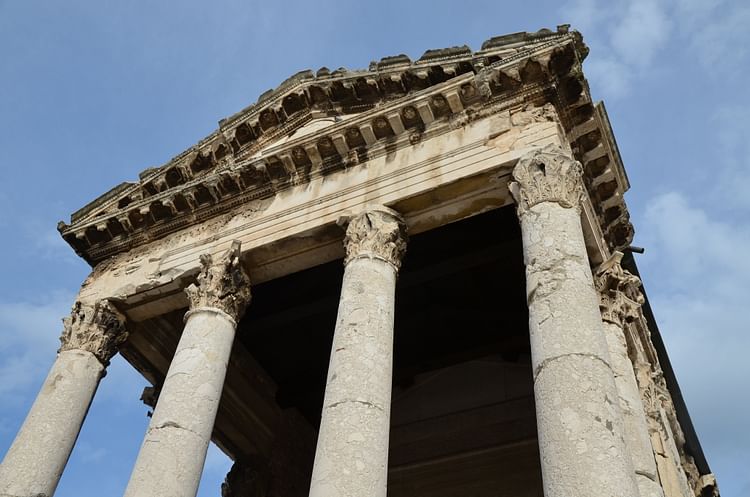 Temple of Augustus in Pula Carole Raddato (CC BY-NC-SA) ](https://www.worldhistory.org/image/14331/temple-of-augustus-in-pula/ "Temple of Augustus in Pula")The temple was converted into a church under the [Byzantine Empire](https://www.worldhistory.org/Byzantine_Empire/). It was destroyed in a bombing raid during World World II and was painstakingly restored to its former glory between 1945 and 1947. Today, it houses a small collection of ancient sculptures, including statues of several emperors. The other twin temple, with only the back wall preserved, was probably dedicated to [Diana](https://www.worldhistory.org/diana/).
### The Small Theatre
On the northeastern slopes of the city's central hill below the castle are the remains of a Roman theatre dating back to the 1st century CE. In addition to an amphitheatre, Roman Pula had two theatres. The largest one, which has not been preserved, was situated outside the city walls, on the slopes of Monte Zaro, and was big enough to hold the city's population (5,000).
[ 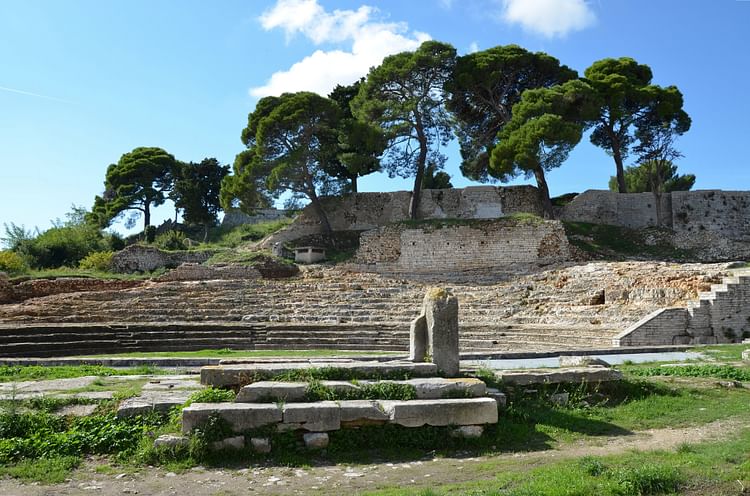 Roman Theatre of Pula Carole Raddato (CC BY-NC-SA) ](https://www.worldhistory.org/image/14327/roman-theatre-of-pula/ "Roman Theatre of Pula")The other theatre, known as the Small Roman Theatre, could accommodate about 1,000 spectators and was located within the city walls on the eastern slopes of the central hill of the town, a few hundred metres from the larger one. Only its reconstructed foundations are visible today, including the *proscene* (where acting took place), the semicircular *orchestra*, and semicircular tiered *cavea* (audience seating area).
### The [Mosaic](https://www.worldhistory.org/Mosaic/) of Dirce
The mosaic of the Punishment of Dirce is one of the most beautiful examples of ancient Roman mosaic art. It was found in 1959 during construction work near the Chapel of St. Mary Formosa, and it has been completely preserved. The multicoloured mosaic floor, dated to the 3rd century CE, covered the whole floor of the central room of a Roman residential house. Its surface of 65 square metres (215 square feet) consists of two unequal sections. One part contains rows of hexagons with stylized rosettes as well as animal figures.
[ 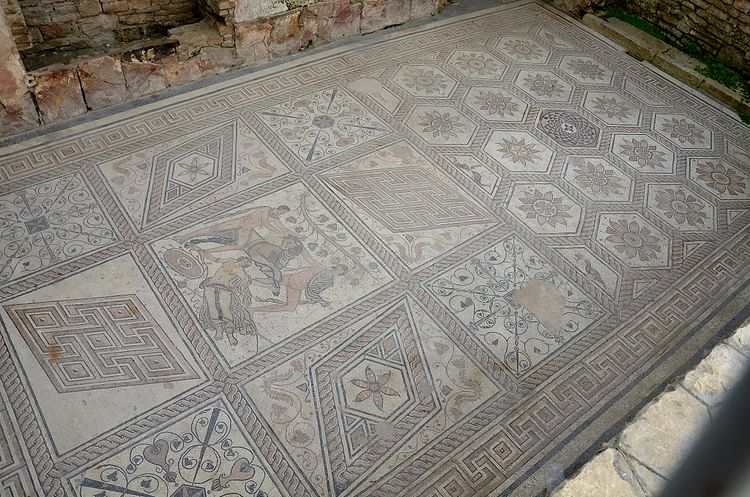 Mosaic of Dirce Carole Raddato (CC BY-NC-SA) ](https://www.worldhistory.org/image/14328/mosaic-of-dirce/ "Mosaic of Dirce")The other part of the mosaic consists of nine non-uniform rectangles. In the centre of the largest one is the only figural representation depicting the myth of the Naiad-[nymph](https://www.worldhistory.org/nymph/) Dirce, the wife of Lycus of [Thebes](https://www.worldhistory.org/disambiguation/Thebes/), who, as punishment for the mistreatment of her niece Antiope, was tied to a wild bull and torn limb from limb. Two male figures, the brothers Amphion and Zethus, are represented in the moments before tying Dirce to a bull whose horns they hold. Dirce is depicted in the lower section, half-lying on her back. The mosaic is preserved *in situ*, two metres (6 ft) below the present-day floor level.
### Archaeological Sites Nearby
Pula is also a good base for exploring the ancient site of Nesactium as well as the Verige Roman Villa, located in the Brijuni Islands National Park.
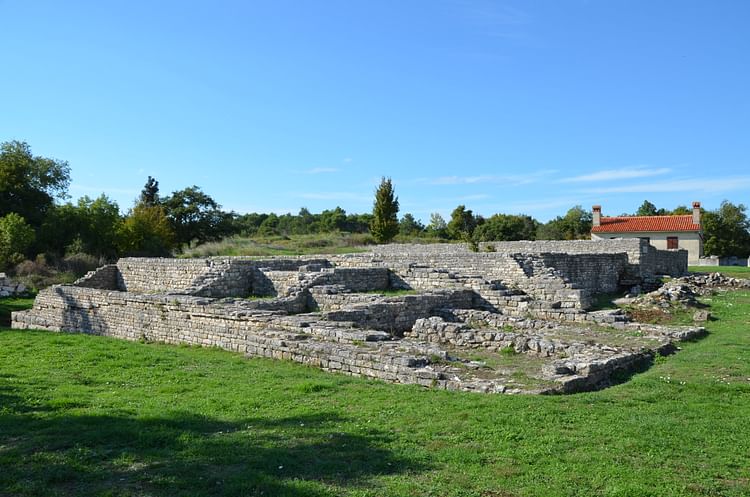
Nesactium, located on an elevated plateau 14 kilometres (9 mi) east of Pula near Vizače, was the seat of the Histri tribe, ruled by its legendary king Epulon. The site contains the remains of a prehistoric cemetery, a Roman *municipium*, and an early Christian basilica from the 6th century CE. It was here that the final and decisive battle took place between the Histri and the Romans in 177 BCE. The settlement was rebuilt by the Romans and regained its former importance. A forum with three small temples, baths, and other structures of public and private character were erected on the central plateau. Remnants of luxurious private houses are located on the slopes, while a rich necropolis extends alongside the road that led to Pula.
[  Nesactium Carole Raddato (CC BY-NC-SA) ](https://www.worldhistory.org/image/14329/nesactium/ "Nesactium")The Verige Roman Villa is a *villa rustica* (countryside villa) located in the bay of Verige off the coast of Istria, within the Brijuni National Park. The Brijuni archipelago has 14 small islands, which are famous for their scenic beauty. In Roman times, numerous residential villas adorned the coasts of these islands, referred to by Pliny the Elder (23-79 CE) as *Insulae Pullariae*. The villa's construction began in the 1st century BCE, reaching its heyday in the 1st century CE. Some parts of the villa were used even up to the 6th century CE. The senatorial Laecanii family owned the villa and it probably came under imperial ownership in the second half of the 1st century CE. It consisted of several buildings of residential and economic character situated in different parts of the bay.
[ 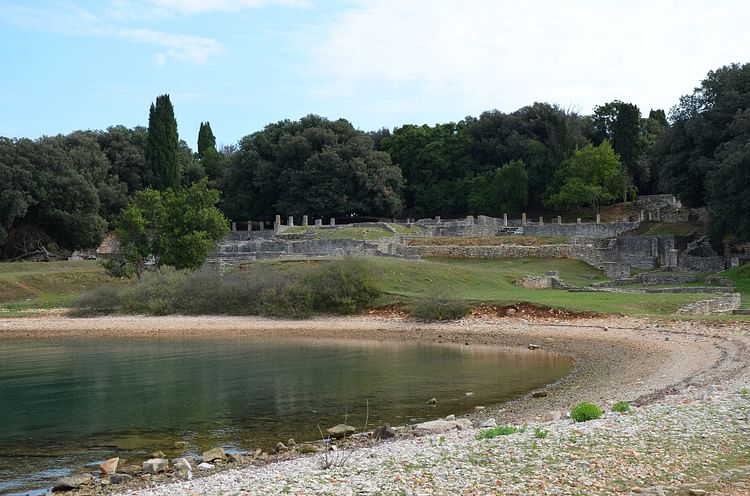 Verige Roman Villa Carole Raddato (CC BY-NC-SA) ](https://www.worldhistory.org/image/14330/verige-roman-villa/ "Verige Roman Villa")The complex also included three temples (to the sea [god](https://www.worldhistory.org/God/) [Neptune](https://www.worldhistory.org/Neptune/), the Capitoline Triad, and the goddess [Venus](https://www.worldhistory.org/venus/)) and a *palaestra*. All these buildings were connected by a system of collonaded promenades stretching one kilometre (0.6 mi) along the sea, in harmony with the landscape. The only way to reach Brijuni National Park from the mainland is by getting on a boat from Fažana, which has a regular service to the island of Veliki Brijuni. Visitors who wish to visit the villa must book the archaeological tour, which includes the boat crossing and a tourist train ride to all the other archaeological attractions on the island. The tour takes approximately four [hours](https://www.worldhistory.org/Horae/).
### Learn more
For more information on Pula’s sightseeing and events, visit . For
more information on visiting Brijuni National Park visit .
***This article was originally printed in Issue 23 of Ancient History Magazine.***
#### Editorial Review
This human-authored article has been reviewed by our editorial team before publication to ensure accuracy, reliability and adherence to academic standards in accordance with our [editorial policy](https://www.worldhistory.org/static/editorial-policy/).
## About the Author
Carole maintains the popular ancient history photo-blog Following Hadrian, where she travels the ancient world in the footsteps of Emperor Hadrian.
- [Facebook Profile](https://www.facebook.com/FollowingHadrian)
- [X/Twitter Profile](https://twitter.com/carolemadge)
## Cite This Work
### APA
Raddato, C. (2021, June 28). Exploring Classical Pula, Croatia. *World History Encyclopedia*.
### Chicago
Raddato, Carole. "Exploring Classical Pula, Croatia." *World History Encyclopedia*, June 28, 2021. .
### MLA
Raddato, Carole. "Exploring Classical Pula, Croatia." *World History Encyclopedia*, 28 Jun 2021, .
## License & Copyright
Submitted by [Carole Raddato](https://www.worldhistory.org/user/FollowingHadrian/ "User Page: Carole Raddato"), published on 28 June 2021. The copyright holder has published this content under the following license: [Creative Commons Attribution-NonCommercial-ShareAlike](https://creativecommons.org/licenses/by-nc-sa/4.0/deed.en). This license lets others remix, tweak, and build upon this content non-commercially, as long as they credit the author and license their new creations under the identical terms. When republishing on the web a hyperlink back to the original content source URL must be included. Please note that content linked from this page may have different licensing terms.