---
title: Legions of Spain, Roman Africa & Egypt
author: Donald L. Wasson
source: https://www.worldhistory.org/article/1757/legions-of-spain-roman-africa--egypt/
format: machine-readable-alternate
license: Creative Commons Attribution-NonCommercial-ShareAlike (https://creativecommons.org/licenses/by-nc-sa/4.0/)
updated: 2025-09-23
---
# Legions of Spain, Roman Africa & Egypt
_Authored by [Donald L. Wasson](https://www.worldhistory.org/user/DWasson/)_
The legions of Spain, [Roman](https://www.worldhistory.org/disambiguation/Roman/) [Africa](https://www.worldhistory.org/disambiguation/africa/), and [Egypt](https://www.worldhistory.org/egypt/) did not see the intensity of action that prevailed elsewhere in [Europe](https://www.worldhistory.org/europe/). However, the presence of these four legions - VII Gemina, IX Hispana, XXII Deiotariana, and II Traiana Fortis - was still essential for the stability of the [empire](https://www.worldhistory.org/empire/).
Although often assigned to simply guard grain supplies or protect a [gold](https://www.worldhistory.org/gold/) mine, the legions were sometimes also called upon to leave their home base and assist the [legions of the Rhine frontier](https://www.worldhistory.org/article/1738/legions-of-the-rhine-frontier/) or in [Dacia](https://www.worldhistory.org/dacia/). Whether protecting the [Nile](https://www.worldhistory.org/nile/), suppressing a rebellion against the Nubians, fighting an over-zealous king in [Armenia](https://www.worldhistory.org/armenia/), or aiding the [Roman emperor](https://www.worldhistory.org/Roman_Emperor/) against the Cantabrians, these four legions were a vital part of the empire.
[  Reenactor with the Emblem of Legio VII Gemina Contando Estrelas (CC BY-SA) ](https://www.worldhistory.org/image/14063/reenactor-with-the-emblem-of-legio-vii-gemina/ "Reenactor with the Emblem of Legio VII Gemina")A legion was easily identified by its name - a name which depended solely on when, where, and by whom the legion was founded. Aside from its name, the emblem which adorned a [Roman legionary](https://www.worldhistory.org/Roman_Legionary/)’s shield varied from legion to legion, giving it a distinct identity. While the bull or boar was common among many legions, unique emblems were V Alaudae’s elephant, III Italica’s stork, X Fretensis’ dolphin, or XVI Gallica’s lion, while other emblems were mythological in nature. Each legion also had a birth sign which represented the month in which it was organized.
### The Only Legion of Spain - Legio VII Gemina
For decades Spain was a place of constant turmoil between [Rome](https://www.worldhistory.org/Rome/) and [Carthage](https://www.worldhistory.org/carthage/) across the sea. In 219 the BCE Carthaginian commander [Hannibal](https://www.worldhistory.org/hannibal/) (247-183 BCE) attacked the Roman-protected [city](https://www.worldhistory.org/city/) of [Saguntum](https://www.worldhistory.org/Saguntum/), triggering the onset of the [Second Punic War](https://www.worldhistory.org/Second_Punic_War/). With the end of the [war](https://www.worldhistory.org/disambiguation/War/) in 201 BCE at the [Battle](https://www.worldhistory.org/disambiguation/battle/) of Zama, Rome divided Spain into two provinces: Hispania Citerior and Hispania Ulterior. Later, [Augustus](https://www.worldhistory.org/augustus/) would reorganize it into Baetica, Lusitania, and Tarraconensis. The northern part of Spain was home to the Cantabrians whose aggression against its neighbors eventually brought Augustus (r. 27 BCE - 14 CE) and Rome into a war that lasted on and off for ten years. In 27 BCE, Augustus commanded six legions: I Germanica, II Augusta, IIII Macedonica, VI Victrix, IX Hispana, and X Gemina — totaling over 70,000 legionaries and auxiliaries — against the Cantabrians and Astures. When the province was finally appeased, the legions, except for VI Victrix, were gradually transferred to other troubled areas of the [Roman Empire](https://www.worldhistory.org/Roman_Empire/), namely the Rhine frontier and Pannonia.
In the 1st century CE, Spain became the home of another legion. Legio VII Gemina (emblem: bull; birth sign: Gemini: she-wolf and twins) was founded by the governor of Hispania Tarraconensis Servius Sulpicius Galba (3 BCE - 69 CE). For some time the legion was known simply as Galba’s Seventh Legion or 7th Galbiana. Upon the [death](https://www.worldhistory.org/disambiguation/Death/) of [Nero](https://www.worldhistory.org/Nero/) (r. 54-68 CE), Galba marched on Rome to take the throne, leaving Legio VI Victrix behind and taking the Seventh with him. This new legion soon became embroiled in the [Year of the Four Emperors](https://www.worldhistory.org/Year_of_the_Four_Emperors/) (69 CE).
After becoming emperor, Galba sent the legion to Pannonia where it was based at Carnuntum, replacing X Gemina who was returned to Spain. Upon the assassination of Galba, VII Gemina sided with [Otho](https://www.worldhistory.org/Otho/) (r. 69 CE), the former governor of Lusitania, who seized the throne. Unfortunately, the Seventh was unable to help him against [Vitellius](https://www.worldhistory.org/Vitellius/) (r. 69 CE) in the First Battle of Bedriacum. After the defeat and death of Otho, the new emperor Vitellius sent II Adiutrix to Spain and returned the Seventh to Pannonia where its commander [Marcus Antonius](https://www.worldhistory.org/Mark_Antony/) Primus declared for [Vespasian](https://www.worldhistory.org/Vespasian/) (r. 69-79 CE) With six legions under his command, Primus achieved a victory at the Second Battle of Bedriacum.
The historian [Tacitus](https://www.worldhistory.org/tacitus/) (c. 56 - c. 118 CE) describes the actions of the legions at Cremona (part of the Bedriacum battle) as each side fought to obtain the standard of the other: "Throughout the night the battle raged in many forms, indecisive and fierce … as parties of combatants snatched them (the standards) from the enemy, and hurried them in this or that direction." Not to be confused with the Seventh legion raised by [Claudius](https://www.worldhistory.org/claudius/) (r. 41-54 CE), Tacitus added that the Seventh, recently created by Galba, was the hardest hit. "Six centurions of the first rank were killed, and some of the standards taken but the eagle was saved by Atilius Verus …" (*Histories*, 3.22) Later, Primus and the Seventh marched on Rome, and while suffering heavy casualties, met and defeated Vitellius’ forces there. Vitellius was brutally murdered with his body being thrown into the Tiber.
[ 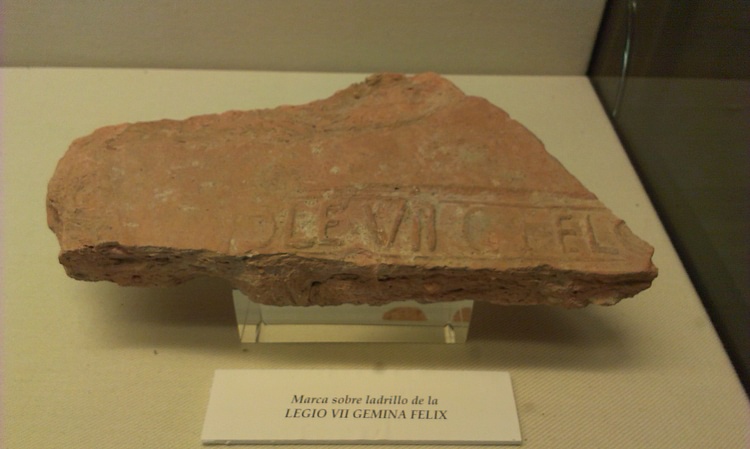 Stamped Brick with the Mark of Legio VII Gemina Viator Imperi (CC BY-SA) ](https://www.worldhistory.org/image/14064/stamped-brick-with-the-mark-of-legio-vii-gemina/ "Stamped Brick with the Mark of Legio VII Gemina")Under Vespasian the legion received its name Gemina when it obtained necessary replacements from the disbanded I Germania. Afterwards, the legion returned to Pannonia where it participated in Gnaeus Clemens’ campaign east of the Rhine. During the Batavian insurrection under Civilis, VII Gemina was returned to Spain when the legions II Adiutrix and VI Victrix were sent to the Rhine.
In 197 CE the governor of [Roman Britain](https://www.worldhistory.org/Roman_Britain/) Clodius Albinus had learned that [Caracalla](https://www.worldhistory.org/Caracalla/) (r. 211-217 CE) was the emperor’s successor and not him. Embittered, he crossed into [Gaul](https://www.worldhistory.org/gaul/) with his legions. The Seventh would support Emperor [Septimius Severus](https://www.worldhistory.org/Septimius_Severus/) (r. 193-211 CE) against Albinus. The would-be usurper was killed with his head being sent to Rome. Legio VII Gemina would return home and eventually remain alone in Spain to protect both its mineral resources and the gold mines. After its return to Spain, the legion’s activities are unclear.
### The Lone Legion of Roman Africa - Legio III Augusta
As with the creation of the province of Spain, Roman Africa or Africa Proconsularis emerged after the fall of Carthage in 146 BCE. Although there is mention of a short-lived I Macriana Libiratrix in 68 CE, during most of the imperial period only one legion, III Augusta (emblem: [Pegasus](https://www.worldhistory.org/Pegasus/); birth sign: Capricorn), called the region home. Since the area was not initially the scene of any external threats, many in Rome believed the legion could govern itself. Most of the legion’s duties were to subdue any political unrest and build roads.
Although little of the legion’s origin is clear, Dando-Collins writes that it appeared around 30 BCE and may have been a descendent of [Pompey](https://www.worldhistory.org/pompey/)’s (106-48 BCE) third legion. Legio III Augusta was with [Octavian](https://www.worldhistory.org/augustus/) at Actium against Anthony and [Cleopatra](https://www.worldhistory.org/disambiguation/cleopatra/) and probably received its title Augusta for its participation in the Cantabrian campaign. From 17 to 23 CE, with assistance from IX Hispana, the legion fought against the Numidian and Moorish cavalry under the leadership of the [Berber](https://www.worldhistory.org/Berbers/) commander Tacfarinas. The legion may have participated in Septimius Severus’ Parthian campaign of 197 CE.
[ 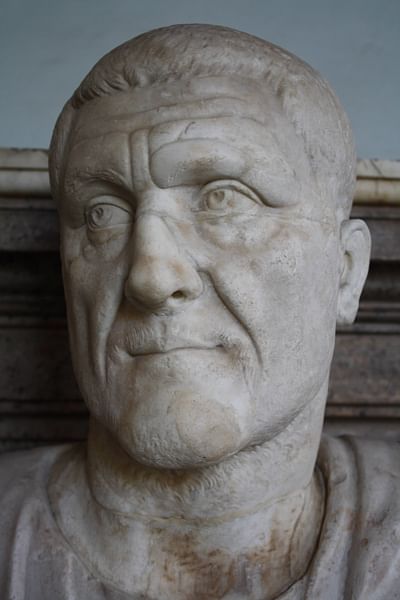 Maximinus I Mark Cartwright (CC BY-NC-SA) ](https://www.worldhistory.org/image/1398/maximinus-i/ "Maximinus I")Much later, during the [Crisis of the Third Century](https://www.worldhistory.org/Crisis_of_the_Third_Century/), the province was the scene of political discontent. In 238 CE Roman Africa rebelled against the unpopular [Maximinus Thrax](https://www.worldhistory.org/Maximinus_Thrax/) (r. 235-238 CE), the first of the so-called '[barracks emperors](https://www.worldhistory.org/Barracks_Emperors/)', favoring the provincial governor [Gordian I](https://www.worldhistory.org/Gordian_Emperors/) and his son [Gordian II](https://www.worldhistory.org/Gordian_Emperors/) as co-emperors. However, the legion, unlike the province, remained loyal to Maximinus. The governor of Numidia, Capellianus, and an ally of Maximinus grew angry and mobilized III Augusta to march on Carthage. The subsequent battle brought the death of [Gordian](https://www.worldhistory.org/Gordian_Emperors/) II and the suicide by hanging of his father. The murder of Maximinus in [Italy](https://www.worldhistory.org/italy/) at the hands of Legio II Parthica and the deaths of would-be emperors Pupienus and Balbinus enabled the 13-year-old [Gordian III](https://www.worldhistory.org/Gordian_Emperors/) (r. 238-244 CE) to sit on the throne. He immediately ordered the III Augusta abolished. Later, reformed under Emperor [Valerian](https://www.worldhistory.org/valerian/) (r. 253-260 CE), the legion remained active in Europe and was part of the army sent by [Stilicho](https://www.worldhistory.org/Stilicho/) (365-408 CE) to put down the attempted revolt of the rebel Roman governor Gildo of northern Africa.
### The Legions of Egypt
Two legions that called Egypt home were XXII Deiotariana and II Traiana Fortis, sharing a fortress at Nicopolis ([Alexandria](https://www.worldhistory.org/alexandria/)). For a short time, III Cyrenaica was also stationed in Egypt but later moved to [Arabia](https://www.worldhistory.org/Arabia/). The legion's main task was to ensure internal security and suppress any unrest that might inhibit the shipment of grain to Rome.
**Legio XXII Deiotariana**
Legio XXII Deiotariana (emblem: [Jupiter](https://www.worldhistory.org/jupiter/)-[Ammon](https://www.worldhistory.org/disambiguation/Ammon/) or eagle; birth sign: unknown) was named after King Deiotarus of [Galatia](https://www.worldhistory.org/galatia/) who had trained his army in the Roman style. In 48 BCE, King Pharnaces II of Pontus threatened Roman allies in [Asia Minor](https://www.worldhistory.org/Asia_Minor/), including Galatia. The Roman governor Gnaeus Calavinus met the invaders in battle but was soundly defeated by Pharnaces. In 47 BCE, [Julius Caesar](https://www.worldhistory.org/Julius_Caesar/) (100-44 BCE), who was in Egypt at the time, responded and, refusing a peaceful settlement, fought Pharnaces at Zela in Pontus. With the help of the depleted army of Deiotarus, the Romans were victorious. [Suetonius](https://www.worldhistory.org/Suetonius/) in his *The Twelve Caesars* wrote:
> From Alexandria he proceeded to [Syria](https://www.worldhistory.org/syria/), and from Syria to Pontus, news have come that Pharnaces …had taken advantage of the confused situation and already gained several successes. Five days after his arrival and four [hours](https://www.worldhistory.org/Horae/)…Caesar crushed him in a single battle. (17)
Supposedly the victory over Pharnaces II of Pontus led [Caesar](https://www.worldhistory.org/disambiguation/caesar/) to exclaim "*Veni, vidi, vici*" ("I came, I saw, I conquered"). Suetonius wrote that this phrase referred to the speed of victory, not the victory itself.
Remnants of the legion were sent to Egypt by Octavian in 30 BCE who gave it the number XXII. One significant event that involved the legion was a rebellion led by the candace of the Kingdom of [Kush](https://www.worldhistory.org/Kush/) (present-day Sudan) when the Kushite army advanced on the [Egyptian](https://www.worldhistory.org/disambiguation/Egyptian/) city of Elephantine in 25 BCE. The prefect of Egypt, Publius Petronius (some claim it was Gaius Petronius), took three legions - III Cyrenaica, XII Fulminata, and XXII Deiotariana - and routed the Kushite army and destroyed the ancient city of Napata. Unfortunately, Petronius strayed too far into the desert in pursuit and was met by a reformed army. Luckily, for both sides, the two leaders arranged a peaceful settlement.
Afterwards, XXII Deiotariana mostly guarded the riverboats of the Nile shipping grain to Alexandria. Evidence indicates the legion’s presence in Alexandria in 119 CE, but little is known after that. There are a number of theories on the legion’s final days. Historian Duncan Campbell writes that the legion was destroyed in Alexandria in 122 CE, while others believe it was crushed in [the Bar-Kochba Revolt](https://www.worldhistory.org/The_Bar-Kochba_Revolt/) of 132-136 CE. However, Dando-Collins claims that it met its end at the hands of the Parthians in Armenia during the reign of [Marcus Aurelius](https://www.worldhistory.org/Marcus_Aurelius/) (r. 161-180 CE).
[ 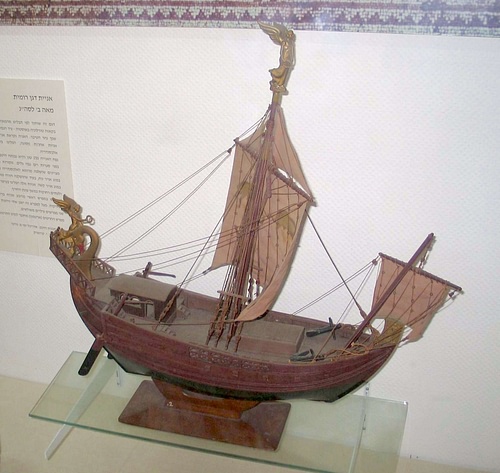 Roman Grain Ship Model Bukvoed (CC BY-SA) ](https://www.worldhistory.org/image/14105/roman-grain-ship-model/ "Roman Grain Ship Model")**Legio II Traiana Fortis**
Legio II Traiana Fortis (emblem: [Hercules](https://www.worldhistory.org/hercules/)' hammer; birth sign: Aries) was raised by Emperor [Trajan](https://www.worldhistory.org/trajan/) (r. 98-117 CE) around 105 CE in preparation for his Dacian campaign. In addition to the legion's assistance in Dacia, it may have also participated in his Parthian campaign of 113-117 CE.
The legion was transferred to Egypt in 127 CE, making its base at Nicopolis (Alexandria), and aided in the construction of an [aqueduct](https://www.worldhistory.org/aqueduct/) at the Euphrates River. The legion assisted in the suppression of the Jewish Revolt of 132-136 CE and was active in the Parthian campaigns of both emperors [Lucius Verus](https://www.worldhistory.org/Lucius_Verus/) (r. 161-169 CE) and Septimius Severus. In 172 CE, an Egyptian priest named Isodorus led a revolt of Bucoli herdsmen, laying siege to Alexandria for months. The city was saved when the governor of Syria, Avidius Cassius, arrived with a relief force.
Afterwards, the legion spent most of its time in Egypt on internal security and, according to some sources, was still in Alexandria in the 4th century CE. Dando-Collins writes that the legion possibly sided with Queen [Zenobia](https://www.worldhistory.org/zenobia/) of Palmyra during her seizure of Egypt in 269 CE. He claims it was absorbed into the [Byzantine](https://www.worldhistory.org/disambiguation/Byzantine/) army after the [fall of the Western Roman Empire](https://www.worldhistory.org/article/835/fall-of-the-western-roman-empire/).
#### Editorial Review
This human-authored article has been reviewed by our editorial team before publication to ensure accuracy, reliability and adherence to academic standards in accordance with our [editorial policy](https://www.worldhistory.org/static/editorial-policy/).
## Bibliography
- [Baker, Simon. *Ancient Rome.* BBC Physical Audio, 2007.](https://www.worldhistory.org/books/1846072840/)
- [Campbell, Duncan B & Delf, Brian. *Roman Legionary Fortresses 27 BC–AD 378.* Osprey Publishing, 2006.](https://www.worldhistory.org/books/1841768952/)
- [Dando-Collins, Stephen. *Legions of Rome.* Thomas Dunne Books, 2012.](https://www.worldhistory.org/books/1250004713/)
- [Goldsworthy, Adrian. *Complete Roman Army .* Thames & Hudson, 2011.](https://www.worldhistory.org/books/0500288992/)
- [Pollard, Nigel & Berry, Joanne. *The Complete Roman Legions.* Thames & Hudson, 2012.](https://www.worldhistory.org/books/0500251835/)
- [Rodgers, Nigel. *Roman Empire.* Lorenz Books, 2006.](https://www.worldhistory.org/books/0754816028/)
- [Scarre, Chris. *Chronicle of the Roman Emperors.* Thames & Hudson, 1995.](https://www.worldhistory.org/books/0500289891/)
- [Suetonius. *The Twelve Caesars.* Penguin Classics, 2007.](https://www.worldhistory.org/books/0140455167/)
## About the Author
Donald has taught Ancient, Medieval and U.S. History at Lincoln College (Normal, Illinois)and has always been and will always be a student of history, ever since learning about Alexander the Great. He is eager to pass knowledge on to his students.
## Cite This Work
### APA
Wasson, D. L. (2021, May 25). Legions of Spain, Roman Africa & Egypt. *World History Encyclopedia*.
### Chicago
Wasson, Donald L.. "Legions of Spain, Roman Africa & Egypt." *World History Encyclopedia*, May 25, 2021. .
### MLA
Wasson, Donald L.. "Legions of Spain, Roman Africa & Egypt." *World History Encyclopedia*, 25 May 2021, .
## License & Copyright
Submitted by [Donald L. Wasson](https://www.worldhistory.org/user/DWasson/ "User Page: Donald L. Wasson"), published on 25 May 2021. The copyright holder has published this content under the following license: [Creative Commons Attribution-NonCommercial-ShareAlike](https://creativecommons.org/licenses/by-nc-sa/4.0/deed.en). This license lets others remix, tweak, and build upon this content non-commercially, as long as they credit the author and license their new creations under the identical terms. When republishing on the web a hyperlink back to the original content source URL must be included. Please note that content linked from this page may have different licensing terms.