---
title: Legions of the Rhine Frontier
author: Donald L. Wasson
source: https://www.worldhistory.org/article/1738/legions-of-the-rhine-frontier/
format: machine-readable-alternate
license: Creative Commons Attribution-NonCommercial-ShareAlike (https://creativecommons.org/licenses/by-nc-sa/4.0/)
updated: 2025-07-21
---
# Legions of the Rhine Frontier
_Authored by [Donald L. Wasson](https://www.worldhistory.org/user/DWasson/)_
After [Julius Caesar](https://www.worldhistory.org/Julius_Caesar/)’s (100-44 BCE) [conquest](https://www.worldhistory.org/warfare/) of [Gaul](https://www.worldhistory.org/gaul/), [Roman](https://www.worldhistory.org/disambiguation/Roman/) legions pushed the borders of the [Roman Empire](https://www.worldhistory.org/Roman_Empire/)’s frontier to the banks of the Rhine River. [Augustus](https://www.worldhistory.org/augustus/) (r. 27 BCE - 14 CE) divided the newly acquired region into three provinces: [Gallia](https://www.worldhistory.org/gaul/) Aquitania, Gallia Lugdunensis, and Gallica Belgica (the Rhine frontier). Drusus [Julius](https://www.worldhistory.org/disambiguation/Julius/) [Caesar](https://www.worldhistory.org/disambiguation/caesar/) (14 BCE - 48 CE) split the Rhine corridor into two separate zones: Germania Inferior (Lower Germany) and Germania Superior (Upper Germany). However, despite [Rome](https://www.worldhistory.org/Rome/)’s best efforts, the territory remained unstable and would remain a place of conflict for years to come, which prompted Augustus and his successors to concentrate a significant number of legions throughout the Rhine provinces.
[ 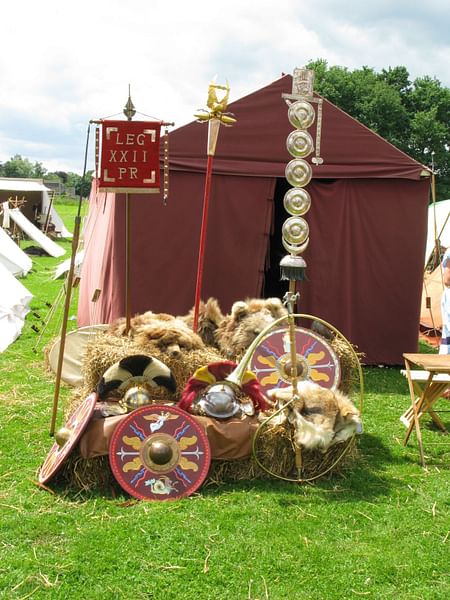 Roman Standards Michael (CC BY-ND) ](https://www.worldhistory.org/image/13956/roman-standards/ "Roman Standards")Historian Nigel Pollard in his *The Complete Roman Legions* identified two legions as the army of Lower Germany:
- Legio I Minervia
- Legio XXX Ulpia Victrix
Other legions stationed along the Rhine include:
- Legio VIII Augusta
- Legio XXII Primigenia Pia Fidelis
- [Legio V Alaudae](https://www.worldhistory.org/Legio_V_Alaudae/)
- [Legio XXI Rapax](https://www.worldhistory.org/Legio_XXI_Rapax/)
### Legion Names, Numbers, & Emblems
The naming and numbering of the Roman legions depended on when, where, and by whom they were formed. Some legions were named after a successful campaign or the area of their formation, others after the emperor's family. The [Marian Reforms](https://www.worldhistory.org/article/1598/marian-reforms/) gave each legion one common standard, the [silver](https://www.worldhistory.org/Silver/) (later [gold](https://www.worldhistory.org/gold/)) eagle. [Roman armor and weapons](https://www.worldhistory.org/article/1692/roman-armor--weapons/) worn by the legionaries were similar, and each legion adopted its own standard, birth sign, and emblem, which generated a sense of identity, unity, and pride. The emblem which adorned a [Roman legionary](https://www.worldhistory.org/Roman_Legionary/)’s shield was often either an animal or a bird, or in some cases, mythological creatures or other such symbols. A legion’s birth sign represented the month in which it was organized. Since many of the legions were formed during the winter months when they were not on campaign, Capricorn was a common birth sign although Gemini, Aries, Taurus, and Cancer appear.
### The Legions of Lower Germany
**Legio I Minervia**
Legio I Minervia (emblem: [Minerva](https://www.worldhistory.org/Minerva/)/Gorgon’s Head; birth sign: Aries), named after [Roman Emperor](https://www.worldhistory.org/Roman_Emperor/) [Domitian](https://www.worldhistory.org/domitian/)’s (r. 81-96 CE) favorite deity, was raised in 82 CE for his campaign against the Chatti. In 89 CE, I Minervia was one of the legions, along with VI Victrix, X Gemina, and XXII Primigenia, to be sent by Domitian to Moguntiacum (modern Mainz, Germany) to defeat Lucius Antonius Saturninus, the rebellious governor of Upper Germany who had the support of Legios XIV Gemina and XXI Rapax. As a reward for their bravery, all four received the title *Pia Fidelis Domitiana* ("Dutiful and Loyal of Domitian"), However, after the assassination of the unpopular emperor, I Minervia would receive a new name: I Minervia Pia Fidelis. One significant outcome of the rebellion was that no two legions would share the same fortress again.
After the emperor’s [death](https://www.worldhistory.org/disambiguation/Death/), the legion was transferred to a fortress at Bonna (modern-day Bonn, Germany), replacing XXI Rapax, where it would maintain a base until the 4th century CE. Stationed briefly in Moesia, the legion fought with Emperor [Trajan](https://www.worldhistory.org/trajan/) (r. 98-117 CE) in the Dacian Wars (101 -106 CE) and in [Parthia](https://www.worldhistory.org/disambiguation/Parthia/) under [Lucius Verus](https://www.worldhistory.org/Lucius_Verus/) (r. 161-169 CE). There is evidence they fought alongside [Marcus Aurelius](https://www.worldhistory.org/Marcus_Aurelius/) (r. 161-180 CE) against the Marcomanni and supported [Septimius Severus](https://www.worldhistory.org/Septimius_Severus/) (r. 193-211 CE) at the [Battle](https://www.worldhistory.org/disambiguation/battle/) of Lugdunum in 197 CE against Clodius Albinus, usurper and claimant to the throne. After the battle, the legion remained at Lugdunum until 211 CE.
[  Roman Legionaries Hans Splinter (CC BY-ND) ](https://www.worldhistory.org/image/13598/roman-legionaries/ "Roman Legionaries")Throughout its long history, the legion went through a number of name additions. The name *Antoniniana* was adopted from the family name of [Caracalla](https://www.worldhistory.org/Caracalla/) (211- 217 CE) or [Elagabalus](https://www.worldhistory.org/Elagabalus/) (218 -222 CE), however, it was dropped after the assassination of the latter. Following service with [Severus Alexander](https://www.worldhistory.org/Alexander_Severus/) (222-235 CE), the legion became I Minervia Pia Fidelis Severiana Alexandriana, and for their time spent with Emperor Maximus Thrax (235-238) against the [Alemanni](https://www.worldhistory.org/alemanni/), they became I Minervia Maximiniana Pia Fidelis Antoniana; of course, *Maximiniana* was dropped after the death of Thrax. Under [Gordian III](https://www.worldhistory.org/Gordian_Emperors/) (r. 238 -244 CE) they received the additional title of *Gordiana*.
Aside from the many name changes, the legion fought with [Gallienus](https://www.worldhistory.org/Gallienus/) (r. 253-268) against the Frankish invasion of Lower Germany (256-258 CE) and supported [Postumus](https://www.worldhistory.org/Postumus/) (260-269 CE), governor of the rebel Gallic [Empire](https://www.worldhistory.org/empire/). Although the remainder of the legion’s fate is unclear, historian Stephen Dando-Collins in his *Legions of Rome* writes that they were summoned by the Roman commander [Stilicho](https://www.worldhistory.org/Stilicho/) (365-408 CE) to defend [Italy](https://www.worldhistory.org/italy/) in 401 CE against the [Visigoths](https://www.worldhistory.org/visigoth/) and were possibly destroyed by [Alaric](https://www.worldhistory.org/Alaric/) after the death of the commander.
**Legio XXX Ulpia Victrix**
Along with II Traiana, Legio XXX Victrix or Ulpia Victrix (emblem: [Neptune](https://www.worldhistory.org/Neptune/); birth sign: Capricorn) was formed by Emperor Trajan around 105 CE to fight in the Dacian Wars (101- 106 CE). *Ulpia* comes from his family name while *Victrix* was a reward for the legion’s acts of bravery during the [war](https://www.worldhistory.org/disambiguation/War/). After spending time in Pannonia, where they replaced XI Claudia, they were sent to the fortress at Vetera (modern-day Xanten) in Lower Germany, maintaining a base there for the next 200 years. They traveled outside Germany to serve with [Antoninus Pius](https://www.worldhistory.org/Antoninus_Pius/) (r. 138-161 CE) in [Mauretania](https://www.worldhistory.org/Mauretania/) and fought under Lucius Verus in the Parthian Wars in 162 CE. They fought with Marcus Aurelius against the Marcomanni, and like I Minervia, XXX Victrix was with Septimius Severus against Clodius Albinus, receiving the title *Pia Fidelis*.
In the early 3rd century CE, they fought in both Gaul and Hispania as well as with Severus [Alexander](https://www.worldhistory.org/disambiguation/Alexander/) in his Persian campaign. During the [Crisis of the Third Century](https://www.worldhistory.org/Crisis_of_the_Third_Century/), they supported Postumus and his Gallic Empire. There are mixed opinions concerning their activities after this: Dando-Collins claims the legion was one of seven that defended the [city](https://www.worldhistory.org/city/) of Amida in [Mesopotamia](https://www.worldhistory.org/Mesopotamia/) against the Persians. Unfortunately, the battle was a disaster, the survivors were captured, and in 359 CE, the legion ceased to exist. Pollard, however, believes otherwise and says they remained at Vetera until the fall of the frontier in 407 CE.
### Additional Legions of the Rhine
**Legio VIII Augusta**
Among the many legions that served along the Rhine was Legio VIII Augusta (emblem: bull; birth sign: Capricorn), descended from an old legion of Julius Caesar. After serving with Caesar during the Gallic Wars, the legion served under [Octavian](https://www.worldhistory.org/augustus/). They fought with Octavian against the forces of [Mark Antony](https://www.worldhistory.org/Mark_Antony/) at Mutina in 43 BCE, receiving the title *Mutinensis*, and at Perugia in 41 BCE. There is speculation, with little proof, that they may have been with the future emperor at the [Battle of Actium](https://www.worldhistory.org/Battle_of_Actium/) against [Antony](https://www.worldhistory.org/Mark_Antony/) and [Cleopatra](https://www.worldhistory.org/disambiguation/cleopatra/) in 31 BCE. They were with Octavian during the Cantabrian Wars, receiving the title *Augusta*. VIII Augusta was later transferred to Illyricum, however, the date is unknown. Evidence indicates that they were in Pannonia or Noricum by 6 CE. While they were supposed to serve under [Tiberius](https://www.worldhistory.org/Tiberius/) (r. 14-37 CE) against King Marobodius of the Marcomanni, they were reassigned to do battle against the rebellious Pannonians. For three years they remained there with legions XV Apollinaris and IX Hispania.
While the next few years of the legion are unclear, there is a possibility that they may have been part of the invasion of [Britain](https://www.worldhistory.org/disambiguation/Britain/) under Emperor [Claudius](https://www.worldhistory.org/claudius/) (r. 41-54 CE). During the [Year of the Four Emperors](https://www.worldhistory.org/Year_of_the_Four_Emperors/) (69 CE), the legion, having been stationed in Moesia, sided with Emperor [Otho](https://www.worldhistory.org/Otho/) but arrived too late to assist him in the First Battle of Bedriacum. After the defeat of Otho, VIII Augusta joined with [Vespasian](https://www.worldhistory.org/Vespasian/)’s (r. 69-79 CE) forces against [Vitellius](https://www.worldhistory.org/Vitellius/) and was victorious at the Second Battle of Bedriacum. Following the defeat of Civilis and the [Batavian Revolt](https://www.worldhistory.org/article/286/the-batavian-revolt/), Vespasian sent VIII Augusta, along with I Adiutrix, XI Claudia, and XIV Gemina, to Upper Germany. The legion would remain stationed at Argentoratum (modern Strasbourg, France).
[  Map of the Rhine frontier of the Roman empire, 70AD Hans Erren (CC BY-SA) ](https://www.worldhistory.org/image/549/map-of-the-rhine-frontier-of-the-roman-empire-70ad/ "Map of the Rhine frontier of the Roman empire, 70AD")Little of the legion’s activities are known until [Hadrian](https://www.worldhistory.org/hadrian/) (r. 117-138 CE) sent several cohorts to Britain. Pollard writes that the legion may have participated in Marcus Aurelius’ wars with the Marcomanni. Later, under the reign of [Commodus](https://www.worldhistory.org/commodus/) (r. 180-192 CE), they were awarded the title *Pia Fidelis Constans Commoda* for their suppression of the Roman commander Maternus in 186 CE; of course, *Commoda* was dropped after the emperor’s assassination. In 213 CE, Caracalla sent them against the Alemanni. Evidence shows that Gallienus awarded them the title *V Pia V Fidelis*, but after this, there is little mention of their activities.
**Legio XXII Primigenia Pia Fidelis**
Legio XXII Primigenia Pia Fidelis (emblem: eagle; birth sign: Capricorn) may have been formed by either [Caligula](https://www.worldhistory.org/Caligula/) (r. 37-41 CE) for his planned invasion of Britain or by Claudius. Little is known of the legion’s activities until the Year of the Four Emperors. Like other legions on the Rhine, they supported Vitellius. Several cohorts of the legion were at the Second Battle of Bedriacum where they were defeated by Vespasian’s forces. While other legions fought at Bedriacum, V Alaudae and XV Primigenia were fighting for their lives at Vetera against the Batavians. The legions IIII Macedonica and XXII Primigenia (the remaining cohorts) were supposed to provide relief at Vetera but, instead, were sent to Moguntiacum. Pollard writes that they did not engage Civilis, but Dando-Collins claims that they surrendered to the rebels. He added that Vespasian later sent the legion to Vetera, as 'penance' to rebuild the fortress.
[ 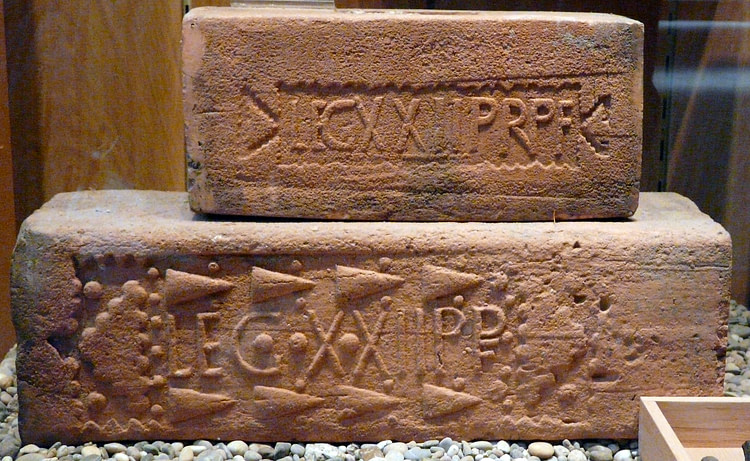 Roman Stamped Bricks Hartmann Linge (CC BY-SA) ](https://www.worldhistory.org/image/5559/roman-stamped-bricks/ "Roman Stamped Bricks")Afterwards, while stationed at the new Vetera fortress, the legion was sent, along with I Minervia, VI Victrix, and X Gemina, to engage the rebellious governor Saturninus; all four legions received the title *Pia Fidelis Domitiana;* of course, *Domitiana* was later dropped. Returning to Moguntiacum, they would maintain a base there for the next two centuries. All or part of the legion saw service in Trajan’s Parthian War and aided in the construction of [Hadrian's Wall](https://www.worldhistory.org/Hadrians_Wall/) and the [Antonine Wall](https://www.worldhistory.org/Antonine_Wall/). They saw action with Lucius Verus’ Parthian war and Marcus Aurelius’ war against the Marcomanni. They were engaged in Caracalla and his German campaign of 213 CE, receiving the title *Antoniana*. They were also campaigning with Severus Alexander, receiving the title *Alexandriana*. The legion supported Gallienus’ battle with Postumus, receiving the titles *Pia VI Fidelis VI* and *Pia VII Fidelis VII*. Afterwards, Dando-Collins writes the legion "probably perished in the battles which preceded the fall of Rome in AD 410" (189).
**Legio V Alaudae**
Legio V Alaudae (emblem: elephant; birth sign: Capricorn) was founded by Caesar in 52 BCE and fought in the Gallic Wars. It gained its elephant emblem from its battle against the Numidian king Juba I (r. 60-46 BCE) and his elephants in 46 BCE. After serving with [Mark](https://www.worldhistory.org/disambiguation/Mark/) Antony, the legion, stationed with X Gemina in Hispania Ulterior, fought with Octavian in the Cantabrian Wars of 27-19 BCE. Unfortunately, during a defeat in Gaul in 17 BCE against the Sugambri, Usipetes, and Tencteri tribes, the legion lost its eagle. After the [Battle of Teutoburg Forest](https://www.worldhistory.org/article/1010/battle-of-teutoburg-forest/) in 9 CE where [Publius Quinctilius Varus](https://www.worldhistory.org/Publius_Quinctilius_Varus/) lost three legions, the legionaries were stationed on the Rhine, and by 14 CE found themselves relocated to Vetera along with XXI Rapax. During this time, they fought with [Germanicus](https://www.worldhistory.org/Germanicus/) in Germany, and while the legion was still stationed in Lower Germany, several cohorts may have been sent to Britain. In 28 CE, they reportedly fought against the Frisii.
When Galba (r. 68-69 CE) became emperor, V Alaudae was reluctant to swear allegiance, transferring their loyalty to Vitellius. However, after fighting in the First Battle of Bedriacum, several of the legion’s cohorts were sent to prevent pro-Vespasian forces from reaching Rome, but the legion’s commander decided to switch sides and support Vespasian. The legion resisted and put their commander in chains. Later, the defeated legion was sent to Illyricum. Several of the cohorts that were still stationed on the Rhine were massacred at Vetera along with XV Primigenia by the Batavian rebel Civilis. The fate of the remainder of the legion is unknown, possibly disbanded along with I Germanica and XV Primigenia, or as some suggest, sent to the Balkans. Dando-Collins asserts they served in Pannonia and Moesia but were wiped out in [Dacia](https://www.worldhistory.org/dacia/).
**Legio XXI Rapax**
Although Legio XXI Rapax’s (emblem: bear; birth sign: Capricorn) origins are unclear, it was probably formed by Octavian and served in his Cantabrian campaign. By 15 BCE, it was preparing to fight alongside Tiberius against the Marcomanni but was sent to suppress the Pannonian revolt. After the Varian disaster, the legion was sent to Vetera in Lower Germany where it shared a fortress with V Alaudae, fighting in Germanicus’ campaign against the Chatti. In 21 CE, along with several other legions, XXI Rapax was sent to Gaul to suppress a rebellion by the Turoni. In preparation for Claudius’ invasion of Britain, the legion was sent to Upper Germany.
[ 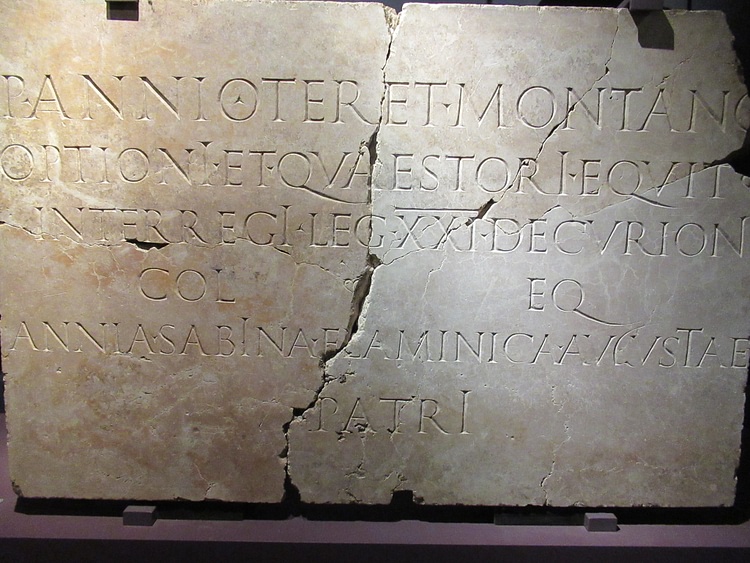 Funerary Inscription of a Roman Soldier Damian Tournay (CC BY-NC) ](https://www.worldhistory.org/image/13955/funerary-inscription-of-a-roman-soldier/ "Funerary Inscription of a Roman Soldier")In the Year of the Four Emperors, the legion sided with Vitellius and marched on Italy, defeating Otho in the First Battle of Bedriacum. They met their defeat at the Second Battle of Bedriacum and, like the other defeated legions, were sent to either Illyricum or northern Italy but returned to Germany to help suppress Civilis and the Batavian revolt. They were victorious at Vetera. The legion was sent to Bonna, replacing I Germanica, and later helped defeat the Chatti under Domitian. Along with the XIV, they supported the rebellious governor Saturninus. Their exact fate is debatable. According to Pollard, after Saturninus, the legion was either sent to Pannonia or disbanded. However, citing the writings of historian [Tacitus](https://www.worldhistory.org/tacitus/) (c. 56 - c. 118 CE), Dando-Collins states XXI Rapax was destroyed by the Dacians and led off in chains.
#### Editorial Review
This human-authored article has been reviewed by our editorial team before publication to ensure accuracy, reliability and adherence to academic standards in accordance with our [editorial policy](https://www.worldhistory.org/static/editorial-policy/).
## Bibliography
- [Campbell, Duncan B & Delf, Brian. *Roman Legionary Fortresses 27 BC–AD 378.* Osprey Publishing, 2006.](https://www.worldhistory.org/books/1841768952/)
- [Dando-Collins, Stephen. *Legions of Rome.* St Martins Press, 2012.](https://www.worldhistory.org/books/1250004713/)
- [Goldsworthy, Adrian. *Complete Roman Army .* Thames & Hudson, 2011.](https://www.worldhistory.org/books/0500288992/)
- [Hornblower, Simon & Spawforth, Antony & Eidinow, Esther. *The Oxford Classical Dictionary.* Oxford University Press, 2012.](https://www.worldhistory.org/books/0199545561/)
- [Nigel Rodgers & Hazel Dodge. *Roman Empire.* Metro Books, 2021.](https://www.worldhistory.org/books/1435104552/)
- [Pollard, Nigel & Berry, Joanne. *The Complete Roman Legions.* Thames & Hudson, 2012.](https://www.worldhistory.org/books/0500251835/)
## About the Author
Donald has taught Ancient, Medieval and U.S. History at Lincoln College (Normal, Illinois)and has always been and will always be a student of history, ever since learning about Alexander the Great. He is eager to pass knowledge on to his students.
## Questions & Answers
### How were the legions named?
The legions were named according to when, where, or why they were founded. The name may have come from an emperor’s family name or the area of formation. Each legion adopted its own standard, birth sign, and emblem, which generated a sense of identity, unity, and pride.
### For which emperors did Legio I Minerva fight?
Legio I Minerva fought for Trajan in the Dacian Wars, Lucius Verus in his campaigns in Parthia, Marcus Aurelius and his war against the Marcomanni, and Septimius Severus at the Battle of Lugdunum.
### How did Legio XXX Ulpia Victrix gets its name?
Legio XXX Ulpia Victrix got its name from Emperor Trajan’s family name and its bravery during battle.
### What was the fate of Legio V Alaudae?
The fate of several of the cohorts of Legio V Alaudae was depicted through their massacre at Vetera along with XV Primigenia by the Batavian rebel Civilis. The fate of the remainder of the legion is unknown, possibly disbanded.
### Who did Legio XXX Rapax support in the Year of the Four Emperors?
In the Year of the Four Emperors, Legio XXX Rapax supported Vitellius and his march on Italy, defeating Otho in the First Battle of Bedriacum. They met their defeat at the Second Battle of Bedriacum.
## Cite This Work
### APA
Wasson, D. L. (2021, May 04). Legions of the Rhine Frontier. *World History Encyclopedia*.
### Chicago
Wasson, Donald L.. "Legions of the Rhine Frontier." *World History Encyclopedia*, May 04, 2021. .
### MLA
Wasson, Donald L.. "Legions of the Rhine Frontier." *World History Encyclopedia*, 04 May 2021, .
## License & Copyright
Submitted by [Donald L. Wasson](https://www.worldhistory.org/user/DWasson/ "User Page: Donald L. Wasson"), published on 04 May 2021. The copyright holder has published this content under the following license: [Creative Commons Attribution-NonCommercial-ShareAlike](https://creativecommons.org/licenses/by-nc-sa/4.0/deed.en). This license lets others remix, tweak, and build upon this content non-commercially, as long as they credit the author and license their new creations under the identical terms. When republishing on the web a hyperlink back to the original content source URL must be included. Please note that content linked from this page may have different licensing terms.