---
title: Sacred Sites & Rituals in the Ancient Celtic Religion
author: Mark Cartwright
source: https://www.worldhistory.org/article/1710/sacred-sites--rituals-in-the-ancient-celtic-religi/
format: machine-readable-alternate
license: Creative Commons Attribution-NonCommercial-ShareAlike (https://creativecommons.org/licenses/by-nc-sa/4.0/)
updated: 1970-01-01
---
# Sacred Sites & Rituals in the Ancient Celtic Religion
_Authored by [Mark Cartwright](https://www.worldhistory.org/user/markzcartwright/)_
In the [religion](https://www.worldhistory.org/religion/) of the ancient [Celts](https://www.worldhistory.org/celt/) who lived in [Iron Age](https://www.worldhistory.org/disambiguation/Iron_Age/) [Europe](https://www.worldhistory.org/europe/) from 700 BCE to 400 CE, certain natural sites like springs, river sources, and groves were held as sacred. These places, as well as some urban sites, often had purpose-built temples, shrines, and sanctuaries. Here, druids performed rituals and prayers while votive offerings of precious goods, as well as animal and human sacrifices, were given to the [Celtic](https://www.worldhistory.org/celt/) gods to gain their favour and ensure the continued success of the community. Celtic religious practices and sacred sites initially survived the expansion of the [Roman Empire](https://www.worldhistory.org/Roman_Empire/), but from the 1st century CE, they came under direct attack and prohibition. Following the spread of [Christianity](https://www.worldhistory.org/christianity/) in Late Antiquity, the [Celtic religion](https://www.worldhistory.org/disambiguation/Celtic_Religion/) all but disappeared from mainland Europe.
[  Celtic Heads Sculpture, Entremont Michel Wal (CC BY-SA) ](https://www.worldhistory.org/image/13613/celtic-heads-sculpture-entremont/ "Celtic Heads Sculpture, Entremont")### The Religion of the Celts
The [ancient Celts](https://www.worldhistory.org/celt/) were the peoples who spoke the Celtic language and inhabited western and central Europe from the 1st millennium BCE to several centuries into the 1st millennium CE. The Celts themselves likely had no feeling of belonging to a European-wide [culture](https://www.worldhistory.org/disambiguation/culture/), but one of several areas which did unite them was religious beliefs, even if these may have varied in details from region to region. The Celts have left very few written sources of their own and so study of their culture is restricted to [archaeology](https://www.worldhistory.org/Archaeology/), artefacts, and descriptions by contemporary Greco-[Roman](https://www.worldhistory.org/disambiguation/Roman/) writers. There certainly existed variations in religious practices across both time and space but there are notable points of commonality across Iron Age Europe.
The religious leaders in Celtic communities were the druids. Known for their great wisdom and knowledge of traditions, druids managed religious rituals, interpreted events of nature, divined the future, and made medicinal potions. Druids were repositories of the community's history and may also have been required to cast taboos (or, less accurately, spells) on people, ensuring compliance to the society's rules. Druids thus had the power to exclude individuals from religious rituals, which, in effect, made that person unclean and an outsider within the community.
### Natural Sacred Sites
The Celts believed certain natural sites had spiritual importance; these sites included hills and mountain tops, impressive trees, and bodies of water such as springs, rivers, lakes, and bogs. Especially sacred were those points where movements of waters joined like estuaries and river confluences. Such sites were considered meeting places between the physical and supernatural worlds as water was a conduit to the Otherworld. The sources of major rivers were particularly attractive to the Celts and sanctuaries are attested at the sources of the Marne and Seine Rivers. Nearly 200 wooden sculptures were discovered at the latter sanctuary, known as Sequana (also the Celtic name for the Seine), located northwest of Dijon. The high number of precious artefacts recovered from the River Thames over the last few decades indicate that this, too, was a major destination for votive offerings deposited by British Celts.
[  British Druid by William Stukeley William Stukeley (Public Domain) ](https://www.worldhistory.org/image/13357/british-druid-by-william-stukeley/ "British Druid by William Stukeley")Individual trees were held as sacred by local communities and tribal gatherings were often held under their shade. A *nemeton* or sacred grove of trees was also the site of certain rituals. At what must have once been such sacred areas, votive plaques have been found dating to the Gallo-Roman period. Inscriptions on these plaques reveal they were dedicated to gods of specific types of trees like Fagus (beech), Robur (oak), and several others who have not yet been identified. The oak tree seems to have been particularly important if we are to believe ancient writers who focus on it almost exclusively when discussing the Celts. In [Ireland](https://www.worldhistory.org/disambiguation/Ireland/), the ash and the yew tree were especially significant in religion and [mythology](https://www.worldhistory.org/mythology/). In later antiquity, under influence from the [Mediterranean](https://www.worldhistory.org/disambiguation/mediterranean/) cultures, a *nemeton* came to mean any sacred site with a [temple](https://www.worldhistory.org/temple/) or shrine with trees in the vicinity. Activities held at natural sites considered to be sacred for one reason or another would have left few archaeological remains except votive offerings.
### Temples & Sanctuaries
It seems reasonable to suppose that the ancient Celts used impressive existing [megalithic](https://www.worldhistory.org/disambiguation/megalithic/) structures in their religious ceremonies, at least in their early history. Such sites as [Stonehenge](https://www.worldhistory.org/stonehenge/) in southern [Britain](https://www.worldhistory.org/disambiguation/Britain/) and [Carnac](https://www.worldhistory.org/Carnac/) in northwest France provided handy stone structures and alignments that, although predating the Celts by centuries, would have added a certain mystique and gravitas to rituals. Indeed, so connected were druids with these [Neolithic](https://www.worldhistory.org/Neolithic/) sites that in the medieval period they were considered their architects.
Sacred areas were created at or near urban sites. One type, sometimes known as *Viereckschanzen* after a great number were discovered in southern Germany (although they exist at Celtic sites from France to Bohemia), was a square or rectangular cleared area surrounded by earthworks. These human-made perimeters consisted of a rampart, outer ditch, and a single gate (most often on the east side). The bare sacred space often had wooden poles driven into it, presumably for supporting a number of roofed structures and/or for carving symbols and images on. Some of these ritual precincts (but not usually the ones in Germany, which are curiously devoid of artefacts) had deep shafts dug in them where votive offerings were placed. [Pottery](https://www.worldhistory.org/pottery/) shards in these shafts most often date to the 2nd and the 1st century BCE.
[ 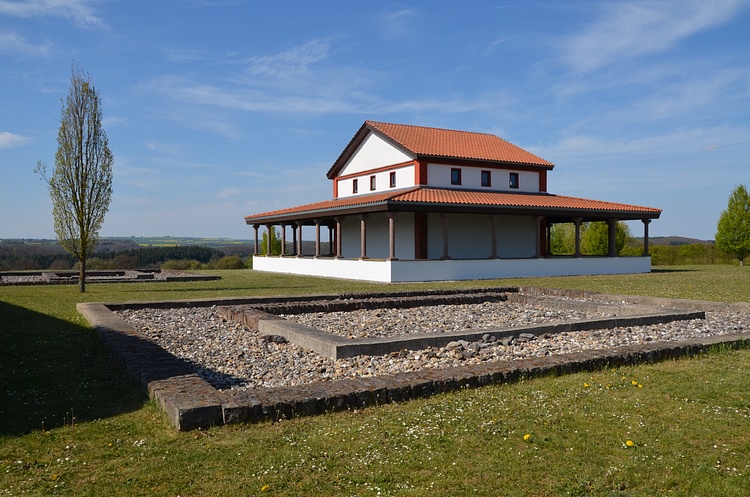 Martberg Archaeological Park Carole Raddato (CC BY-NC-SA) ](https://www.worldhistory.org/image/13296/martberg-archaeological-park/ "Martberg Archaeological Park")The Celts created life-size wooden statues of human figures, which stood at sacred sites, both natural and purpose-built. The carved wooden statues are usually featureless (but not always, some are very realistic) and wear a hooded cloak. The figures may well have been adorned with massive neck torcs which have also been recovered and were too large and heavy to be worn by a person. Another type of [sculpture](https://www.worldhistory.org/disambiguation/Sculpture/) erected at sacred sites was carved stone pillars, sometimes with four sides, sometimes hemispherical and all decorated with heads and or complex vegetal designs.
Stone temples first appeared amongst the Celts from the 4th century BCE. Typically given monumental doorways decorated with reliefs and paintings, the roofing was made of thatch or intertwined branches which were then covered with clay and lime. For the Celts, the head was considered the home of the soul and so it is not surprising that masks were a common decoration of temples. In [Gaul](https://www.worldhistory.org/gaul/), temples sometimes had stone columns with niches in which were placed real human heads or skulls. A Celtic temple at the fortified site or *[oppidum](https://www.worldhistory.org/oppidum/)* of Sallurii in northern [Italy](https://www.worldhistory.org/italy/) is described by the Roman writer Strabo (c. 64 BCE - 24 CE). Here, a long pathway lined with sculptures of [Celtic warriors](https://www.worldhistory.org/Celtic_Warrior/) led up to the sanctuary on a low hill where a chamber was filled with yet more heads, earning its name, the Hall of the Heads. This temple was destroyed by the Romans in 124 BCE.
Following contact with the Greeks, [Etruscans](https://www.worldhistory.org/Etruscan_Civilization/), and Romans, the Celts built more sophisticated temples that came to house representations of gods which were the focus of rituals and worship. These followed the norms of classical [architecture](https://www.worldhistory.org/disambiguation/architecture/) with a columned portico or veranda leading to a single cella within. The whole temple might be enclosed by a low [wall](https://www.worldhistory.org/wall/) and they were sometimes built in pairs or even threes. At the same time, there is evidence of small stone temples or shrines at *[oppida](https://www.worldhistory.org/oppidum/)*.
[ 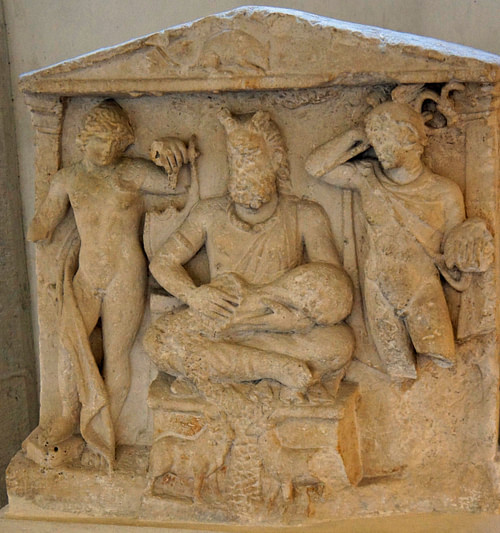 Cernunnos Rheims Relief G. Garitan (CC BY-SA) ](https://www.worldhistory.org/image/13497/cernunnos-rheims-relief/ "Cernunnos Rheims Relief")Chamalières is a good example of a natural sacred Celtic site which developed into a Gallo-Roman one. Located in central France, it is the source of two natural springs and so a typical choice for a sacred site. Thousands of wooden human figures have been excavated at the site, and its continued use in later times is attested by the discovery of an incantation inscribed on a lead tablet dating to the 1st century CE.
The druids had their own sacred places where they gathered at annual events. [Julius Caesar](https://www.worldhistory.org/Julius_Caesar/) (100-44 BCE) mentions in his *Gallic Wars* such a site in the region of the Carnutes tribe in central France (around modern Orléans), and we know, too, that Mona (Anglesey, Wales) was considered a holy island for druids prior to the mid-1st century CE. In the 1940s CE, the lake on Anglesey, Llyn Cerrrig Bach, was explored when a military airport was being built at the site. The lake and nearby bog gave up many of their Celtic artefacts, presumably thrown in as votive offerings over the centuries from the 2nd century BCE to the 1st century CE. There were swords, shield bosses, spear points, cauldrons, decorative [metal](https://www.worldhistory.org/disambiguation/metal/) pieces for riding gear and chariots, slave chains which include collars, and a great number of animal bones.
### Rituals, Offerings & Sacrifices
Rituals were held at times of stress to the community but also likely followed a particular schedule based on astronomy and, in particular, the phases of the Moon. Prayers and incantations were offered to the gods. Votive offerings were made to propitiate the gods, bring a favourable outcome to a future event, or avert community disasters such as [war](https://www.worldhistory.org/disambiguation/War/), drought, floods, and famine. Such offerings could take the form of foodstuffs, precious goods like a piece of jewellery, decorated weapons and armour (particularly those taken from an enemy), or finely made pottery vessels, and, in the case of recovery from illness, small models of the sufferer or the affected part of the body.
[ 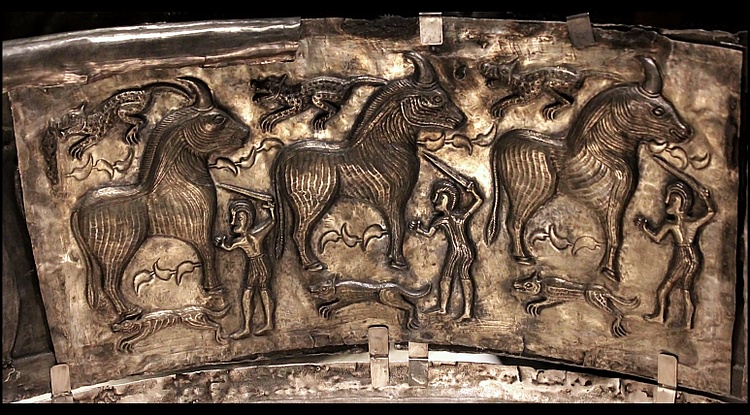 Bull Panel, Gundestrup Cauldron Claude Valette (CC BY-SA) ](https://www.worldhistory.org/image/13428/bull-panel-gundestrup-cauldron/ "Bull Panel, Gundestrup Cauldron")Often, precious objects were bent or broken before they were offered to the gods. Many hoards, buried in shallow pits, have been discovered, often by accident. Typically, several items are bundled together such as broken or complete torcs, necklaces, and coins made from [gold](https://www.worldhistory.org/gold/), [bronze](https://www.worldhistory.org/disambiguation/bronze/), or iron. Such deposits were often added to over a period of years, and the number of such hoards found in close proximity to each other suggests that the general location was regarded as sacred in some way. For example, at the site of Hallaton in [England](https://www.worldhistory.org/disambiguation/england/), archaeologists discovered over 5,000 coins buried in 16 different places. Nearby were remains of ritual animal sacrifices, further pointing to a religious significance of the [burial](https://www.worldhistory.org/burial/) of these coins as opposed to merely being safe deposits.
Sacrifices were also made, both of animals and, much more rarely, humans. Animals were typically burned or buried intact at a site, especially oxen, bulls, dogs, and horses (or the leg of a horse). There is, too, evidence that feasting went on where part of the animal was eaten before the remains were left to the gods. According to [Julius](https://www.worldhistory.org/disambiguation/Julius/) [Caesar](https://www.worldhistory.org/disambiguation/caesar/), the Celts in Gaul practised *Totenfolge*, that is executing attendants, slaves, and perhaps family members of important figures who had died - although it may have been a case of voluntary suicide - and then burying them with the deceased. Caesar notes that the practice had died out by the 1st century BCE.
Although there is a significant amount of archaeological evidence of human sacrifice, it is not always completely unambiguous. Human sacrificial victims seem to have most often been enemy warriors captured after a [battle](https://www.worldhistory.org/disambiguation/battle/). A possible sacrificial victim (not all scholars agree) is [Lindow Man](https://www.worldhistory.org/Lindow_Man/), a corpse discovered at Lindow Moss, a bog near Cheshire in England. Lindow Man lived no later than the turn of the 1st and 2nd century CE, and he was in good health. He died in what seems to have been a standard manner for ritual killings: hit on the head, strangled, and had his throat cut. The corpse was then put in water for some time and then buried. An alternative ritual was to drown a sacrificial victim, a method particularly associated with the [god](https://www.worldhistory.org/God/) Teutates. Victims offered to the god Esus were hung from a tree and their limbs ripped from the torso, while those for Taranis were placed in a hollow tree and burnt alive. Still other methods of sacrificing humans included impaling, shooting them down with arrows or, most elaborate of all (at least according to Strabo), building a [giant](https://www.worldhistory.org/Giants/) human figure of straw and wood, placing inside an assortment of cattle, wild animals, and humans, and then setting the whole thing ablaze. Whatever the method, it is likely that human sacrifices were only made at a time of great stress to a community such as war or famine.
[ 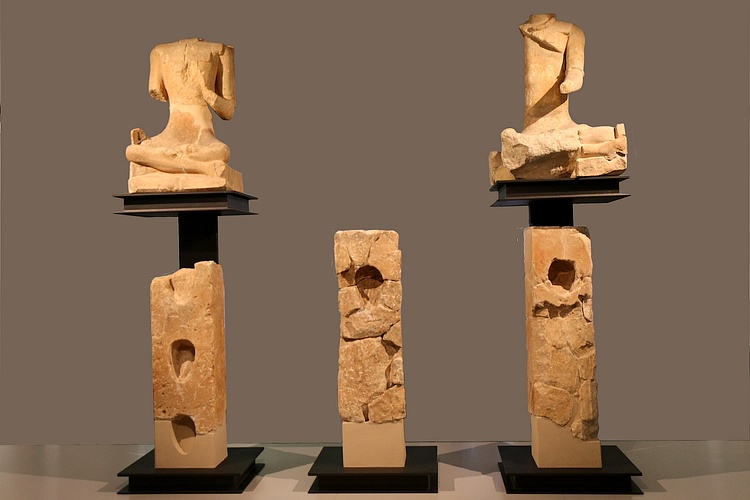 Figures & Head Columns from Celtic Roquepertuse Rvalette (CC BY-SA) ](https://www.worldhistory.org/image/13612/figures--head-columns-from-celtic-roquepertuse/ "Figures & Head Columns from Celtic Roquepertuse")Another ceremony, which could be held at a sacred site, although not exclusively, was to divine future events. Prophecy was based on interpreting certain signs such as a particular flight of birds or a rare natural phenomenon. The ability to see the future was enhanced by, for example, eating particular foodstuffs like acorns. Another method to ‘read’ future events was to examine closely the entrails of animals or how a sacrificial victim died. Prophecy may well have been carried out by seers, a group distinct from druids.
### Decline
One thing the Celts could not have foreseen was the ultimate eradication of their religion. From the 1st century BCE and the [conquest](https://www.worldhistory.org/warfare/) of Gaul, the ever-expanding Roman [Empire](https://www.worldhistory.org/empire/) at first took a less aggressive stance against the Celtic religion, satisfying itself with robbing Celtic temples of their treasures. There were even adoptions, such as the Roman expansion of the temples at Sequana. By the 1st century CE, though, measures were taken to seek out and destroy the religion’s leaders, even if the Celts themselves had begun to absorb some of the Greco-Roman gods into their own [pantheon](https://www.worldhistory.org/Pantheon/). Druidism was forbidden and such important sanctuaries as the one on Anglesey were destroyed by the [Roman army](https://www.worldhistory.org/Roman_Army/). The Celtic religion continued in more remote or unconquered areas like [Scotland](https://www.worldhistory.org/disambiguation/Scotland/) and Ireland but the spread of Christianity then ensured that pagan practices eventually became so demonised that they all but disappeared, at least from public view.
#### Editorial Review
This human-authored article has been reviewed by our editorial team before publication to ensure accuracy, reliability and adherence to academic standards in accordance with our [editorial policy](https://www.worldhistory.org/static/editorial-policy/).
## Bibliography
- [Chadwick, Nora & Cunliffe, Barry. *The Celts.* Penguin Books, 1998.](https://www.worldhistory.org/books/0140250743/)
- [Cunliffe, Barry. *The Ancient Celts.* Oxford University Press, 2018.](https://www.worldhistory.org/books/0198752938/)
- [Eluere, Christiane . *The Celts First Masters of Europe /anglais.* THAMES HUDSON, 1993.](https://www.worldhistory.org/books/0500300348/)
- [Farley, Julia & Fraser, Hunter. *Celts - Art & Identity.* British Museum Press, 2015.](https://www.worldhistory.org/books/0714128368/)
- [MacKillop, James. *A Dictionary of Celtic Mythology .* Oxford University Press, 2017.](https://www.worldhistory.org/books/0198804849/)
- [Maier, Bernhard. *Dictionary of Celtic Religion and Culture .* BOYE6, 2000.](https://www.worldhistory.org/books/0851156606/)
## About the Author
Mark is WHE’s Publishing Director and has an MA in Political Philosophy (University of York). He is a full-time researcher, writer, historian and editor. Special interests include art, architecture and discovering the ideas that all civilizations share.
## Cite This Work
### APA
Cartwright, M. (2021, March 15). Sacred Sites & Rituals in the Ancient Celtic Religion. *World History Encyclopedia*.
### Chicago
Cartwright, Mark. "Sacred Sites & Rituals in the Ancient Celtic Religion." *World History Encyclopedia*, March 15, 2021. .
### MLA
Cartwright, Mark. "Sacred Sites & Rituals in the Ancient Celtic Religion." *World History Encyclopedia*, 15 Mar 2021, .
## License & Copyright
Submitted by [Mark Cartwright](https://www.worldhistory.org/user/markzcartwright/ "User Page: Mark Cartwright"), published on 15 March 2021. The copyright holder has published this content under the following license: [Creative Commons Attribution-NonCommercial-ShareAlike](https://creativecommons.org/licenses/by-nc-sa/4.0/deed.en). This license lets others remix, tweak, and build upon this content non-commercially, as long as they credit the author and license their new creations under the identical terms. When republishing on the web a hyperlink back to the original content source URL must be included. Please note that content linked from this page may have different licensing terms.