---
title: 10 Virtual Tours of Archaeological Sites & Museums in Turkey
author: Carole Raddato
source: https://www.worldhistory.org/article/1706/10-virtual-tours-of-archaeological-sites--museums/
format: machine-readable-alternate
license: Creative Commons Attribution-NonCommercial-ShareAlike (https://creativecommons.org/licenses/by-nc-sa/4.0/)
updated: 2023-05-15
---
# 10 Virtual Tours of Archaeological Sites & Museums in Turkey
_Authored by [Carole Raddato](https://www.worldhistory.org/user/FollowingHadrian/)_
Thanks to the new [Sanal Muze](https://sanalmuze.gov.tr/) digital portal released by the Ministry of [Culture](https://www.worldhistory.org/disambiguation/culture/) and Tourism of [Turkey](https://www.worldhistory.org/Asia_Minor/) in 2020 CE, history lovers and art enthusiasts can now take virtual tours of Turkey's best archaeological sites and museums. There are currently 33 online tours available, giving visitors a fantastic opportunity to check out archaeological sites and museums they may not have yet visited.
Since the COVID-19 pandemic broke out and travel came to a near standstill, museums and cultural organizations have been encouraged to create alternative digital spaces with online exhibitions and virtual experiences. Turkey opened the digital doors of its museums and cultural sites to people across the globe and turned days of self-isolation into an opportunity to explore a myriad of destinations in a unique and immersive way.
[  A Screen Shot from the Virtual Tour of Turkey's Archaeological Museum of Antalya Carole Raddato (Copyright, fair use) ](https://www.worldhistory.org/image/13578/a-screen-shot-from-the-virtual-tour-of-turkeys-arc/ "A Screen Shot from the Virtual Tour of Turkey's Archaeological Museum of Antalya")These Turkish cultural sites are now just a click away. They are best experienced in fullscreen mode. Right-click anywhere on the video to enter fullscreen.
### ARCHAEOLOGICAL SITES
**[Ephesus](https://www.worldhistory.org/ephesos/)**
The ancient [Greek](https://www.worldhistory.org/disambiguation/greek/) [city](https://www.worldhistory.org/city/) of [Ephesus](https://www.worldhistory.org/ephesos/) is undoubtedly the most renowned archaeological site in Turkey and was added to UNESCO's World Heritage Sites List in 2015 CE. Located on the [Aegean](https://www.worldhistory.org/aegean/) coast near the seaside city of Izmir, the site is home to the great [Temple](https://www.worldhistory.org/temple/) of [Artemis](https://www.worldhistory.org/artemis/), one of [the Seven Wonders](https://www.worldhistory.org/The_Seven_Wonders/) of the Ancient World. Stroll around the paved street of Ephesus, where impressive monuments such as the [Library of Celsus](https://www.worldhistory.org/Library_of_Celsus/), the [Great Theatre](https://member.ancient.eu/image/693/theatre-of-ephesus/) and the [Temple of Hadrian](https://member.ancient.eu/image/3798/temple-of-hadrian-at-ephesus/) will be revealed to you in all their glory.
**[Göbekli Tepe](https://www.worldhistory.org/Göbekli_Tepe/)**
Göbekli Tepe is Turkey's latest addition to UNESCO's World Heritage list (2018 CE). This groundbreaking historical site boasts the oldest man-made temple in history, dating back to 10,000 BCE. Göbekli Tepe (Turkish for the 'hill of the navel') was discovered in 1995 CE by a German archaeologist (Klaus Schmidt, 1953-2014 CE) approximately 16 kilometres (ten miles) northeast of Şanlıurfa in southeastern Turkey and has since been defined as the "zero point of history". The site occupies a 300-metre (1,000 foot) artificial mound located at the highest point of a mountain ridge and consists of a series of circular or oval structures with monolithic [T-shaped stone pillars](https://member.ancient.eu/image/13198/t-shaped-pillars-at-gobekli-tepe/).
[Take the tour](https://sanalmuze.gov.tr/TR-259963/gobeklitepe-oren-yeri—-sanliurfa.html)
[  Göbekli Tepe Teomancimit (CC BY-SA) ](https://www.worldhistory.org/image/3847/gobekli-tepe/ "Göbekli Tepe")**Hierapolis**
The ruins of the [Hellenistic](https://www.worldhistory.org/Hellenic_World/) spa city of Hierapolis are located near the town of Denizli, atop Pamukkale's spectacular travertines terraces, one of Turkey's most popular sights. Designated a UNESCO World Heritage site in 1988 CE, the site of Hierapolis extends over a large area with remarkable ancient remains of the Graeco-[Roman](https://www.worldhistory.org/disambiguation/Roman/) period. They include baths, temple ruins, a [monumental gate](https://member.ancient.eu/image/4410/frontinus-gate-in-hierapolis-phrygia/), a nymphaeum, a [necropolis](https://member.ancient.eu/image/4400/northern-necropolis-of-hierapolis-phrygia/), and a well-preserved [theatre](https://member.ancient.eu/image/3834/roman-theatre-of-hierapolis/).
**Laodicea on the Lycus**
Laodicea is located ten kilometres (six miles) away from Hierapolis. The city was founded in the 3rd century BCE on the river Lycus by the [Seleucid](https://www.worldhistory.org/Seleucid_Empire/) King Antiochus II (r. 261-246 BCE). It became one of the most important and flourishing commercial centres of [Asia Minor](https://www.worldhistory.org/Asia_Minor/). Today, Laodicea boasts impressive remains, including two theatres, the biggest [stadium](https://www.worldhistory.org/Stadium/) of [Anatolia](https://www.worldhistory.org/Asia_Minor/), four bath complexes, five agoras, five nymphaea, [temples](https://member.ancient.eu/image/4388/roman-temple-front-laodicea/), churches, and monumental [colonnaded streets](https://member.ancient.eu/image/4390/colonnaded-street-at-laodicea-on-the-lycus-turkey/).
**Hattusa**
Located in the province of Çorum in north-central Turkey, Hattusa was the [Hittites](https://www.worldhistory.org/hittite/)' capital city in the late [Bronze Age](https://www.worldhistory.org/disambiguation/Bronze_Age/) (2000–1200 BCE). It was the head of an [empire](https://www.worldhistory.org/empire/) that stretched across Anatolia and northern [Syria](https://www.worldhistory.org/syria/)'s broad lands, from the Aegean in the west to the Euphrates in the east. The ruins of the [city walls](https://member.ancient.eu/image/10313/city-wall-of-hattusa-reconstruction/), [gates](https://member.ancient.eu/image/4892/lion-gate-at-hattusa/), [temples](https://member.ancient.eu/image/10322/the-great-temple-of-hattusa/), and the palaces awaiting the visitors today provide a comprehensive picture of the [Hittite](https://www.worldhistory.org/hittite/) capital in the 13th century BCE.
### MUSEUMS
**Museum of Anatolian Civilizations**
The Museum of Anatolian Civilizations is Turkey's most outstanding museum, occupying two Ottoman-era buildings in the heart of Ankara's old city. The museum, which was elected as the first 'European Museum of the Year' in 1997 CE, displays an extensive collection of historical artefacts from Anatolia's many diverse cultures. The exhibits are laid out in chronological order in an exceptionally well-designed area. They include 8,000-year-old '[goddess figurines](https://member.ancient.eu/image/13585/seated-woman-of-catalhoyuk/)' from Çatalhöyük (one of the most important, and largest, [Neolithic](https://www.worldhistory.org/Neolithic/) settlements on earth), [Bronze](https://www.worldhistory.org/disambiguation/bronze/) Age treasures from the royal tombs in [Alacahöyük](https://member.ancient.eu/image/13603/alacahoyuk-bronze-standards/), superb Hittite reliefs and sculptures, and incredible inlaid [wooden furniture](https://member.ancient.eu/image/13602/gordium-wooden-furniture/) from the Phrygian capital Gordion.
[Take the tour](https://sanalmuze.gov.tr/TR-259961/anadolu-medeniyetleri-muzesi—-ankara.html)
[ 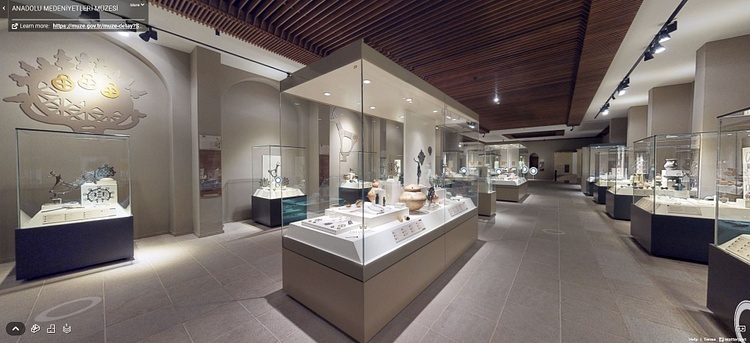 A Screen Shot from the Virtual Tour of Turkey's Museum of Anatolian Civilizations Carole Raddato (Copyright, fair use) ](https://www.worldhistory.org/image/13589/a-screen-shot-from-the-virtual-tour-of-turkeys-mus/ "A Screen Shot from the Virtual Tour of Turkey's Museum of Anatolian Civilizations")**Hatay [Archaeology](https://www.worldhistory.org/Archaeology/) Museum**
Spread over 19 halls, Hatay's new archaeological museum, located in Antakya in southeastern Turkey, contains one of the world's finest collections of Roman and [Byzantine](https://www.worldhistory.org/disambiguation/Byzantine/) mosaics. They were unearthed in the ancient [cities](https://www.worldhistory.org/city/) of Daphne, Seleucia Pieria, and [Antioch](https://www.worldhistory.org/Antiochia/). Among the notable works found in the museum are the [Ariadne Abandoned on Naxos](https://member.ancient.eu/image/13593/ariadne-abandoned-on-naxos/) and [Megalopsychia Hunt](https://member.ancient.eu/image/13591/megalopsychia-hunt-mosaic/) mosaics, a [colossal statue of a Neo-Hittite king](https://member.ancient.eu/image/13594/neo-hittite-king-suppiluliuma/) that dates back 3,000 years and the world-famous Antakya Sarcophagus from the 3rd century CE with ornate marble carvings.
**Antalya Museum**
The archaeological museum at Antalya is one of the most attractive museums in Turkey and a must for visitors exploring the archaeological sites in the area. It houses a unique collection of [Roman marble sculptures](https://member.ancient.eu/image/13610/roman-sculptures-from-perge/) dating from the 2nd and 3rd centuries CE from nearby sites such as Perge, including the so-called [Weary Hercules](https://member.ancient.eu/image/13609/weary-hercules-statue-from-perge/), whose upper half was smuggled from Perge to the United State of America in 1981 CE and returned to Antalya in 2011 CE. A total of 13 spacious halls display exhibits from the [Paleolithic](https://www.worldhistory.org/Paleolithic/) Age to Ottoman times.
**Adana Museum**
Housed inside a now-defunct 100-year-old historical textile factory, the Adana Museum is Turkey's largest museum complex. It hosts more than 2,000 artefacts which shed light on the history of the region of [Cilicia](https://www.worldhistory.org/Cilicia/), alternately ruled by the Hittites, Assyrians, Greeks, Romans, Armenians, Seljuk, and Ottomans. Among the highlights is a stone statue of the Late Hittite weather [god](https://www.worldhistory.org/God/) Tarhunda on a [chariot](https://www.worldhistory.org/chariot/) pulled by bulls, Roman-era sarcophagi, and stunning mosaics.
**Zeugma [Mosaic](https://www.worldhistory.org/Mosaic/) Museum**
This museum, located in Gaziantep, showcases an outstanding collection of mosaics that once adorned the villas of wealthy citizens in Zeugma, a Roman garrison town that now lies under the reservoir created by the construction of one of Turkey's largest dams in 2000 CE. The museum's most famous exhibit is the '[Gypsy Girl](https://member.ancient.eu/image/2728/mosaic-of-a-gypsy-girl/)', considered the Mona Lisa of mosaics. Other mosaics depict various mythological figures such as gods, goddesses, and ancient heroes.
Those interested in discovering more sites and museums listed under Turkey’s Ministry of Culture and Tourism can access them at [sanalmuze.gov.tr](https://sanalmuze.gov.tr/).
#### Editorial Review
This human-authored article has been reviewed by our editorial team before publication to ensure accuracy, reliability and adherence to academic standards in accordance with our [editorial policy](https://www.worldhistory.org/static/editorial-policy/).
## About the Author
Carole maintains the popular ancient history photo-blog Following Hadrian, where she travels the ancient world in the footsteps of Emperor Hadrian.
- [Facebook Profile](https://www.facebook.com/FollowingHadrian)
- [X/Twitter Profile](https://twitter.com/carolemadge)
## Cite This Work
### APA
Raddato, C. (2021, March 14). 10 Virtual Tours of Archaeological Sites & Museums in Turkey. *World History Encyclopedia*.
### Chicago
Raddato, Carole. "10 Virtual Tours of Archaeological Sites & Museums in Turkey." *World History Encyclopedia*, March 14, 2021. .
### MLA
Raddato, Carole. "10 Virtual Tours of Archaeological Sites & Museums in Turkey." *World History Encyclopedia*, 14 Mar 2021, .
## License & Copyright
Submitted by [Carole Raddato](https://www.worldhistory.org/user/FollowingHadrian/ "User Page: Carole Raddato"), published on 14 March 2021. The copyright holder has published this content under the following license: [Creative Commons Attribution-NonCommercial-ShareAlike](https://creativecommons.org/licenses/by-nc-sa/4.0/deed.en). This license lets others remix, tweak, and build upon this content non-commercially, as long as they credit the author and license their new creations under the identical terms. When republishing on the web a hyperlink back to the original content source URL must be included. Please note that content linked from this page may have different licensing terms.