---
title: A Roman Trail in the Moselle Valley
author: Carole Raddato
source: https://www.worldhistory.org/article/1657/a-roman-trail-in-the-moselle-valley/
format: machine-readable-alternate
license: Creative Commons Attribution-NonCommercial-ShareAlike (https://creativecommons.org/licenses/by-nc-sa/4.0/)
updated: 2025-09-08
---
# A Roman Trail in the Moselle Valley
_Authored by [Carole Raddato](https://www.worldhistory.org/user/FollowingHadrian/)_
The Moselle Valley is Germany's oldest winegrowing region. The Romans brought viticulture to this area and planted vines along the Moselle River 2000 years ago. After settling the region c. 50 BCE and establishing the [city](https://www.worldhistory.org/city/) of Trier (*Augusta Treverorum*) in 17 BCE, a Gallo-[Roman](https://www.worldhistory.org/disambiguation/Roman/) [culture](https://www.worldhistory.org/disambiguation/culture/) developed in the territory of the Belgic Treveri tribe that inhabited the valley in what is now Luxembourg, southeastern Belgium, and southwestern Germany.
[  Reconstructed Funerary Temple in the Moselle Valley Carole Raddato (CC BY-NC-SA) ](https://www.worldhistory.org/image/13310/reconstructed-funerary-temple-in-the-moselle-valle/ "Reconstructed Funerary Temple in the Moselle Valley")Between Trier and the junction with the Rhine at Koblenz, archaeologists have found remains of Roman estates, temples, mausolea, and wine presses. They constitute the largest concentration of Roman ruins north of the Alps.
The Moselle River owes its name to the Romans, who called it Mosella or 'little Meuse'. It is one of the longest of the Rhine's tributaries at 545 kilometres (339 mi). The extensive cultivation of vines on its slopes is well-attested in the poem *Mosella* written by the 4th-century CE Gallo-Roman poet Ausonius (310-395 CE). Ausonius praises the Moselle for its clear waters, fish, quality vineyards, and people. He dwells on its beauty, which is impressive in the glow of the setting sun.
[  Ausonius Carole Raddato (CC BY-NC-SA) ](https://www.worldhistory.org/image/13243/ausonius/ "Ausonius")> Here one sees the sky without branches twined together, green and dark, buried in fog, here the brightness of daylight never hides. I saw this land of well-tended fields and estates set on hills and cliffs green with vines and hedges running across the slopes like schoolboys at play and murmuring below in the valley, the Moselle, my new-found river hurried along. The pleasant scene recalled to me my distant home, Bordeaux. May I pay my respects to the river praised by every man working in his field? You bring the honour of [empire](https://www.worldhistory.org/empire/) to Trier.
> Ausonius, *Mosella* (Translation by Harold Isbell, 1965 CE)
[  Moselle Valley Carole Raddato (CC BY-NC-SA) ](https://www.worldhistory.org/image/13242/moselle-valley/ "Moselle Valley")The Moselle Valley in the Rhineland-Palatinate and Saarland regions of Germany has majestic landscape, hilltop castles, picturesque villages, vineyards, and savoury wines to draw visitors. The region is also a testament to the Gallo-Roman era north of the Alps, with 100 Roman sights showing aspects of Roman life.
The cross-border cultural route "[Straßen der Römer](https://www.strassen-der-roemer.eu/)" (Roads of the Romans) connects these sights thanks to well-developed archaeological hiking trails and paths. Impressive reconstructions and excavated sites are waiting to be discovered. Descriptions of archaeological monuments provide walkers with access to a thousand-year-old cultural landscape.
[  Roman Trail in the Moselle Valley Carole Raddato (CC BY-NC-SA) ](https://www.worldhistory.org/image/13313/roman-trail-in-the-moselle-valley/ "Roman Trail in the Moselle Valley")Find the best places to visit in this region with our list of the top Roman attractions in the Moselle Valley. For lesser-known Roman sights and museums, including those in Luxembourg, check our map below.
### Roman Villa Borg
The [Villa Borg](http://www.villa-borg.de) is a reconstructed Roman *villa rustica* located in the village of Borg in Saarland. The complex illustrates how pleasant life was for the Roman elite 2,000 years ago. Visitors can wander the 7.5-hectare (18-acre) estate and learn about [Roman daily life](https://www.worldhistory.org/article/637/roman-daily-life/) while visiting the fully functional baths, recreated gardens and kitchen, and archaeological museum.
[  Roman Villa Borg Carole Raddato (CC BY-NC-SA) ](https://www.worldhistory.org/image/13249/roman-villa-borg/ "Roman Villa Borg")Only the *pars dominica*, the residential area exclusive to the master (*dominus*) and his family, has been excavated. Excavation work is being carried out in the area of the *pars rustica -* the space reserved for servants and workers of the farm - and can be visited during the opening [hours](https://www.worldhistory.org/Horae/) of the Villa Borg.
[  Roman Villa Borg - Reconstructed Caldarium Carole Raddato (CC BY-NC-SA) ](https://www.worldhistory.org/image/13274/roman-villa-borg---reconstructed-caldarium/ "Roman Villa Borg - Reconstructed Caldarium")The Villa Borg has a year-round programme of events and festivals, including 'Exclusive bathing evening,' 'Roman wine tasting with the slave Jatros', and 'Cooking like the Romans'.
- Opening times: Every day except Monday. February-March: 11:00-16:00, April to October: 10:00-18:00, November 11:00-16:00. December, January closed.
### Roman Villa Nennig
The Roman Villa Nennig (in the village of Nennig), houses an illustrated [mosaic](https://www.worldhistory.org/Mosaic/) - one of the most important Roman artefacts north of the Alps. The mosaic is protected by a building constructed around 150 years ago and covers an area of roughly 160 m² (1700 ft²). The mosaic dates to the 3rd century CE and portrays musicians, hunting scenes, and gladiatorial contests.
[  Roman Villa Nennig Carole Raddato (CC BY-NC-SA) ](https://www.worldhistory.org/image/13251/roman-villa-nennig/ "Roman Villa Nennig")The mosaic paved the *atrium* (reception hall) of a large *villa urbana* built by a wealthy Roman. The villa complex included [Roman baths](https://www.worldhistory.org/Roman_Baths/) with heated rooms, small pavilions, and magnificent gardens. A two-storied colonnaded portico flanked by three-storied tower wings ran across the façade of the main building.
[  Mosaic with Organist and Horn Player Carole Raddato (CC BY-NC-SA) ](https://www.worldhistory.org/image/13250/mosaic-with-organist-and-horn-player/ "Mosaic with Organist and Horn Player")A raised platform within the building provides a view of the mosaic's scene. The mosaic comprises seven octagonal medallions surrounding two central quadrangles, one decorated with a scene of gladiatorial combat, the other occupied by a marble basin.
- Opening times: Every day except Monday. April-September: 08:30-12:00 / 13:00-18:00. March, October, November: 09:00-12:00 / 13:00-16:30. December, January, February closed.
### Roman [Temple](https://www.worldhistory.org/temple/) Tawern
The [Roman Temple Tawern](http://www.roemisches-tawern.de/) is a reconstructed Gallo-Roman sanctuary on the Metzenberg in Tawern. The original sanctuary was built in the 1st century CE above the major road leading from Metz to Trier and was used until the end of the 4th century CE.
[  Tawern Temple Complex Carole Raddato (CC BY-NC-SA) ](https://www.worldhistory.org/image/13238/tawern-temple-complex/ "Tawern Temple Complex")The sanctuary was excavated in 1986-1988 CE, and seven buildings of various periods and different sizes and plans were found. The temple district and a large building were partially reconstructed on the original foundations.
Travellers on the nearby main Roman road would have stopped at the sanctuary to thank the gods. Mercury, the [god](https://www.worldhistory.org/God/) of [trade](https://www.worldhistory.org/disambiguation/trade/), commerce, and travel, was the main deity worshipped at the sanctuary, but other gods were worshipped too ([Epona](https://www.worldhistory.org/article/153/epona/), [Apollo](https://www.worldhistory.org/apollo/), as well as [Isis](https://www.worldhistory.org/isis/)-[Serapis](https://www.worldhistory.org/Serapis/)).
[ 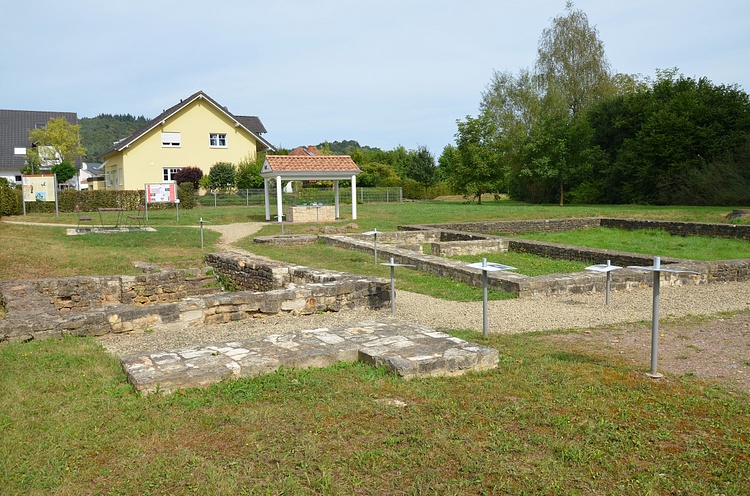 Vicus Tabernae Carole Raddato (CC BY-NC-SA) ](https://www.worldhistory.org/image/13281/vicus-tabernae/ "Vicus Tabernae")In the village of Tawern, visitors can also see the remains of the small Gallo-Roman town (*vicus*) whose ancient name was Tabernae. '*Tabernae*' was the Roman name for way-stations or hotels on roads between towns where travellers could rest.
- *Vicus* and temple are freely accessible and signposted. The temple is on the G11 hiking trail - a ten-minute walk from the forest parking lot.
### Igel [Column](https://www.worldhistory.org/column/)
The Igel Column is a multi-storey Roman sandstone funerary monument located on the left bank of the Moselle, 8 kilometres (five mi) south of Trier. It is one of the best-known Roman [burial](https://www.worldhistory.org/burial/) structures in Germany and the only Roman mausoleum north of the Alps still standing today, some 1,700 years later. The monument is decorated with mythological scenes and motifs from everyday life and is 23 metres (75 ft) in height. The Igel Column is part of the UNESCO World Heritage Site, which includes the Roman Monuments, the Cathedral of St. Peter, and the Church of Our Lady in Trier.
[ 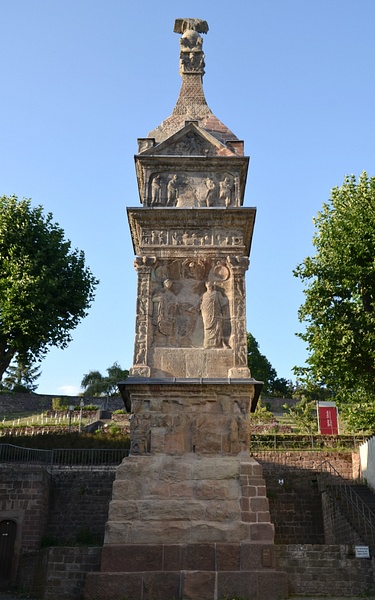 Igel Column Carole Raddato (CC BY-NC-SA) ](https://www.worldhistory.org/image/13241/igel-column/ "Igel Column")The monument was erected c. 250 CE by two wealthy cloth merchants of [Celtic](https://www.worldhistory.org/celt/) origin, Secundinius Aventinus and Secundinius Securus, who were brothers. The originally coloured monument advertised the cloth business of the Secundinii family in the city of *Augusta Treverorum* (Trier).
[ 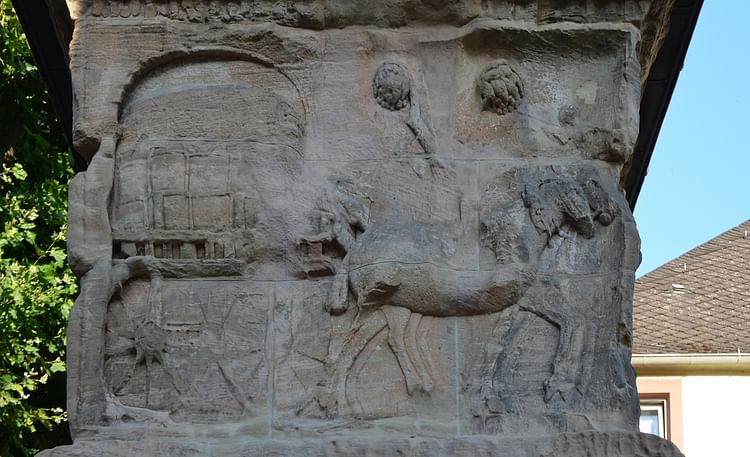 Relief Showing a Scene of Cloth Trade Carole Raddato (CC BY-NC-SA) ](https://www.worldhistory.org/image/13284/relief-showing-a-scene-of-cloth-trade/ "Relief Showing a Scene of Cloth Trade")The reliefs on the four sides show traces of painting. A polychrome reconstruction of the column can be found in the Rheinisches Landesmuseum in Trier.
- Always open; free
### Trier
Nicknamed the '[Rome](https://www.worldhistory.org/Rome/) of the North,' [Trier](http://www.trier-info.de/en) is Germany's oldest city. There is no place in northern [Europe](https://www.worldhistory.org/europe/) where such a concentration of Roman remains has been preserved as in Trier. A [UNESCO World Heritage site](http://whc.unesco.org/en/list/367) with nine locations (seven of which are Roman), this is where you will see the best-preserved Roman city gate north of the Alps. Founded by [Augustus](https://www.worldhistory.org/augustus/) in 15 BCE, Trier was the Roman city of *Augusta Treverorum* ('City of Augustus in the land of the Treveri') for 500 years. It is now a vibrant university city easily explored on foot.
[ 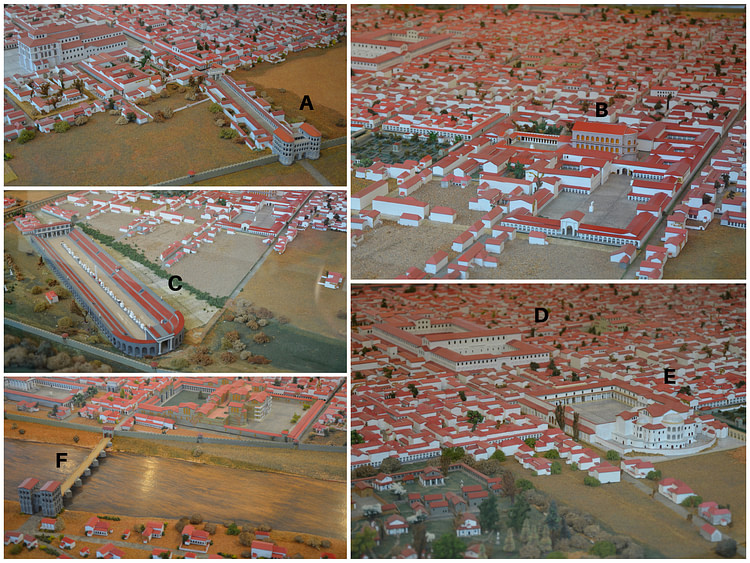 Scale Model of Augusta Treverorum (Trier) Carole Raddato (CC BY-NC-SA) ](https://www.worldhistory.org/image/13293/scale-model-of-augusta-treverorum-trier/ "Scale Model of Augusta Treverorum (Trier)") *A) Porta Nigra; B) Basilica of [Constantine](https://www.worldhistory.org/disambiguation/Constantine/); C) [Circus](https://www.worldhistory.org/disambiguation/Circus/); D) Forum; E) Imperial Baths; F) Roman Bridge across the Moselle River*
**Porta Nigra**
The Porta Nigra, Trier's landmark, is the best-preserved Roman city gate north of the Alps. Constructed in grey sandstone around 170 CE, it guarded the northern entry to the Roman town of Augusta Treverorum. While the other three city gates were destroyed in medieval times, this 'black gate' survived because it was converted into a church to honour St. Simeon, a pious [Greek](https://www.worldhistory.org/disambiguation/greek/) recluse who lived inside the gate for six years.
[ 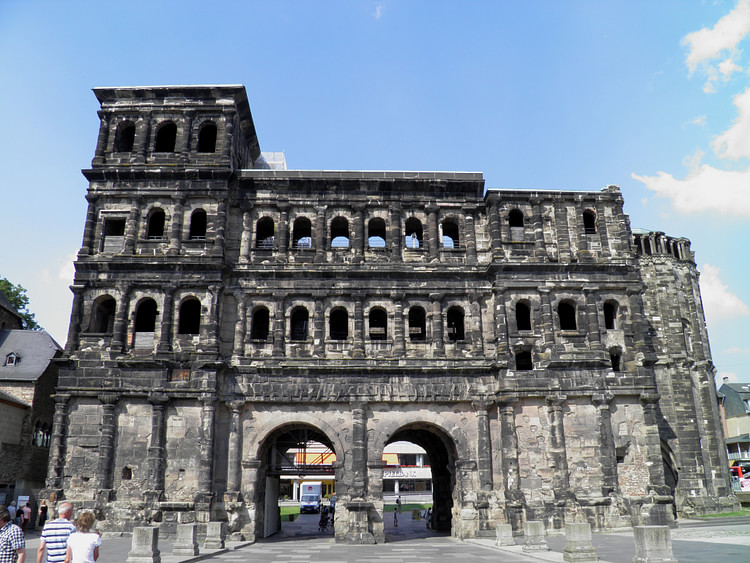 Porta Nigra, Trier Carole Raddato (CC BY-NC-SA) ](https://www.worldhistory.org/image/13291/porta-nigra-trier/ "Porta Nigra, Trier")In 1802 CE, [Napoleon Bonaparte](https://www.worldhistory.org/Napoleon_Bonaparte/) (1769-1821 CE) dissolved the church, and the monument was converted to its Roman form. Today, the Porta Nigra serves as the central information centre on the Roman city.
**[Amphitheatre](https://www.worldhistory.org/amphitheatre/)**
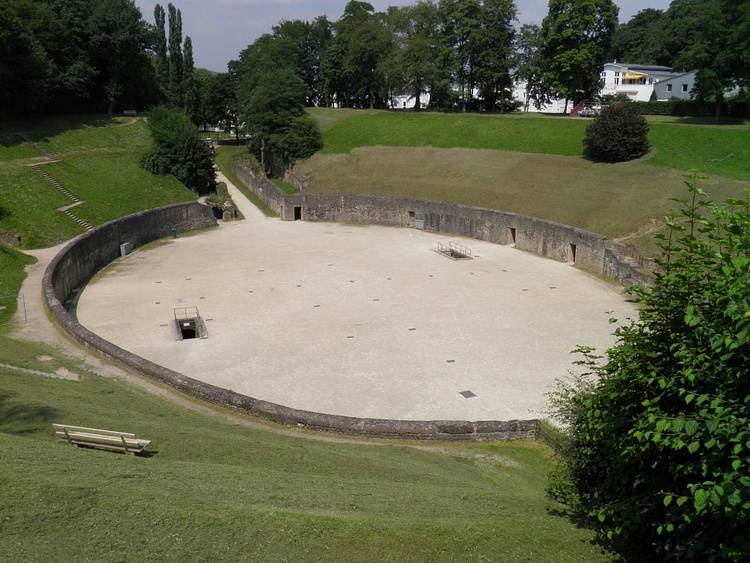
The Trier amphitheatre was built towards the end of the 2nd century CE. It is estimated it held up to 18,000 spectators for [gladiator](https://www.worldhistory.org/gladiator/) tournaments and animal fights. Trier's amphitheatre measures 120 x 145 metres (400 x 475 ft) and ranks tenth among the world's largest preserved Roman amphitheatres.
[  Trier Amphitheatre Carole Raddato (CC BY-NC-SA) ](https://www.worldhistory.org/image/13292/trier-amphitheatre/ "Trier Amphitheatre")**Basilica of Constantine (*Aula Palatina*)**
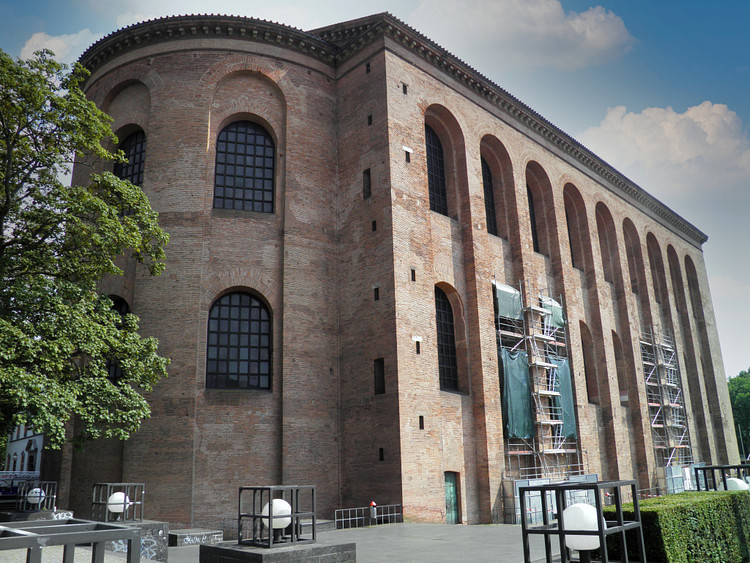
The Basilica of Constantine was built c. 310 CE by [Constantine I](https://www.worldhistory.org/Constantine_I/) (r. 306-337 CE) as the imperial [palace](https://www.worldhistory.org/disambiguation/palace/)'s reception and throne room. Its interior is 67 metres (220 ft) long and 33 metres (108 ft) high, and the brick-built basilica is the largest single-room Roman structure in existence. Originally, the basilica was part of a larger palace complex. Today, it is used as the Protestant Church of the Redeemer.
[  Basilica of Constantine, Trier Carole Raddato (CC BY-NC-SA) ](https://www.worldhistory.org/image/13303/basilica-of-constantine-trier/ "Basilica of Constantine, Trier")**Imperial Baths**
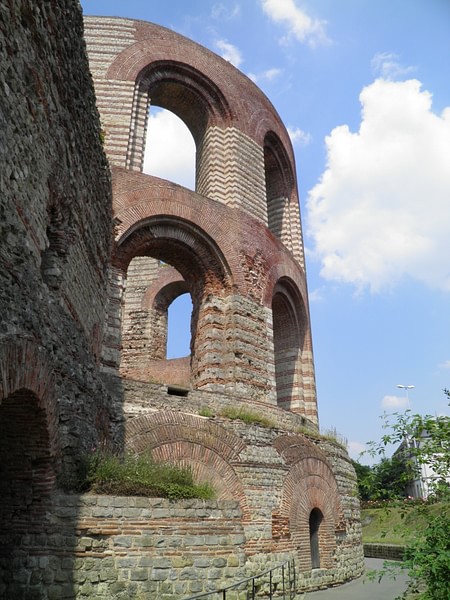
The Imperial Baths is a Roman thermal bathing complex constructed in the 4th century CE. The building was never completed, and there is evidence it was later used as a military barracks when Germanic tribes sacked Trier. The complex was converted into a castle during the Middle Ages.
[  Imperial Baths, Trier Carole Raddato (CC BY-NC-SA) ](https://www.worldhistory.org/image/13304/imperial-baths-trier/ "Imperial Baths, Trier")**Roman Bridge**
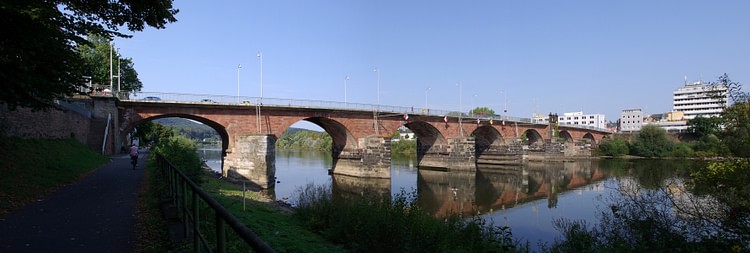
The Roman bridge in Trier is Germany's oldest standing bridge and spans the Moselle River. It was built in 144 CE from black basalt from the Eifel mountains, but its superstructure, now made of stone, was once made of wood so that the bridge could be set on fire in times of [war](https://www.worldhistory.org/disambiguation/War/).
[  Roman Bridge, Trier Berthold Werner (CC BY-SA) ](https://www.worldhistory.org/image/13305/roman-bridge-trier/ "Roman Bridge, Trier")###
Longuich Villa Urbana
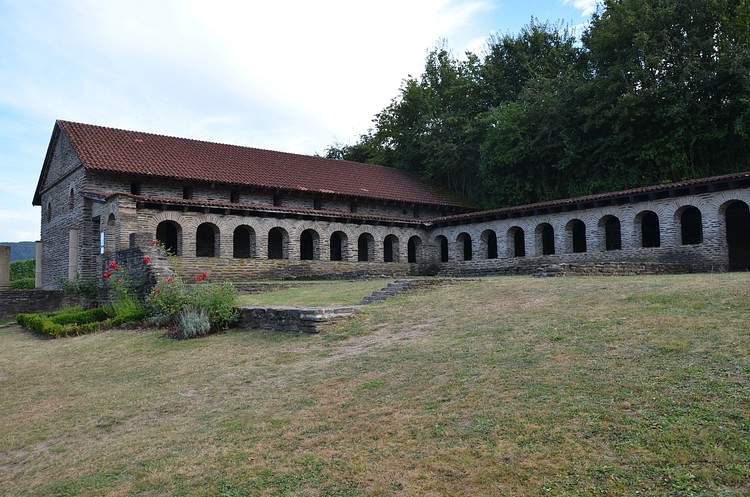
The partial reconstruction of a Roman villa can be visited among the vineyards of Longuich. The villa was built in the 2nd century CE and measured 110 by 28 metres (260 x 91 ft). Only a small part has been excavated and studied. The buildings were discovered in 1984 CE during land surveyor work and then partially reconstructed. Today, travellers can visit a part of the former side wing that has a bathing complex. There are guided tours from April-October on Sundays at 10:30 am.
[  Longuich Villa Urbana Carole Raddato (CC BY-NC-SA) ](https://www.worldhistory.org/image/13253/longuich-villa-urbana/ "Longuich Villa Urbana")- Always open; free
### Mehring Villa Rustica
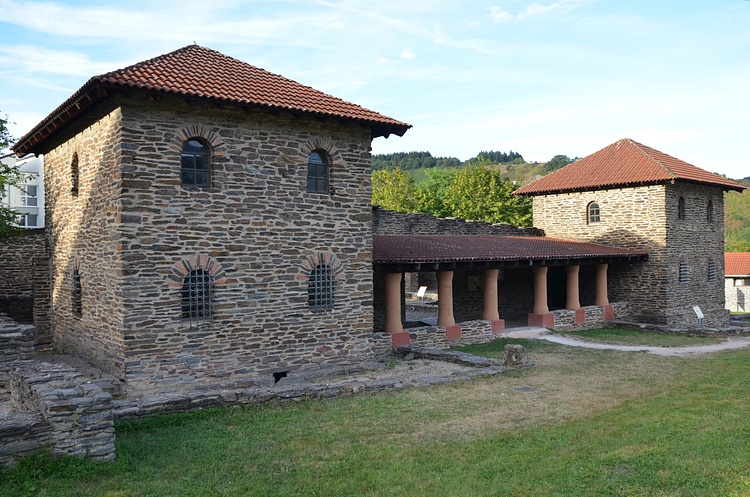
In the middle of Mehring (on the right bank of the Moselle), another Roman villa has been partially reconstructed. The building was erected in the first half of the 2nd century CE. During the 3rd and 4th centuries CE, the villa was enlarged to 34 rooms. It was one of the largest and most impressive villas in the region around Trier. There are guided tours from [Easter](https://www.worldhistory.org/Easter/) to October on Sundays at 11:30 am.
[  Mehring Villa Rustica Carole Raddato (CC BY-NC-SA) ](https://www.worldhistory.org/image/13254/mehring-villa-rustica/ "Mehring Villa Rustica")- Always open; free
### Roman Centre Neumagen-Dhron
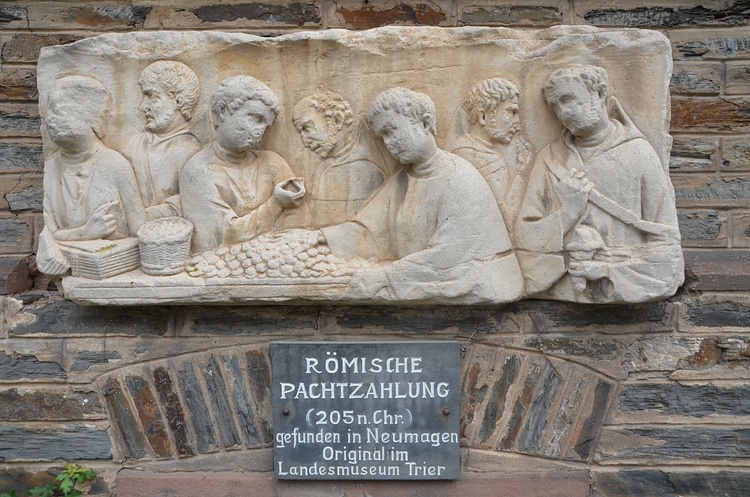
[Neumagen-Dhron](http://www.neumagen-dhron.de) is considered 'Germany's Oldest Winemaking Centre' and where many funerary reliefs and monuments from Roman times were unearthed, including the famous Neumagen Wine Ship. They were found inside the foundation walls of Neumagen and used as a cheap building material.
[  Neumagen Wine Ship Carole Raddato (CC BY-NC-SA) ](https://www.worldhistory.org/image/9651/neumagen-wine-ship/ "Neumagen Wine Ship")*Noviomagus Treverorum* ('Noviomagus of the Treviri') was the name of the Roman settlement of Neumagen. It had a road station and fort with 13 towers in late antiquity, built at the command of [Constantine the Great](https://www.worldhistory.org/Constantine_I/) to protect the city from Germanic tribes. An 800-metre (0,5 mi) circular archaeological trail around the town centre shows replicas of important reliefs discovered in Neumagen and the visible remains of the [Roman fort](https://www.worldhistory.org/Roman_Fort/)'s walls. You can enjoy a 40-minute historical tour of Neumagen with your smartphone - download the Lauschtour App from the App Store or Google Play and load the 'Roman Tour Neumagen-Dhron'. The original finds from Neumagen-Dhron can be seen in the Rheinisches Landesmuseum in Trier.
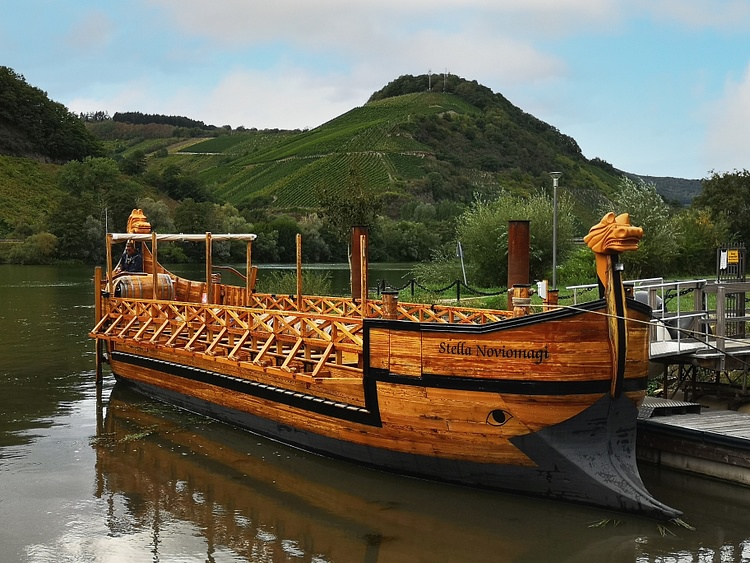
[  Tax Payment Relief (replica) Carole Raddato (CC BY-NC-SA) ](https://www.worldhistory.org/image/13287/tax-payment-relief-replica/ "Tax Payment Relief (replica)")The town also has a special attraction - the 'Stella Noviomagi' - a working replica of a Roman galley that transported wine along the Moselle River. Its reconstruction is based mainly on stone funerary monuments excavated from the foundations of the Roman Neumagen fort. Up to 40 people can row the ship, but it is also powered by two motors. A two-hour drive through the beautiful Moselle can be booked from April-October (fee: adults € 18, children 6-14 years € 9, children under 6 years: free) and usually start on Saturdays at 3.30 pm and Sundays at 10.00 am.
[  Stella Noviomagi Roman Boat Replica Carole Raddato (CC BY-NC-SA) ](https://www.worldhistory.org/image/13289/stella-noviomagi-roman-boat-replica/ "Stella Noviomagi Roman Boat Replica")### Piesport Roman Wine Press
The remains of two Roman wineries dating to the 2nd and 4th centuries CE were found on the edge of the famous slopes of the 'Piesporter Goldtröpfchen,' the biggest winegrowing centre in the Mosel region.
[ 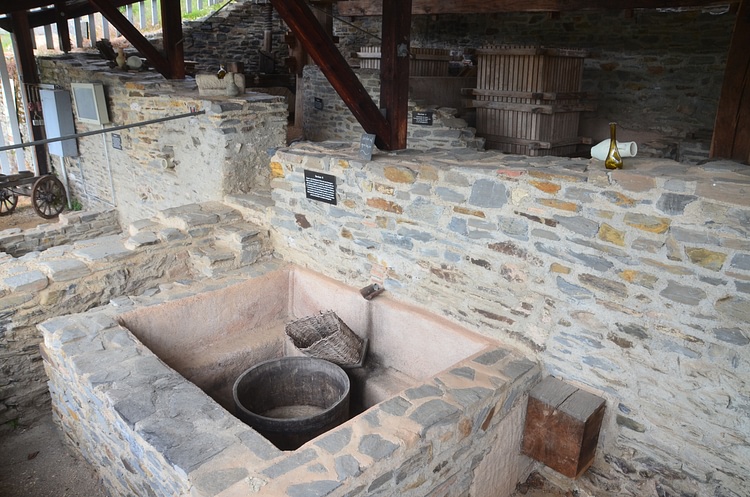 Piesport Roman Wine Press Carole Raddato (CC BY-NC-SA) ](https://www.worldhistory.org/image/13278/piesport-roman-wine-press/ "Piesport Roman Wine Press")The [4th-century CE winery](http://www.piesport.de) has been reconstructed and is functional. You can see it in action at the annual Roman Wine Press Festival in early October. You will be transported back 1700 years when slaves stomped the grapes with their bare feet.
### Landshut Castle
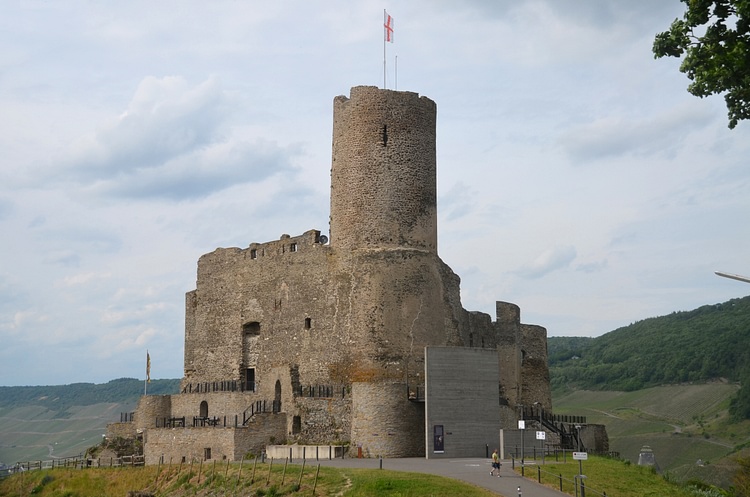
A visit to the ruined 13th-century CE [Landshut Castle](https://en.bernkastel.de) in the twin towns of Bernkastel-Kues is rewarded with glorious views of the Moselle landscape. In 2012 CE, the foundations of a 4th-century CE Roman fort were discovered. The previously unknown fortress can plausibly be linked to the 'princastellum,' the first-ever Roman fort built on the Moselle, recorded in the early 8th century CE *Ravenna Cosmography*.
[  Landshut Castle Carole Raddato (CC BY-NC-SA) ](https://www.worldhistory.org/image/13295/landshut-castle/ "Landshut Castle")- An hourly shuttle bus from the riverfront of Bernkastel costs €5 uphill, €3.50 downhill, or €7 return.
### Martberg Archaeological Park
[The park is a fortified Celtic city](http://www.martberg-pommern.de) (*[oppidum](https://www.worldhistory.org/oppidum/)*) and religious centre developed c. 100 BCE on the Martberg plateau above Pommern. It belonged to the Treveri and served as a political and economic centre. The 45-hectare (111 acres) plateau once had small houses made of wood and clay and an extensive temple that remained important throughout the Roman period.
[ 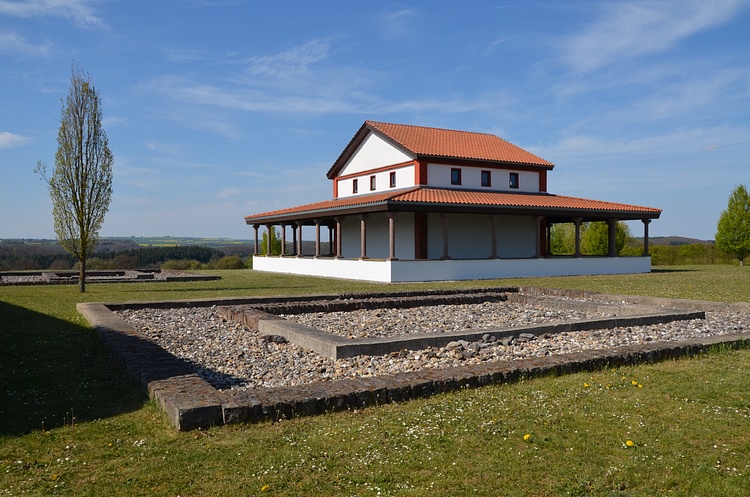 Martberg Archaeological Park Carole Raddato (CC BY-NC-SA) ](https://www.worldhistory.org/image/13296/martberg-archaeological-park/ "Martberg Archaeological Park")Lenus [Mars](https://www.worldhistory.org/Mars/), a Celtic healing god, was worshipped here, and many sick people came to be cured. More than 16,000 coins, hundreds of brooches, jewellery, weapons, and vessels were unearthed. Part of the ground plan has been uncovered, and some buildings have also been reconstructed.
- Opening times: April-June: Friday-Sunday and holidays 11:00-17:00 / July-October: Wednesday-Sunday 11:00-17:00
### Meurin Roman Mine
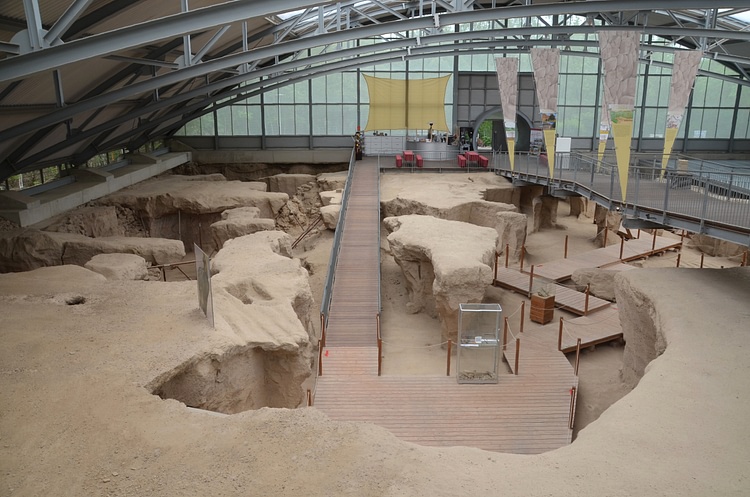
The [Meurin Roman mine](http://www.roemerbergwerk.de) at Kretz is the largest underground Roman tuff (rock made of volcanic ash) quarry north of the Alps. The layers of tuff - several metres thick and quarried for more than 2,000 years - were created by the Laacher See volcanic eruption 13,000 years ago. The finds have been protected from the elements by a large glass hall and an educational display has been integrated into the mining galleries.
[  Meurin Roman Mine Carole Raddato (CC BY-NC-SA) ](https://www.worldhistory.org/image/13302/meurin-roman-mine/ "Meurin Roman Mine")- Opening times: Tuesday-Sunday and holidays 11:00-16:00. Closed on Mondays and during the winter season.
### State Museums
The archaeological finds from the region can be seen in two state museums - the Rheinisches Landesmuseum in Trier and the Landesmuseum in Koblenz.
**Rheinisches Landesmuseum Trier**
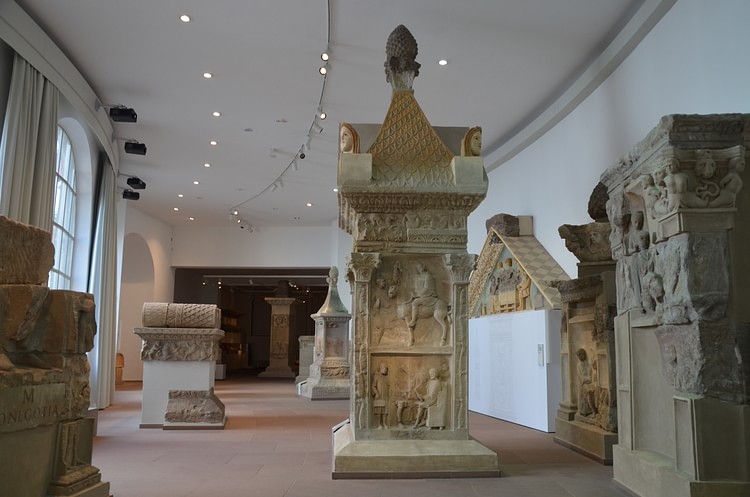
The [Rheinisches Landesmuseum](http://www.landesmuseum-trier.de) is Trier's largest and best-known museum. Its collection documents the [civilisation](https://www.worldhistory.org/civilization/), [economy](https://www.worldhistory.org/disambiguation/economy/), settlements, [religion](https://www.worldhistory.org/religion/), and art of the first four centuries CE, emphasising the Roman past of *Augusta Treverorum*. The visitor will see funerary monuments from Neumagen-Dhron with scenes of everyday life, mosaics from the Roman imperial palace, and the world's largest hoard of Roman [gold](https://www.worldhistory.org/gold/) ever found (with 2650 *aurei*).
[  Rheinisches Landesmuseum Trier Carole Raddato (CC BY-NC-SA) ](https://www.worldhistory.org/image/13317/rheinisches-landesmuseum-trier/ "Rheinisches Landesmuseum Trier")**Landesmuseum Koblenz**
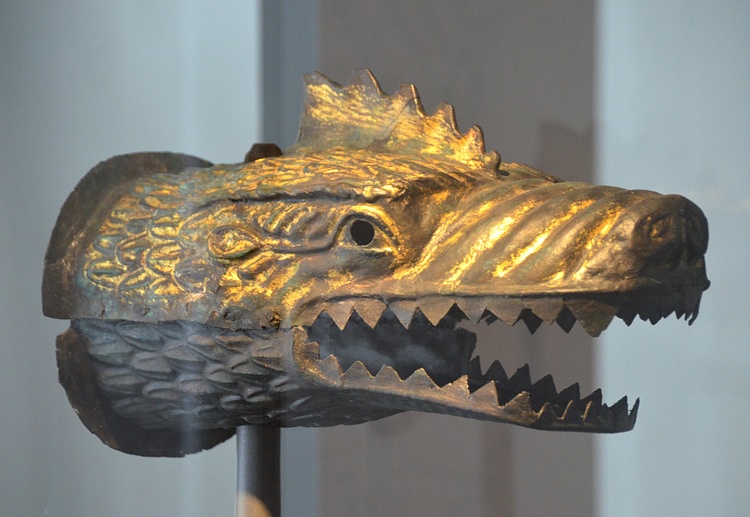
High above the confluence of the Moselle and Rhine rivers sits the Ehrenbreitstein Fortress, once a military fortification and now a popular destination. It houses a Landesmuseum where Celtic and Roman objects can be seen, including finds from the Martberg - a small fine blue glass ship, and a valuable [Roman cavalry](https://www.worldhistory.org/Roman_Cavalry/) *Draco* standard.
[  Niederbieber Draco Carole Raddato (CC BY-NC-SA) ](https://www.worldhistory.org/image/13318/niederbieber-draco/ "Niederbieber Draco")### Other Things to Do & Visit
- Hike the [*Moselsteig* Trail](http://www.moselsteig.de/moselsteig): Inaugurated in 2014 CE and an ideal way to explore the Moselle Valley. There are [24 routes](https://www.moselsteig.de/moselsteig/?type=900913), stretching from Perl to Koblenz and covering a total of 375 kilometres (233 mi).
- Cycle along the Moselle: 240 kilometres (149 mi) of cycling paths lead visitors through wine villages. You can rent bikes in most towns. The 'Lauschtour' audio tour app can be downloaded free from the Apple App Store or Google Play. Learn more [here](https://www.tourenplaner-rheinland-pfalz.de/en/tour/long-distance-cycling/the-moselle-river-cycle-route-in-full-from-perl-to-koblenz/3371404/).
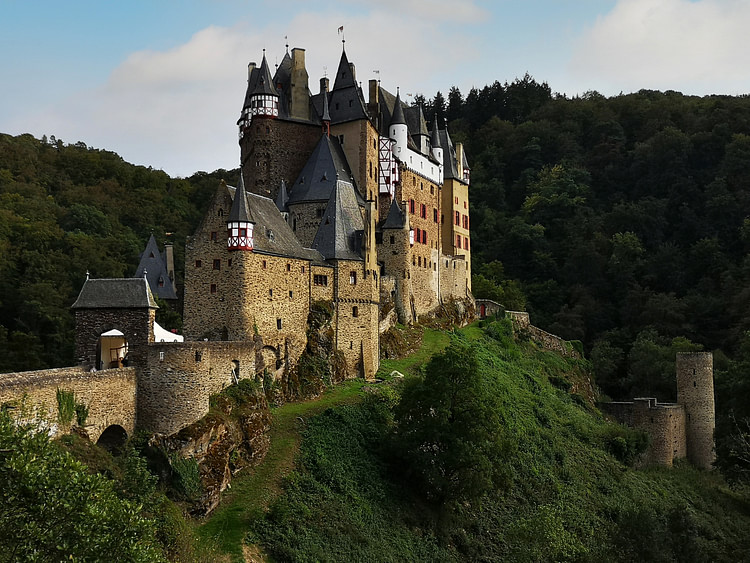
- Visit [Burg Eltz](https://burg-eltz.de/en/homepage): One of Germany's best-preserved medieval castles is situated on a 70-metre (229 ft) high rock, hidden in the Eltz Valley.
[  Burg Eltz, Germany Carole Raddato (CC BY-NC-SA) ](https://www.worldhistory.org/image/13316/burg-eltz-germany/ "Burg Eltz, Germany")- A boat trip on the Moselle: From April-October, round trips, day and half-day trips, and charters are offered between Koblenz and Trier. The leading local cruise company on the Moselle is [Gebrüder Kolb](https://www.moselrundfahrten.de/).
- Visit historical towns: Take a walk through the medieval villages of Cochem, Bernkastel, and Beilstein.
- Wine tasting tour and wineries: There are endless possibilities for customizable wine tastings and wine tours in Moselle. Find out about wine tasting tours [here](https://www.winetourism.com/wine-tasting-tours-in-mosel/).
The Moselle Valley's ancient Roman heritage has plenty to offer tourists and history buffs alike. At you will find information about sights, activities, wine festivals, and more.
#### Editorial Review
This human-authored article has been reviewed by our editorial team before publication to ensure accuracy, reliability and adherence to academic standards in accordance with our [editorial policy](https://www.worldhistory.org/static/editorial-policy/).
## Bibliography
- Harold Isbell. "Two from Ausonius." *Arion: A Journal of Humanities and the Classics*, Vol. 4, No. 2 (Summer, 1965), pp. 221-232.
- [Various & Isbell, Harold. *The Last Poets of Imperial Rome.* Penguin Classics, 1983.](https://www.worldhistory.org/books/0140442464/)
## About the Author
Carole maintains the popular ancient history photo-blog Following Hadrian, where she travels the ancient world in the footsteps of Emperor Hadrian.
- [Facebook Profile](https://www.facebook.com/FollowingHadrian)
- [X/Twitter Profile](https://twitter.com/carolemadge)
## Cite This Work
### APA
Raddato, C. (2021, January 26). A Roman Trail in the Moselle Valley. *World History Encyclopedia*.
### Chicago
Raddato, Carole. "A Roman Trail in the Moselle Valley." *World History Encyclopedia*, January 26, 2021. .
### MLA
Raddato, Carole. "A Roman Trail in the Moselle Valley." *World History Encyclopedia*, 26 Jan 2021, .
## License & Copyright
Submitted by [Carole Raddato](https://www.worldhistory.org/user/FollowingHadrian/ "User Page: Carole Raddato"), published on 26 January 2021. The copyright holder has published this content under the following license: [Creative Commons Attribution-NonCommercial-ShareAlike](https://creativecommons.org/licenses/by-nc-sa/4.0/deed.en). This license lets others remix, tweak, and build upon this content non-commercially, as long as they credit the author and license their new creations under the identical terms. When republishing on the web a hyperlink back to the original content source URL must be included. Please note that content linked from this page may have different licensing terms.