---
title: Some new hypotheses on the problems of the Indo-Greek kingdoms
author: Antoine Simonin
source: https://www.worldhistory.org/article/164/some-new-hypotheses-on-the-problems-of-the-indo-gr/
format: machine-readable-alternate
license: Creative Commons Attribution-NonCommercial-ShareAlike (https://creativecommons.org/licenses/by-nc-sa/4.0/)
updated: 1970-01-01
---
# Some new hypotheses on the problems of the Indo-Greek kingdoms
_Authored by [Antoine Simonin](https://www.worldhistory.org/user/Deathfinger/)_
*Warning: See the definitions of Greco-Bactrian and [Indo-Greek](https://www.worldhistory.org/Indo-Greek/) Kingdoms before reading this article, otherwise the following lines could give you serious headaches!*
A lack of information is a common problem for historians of the Greco-Bactrian and Indo-[Greek](https://www.worldhistory.org/disambiguation/greek/) kingdoms, due to the almost-inexistence of written accounts about them. The fact that the modern political problems in the area allow looters to spread whatever remains in all directions makes things worse, as it is removing the possibility of scientific studies. Most of what we know about those kings is through [numismatics](https://www.worldhistory.org/Numismatics/). Although Greek and [Roman literature](https://www.worldhistory.org/Roman_Literature/) speaks of about 6 Greco-Bactrian kings, coins number more than 32 kings! Knowing this, and the fact that a lot of coins are still circulating around the world without scientific study, the hypotheses and reviews of chronology for those kings are numerous, and almost every year brings new hypotheses to this really complex problem.
Some unorthodox hypotheses are found in the book of Widemann from 2009 (see references), and even if *a priori* they seem a bit far-fetched, some parallels with other [Hellenistic](https://www.worldhistory.org/Hellenic_World/) kingdoms and with some Indian problems make them surprisingly plausible. The principal hypotheses are detailed in the following lines:
**(1)**
The principal problem that occurs in the study of Greco-Bactrian and Indo-Greek kingdoms is the number of their kings. More than 32 kings in not really more than 250 years, is hard to imagine. In his book, Widemann takes the idea, which is also found implicitly in Mitchiner, that some Bactrian kings could have been co-opted. The following reasons are possible:
There is proof of fighting between Greco-Bactrian kings soon after they conquered Indian territories in the Punjab. After this we have several kings who issued only monolingual coins (Greek), and others who issued almost only bilingual ones. This shows a geographical frontline between those kingdoms somewhere in the Hindukush, some ruling over the Bactrian territories and the others over the Indian ones. A deep study of the [coin](https://www.worldhistory.org/coinage/) legends shows that it seems Greco-Bactrian kings, at least at some point, used titles a different way than other Hellenistic kingdoms. In the memorial [coinage](https://www.worldhistory.org/coinage/) of Agathokles (where on the obverse the king is commemorated and on the reverse is Agathokles himself), posthumous titles are added to kings. One of them, Theos (meaning "the [God](https://www.worldhistory.org/God/)") is added to Euthydemos I, who is called like this in his coins, and to [Diodotos](https://www.worldhistory.org/disambiguation/diodotos/) I, whom we know that he let his son Diodotos II take part of kingship during his reign.
This, added to a somewhat intriguing title of a later queen, Agathokleia "Theotropos", which can be put in parallel with the usual "Epitropos" title meaning "regent", lets Widemann think about a designation of superiority by the kings who take the title Theos. They were always the ones who made monolingual coins and ruled in [Bactria](https://www.worldhistory.org/Bactria/), meanwhile the others, called Sôter ("Saviour") or Dikaios ("The Just"), are always issuing bilingual coins. Note that, since [Eucratides](https://www.worldhistory.org/disambiguation/Eucratides/)' usurpation c. 170 BC, this system no longer applies.
[](https://www.worldhistory.org/image/258/ "Commemorative coin of Euthydemos from Agathokles of Bactria")[  Commemorative coin of Euthydemos from Agathokles of Bactria Wildwinds.com, courtesy of cngcoins.com. Republished with permission (Copyright) ](https://www.worldhistory.org/image/258/commemorative-coin-of-euthydemos-from-agathokles-o/ "Commemorative coin of Euthydemos from Agathokles of Bactria") Holding a large kingdom, with a good half being populated by non-Greeks, with both parts of this kingdom separated by the strong Hindukush mountains, knowing that civil [war](https://www.worldhistory.org/disambiguation/War/) is just to an end, is a pretty hard thing. All of those can be the reason of a co-opted system, with a king of Bactria ruling nominally all of the kingdom but in fact just the part West and North of the Hindukush, and a co-opted king ruling East of it, but with the Bactrian king having the precedence over the Indo-Greek one. Other parallels exist in ancient times: First we have the obvious diarchies and tetrachies of the Romans, with the idea of several kings for the same state. We also have the "epistrategoi" of late [Ptolemaic Egypt](https://www.worldhistory.org/Ptolemaic_Egypt/), in which those men had such great power on a specific province that they only answered directly to the king himself.
**(2)**
We also have the problem of the [Saka](https://www.worldhistory.org/Scythians/) invasions in the [Ganges](https://www.worldhistory.org/Ganges/) area. Bopearachchi talks about a Saka invasion c. 70 BC which led to the rule of the mighty Maues at [Taxila](https://www.worldhistory.org/taxila/). Nevertheless, there is no proof of such an invasion.
Maues is a special case: First he is the only Saka ruler to represent himself by a bust on his coin, the others showing themselves on a horse, like mounted warriors.
Second, there is a rare coinage of him with a certain queen Machènè (she is on the observe with the Greek legend, and he is on the reverse with the kharosthi legend). Machènè seems to be a Greek name, and the character which is at the obverse is usually the most important. If they were married, or if she was regent, they would be on the same side of the coin, like all others did, even Indo-Greek ones (see [Calliope](https://www.worldhistory.org/Calliope/)/Hermaios, or Agathokleia/[Strato](https://www.worldhistory.org/disambiguation/Strato/) for example). So there is probably something different here.
Widemann's thesis is that Maues was the chief of the [Sakas](https://www.worldhistory.org/Scythians/) settled in the [Indo-Greek kingdom](https://www.worldhistory.org/Indo-Greek/). This is highly possible: We have proof that Bactrian kings used Sakas to contain other invaders; many of them probably became somewhat Hellenized and went south to Punjab with their Greek rulers when they abandoned Bactria to the Yuezhei. The kind of representation that is found on Maues' coins supports this argument. Maybe Maues took an important place in a moment of crisis, such as being a vice-regent. We have a certain Telephos, an Indo-Greek king by his name at least, who called himself "son of Maues". Maybe he was the son of Machènè, and as queen she looked for the protection of the Sakas and so found Maues in a time of weakness? We must not forget that in Macedonia, [Antigonos](https://www.worldhistory.org/disambiguation/Antigonos/) Doson, being the vice-regent for Philip, appears in an inscription with the title of king, although Philip gave him no title.
We know far too little to say what is right or wrong, but what is certain is that Maues was not a "Saka invader" from the North of the Hindukush. His coins show him like an Hellenized Saka, probably one of those settled in Indo-Greek Patalene or Surastene.
**(3)**
Following Bopearachchi, there was an almost-consensus that the last Indo-Greek kingdom survived in the Eastern Punjab until c. 10 AD, under the rule of Strato II or III. Nevertheless, taking one hypothesis of Bopearachchi in another way, there are some indications that could show us that there still existed one Indo-Greek kingdom around [Alexandria](https://www.worldhistory.org/alexandria/) Kapisa (Alexandria of the "Caucasus") until c. 15/20 AD.
The problem is related of the "Hermaios" coinage. Many coins bearing this name have been discovered, but the chronological field of those coins is really too large for only one king. In ancient times, kings never put a number after their name when they were not the first to take the name. For example, Ptolemaios XI issued "Ptolemaiou Basileôs", without any number. Even knowing this, Bopearachchi chose to put some of the "Hermaios coins" in a "barbarous imitations" section, due to their poor style and their belonging to the Hindukush area in the very late 1st century BC, because that is the only really plausible solution that works with his theory on the Saka invasion c. 70 BC.
Nevertheless, the Sakas who settled into independent kingdoms in [India](https://www.worldhistory.org/india/) in the 1st century BC seemed to have always made coins with their own representations and names. Even the Sakas of Seistan, West of the Hindukush, had at this time their own coinage, so why imitate the series of an Indo-Greek king? In the same way, there is coinage of Hermaios (at the obverse in Greek legend), but with a reverse of the koushan Kujula Kadphises (in Kharosthi).
[](https://www.worldhistory.org/image/257/ "Coin of both Hermaios and Kujula Kadphises")[ 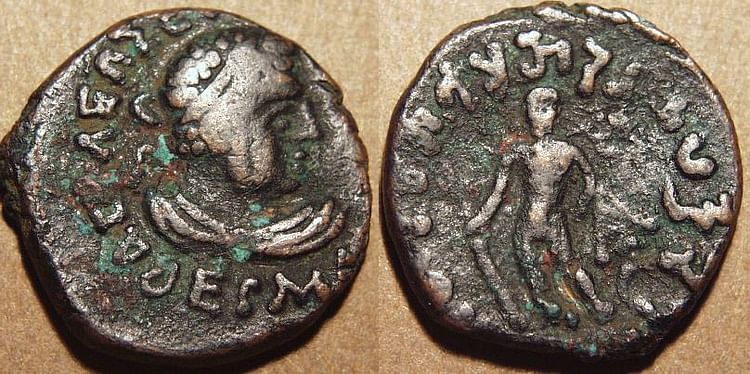 Coin of both Hermaios and Kujula Kadphises CoinIndia.com (CC BY-SA) ](https://www.worldhistory.org/image/257/coin-of-both-hermaios-and-kujula-kadphises/ "Coin of both Hermaios and Kujula Kadphises")More than seeing a simple imitation of a local currency, there is more probably an indication of a diplomatic message to the Greeks: a King named Hermaios allied himself with Kujula, or Kujula claimed to be in the succession of the Greek rulers of this area by minting this coin. Here we are dealing with the least known part of the Indo-Greek history, so for now it is impossible to say why this coin was minted, but what seems rather possible is the existence of several kings named Hermaios ruling an Indo-Greek kingdom centred around Alexandria Kapisa in the Hindukush at most until the invasion of Gondophares II c. 20 AD.
So here are three theses that could, if proven correct, change many of our views on Bactrian history and even also on Indian and Indo-Saka history. The co-opted system of rulership would make those Indo-Greek kingdoms even more exceptional and interesting to study, showing an example of how to deal with the problem of ruling two very different and separate areas in ancient times.
#### Editorial Review
This human-authored article has been reviewed by our editorial team before publication to ensure accuracy, reliability and adherence to academic standards in accordance with our [editorial policy](https://www.worldhistory.org/static/editorial-policy/).
## Bibliography
- [François Widemann. *Les successeurs d'Alexandre en Asie centrale et leur héritage culturel.* Riveneuve, 2009.](https://www.worldhistory.org/books/2914214715/)
- [Michael Mitchiner. *Indo-Greek and Indo-Scythian Coinage.* Hawkins Publications, 1976.](https://www.worldhistory.org/books/0904173054/)
- Osmund Bopearachchi. *Monnaies gréco-bactriennes et indo-grecques, catalogue raisonné.* Bibiliothèque Nationale de France, 1991
## About the Author
Passionate about ancient Central Asia. Maintains the website From Bactria to Taxila. Works in the Europa Barbarorum project.
- [Linkedin Profile](https://www.linkedin.com/in/antoine-simonin/52/685/a9a/e)
## Cite This Work
### APA
Simonin, A. (2012, January 18). Some new hypotheses on the problems of the Indo-Greek kingdoms. *World History Encyclopedia*.
### Chicago
Simonin, Antoine. "Some new hypotheses on the problems of the Indo-Greek kingdoms." *World History Encyclopedia*, January 18, 2012. .
### MLA
Simonin, Antoine. "Some new hypotheses on the problems of the Indo-Greek kingdoms." *World History Encyclopedia*, 18 Jan 2012, .
## License & Copyright
Submitted by [Antoine Simonin](https://www.worldhistory.org/user/Deathfinger/ "User Page: Antoine Simonin"), published on 18 January 2012. The copyright holder has published this content under the following license: [Creative Commons Attribution-NonCommercial-ShareAlike](https://creativecommons.org/licenses/by-nc-sa/4.0/deed.en). This license lets others remix, tweak, and build upon this content non-commercially, as long as they credit the author and license their new creations under the identical terms. When republishing on the web a hyperlink back to the original content source URL must be included. Please note that content linked from this page may have different licensing terms.