---
title: Alexandros I Balas
author: Adrian Dumitru
source: https://www.worldhistory.org/article/159/alexandros-i-balas/
format: machine-readable-alternate
license: Creative Commons Attribution-NonCommercial-ShareAlike (https://creativecommons.org/licenses/by-nc-sa/4.0/)
updated: 1970-01-01
---
# Alexandros I Balas
_Authored by [Adrian Dumitru](https://www.worldhistory.org/user/ariarathes/)_
Alexandros I Balas was a [Seleucid](https://www.worldhistory.org/Seleucid_Empire/) king from 152 BC to 145 BCE. As the Seleucid king Demetrius I Soter (162-150 BCE) became more and more unpopular due to his arrogance and drunkenness, it was quite an easy task for the rival kingdoms, such as [Pergamum](https://www.worldhistory.org/pergamon/) or [Egypt](https://www.worldhistory.org/egypt/) to stir up a revolt against him. As a competitor was lacking, two youngsters were found, a boy and a girl who were presumed to be the children of Antiochus IV Epiphanes, the uncle of Demetrius. The boy was presented to the [Roman Senate](https://www.worldhistory.org/Roman_Senate/) as the legitimate heir of the Seleucid kingdom. The Senate gave a *senatus consultum* authorizing the new heir to claim his kingdom ([Polybius](https://www.worldhistory.org/Polybius/), XXXIII, 18, 6-14) - but did nothing more to strengthen this claim.
[ 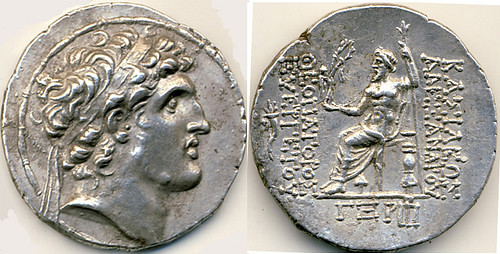 Alexandros I Balas Oku-yun (Public Domain) ](https://www.worldhistory.org/image/8618/alexandros-i-balas/ "Alexandros I Balas")[Alexander](https://www.worldhistory.org/disambiguation/Alexander/) - for it was him - landed at Ptolemais-Ake, on the Phoenician coast. He was helped and supported by Attalus II, the king of Pergamum, and Ariarathes IV, the king of Cappadocia. But the strongest help came from the king of Egypt, [Ptolemy](https://www.worldhistory.org/disambiguation/Ptolemy/) VI Philometor. Not only did he offer military support, but also the hand of his daughter, [Cleopatra](https://www.worldhistory.org/disambiguation/cleopatra/) Thea. Alexander did his best to win the support of the Jewish rebels and march on to [Antioch](https://www.worldhistory.org/Antiochia/). The final [battle](https://www.worldhistory.org/disambiguation/battle/) between him and Demetrius I apparently took place around June or July 150 BCE, according to a [cuneiform](https://www.worldhistory.org/cuneiform/) tablet.
After he became the uncontested ruler of [Syria](https://www.worldhistory.org/syria/) (to some modern authors, this would be the moment Ptolemy VI became fully involved in his support and the royal wedding was celebrated), Alexander went on living an easy life, full of pleasure, perhaps neglecting his royal duties. The date of the loss of [Mesopotamia](https://www.worldhistory.org/Mesopotamia/) to the Arsakids, rulers of [Parthia](https://www.worldhistory.org/disambiguation/Parthia/), could be placed between 155 BCE and 140 BCE (it is a very debated issue for the modern historians). It is however almost certain that [Media](https://www.worldhistory.org/disambiguation/media/) was lost c. 148 BC, and the king of Elymais, Kamnaskires, took [Susa](https://www.worldhistory.org/susa/) around 147 BCE.
In 147 BCE, Demetrius II (soon to be styled *Nikator*, that is "the Victorious"), a son of Demetrius I, landed in [Cilicia](https://www.worldhistory.org/Cilicia/) to claim his throne. The father-in-[law](https://www.worldhistory.org/disambiguation/law/) rushed to help Alexander, but, for some unknown reason, the latter tried to assassinate him in the [city](https://www.worldhistory.org/city/) of Ptolemais. Ptolemy VI simply changed sides, while Antioch on the Orontes, the capital city, revolted and offered the crown to Ptolemy, who was wise enough to decline it, but persuaded the citizens to support Demetrius II.
The final battle was fought in Syria, on the Oinoparas river. Alexander was defeated and fled - but Ptolemy was seriously wounded and died soon after. The end was close also for the former king - he sought refuge with an Arab sheikh, but was assassinated.
Whether Alexander I Balas was really the "lost and found son" of Antiochus IV is uncertain. Seleucid or not, he is a typical figure for the last century of the history of the [Seleucid Empire](https://www.worldhistory.org/Seleucid_Empire/). He was a usurper, backed by foreign powers, and came into possession of his kingdom as an adventurer. He lost his throne to another royal claimant (which gave the Jewish rebels the opportunity to auction off their support to two rival Seleucid kings, thus gaining some new privileges and having some old ones confirmed). According to some obscure stories preserved in Athenaios, he might not have been very cultivated (unlike the other Seleucid kings), but he liked sports, and was (so it is said) a handsome young man.
His full royal name was Alexander Theopator Euergetes (meaning "He who comes from a divine father, benefactor"), and Balas (never to appear on the official coins of the kingdom) might have been his original name, according to Justinus, XXXV, 1, 6-7.
#### Editorial Review
This human-authored article has been reviewed by our editorial team before publication to ensure accuracy, reliability and adherence to academic standards in accordance with our [editorial policy](https://www.worldhistory.org/static/editorial-policy/).
## Bibliography
- A. HOUGHTON & C. LORBER & O. HOOVER. *Seleucid Coins. A comprehensive catalogue,.* New York & London, 2008, Part II, Vol.
- E.R. BEVAN. *The House of Seleucus.* London, 1902, vol. II, pp. 2.
- E.S. GRUEN. *The Hellenistic World and the Coming of Rome.* Berkeley, 1984
## Cite This Work
### APA
Dumitru, A. (2012, January 18). Alexandros I Balas. *World History Encyclopedia*.
### Chicago
Dumitru, Adrian. "Alexandros I Balas." *World History Encyclopedia*, January 18, 2012. .
### MLA
Dumitru, Adrian. "Alexandros I Balas." *World History Encyclopedia*, 18 Jan 2012, .
## License & Copyright
Submitted by [Adrian Dumitru](https://www.worldhistory.org/user/ariarathes/ "User Page: Adrian Dumitru"), published on 18 January 2012. The copyright holder has published this content under the following license: [Creative Commons Attribution-NonCommercial-ShareAlike](https://creativecommons.org/licenses/by-nc-sa/4.0/deed.en). This license lets others remix, tweak, and build upon this content non-commercially, as long as they credit the author and license their new creations under the identical terms. When republishing on the web a hyperlink back to the original content source URL must be included. Please note that content linked from this page may have different licensing terms.