---
title: Exploring Mount Nemrut - A Meeting Point Between East & West
author: Carole Raddato
source: https://www.worldhistory.org/article/1589/exploring-mount-nemrut---a-meeting-point-between-e/
format: machine-readable-alternate
license: Creative Commons Attribution-NonCommercial-ShareAlike (https://creativecommons.org/licenses/by-nc-sa/4.0/)
updated: 1970-01-01
---
# Exploring Mount Nemrut - A Meeting Point Between East & West
_Authored by [Carole Raddato](https://www.worldhistory.org/user/FollowingHadrian/)_
Set within the Anti-Taurus mountain range in southeastern [Turkey](https://www.worldhistory.org/Asia_Minor/), beyond the borders of Adiyaman, is the archaeological wonder of Mount Nemrut. Forgotten for centuries, the spellbinding peak of Nemrut Dagi (its Turkish name) has since managed to capture the imagination of thousands of visitors who come annually to witness the pure magic of its landscape at dawn and dusk, when the mighty stone heads glow [gold](https://www.worldhistory.org/gold/).
[ 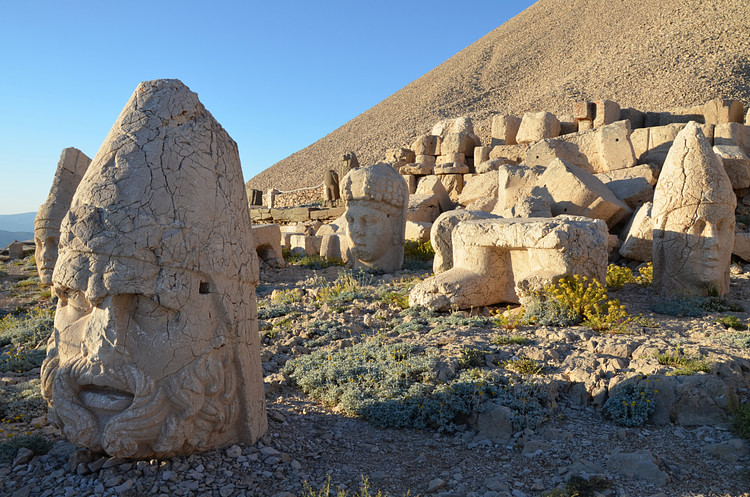 Colossal Heads on the West Terrace of Mount Nemrut Carole Raddato (CC BY-NC-SA) ](https://www.worldhistory.org/image/12582/colossal-heads-on-the-west-terrace-of-mount-nemrut/ "Colossal Heads on the West Terrace of Mount Nemrut")Mount Nemrut is located at the heart of what was the Kingdom of [Commagene](https://www.worldhistory.org/Commagene/), a small Hellenised Armenian kingdom that carved its place in history from the living rock. In 62 BCE, King Antiochus I (70 - c. 38 BCE), one of the megalomaniacal rulers of this small local dynasty, decided to leave an enduring monument to his greatness and ordered the construction of a [tomb](https://www.worldhistory.org/tomb/)-sanctuary on the summit of Mount Nemrut.
Often referred to as the “Throne of the Gods", most people will have seen photos of the huge stone heads atop the mountain, but few know of the history or function of this extraordinary site. Without a doubt, a trip to Mount Nemrut is the highlight of any journey to Commagene, but there is more to discover. Other attractive sites of interest are incorporated into the Nemrut Dagi National Park - the [burial](https://www.worldhistory.org/burial/) site of the royal [women](https://www.worldhistory.org/disambiguation/women/) at Karakus; the beautifully preserved Cendere Bridge; and the [city](https://www.worldhistory.org/city/) of Arsameia. All of these places are located close to each other.
### Getting There
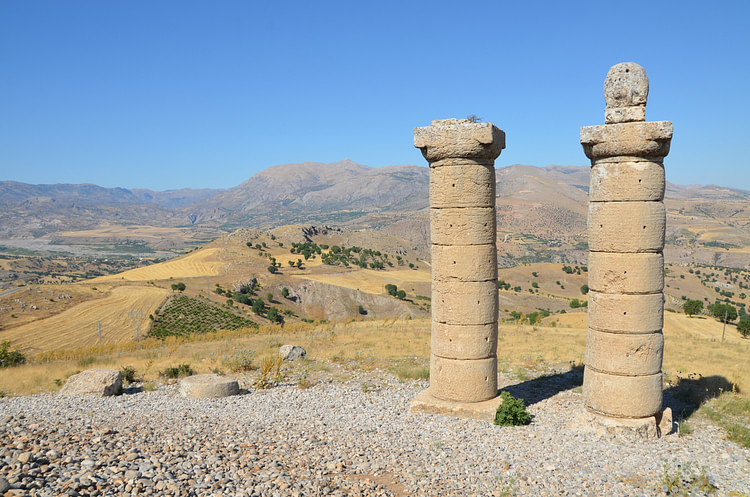
In July 2017, while travelling around some of Turkey's most historic sites in [Cilicia](https://www.worldhistory.org/Cilicia/), I set out to explore Mount Nemrut, which had been at the top of my bucket list for many years. It was a five-hour-long drive from my base in Adana to the Karakus Tumulus, the first stop on approaching the National Park from the south.
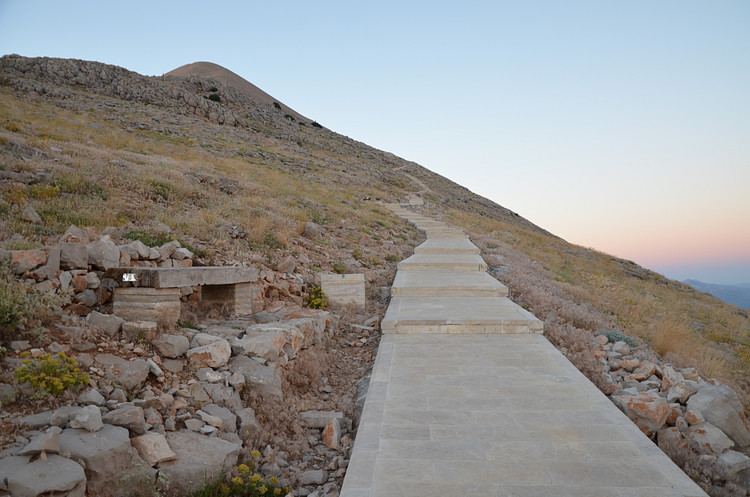
[  Tumulus of Karakus with Distant Views of Mount Nemrut Carole Raddato (CC BY-NC-SA) ](https://www.worldhistory.org/image/12603/tumulus-of-karakus-with-distant-views-of-mount-nem/ "Tumulus of Karakus with Distant Views of Mount Nemrut")Travelling in Commagene used to be quite a challenge due to its extremely remote and inaccessible location. Before the building of the road in the 1960s CE, the summit was accessible only by donkey or on foot, which required many [hours](https://www.worldhistory.org/Horae/) of riding or walking. Today, many people make the trip to the summit with an arranged tour guide, but independent travellers can use their own transport to get to the top, where shuttles take visitors to the foot of the hill for a small fee. Then, it is a 600-metre (1,960 feet) climb along the processional way leading up to the mountaintop sanctuary.
[  Path to Mount Nemrut Carole Raddato (CC BY-NC-SA) ](https://www.worldhistory.org/image/12597/path-to-mount-nemrut/ "Path to Mount Nemrut")Antiochus chose the highest mountain peak of his kingdom for his mausoleum. On its summit, at an altitude of 2,150 metres (7,000 feet), he built a high *tumulus* (artificial mound) that is still visible today in every direction from over 100 kilometres (62 miles) away. According to inscriptions left behind before he died, Antiochus wanted to be buried in a high and holy place among the gods. The king wished to be preserved for eternity, and by all accounts, he succeeded.
However, it was only in 1881 CE that a German road engineer reported the tomb's discovery. Since then, the site has been excavated by many native and foreign researchers. It became the world's highest open-air museum and was included on the prestigious UNESCO World Heritage List in 1987 CE.
#### Magazine Syndication
[](https://www.karwansaraypublishers.com/pages/ancient-history?tap_a=88561-7cbe2d&tap_s=1481998-1eac29 "Ancient History Magazine")### Ancient History Magazine
FREE SHIPPING WORLDWIDE This article was first published in Ancient History Magazine and republished with permission. Ancient History looks at every aspect of the ancient world: you'll find articles covering politics, society, literature, language, religion, economics, and art - all in one magazine! [Get the Magazine](https://www.karwansaraypublishers.com/pages/ancient-history?tap_a=88561-7cbe2d&tap_s=1481998-1eac29)
.button_container {
margin-top: 1em;
}
.sponsor.book h3 {
text-transform: none;
margin-top: 0px;
margin-bottom: 15px;
font-family: "Libre Baskerville", "Palatino Linotype", "Book Antiqua", Palatino, serif;
}
.sponsor_message {
margin-left: 190px;
font-family: Karla, Arial, Helvetica, sans-serif;
line-height: 140%;
min-height: 200px;
}
.sponsor.book {
padding: 10px 0px 25px 0px;
margin: 25px 0px;
border-top: 1px dotted #dadada;
border-bottom: 1px dotted #dadada;
}
.sponsor.book .key_art {
margin-top: 0px;
margin-bottom: 10px;
float: left;
border: 1px solid #f3f3f3;
}
.sponsor h4 {
font-weight: normal;
text-transform: uppercase;
color: silver;
margin-bottom: 10px;
margin-top: 0px;
font-family: Karla,Arial,Helvetica,sans-serif;
font-size: 13px;
padding: 0;
}
.sponsor_book_author {
color: silver;
margin: -10px 0px 20px;
}
@media (max-width: 1199px) {
.sponsor.book .key_art {
float: none;
width: 100%;
}
.sponsor.book .sponsor_message {
margin-left: 0px;
}
.sponsor.book h3 {
margin-top: 20px;
margin-bottom: 10px;
}
}
@media (max-width: 767px) {
}
### The Kingdom of Commagene
The ancient Commagene Kingdom occupied what had been [Seleucid](https://www.worldhistory.org/Seleucid_Empire/) territory on the right bank of the Euphrates river. It consisted of the land between the plains of northern [Syria](https://www.worldhistory.org/syria/) and the eastern Taurus Mountains, the portion of southeastern [Asia Minor](https://www.worldhistory.org/Asia_Minor/) that today roughly corresponds with Adiyaman Province and the north of Gaziantep Province.
Its history begins with the reign of Ptolemaeus of Commagene (201-130 BCE), a Seleucid officer of Orontid Armenian descent who became king around 162 BCE and established himself as an independent ruler. His kingdom controlled the crossings of the Euphrates River from [Mesopotamia](https://www.worldhistory.org/Mesopotamia/) and several routes over the Taurus Mountains. As a result, it played a significant role as a buffer state between the [Seleucid Empire](https://www.worldhistory.org/Seleucid_Empire/) in the west and [Parthia](https://www.worldhistory.org/disambiguation/Parthia/) in the east. Ptolemaeus was succeeded by his son Sames II (r. 130-109 BCE), who founded the fortress at Samosata.
According to the ancient [Greek](https://www.worldhistory.org/disambiguation/greek/) historian Strabo (c. 64 BCE - c. 24 CE), the kingdom became wealthy from [trade](https://www.worldhistory.org/disambiguation/trade/) and [agriculture](https://www.worldhistory.org/disambiguation/Agriculture/), particularly on the fertile lands around the capital. As part of a peace alliance between the Kingdom of Commagene and the Seleucid [Empire](https://www.worldhistory.org/empire/), Mithridates I Callinicus (r. 109-70 BCE), the son and successor of Sames II, was married to the Seleucid princess Laodice VII Thea. Gradually, the kingdom became Hellenized, and Greek was adopted as the official language.
[ 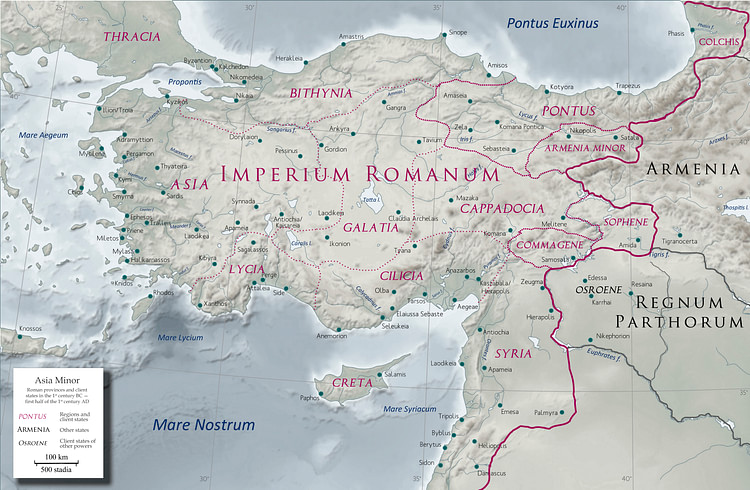 Asia Minor in the Early 1st Century CE Caliniuc (CC BY-SA) ](https://www.worldhistory.org/image/12596/asia-minor-in-the-early-1st-century-ce/ "Asia Minor in the Early 1st Century CE")Commagene reached its height in the 1st century BCE under Antiochus I. During his long reign, the Romans waged [war](https://www.worldhistory.org/disambiguation/War/) against the Parthians, and Antiochus allied himself with the Romans, before forming alliances with the Parthians by arranging the marriage of his daughter Laodice to Orodes II of Parthia (57-37 BCE). Commagene maintained its independence until its annexation by the [Roman Empire](https://www.worldhistory.org/Roman_Empire/) in 17 CE. It re-emerged as an independent kingdom from 38 CE but was permanently absorbed into the [Roman](https://www.worldhistory.org/disambiguation/Roman/) province of Syria in 72 CE when the emperor [Vespasian](https://www.worldhistory.org/Vespasian/) (r. 69-79 CE) deposed Antiochus IV (38-72 CE) for his alleged conspiracy with the Parthians against the Romans.
### Antiochus I's Tomb-Sanctuary on Mount Nemrut
Antiochus I - "a just, eminent [god](https://www.worldhistory.org/God/), friend of Romans and friend of Greeks" (as his full title goes) - was the son of King Mithridates I Calinicus (109–70 BCE) and Queen Laodice VII Thea of Commagene (b. 122 BCE). Half-Armenian and half-Greek, Antiochus counted himself as a descendant of the Achaemenids on his father's side and the Seleucids on his mother's - two of the greatest dynasties in the ancient world.
The self-obsessed ruler instituted a royal cult and ordered the construction of a tomb-sanctuary (*hierothesion*) on Mount Nemrut so that he could be worshipped as a god after his [death](https://www.worldhistory.org/disambiguation/Death/). This extraordinary funerary complex consists of a 50-metre-high (164 feet) artificial mound (*tumulus*) of crushed limestone, three cult terraces (east, west, and north), and a large altar with a stepped platform. The body of King Antiochus is thought to have been buried in a chamber beneath his man-made mountain, but despite repeated attempts, his tomb has yet to be found.
[  King Antiochus I on Mount Nemrut Carole Raddato (CC BY-NC-SA) ](https://www.worldhistory.org/image/12585/king-antiochus-i-on-mount-nemrut/ "King Antiochus I on Mount Nemrut")### Visiting the Sanctuary
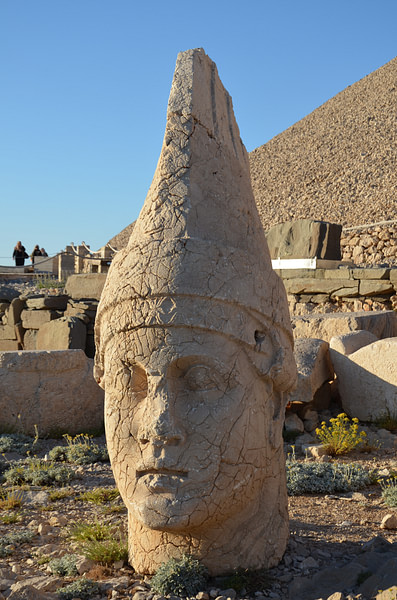
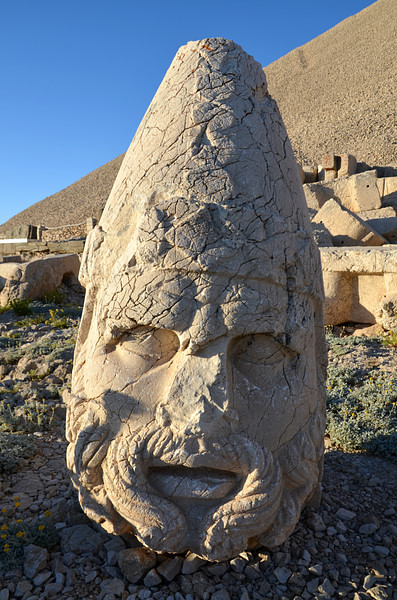
Visitors access the different terraces via a narrow processional way around the base of the tumulus. The east and west terraces lie on either side and are both dominated by a row of five colossal enthroned statues. Sitting majestically with their back to the tumulus, the figures, between 8 and 10 metres (26-32 feet) tall, have been identified as Antiochus I and a pantheon of Greek, Armenian, and Persian deities that reflected Antiochus' mixed ancestry - [Zeus](https://www.worldhistory.org/zeus/)-Orosmasdes-[Ahura Mazda](https://www.worldhistory.org/Ahura_Mazda/), Artagnes-Bahram-[Hercules](https://www.worldhistory.org/hercules/)-[Ares](https://www.worldhistory.org/Ares/), [Apollo](https://www.worldhistory.org/apollo/)-Mithras-[Helios](https://www.worldhistory.org/Helios/)-[Hermes](https://www.worldhistory.org/Hermes/), and Commagene-Atargatis-[Juno](https://www.worldhistory.org/Juno/) Dolichena.
Their stone heads, tossed to the ground by earthquakes, have been rearranged to help visitors understand who they were. King Antiochus is seated on the left end side. He is dressed in Persian garb and wears an Armenian tiara, while the gods are represented in assorted Greek and Persian apparel. Apollo-Mithras-Helios-Hermes, for example, wears Persian clothes. The goddess Commagene is dressed in the Greek style and holds a *cornucopia* filled with fruits and flowers (symbolising the fertility of the kingdom).
[  Eastern Terrace of Mount Nemrut Carole Raddato (CC BY-NC-SA) ](https://www.worldhistory.org/image/8298/eastern-terrace-of-mount-nemrut/ "Eastern Terrace of Mount Nemrut")The blending of eastern and western cultures follows the principle known as syncretism that was propounded by [Alexander the Great](https://www.worldhistory.org/Alexander_the_Great/) (356-323 BCE) and his successors to help bind the peoples of the former Persian [Achaemenid Empire](https://www.worldhistory.org/Achaemenid_Empire/) with their Greek conquerors. The enthroned gods were flanked on either side by larger-than-life statues of guardian creatures, a lion and an eagle, and by a group of sandstone slabs representing hand-shaking (*dexiosis*) scenes of the king with the different deities. Two rows of stelae completed the monument with portraits of Antiochus' [Achaemenid](https://www.worldhistory.org/disambiguation/Achaemenid/) and [Hellenistic](https://www.worldhistory.org/Hellenic_World/) ancestors.
### East, West, & North Terraces
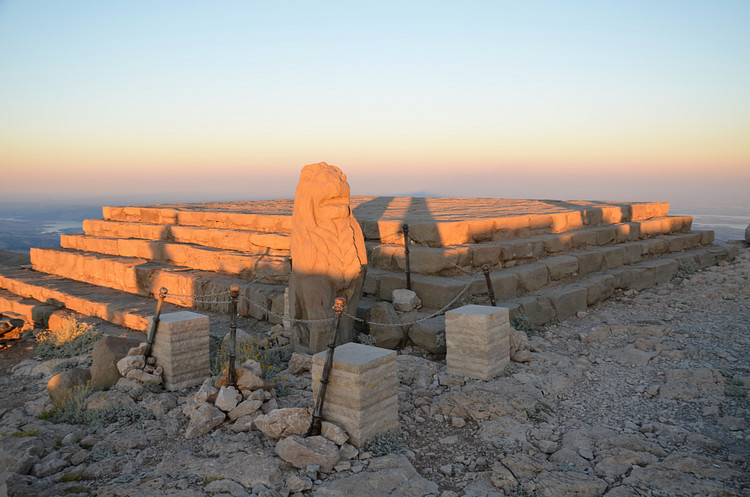
The East Terrace is the best-preserved. The colossal enthroned statues stand on a tiered podium, some 7 metres (22 feet) above the terrace, facing toward the sunrise. On the back of these statues, a long inscription carved in Greek details the historical and legal aspects regarding the sanctuary and the establishment of the new cult. Opposite the seated statues are the foundations of what is believed to be a sacrificial altar.
[  Stepped Altar on Mount Nemrut Carole Raddato (CC BY-NC-SA) ](https://www.worldhistory.org/image/12600/stepped-altar-on-mount-nemrut/ "Stepped Altar on Mount Nemrut")The West Terrace had the same features as those displayed on the East Terrace but was considerably narrower than its eastern counterpart and had no main altar. It is now also more damaged, although the colossal heads are better preserved. The order of the enthroned statues, this time facing the setting sun and standing only 2 metres (6.5 feet) above the terrace, is identical to those of the East Terrace. Alongside the great statues, five superb cult reliefs have survived.
[  Head of Hercules-Artagnes-Ares on Mount Nemrut Carole Raddato (CC BY-NC-SA) ](https://www.worldhistory.org/image/12584/head-of-hercules-artagnes-ares-on-mount-nemrut/ "Head of Hercules-Artagnes-Ares on Mount Nemrut")Three of them represent *dexiosis* scenes showing Antiochus shaking hands with Apollo, Zeus, and Hercules, while the fifth one, the finest, is thought to represent a kind of horoscope, one of the oldest known in the world. It depicts a lion with 19 stars, signifying the constellation Leo, three planets (identified by Greek inscriptions as [Mars](https://www.worldhistory.org/Mars/), [Jupiter](https://www.worldhistory.org/jupiter/), and Mercury) and a crescent moon (representing Commagene). Recent research has shown that the lion relief may reflect the situation of the skies at particular events like the coronation of Mithridates I in 109 BCE and his son Antiochus in 62 BCE. All the reliefs have been removed from the site and are stored in the Adiyaman Archaeological Museum. On the far side of the terrace are reliefs of Antiochus' paternal ancestors, who linked him with the Achaemenid royal house.
[ 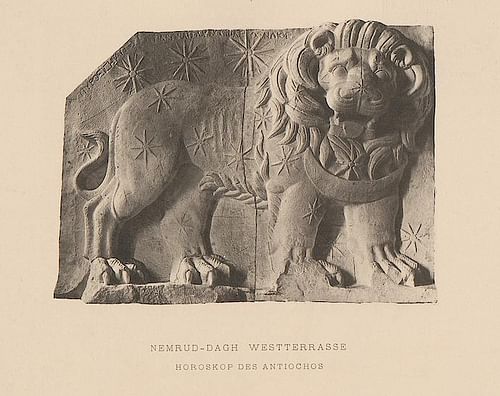 Relief of the Lion Horoscope from Mount Nemrut Unknown photographer (Public Domain) ](https://www.worldhistory.org/image/12598/relief-of-the-lion-horoscope-from-mount-nemrut/ "Relief of the Lion Horoscope from Mount Nemrut")Between the East and West terraces is the 86-metre-long (282 feet) North Terrace. It is quite narrow and was probably never finished as the stelae lying nearby are all unworked, bearing no inscriptions or figures. There is also no statue. Some scholars have advanced the possibility that this terrace was allocated for the use of kings who would take the throne after Antiochus. However, Antiochus' son, Mithridates II (c. 38-20 BCE), probably decided to halt construction projects on Mount Nemrut and instead turned to his own initiatives, such as the construction of the burial monument at Karakus.
### Karakus, the Cendere Bridge, & Arsameia
Upon entering the Nemrut Dagı National Park from the south, the visitor passes a huge tumulus to the left of the road. Like Mount Nemrut, the Karakus Tumulus is an artificial mound, albeit on a more modest scale. It was built by Antiochus' son, Mithridates II of Commagene, as the last resting place of his mother Isias, his sister Antiochis, and his niece Aka I, offering evidence of the importance the Commagene Kingdom placed on women.
The tumulus, about 25 metres (82 feet) in height, was originally encircled by three groups of three Doric columns. Only three columns now remain, topped with an eagle, a lion, and a *dexiosis* relief of King Mithridates II and his sister Laodice shaking hands. On a clear day, the tumulus on the summit of Mount Nemrut is visible as the highest point to the northeast.
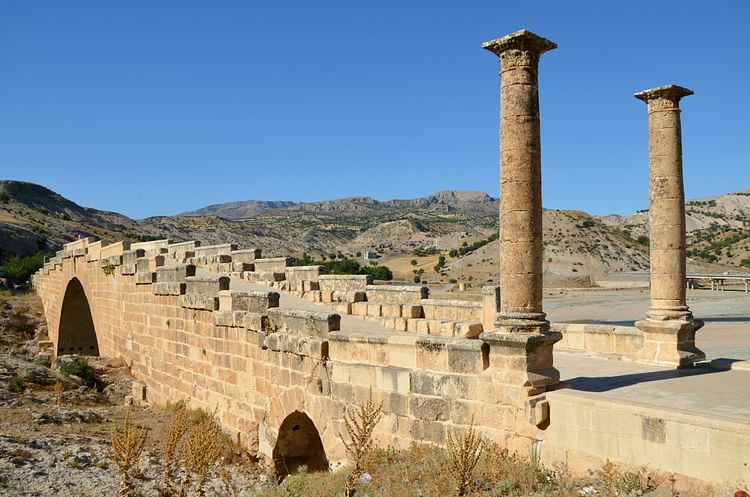
[ ![Tumulus of Karakus [South Side]](https://www.worldhistory.org/img/r/p/750x750/12602.jpg?v=1636186506) Tumulus of Karakus \[South Side\] Carole Raddato (CC BY-NC-SA) ](https://www.worldhistory.org/image/12602/tumulus-of-karakus-south-side/ "Tumulus of Karakus [South Side]")About ten kilometres (6.2 miles) away, the road to Nemrut takes the traveller to one of the best-preserved Roman stone bridges. Known today as Cendere or Severan Bridge, it spans the Cendere River, a tributary of the Euphrates called Chabinas in antiquity. An inscription built into one of its parapets reveals that it was built by the Sixteenth Roman legion (Legio XVI Flavia Firma) in the last years of the 2nd century CE, and was dedicated to the [Roman emperor](https://www.worldhistory.org/Roman_Emperor/) [Septimius Severus](https://www.worldhistory.org/Septimius_Severus/) (r. 193-211 CE).
[ 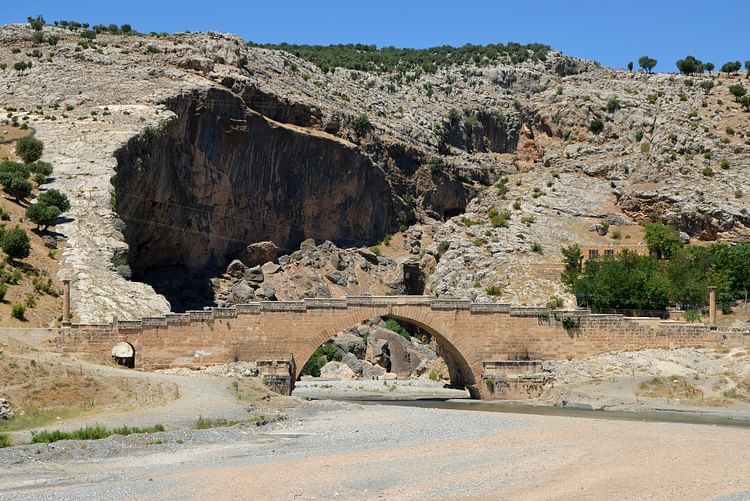 Severan Bridge Carole Raddato (CC BY-NC-SA) ](https://www.worldhistory.org/image/8288/severan-bridge/ "Severan Bridge")There were dedications on the four columns located at each end of the bridge informing us that the financing of the bridge was undertaken by four Commagenean [cities](https://www.worldhistory.org/city/) (Samasata, Perre, Doliche, and Germaniceia). Two columns were dedicated to Septimius Severus and his wife [Julia Domna](https://www.worldhistory.org/Julia_Domna/), while the others were dedicated to their two sons Geta and [Marcus Aurelius](https://www.worldhistory.org/Marcus_Aurelius/) Severus Antoninus. The latter eventually reigned as [Caracalla](https://www.worldhistory.org/Caracalla/) (r. 198-217 CE), had his brother Geta (r. 209-211 CE) killed, and erased him from history. Only three columns have survived as Geta's one was removed from the bridge after his assassination.
[  View of the Severan Bridge from the Southeast Carole Raddato (CC BY-NC-SA) ](https://www.worldhistory.org/image/12604/view-of-the-severan-bridge-from-the-southeast/ "View of the Severan Bridge from the Southeast")About 10 kilometres (6.2 miles) onwards from the Roman bridge, a signpost takes the visitor to the ancient Commagene capital of Arsameia where Antiochus built a *hierothesion* (funerary monument) to his father Mithridates I Callinicus. A path leads uphill to the [Acropolis](https://www.worldhistory.org/Acropolis/) past several free-standing sculptures. The first is a stele of the sun god, Mithras, that originally showed the god shaking hands with King Antiochus. Further along, is another fragmented *dexiosis* with an unidentified king shaking hands with Mithras and two damaged reliefs depicting Mithridates and Antiochus.
[  Antiochus I of Commagene Shaking Hands with Hercules Carole Raddato (CC BY-NC-SA) ](https://www.worldhistory.org/image/8634/antiochus-i-of-commagene-shaking-hands-with-hercul/ "Antiochus I of Commagene Shaking Hands with Hercules")From here, the path climbs to the masterpiece of Arsameia: a superb and perfectly preserved three-and-a-half-metre-high (11.4 feet) *dexiosis* relief depicting King Antiochus, dressed in Persian attire and wearing the Armenian tiara. He is shaking hands with the Greek demigod Hercules who is recognisable thanks to his distinctive lion skin and his club in his left hand. Cut into the rock [wall](https://www.worldhistory.org/wall/) below the relief is an inscription, and below that is the entrance to a 158-metre-long (518 feet) tunnel. The inscription, written in five columns in the Greek language, describes the building activities of Antiochus at Arsameia and specifies the ritual celebrations to be practised in honour of his father Mithridates I Callinicus.
[ 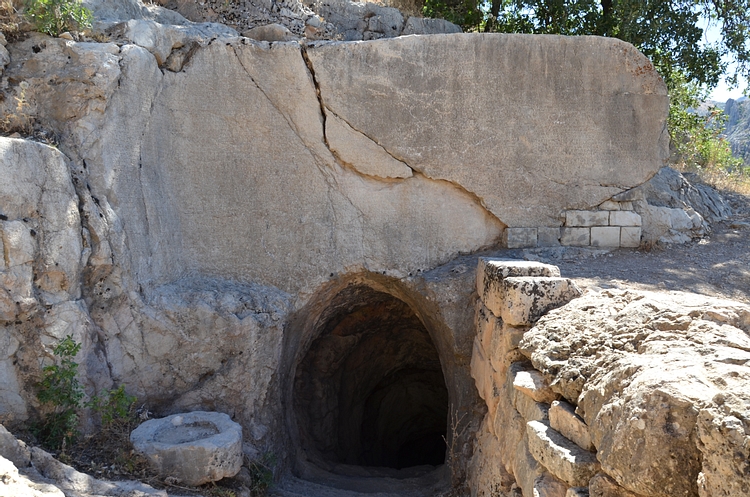 Great Cult Inscription of Arsameia Carole Raddato (CC BY-NC-SA) ](https://www.worldhistory.org/image/12607/great-cult-inscription-of-arsameia/ "Great Cult Inscription of Arsameia")From the tunnel, the path climbs a little further to the plateau of the Acropolis where the most imposing buildings of Arsameia once stood. The ruins are scant with a few [column](https://www.worldhistory.org/column/) bases scattered on the floor and the remains of a staircase of white limestone, but the setting is beautiful, offering scenic views into the valley below.[ 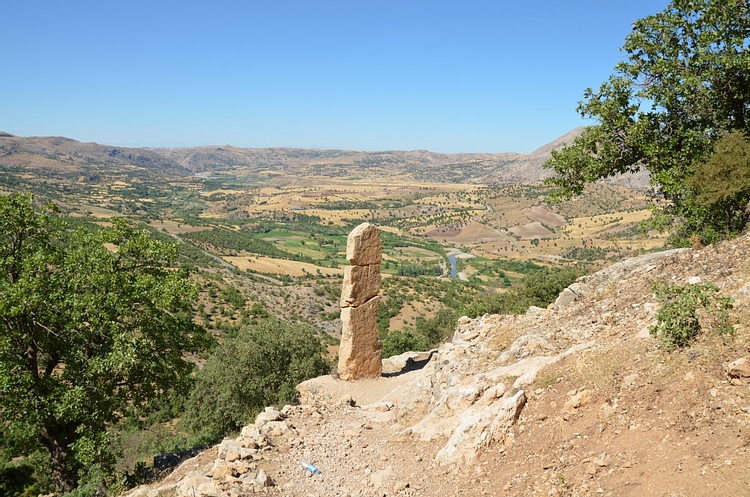 Arsameia on the Nymphaios Carole Raddato (CC BY-NC-SA) ](https://www.worldhistory.org/image/12608/arsameia-on-the-nymphaios/ "Arsameia on the Nymphaios")
### Tips for Visiting Nemrut
WHEN TO VISIT: May through October is best, though sunrise and sunset will be chilly in the spring and autumn months. The mountain is snow-covered from mid-October to the end of April, and winter weather may make the route close to the summit impassable. Most of the local accommodation also closes during the winter months. The best time to visit is June, July, and August when the temperature at the summit is pleasantly cool. The site attracts lots of visitors at sunrise or sunset when the summit is at its most crowded. The trick is to get there just as the early crowd is leaving or before it arrives for the sunset. Then you may have the place to yourself.
GETTING TO NEMRUT: The Nemrut Dagı National Park can be reached by good paved road either from Adiyaman in the south (86 km/53 miles) or Malatya in the north (96 km/60 miles). There are daily flights operated by Turkish Airlines or AnadoluJet to both cities from Istanbul and Ankara. Adıyaman and Kahta make good bases as both have suitable accommodation. The main centres for organised tours to Mount Nemrut for those who do not have transport are Kahta and Malatya, but it is also possible to book a tour from Cappadocia with overnight accommodation.
WHAT TO BRING: Good shoes for the half-hour walk to the summit, warm and windproof clothing no matter whether you go for sunrise or sunset visits, water, and sun cream if you are visiting during the heat of the day.
WHERE TO STAY: The nearest accommodation options from the summit are in the village of Karadut, situated 10 km (6.2 miles) to the south. I can recommend the Karadut Pension, which has simple but clean small rooms and offers good meals.
***This article was originally printed in [Issue 21](https://www.karwansaraypublishers.com/ancient-history-magazine/ahm-shop/single-issues/ahm-issue-21.html) of Ancient History Magazine.***
#### Editorial Review
This human-authored article has been reviewed by our editorial team before publication to ensure accuracy, reliability and adherence to academic standards in accordance with our [editorial policy](https://www.worldhistory.org/static/editorial-policy/).
## Bibliography
- [Blomer, Michael & Winter, Engelbert. *Commagene.* Ege Yayinlari, 2011.](https://www.worldhistory.org/books/9944483354/)
- [Miszczak, Izabela & Ates, Alper K. *The Secrets of Mount Nemrut.* ASLAN Publishing House, 2018.](https://www.worldhistory.org/books/8394426980/)
## About the Author
Carole maintains the popular ancient history photo-blog Following Hadrian, where she travels the ancient world in the footsteps of Emperor Hadrian.
- [Facebook Profile](https://www.facebook.com/FollowingHadrian)
- [X/Twitter Profile](https://twitter.com/carolemadge)
## Cite This Work
### APA
Raddato, C. (2020, August 20). Exploring Mount Nemrut - A Meeting Point Between East & West. *World History Encyclopedia*.
### Chicago
Raddato, Carole. "Exploring Mount Nemrut - A Meeting Point Between East & West." *World History Encyclopedia*, August 20, 2020. .
### MLA
Raddato, Carole. "Exploring Mount Nemrut - A Meeting Point Between East & West." *World History Encyclopedia*, 20 Aug 2020, .
## License & Copyright
Submitted by [Carole Raddato](https://www.worldhistory.org/user/FollowingHadrian/ "User Page: Carole Raddato"), published on 20 August 2020. The copyright holder has published this content under the following license: [Creative Commons Attribution-NonCommercial-ShareAlike](https://creativecommons.org/licenses/by-nc-sa/4.0/deed.en). This license lets others remix, tweak, and build upon this content non-commercially, as long as they credit the author and license their new creations under the identical terms. When republishing on the web a hyperlink back to the original content source URL must be included. Please note that content linked from this page may have different licensing terms.