---
title: The Heroon of Trysa: A Lycian Tomb Reappears
author: Duncan JD Smith
source: https://www.worldhistory.org/article/1584/the-heroon-of-trysa-a-lycian-tomb-reappears/
format: machine-readable-alternate
license: Creative Commons Attribution-NonCommercial-ShareAlike (https://creativecommons.org/licenses/by-nc-sa/4.0/)
updated: 1970-01-01
---
# The Heroon of Trysa: A Lycian Tomb Reappears
_Authored by [Duncan JD Smith](https://www.worldhistory.org/user/duncanjdsmith/)_
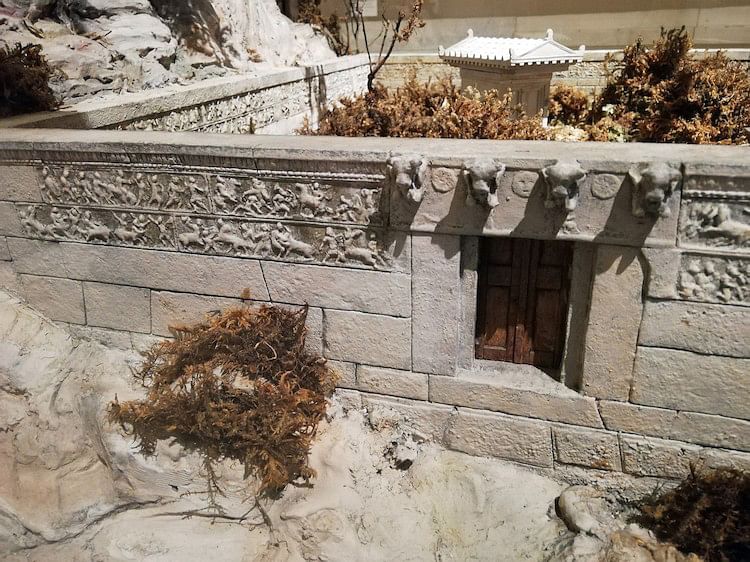
The Heroon of Trysa was the [tomb](https://www.worldhistory.org/tomb/) of a powerful [Lycian](https://www.worldhistory.org/lycia/) dynast surrounded by a precinct [wall](https://www.worldhistory.org/wall/) covered with remarkable mythological friezes. It was discovered in 1841 CE when a Polish-Prussian school teacher and classical philologist, [Julius](https://www.worldhistory.org/disambiguation/Julius/) August Schönborn (1801-1857 CE), set out to explore the Teke Peninsula in southwest [Turkey](https://www.worldhistory.org/Asia_Minor/). Over 2,000 years earlier, this mountainous region east of [Rhodes](https://www.worldhistory.org/Rhodes/) had been the Kingdom of [Lycia](https://www.worldhistory.org/lycia/). Schönborn recognised the characteristic ogival stone sarcophagi and pillar tombs of the Lycians. What he discovered on 20 December, however, was altogether different, and the subsequent fate of these friezes would embellish an already intriguing archaeological tale.
[  Model of the Heroon of Trysa Duncan JD Smith (Copyright) ](https://www.worldhistory.org/image/12522/model-of-the-heroon-of-trysa/ "Model of the Heroon of Trysa")### [Homer](https://www.worldhistory.org/homer/)'s Heroes
Considerable mystery surrounds both Trysa and the Lycians. Prompted by the paucity of prehistoric material on the peninsula, archaeologists have suggested the Lycians were nomadic settlers. [Pottery](https://www.worldhistory.org/pottery/) excavated in the 1950s CE at the better-known Lycian site of Xanthos suggests they arrived in the area during the 8th century BCE. If correct, this would make their appearance contemporary with Homer, the semi-legendary author of the *[Iliad](https://www.worldhistory.org/iliad/)* and the *[Odyssey](https://www.worldhistory.org/Odyssey/)*. Indeed, the first literary mention of Lycia is in the *Iliad*, where Homer writes that "The Lycians were led by [Sarpedon](https://www.worldhistory.org/Sarpedon/) with Glaucus, the heroes, Far from Lycia, from the whirling waters of Xanthus" to fight in the [Trojan War](https://www.worldhistory.org/Trojan_War/) (*Iliad*, Book II, line 875). [Herodotus](https://www.worldhistory.org/herodotus/) later posited that Sarpedon had conducted the Lycians to Turkey ([Anatolia](https://www.worldhistory.org/Asia_Minor/)) from [Crete](https://www.worldhistory.org/crete/).
#### Magazine Syndication
[](http://bit.ly/timeless-travels "Timeless Travels Magazine")### Timeless Travels Magazine
Available in Print & Digital Editions This article was first published in Timeless Travels Magazine and republished with permission. Timeless Travels is the unique travel magazine for those who are inspired to travel by their love or interest in archaeology, history or art. Our editorial team highly recommends this magazine! [Get the Magazine](http://bit.ly/timeless-travels)
.button_container {
margin-top: 2em;
}
.sponsor.book h3 {
text-transform: none;
margin-top: 0px;
margin-bottom: 15px;
font-family: "Libre Baskerville", "Palatino Linotype", "Book Antiqua", Palatino, serif;
}
.sponsor_message {
margin-left: 190px;
font-family: Karla, Arial, Helvetica, sans-serif;
line-height: 140%;
min-height: 200px;
}
.sponsor.book {
padding: 10px 0px 25px 0px;
margin: 25px 0px;
border-top: 1px dotted #dadada;
border-bottom: 1px dotted #dadada;
}
.sponsor.book .key_art {
margin-top: 0px;
margin-bottom: 10px;
float: left;
border: 1px solid #f3f3f3;
}
.sponsor h4 {
font-weight: normal;
text-transform: uppercase;
color: silver;
margin-bottom: 10px;
margin-top: 0px;
font-family: Karla,Arial,Helvetica,sans-serif;
font-size: 13px;
padding: 0;
}
.sponsor_book_author {
color: silver;
margin: -10px 0px 20px;
}
@media (max-width: 1199px) {
.sponsor.book .key_art {
float: none;
width: 100%;
}
.sponsor.book .sponsor_message {
margin-left: 0px;
}
.sponsor.book h3 {
margin-top: 20px;
margin-bottom: 10px;
}
}
@media (max-width: 767px) {
}
As for the name 'Lycia', according to [Greek mythology](https://www.worldhistory.org/Greek_Mythology/), it derives from an exiled Athenian merchant, Lycus, who settled in the area sometime in the 5th century BCE. During this time Lycia came under considerable [Greek](https://www.worldhistory.org/disambiguation/greek/) economic and cultural influence, and Lycian deities found counterparts in the Greek [pantheon](https://www.worldhistory.org/Pantheon/). Following the [Peloponnesian War](https://www.worldhistory.org/Peloponnesian_War/) (431-404 BCE), however, Lycia fell increasingly under Persian sway. Greek artisans, notably those based in [war](https://www.worldhistory.org/disambiguation/War/)-torn [Athens](https://www.worldhistory.org/Athens/), sought work instead in Anatolia, and it was during this time that the Heroon of Trysa was constructed.
Trysa is located 792 m (2,600 feet) above sea level on a long ridge of the Taurus mountain range overlooking the Demre Gorge, between the Lycian towns of Myra and Cyaneae (its nearest modern neighbour is the village of Gölbaşi). During Lycian times it would have been one element in a patchwork of [city](https://www.worldhistory.org/city/)-states that covered the Teke Peninsula. The name 'Trysa' makes no appearance in ancient [literature](https://www.worldhistory.org/literature/) though and instead is known only from inscriptions, as well as coins of the period inscribed 'TR'.
Other than a small ruined [temple](https://www.worldhistory.org/temple/) and some cisterns, Trysa's monuments are all sepulchral. Consisting of plain and decorated ogival sarcophagi, as well as a ruined pillar tomb, they dot the partly-terraced ridge, which was originally surrounded by a rubble-built circuit wall of which only the north and west parts remain. These structures aside, Trysa's great treasure is its heroön.
[  Reconstruction of the Entrance to the Heroon of Trysa Duncan JD Smith (Copyright) ](https://www.worldhistory.org/image/12523/reconstruction-of-the-entrance-to-the-heroon-of-tr/ "Reconstruction of the Entrance to the Heroon of Trysa")### Unique Frieze
A *heroön* is defined as a shrine constructed in the classical world over and around the tomb of a respected ruler and used for their veneration and hero worship. The Trysa Heroon stood at the northeast end of the site, where it consisted of a multi-storey tomb of an unnamed ruler and his family set in the middle of a sacred precinct approximately 21 m (70 feet) square. The precinct wall, which stood c. 3 m (9-10 feet) high, was covered on its inner face on all four sides, as well as the outer face of the entrance side, with an originally polychrome limestone frieze in two horizontal bands, one above the other. The funerary cult was celebrated in an adjacent timber structure.
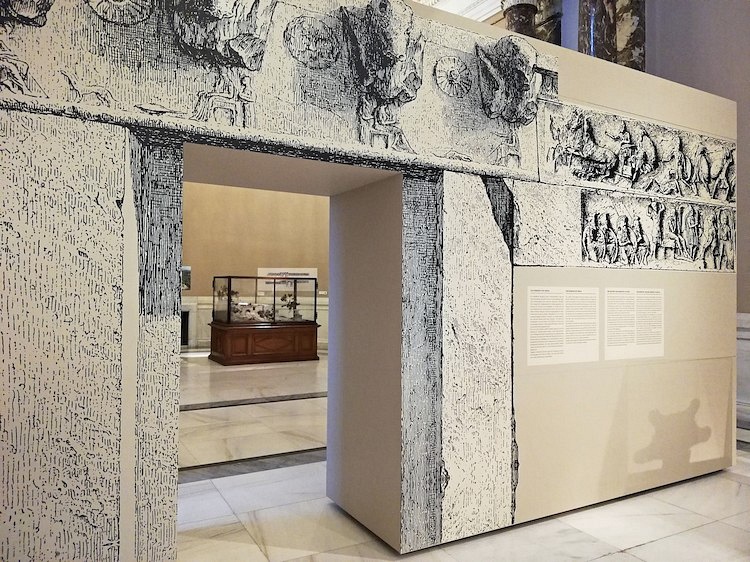
It is these reliefs that make the Heroon of Trysa so special. Probably carved around 380 BCE by émigré Greek artisans, they uniquely intertwine Lycian mythological heroics with similar Greek episodes, which were used to emphasise the heroic status of the buried ruler. These include scenes from the *Iliad* and the *Odyssey*, the exploits of [Theseus](https://www.worldhistory.org/Theseus/), the [Oedipus](https://www.worldhistory.org/Oedipus_the_King/)-themed *[Seven against Thebes](https://www.worldhistory.org/Seven_Against_Thebes/)*, as well as battles of Greeks and [Amazons](https://www.worldhistory.org/amazon/), Centaurs and Lapithae. Typical is the Homeric scene flanking the entrance in the south wall showing the Corinthian hero [Bellerophon](https://www.worldhistory.org/Bellerophon/) on his winged horse [Pegasus](https://www.worldhistory.org/Pegasus/) confronting the fire-breathing Chimera.
[ 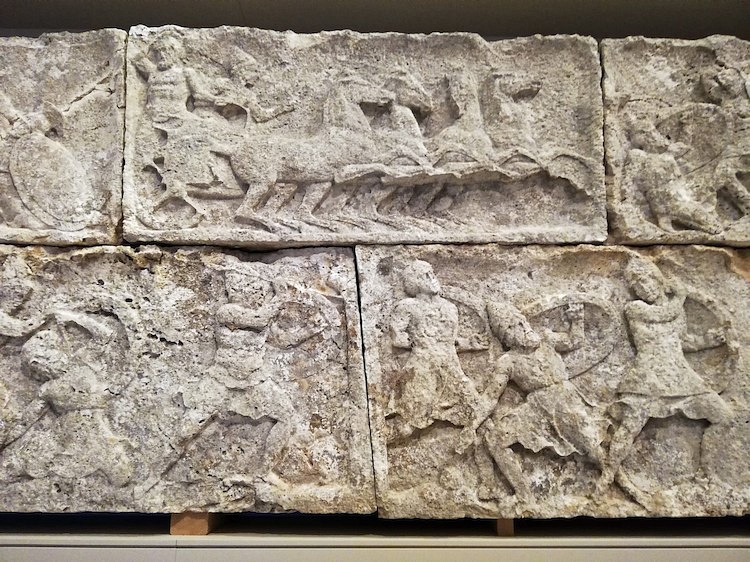 Battle Scene from the Heroon of Trysa Duncan JD Smith (Copyright) ](https://www.worldhistory.org/image/12524/battle-scene-from-the-heroon-of-trysa/ "Battle Scene from the Heroon of Trysa")Also noteworthy are the masterful representations of flowing drapery, the intimations of linear perspective and the novel framing fillets used to break up the scenes on each stone (these include a tree, its trunk and branches shared by two adjacent stones, and the rudders of beached ships dipping down into the stone below). All these are deployed on the west wall in the lively scene of a seashore [battle](https://www.worldhistory.org/disambiguation/battle/) followed by the siege of a city, which in turn gives way to an Amazonomachy (a clash with the legendary all-female warriors). It is difficult not to assume the scene was inspired by the siege of [Troy](https://www.worldhistory.org/troy/).
### Austrian Archaeologists
Unfortunately when describing the Heroon of Trysa today one must use the past tense. Visit the site now and whilst the setting remains undeniably dramatic, the Heroon is largely gone. Its original discoverer, Julius August Schönborn, died in 1857 CE without leaving a map. This did not stop a team of Austrian archaeologists setting out in 1881 CE though to rediscover the site. They were led by Otto Berndorf (1838-1907 CE), Professor of Classical [Archaeology](https://www.worldhistory.org/Archaeology/) at the University of Vienna and first director of excavations at [Ephesus](https://www.worldhistory.org/ephesos/).
Berndorf was different from Schönborn in having the financial resources and political clout to acquire the Heroon for Austria. With financing in place and permission from Ottoman officials, all Berndorf needed was the manpower required to dismantle the monument. His crew built a road up to the site, bringing tools and provisions necessary for the job. They then set about disassembling the frieze, as well as the monumental gateway and parts of the tomb. These were then loaded onto carts and brought down to the sea.
[  Seashore Battle, Heroon of Trysa Duncan JD Smith (Copyright) ](https://www.worldhistory.org/image/12525/seashore-battle-heroon-of-trysa/ "Seashore Battle, Heroon of Trysa")Considering the task in hand, the job went fairly smoothly. It was only marred by the magnificent gateway tipping over a cliff during transport and crashing on rocks below. Despite this, the precious cargo was eventually loaded onto a ship and transported to Trieste. Thereafter it was moved overland to the Austrian capital, Vienna, where it arrived in 1884 CE.
### Heroic Return
The component parts of the Heroon of Trysa were deposited at the soon-to-be-completed Kunsthistorisches Museum on Vienna's famous Ringstrasse. Construction, however, was too far advanced to incorporate what would be an enormous exhibit when reconstructed. So instead, and despite all the effort in acquiring them, the friezes were stored away from the public gaze in the museum's basement.
For the next [hundred years](https://www.worldhistory.org/disambiguation/Hundred_Years/), the Trysa frieze lay hidden. Only in 1984 CE, and then only for a couple of days, was the dismantled frieze made accessible to the public during an Open Doors event. That some 6,500 visitors attended was a measure of the public's curiosity for this unique classical treasure. With the event over, however, the depot closed its doors on the friezes once more.
[ 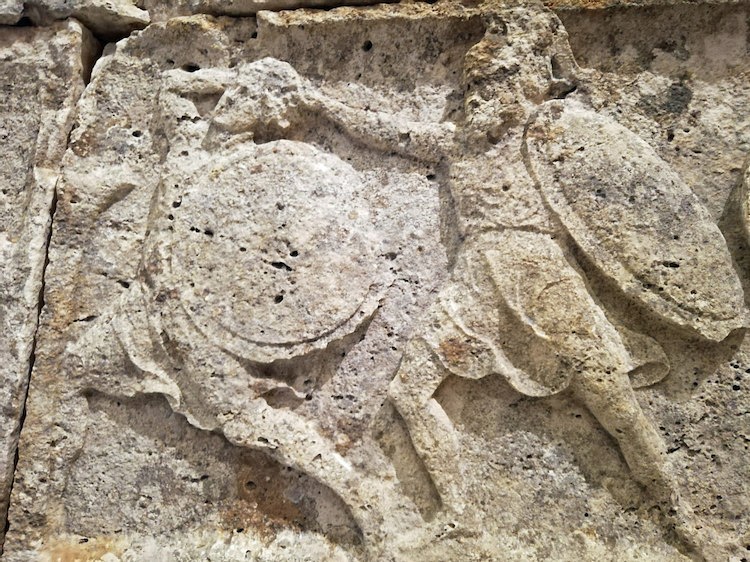 Heroon of Trysa - Detail Duncan JD Smith (Copyright) ](https://www.worldhistory.org/image/12526/heroon-of-trysa---detail/ "Heroon of Trysa - Detail")Thereafter various ideas to display the friezes were proposed, including the construction of a new subterranean gallery beneath the museum forecourt. None came to fruition though, due to lack of funds. Only in late 2018 CE was a partial solution found when some of the reliefs were displayed in the [Ephesus](https://www.worldhistory.org/ephesos/) Museum, which since 1978 CE had occupied rooms in the Habsburgs' Neue Burg on the opposite side of the Ringstrasse. With space limited and the weight of the frieze a cause for concern, it is only a partial reconstruction, the main gateway, for example, being an artistic representation only.
The chance to get up close to a part of the frieze after so many years, however, is worth the compromise, and the experience is nicely fleshed out by a scale model of the heroon as it would originally have appeared. Three relief panels are also currently on display in the Collection of Greek and [Roman](https://www.worldhistory.org/disambiguation/Roman/) Antiquities at the Kunsthistorisches Museum. The longer-term plan is that eventually the entire frieze will be displayed in its own gallery on the ground floor.
*This article was originally published in [Timeless Travels Magazine](https://www.timeless-travels.co.uk/). Travel writer Duncan J. D. Smith is the author and publisher of the Only In Guides, a series of city guidebooks aimed at independent cultural travellers. You can find out more about his work at www.onlyinguides.com and www.duncanjdsmith.com.*
#### Editorial Review
This human-authored article has been reviewed by our editorial team before publication to ensure accuracy, reliability and adherence to academic standards in accordance with our [editorial policy](https://www.worldhistory.org/static/editorial-policy/).
## Bibliography
- [Bean, George E. *Lycian Turkey.* Trafalgar Square Publishing, 1989.](https://www.worldhistory.org/books/0719546621/)
- [Haynes, Sybille. *Land of the Chimaera.* Chatto & Windus, 1974.](https://www.worldhistory.org/books/0701120053/)
- [Landskron, Alice. *Denkmäler in Lykien zwischen Ost und West/2.* Holzhausen Verlag GmbH, 2016.](https://www.worldhistory.org/books/3902976462/)
- Otto Benndorf. *Das Heroon van Gjölbaschi-Trysa.* Wien, 1889
- [Wolfgang Oberleitner. *Das Heroon von Trysa.* 1970.](https://www.worldhistory.org/books/3805316402/)
## About the Author
Travel writer Duncan J. D. Smith FRGS is the author and publisher of the Only In Guides, a series of city guidebooks aimed at independent cultural travellers. You can find out more about his work at www.onlyinguides.com and www.duncanjdsmith.com.
- [Facebook Profile](https://www.facebook.com/theurbanexplorer)
- [X/Twitter Profile](https://twitter.com/OnlyInGuides)
- [Linkedin Profile](https://www.linkedin.com//in/duncanjdsmith/)
## Cite This Work
### APA
Smith, D. J. (2020, August 04). The Heroon of Trysa: A Lycian Tomb Reappears. *World History Encyclopedia*.
### Chicago
Smith, Duncan JD. "The Heroon of Trysa: A Lycian Tomb Reappears." *World History Encyclopedia*, August 04, 2020. .
### MLA
Smith, Duncan JD. "The Heroon of Trysa: A Lycian Tomb Reappears." *World History Encyclopedia*, 04 Aug 2020, .
## License & Copyright
Submitted by [Duncan JD Smith](https://www.worldhistory.org/user/duncanjdsmith/ "User Page: Duncan JD Smith"), published on 04 August 2020. The copyright holder has published this content under the following license: [Creative Commons Attribution-NonCommercial-ShareAlike](https://creativecommons.org/licenses/by-nc-sa/4.0/deed.en). This license lets others remix, tweak, and build upon this content non-commercially, as long as they credit the author and license their new creations under the identical terms. When republishing on the web a hyperlink back to the original content source URL must be included. Please note that content linked from this page may have different licensing terms.