---
title: Ancient Handicrafts in Rural Lebanon
author: Maya Shames
source: https://www.worldhistory.org/article/1545/ancient-handicrafts-in-rural-lebanon/
format: machine-readable-alternate
license: Creative Commons Attribution-NonCommercial-ShareAlike (https://creativecommons.org/licenses/by-nc-sa/4.0/)
updated: 1970-01-01
---
# Ancient Handicrafts in Rural Lebanon
_Authored by [Maya Shames](https://www.worldhistory.org/user/maya.shames/)_
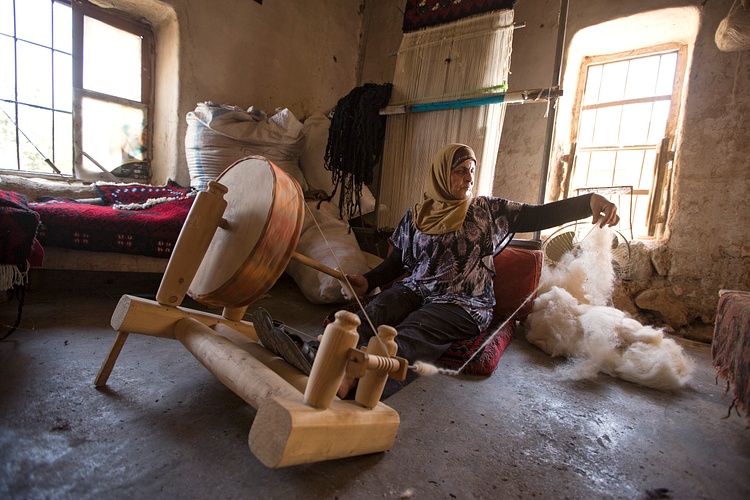
Traditional Lebanese handicrafts are considered to be a major sector of the living cultural heritage in the rural areas of Lebanon. Transmitted from one generation to another, traditional rural Lebanese handicrafts have been able to persist from the Phoenician and [Roman](https://www.worldhistory.org/disambiguation/Roman/) periods until the present day. Rural regions have particular focus when talking about traditional handicrafts because of their rich tangible and intangible cultural heritage. When resources were limited and scarce, rural communities had nothing but to sustain their heritage and integrate handicrafts into their daily life. For rural communities, traditional handicrafts are considered an art of living; craftsmen use local materials to create objects for practical, everyday use. The cultural and historical significance of handicrafts creates a sense of pride among artisans and people living in the rural areas of Lebanon.
[  Weaving in Rural Lebanon UN Women/Joe Saade (CC BY-NC-ND) ](https://www.worldhistory.org/image/12113/weaving-in-rural-lebanon/ "Weaving in Rural Lebanon")### Definition
'Handicraft' is known also as artisanal handicraft “is a type of work where useful and decorative devices are made completely by hand or by using only simple tools, and it is a traditional main sector of craft” (Syndicate of Craftsmen in Lebanon). However, when mass items are produced using machines, it is more applicable to use the term craft.
The handicrafts produced by artisans working in rural areas in Lebanon are unique since artisans use a mix of old production methods and modern techniques. The latter was developed and maintained by local artisans in the rural regions of Lebanon to incorporate handicrafts into modern life as well as to allow for more variations. Visitors are offered the opportunity to explore the ancient and modern processes of making traditional handicrafts by visiting artisans' homes or their small workshops.
### Basket Weaving
Agricultural activities in rural Lebanon date back to Phoenician times. That period witnessed the creation of baskets to facilitate harvesting crops. Baskets were produced from the raw materials available in the region, including reed, grass, and palm leaves. Rustic baskets were used to carry figs, olives, and fruits during harvesting [seasons](https://www.worldhistory.org/Horae/). For centuries, rural communities were keen to weave baskets and sustain the handicraft for many generations as part of their living heritage.
Today, different rural regions specialize in weaving various types of baskets. Amchit (Mount of Lebanon), for example, is famous for its typical and unique basket weaving, using palm leaves. Zgharta-Bcharre (in the north), Kefraya (in the Bekaa), and Saida (in the south) use reed and grass to create larger baskets for the transportation of fruits. In other rural regions of Lebanon, baskets are woven from local bamboo or wood. Today, weavers, with the assistance of experts in the field, have developed modern designs and techniques.
### Nawl Weaving
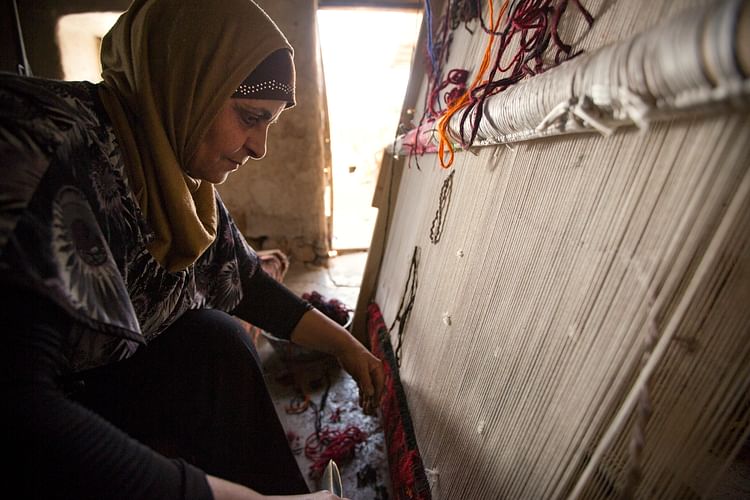
*Nawl* weaving also dates back to the [Phoenicians](https://www.worldhistory.org/phoenicia/). *Nawl* is an old machine used to produce fabrics such as carpets, tablecloths, small [silk](https://www.worldhistory.org/Silk/) bags, jackets, and *abayas* (traditional ceremonial cloaks woven with wool or silk). Phoenicians produced unique *nawl* fabrics made of [Tyrian purple](https://www.worldhistory.org/Tyrian_Purple/) dye.
Silk *nawl* was mainly produced in Mount Lebanon and parts of the *Bekaa* valley. From the reign of [Justinian I](https://www.worldhistory.org/Justinian_I/) (r. 527-565 CE), rural communities relied on silk production for their practical daily use, such as for the production of clothes. Today, many villages specialize in silk *nawl*. Zouk Mikael is very famous for this type of handicraft; during the 18th and 19th centuries CE, it was known as the “silk village” for its distinguished silk *nawl* weaving. The first three Lebanese flags were woven in Zouk Mikael tapestry. In addition to silk *nawl,* tents and carpets were woven from goat hair. In many rural villages in Lebanon, such as in the villages of Kousba and Chhim, one can see many ancient vertical looms.
[  Woman Weaving, Lebanon PhotoUN Women/Joe Saade (CC BY-NC-ND) ](https://www.worldhistory.org/image/12114/woman-weaving-lebanon/ "Woman Weaving, Lebanon")### Embroidery
[Women](https://www.worldhistory.org/disambiguation/women/) also had their influence in creating and transmitting cultural heritage. If necessity is the mother of invention, then embroidery is the invention of women in the rural areas of Lebanon. A living domestic handicraft, embroidery had a major role in facilitating women's lives, particularly wedding occasions. Young ladies, when they turn 10, start embroidering by themselves their trousseau for personal (undergarments, clothes, bags, etc.) and household use (table and bed linen like bed covers, bedsheets, tablecloths, pillow covers…) as well as paintings and portraits of varying designs and colors for home decoration.
Today, embroidery workshops are spread in different rural villages in Lebanon. Visitors are welcome all year round to explore and learn about this traditional handicraft and buy embroidery items. To support women in rural areas and increase their capacities, many initiatives have been developed by local and international NGOs as well as private and public agencies. The purpose is to empower women and create alternative sources of revenue.
### [Pottery](https://www.worldhistory.org/pottery/)
Archaeologists have found evidence for the use of pottery in Lebanon from the [Neolithic period](https://www.worldhistory.org/Neolithic/), c. 5000 BCE. In almost every kitchen and house in rural regions, you can find pottery objects such as bowls, platters, coffee or tea sets, jars (used for conserving olive oil, vinegar, and *arak* - a typical Lebanese homemade beverage) as well as water jars (used to keep water cool at any time and any season of the year).
Potters installed wood-burning ovens and manufactured pottery in the backyard of their houses. They used locally available materials to form the glaze, especially olive oil, an agro-industrial product and part of the culinary tradition of Lebanon. Many traditional pottery workshops still exist in rural villages in Lebanon, Rachaya El Foukhar (*El Foukhar* means pottery in Arabic), Chouf region, Tripoli, Beit Chabab, Assia, and Aita el-Foukhar being the best-known examples.
### Blown Glass
Glass blowing is another very ancient and unique handicraft in the rural regions of Lebanon, which is believed to date back as far as 50 BCE. Phoenician [cities](https://www.worldhistory.org/city/) such as [Tyre](https://www.worldhistory.org/Tyre/), Sarafand, [Sidon](https://www.worldhistory.org/sidon/), and Tripoli were well known for their glass-blowing workshops. Although nowadays there are only a few left, visitors can still find authentic, traditional workshops. In Sarafand, for instance, glass blowing still follows an ancient and unique tradition. One unique feature of the process is that used glass is sorted and recycled. Sorting is done at the glass-blowers' workshops or at home, and the process results in beautiful objects in a wide range of colors and shapes, including traditional drinking bottles, jagged vases, glasses, and jars.
Another example that illustrates an ancient and little-known technique of glass blowing is the Baddaoui-Tripoli workshop. This time, the uniqueness is reflected in the glass material, which is slightly opaque and sprinkled with tiny air bubbles. The results are vases, candle holders, water glasses, etc. in violet, turquoise, green, and yellow colors.
### Conclusion
Despite the many problems faced by craftsmen in Lebanese rural areas, these traditions are still alive and offer visitors a unique experience of magnificent craftsmanship. On a personal level, artisans in Lebanon's rural areas are developing their handicrafts from a simple hobby to professional work; they are also educating others on the processes and skills required. On a national level, many local NGOs and protection agencies are doing their best to preserve Lebanon's cultural heritage. For instance, *La Maison de l'Artisan* (craftsmen' house) promotes handicrafts and provides new market opportunities not only in the capital of Lebanon Beirut but also at regional and international level. For handicrafts to keep telling traditional stories about rural communities, national authorities have to develop and implement effective laws and regulations for the protection of the traditional rural handicrafts and the know-how of craftsmen in Lebanon.
#### Editorial Review
This human-authored article has been reviewed by our editorial team before publication to ensure accuracy, reliability and adherence to academic standards in accordance with our [editorial policy](https://www.worldhistory.org/static/editorial-policy/).
## Bibliography
- [Destination Lebanon](http://www.destinationlebanon.gov.lb/en/TourismType/details/12 "Destination Lebanon"), accessed 23 Apr 2020.
- [Explore Lebanon Archives](http://www.lebanontraveler.com/en/magazine/category/explore-lebanon/ "Explore Lebanon Archives"), accessed 23 Apr 2020.
- [Institut Antonin Artistique](http://www.antonins.org/en/presence/au-liban/autres/institut-antonin-artistique "Institut Antonin Artistique"), accessed 23 Apr 2020.
- [Les Plus Beaux Villages du Liban](http://www.pbvliban.org/the-villages/ "Les Plus Beaux Villages du Liban"), accessed 23 Apr 2020.
- [Ministry of Tourism](http://mot.gov.lb/Publications/Articles "Ministry of Tourism"), accessed 23 Apr 2020.
- [Syndicate of Craftsmen in Lebanon](https://www.lebanesecraftsmen.com/ "Syndicate of Craftsmen in Lebanon"), accessed 23 Apr 2020.
- Abichaker, Ziad. "Embroidery artisans." *Lebanon traveler magazine*, February 11, 2015.
- Azzam, Salim. "Sharing Stories Through Embroidery." *Lebanon traveler magazine*, April 8, 2020.
- Farra-Haddad, N. *Eco-Lebanon nature & rural tourism: a guide to unveil Lebanon.* Lebanon: Hospitality Services s.a.r.l, 2013, 156-278.
- Firro, K. "Silk and agrarian changes in Lebanon, 1860-1914." *International Journal of Middle East Studies*, 2. 22 (May), pp. 151-169.
- Freiha, A. *The Lebanese village.* Beirut : Dar El Machreq.
- Ghadban, S., M. Shames, J. Abou Arrage, and A. Abou Fayyad. "Rural tourism in Lebanon: What does the market reveal?." *Management & Avenir*, special issue no. 96 (December), pp. 165-185.
## Cite This Work
### APA
Shames, M. (2020, April 23). Ancient Handicrafts in Rural Lebanon. *World History Encyclopedia*.
### Chicago
Shames, Maya. "Ancient Handicrafts in Rural Lebanon." *World History Encyclopedia*, April 23, 2020. .
### MLA
Shames, Maya. "Ancient Handicrafts in Rural Lebanon." *World History Encyclopedia*, 23 Apr 2020, .
## License & Copyright
Submitted by [Maya Shames](https://www.worldhistory.org/user/maya.shames/ "User Page: Maya Shames"), published on 23 April 2020. The copyright holder has published this content under the following license: [Creative Commons Attribution-NonCommercial-ShareAlike](https://creativecommons.org/licenses/by-nc-sa/4.0/deed.en). This license lets others remix, tweak, and build upon this content non-commercially, as long as they credit the author and license their new creations under the identical terms. When republishing on the web a hyperlink back to the original content source URL must be included. Please note that content linked from this page may have different licensing terms.