---
title: Museums in the Ancient Mediterranean
author: Mark Cartwright
source: https://www.worldhistory.org/article/1530/museums-in-the-ancient-mediterranean/
format: machine-readable-alternate
license: Creative Commons Attribution-NonCommercial-ShareAlike (https://creativecommons.org/licenses/by-nc-sa/4.0/)
updated: 1970-01-01
---
# Museums in the Ancient Mediterranean
_Authored by [Mark Cartwright](https://www.worldhistory.org/user/markzcartwright/)_
Museums have been around much longer than one might think, but in the ancient world, they were principally institutions of research and learning rather than places to display artworks and artefacts, even if they were often located in grand buildings and decorated with examples of fine [sculpture](https://www.worldhistory.org/disambiguation/Sculpture/) and painting. The name 'museum' derives from the [Muses](https://www.worldhistory.org/muse/), those nine [Greek](https://www.worldhistory.org/disambiguation/greek/) goddesses associated with wisdom and the arts. The most celebrated example in the ancient world was the Museum of [Alexandria](https://www.worldhistory.org/alexandria/), a part of which was the now much more famous [Library of Alexandria](https://www.worldhistory.org/Library_of_Alexandria/). In terms of art for the public's enjoyment, there were alternative places such as the collections within royal palaces, temples, baths and libraries, and, for monumental art, such public arenas as circuses and amphitheatres. In short, then, a citizen of the ancient [Mediterranean](https://www.worldhistory.org/disambiguation/mediterranean/) did not usually lack places where they could admire fine artworks which told tales from [mythology](https://www.worldhistory.org/mythology/) and [religion](https://www.worldhistory.org/religion/), represented episodes of [literature](https://www.worldhistory.org/literature/) and [warfare](https://www.worldhistory.org/warfare/), or gave an exotic glimpse of conquered lands and faraway places.
[  Ivory Token Depicting Egyptian Obelisk and Temple Getty Museum (CC BY) ](https://www.worldhistory.org/image/9010/ivory-token-depicting-egyptian-obelisk-and-temple/ "Ivory Token Depicting Egyptian Obelisk and Temple")### Origins
The name museum derives from the nine Muses of [Greek mythology](https://www.worldhistory.org/Greek_Mythology/), each of which was credited with a particular skill in the arts. A natural spot where birds sang, for example, was a typical place given attachment to the Muses. Such sacred places might then receive an altar or small [temple](https://www.worldhistory.org/temple/) as it was believed the Muses were present there. These places were the very first 'museums'. We know that Mount Helicon in southwest Boeotia - the spot where the Greek writer [Hesiod](https://www.worldhistory.org/hesiod/) (c. 700 BCE) claimed to have met the Muses - had a museum which contained works of Hesiod and statues of figures associated with the arts. Schools, in particular, came to be referred to as 'the places of the Muses'.
The great schools of such famed philosophers as [Plato](https://www.worldhistory.org/plato/) (c. 428 - c. 347 BCE) and [Aristotle](https://www.worldhistory.org/aristotle/) (384-322 BCE), the Academy and Lyceum, respectively, both in [Athens](https://www.worldhistory.org/Athens/), each had a museum. The Lyceum (aka Peripatos) especially, was a model followed by later institutions. Founded around 335 BCE, the Lyceum had three distinctive features: the teamwork of its scholars, its encyclopedic research, and the ambitious goal of assembling as many complete documentary sources as possible.
### Books, Baths & Schools
In antiquity, there was often no particular distinction between libraries and museums, and both could occupy the same building. The ancient library - from Athens to Alexandria - was often a place where legal, sacred and administrative documents were stored, a rich repository of literary works, and a place where lectures could be heard. Early libraries were often attached to a temple or royal [palace](https://www.worldhistory.org/disambiguation/palace/). Greek libraries also came to be attached to public gymnasiums and eventually private libraries developed, too. The first Greek public library is credited by ancient authors to the efforts of [Peisistratos](https://www.worldhistory.org/Pisistratus/) of Athens (d. c. 527 BCE). Libraries became the homes of philosophical schools and educational institutions. Documents were typically in the form of wax or clay tablets, papyrus or leather scrolls, and parchment codexes. The idea was that visitors - usually scholars - could go and read these documents (but could not remove them from the building), much as we would use a reference library today. The texts were kept in partitioned wooden cupboards and these were set in niches in the walls. Other niches often contained statues and so learning and art came to be associated together.
[  Sophia-Wisdom, Celsus Library, Ephesos Mark Cartwright (CC BY-NC-SA) ](https://www.worldhistory.org/image/702/sophia-wisdom-celsus-library-ephesos/ "Sophia-Wisdom, Celsus Library, Ephesos")Just as wealthy citizens donated scrolls to libraries, so too, artworks were given to beautify what was already one of the most pleasant environments in any large [city](https://www.worldhistory.org/city/). Libraries were built using fine marble, had striking [mosaic](https://www.worldhistory.org/Mosaic/) floors, and often a colonnaded garden complete with stone seating and water features. One well-documented example was the Library of [Hadrian](https://www.worldhistory.org/hadrian/) in Athens (built c. 132-134 CE). This library, the largest in the city, was famously described by [Pausanias](https://www.worldhistory.org/disambiguation/Pausanias/) as "the building with 100 columns of Phrygian marble, with halls with painted ceilings, alabaster walls, and niches with statues, in which books were kept" (Attica). One sign that survives from another library in Athens, that of Pantaenus, states: 'No book shall be taken out…Open from dawn to midday' (Hornblower, 830).
The Romans spread the idea of public libraries, often attached to [Roman baths](https://www.worldhistory.org/Roman_Baths/), all across their [empire](https://www.worldhistory.org/empire/). The concept that books belonged to everybody was now firmly established. Indeed, [Roman](https://www.worldhistory.org/disambiguation/Roman/) Baths were another kind of museum in themselves, this time one open to the public. Baths were not only splendid buildings with soaring domes and arches, ornate fountains and flashy mosaic walls and ceilings, but they were frequently adorned with statues and artworks. Statues represented not just the gods but also politicians, orators, philosophers, and poets.
### Palaces
Royal palaces, too, became museums in the modern sense as rulers collected fine art from the territories they conquered. Even in the [Bronze Age](https://www.worldhistory.org/disambiguation/Bronze_Age/), the Minoans of [Crete](https://www.worldhistory.org/crete/) were collecting fine pieces from across the [Aegean](https://www.worldhistory.org/aegean/). The general public could not see them, of course, but rulers seem to have always delighted in showing off their connoisseurship to their favoured inner circle of friends and to visiting ambassadors. Indeed, ambassadors from other kingdoms were an important source of collections as the giving of precious gifts were a common part of international relations.
[  South Propylon of the Palace of Knossos Carole Raddato (CC BY-NC-SA) ](https://www.worldhistory.org/image/10593/south-propylon-of-the-palace-of-knossos/ "South Propylon of the Palace of Knossos")The Palace of [Constantinople](https://www.worldhistory.org/Constantinople/), first built in the 4th century CE, is perhaps the most famous example from antiquity. The palace acquired all manner of works thanks to the endeavours of one Lausus, a powerful court eunuch. Collection highlights included the [Statue of Zeus at Olympia](https://www.worldhistory.org/Statue_of_Zeus_at_Olympia/) (one of [the Seven Wonders](https://www.worldhistory.org/The_Seven_Wonders/) of the World and moved there in 395 CE), the Cnidian [Aphrodite](https://www.worldhistory.org/Aphrodite/) by the famed Greek sculptor Praxiteles, an emerald statue of [Athena](https://www.worldhistory.org/athena/), and a famous statue of [Hera](https://www.worldhistory.org/Hera/) from [Samos](https://www.worldhistory.org/samos/). None of these works has survived. When [Christianity](https://www.worldhistory.org/christianity/) took over as the main religion, many sacred objects also found their way to the Palace. These included the Mandylion icon, a shroud thought to have been imprinted with an impression of the face of [Jesus Christ](https://www.worldhistory.org/Jesus_Christ/) in the now-classic pose known as the Pantokrator which is seen today in churches worldwide. The shroud was taken to France by Crusader knights but then lost during the [French Revolution](https://www.worldhistory.org/French_Revolution/). The Palace's main gate, the Chalke Gate, displayed the biggest icon in Constantinople, a gilded representation of [Jesus](https://www.worldhistory.org/Jesus_Christ/) Christ known as Christ Chalkites.
Within the Palace was the Chrysotriklinos, the main audience hall built by Justin II (r. 565-574 CE). The room was awash with [gold](https://www.worldhistory.org/gold/) decorations, hence its name, which means "Golden Hall". To make sure visitors were left in no doubt as to the [Byzantine emperor](https://www.worldhistory.org/Byzantine_Emperor/)'s power and wealth there was a huge cabinet, the *pentapyrgion*, which was filled with treasures from across the [Byzantine Empire](https://www.worldhistory.org/Byzantine_Empire/).
### Temples & Sacred Sites
Richly decorated temples such as the [Parthenon](https://www.worldhistory.org/parthenon/), which usually had a wondrous statue of a [god](https://www.worldhistory.org/God/) inside made of wood, gold, and ivory, and sacred sanctuary sites like [Delos](https://www.worldhistory.org/delos/) offered another form of what we would today consider a museum or gallery. Sites like Delphi and [Olympia](https://www.worldhistory.org/Olympia/) received donations from city-states across the Mediterranean, and these were not in the form of cash but dedicatory statues, small ornate buildings, tripods, weapons, helmets, shields and armour in the hope that the gods would favour the donator.
[ 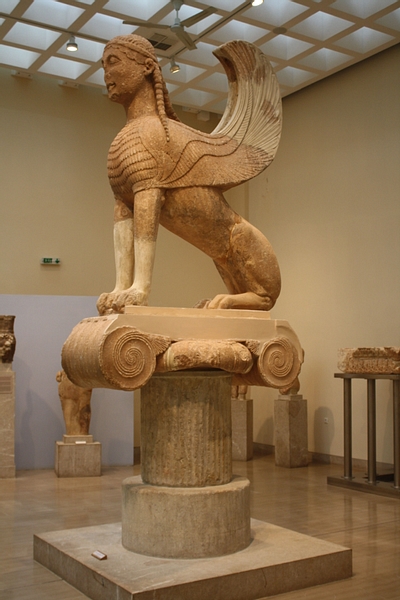 Naxian Sphinx of Delphi Mark Cartwright (CC BY-NC-SA) ](https://www.worldhistory.org/image/872/naxian-sphinx-of-delphi/ "Naxian Sphinx of Delphi")A tour around these open-air sites and their treasury buildings would have struck wonder in the beholder and given the visitor an insight into the development of art and military technology over centuries. Some of the artworks gained fame in their own right. At Delphi, for example, there was the great bronze Bull of Corcyra (580 BCE), the ten statues of the kings of [Argos](https://www.worldhistory.org/argos/) (c. 369 BCE), a [giant](https://www.worldhistory.org/Giants/) gold four-horse [chariot](https://www.worldhistory.org/chariot/) offered by [Rhodes](https://www.worldhistory.org/Rhodes/), and a huge bronze statue of the Trojan Horse offered by the Argives (c. 413 BCE). Lining the sacred way at Delphi which pilgrims followed were hundreds of statues, of which only the pedestals now survive. Olympia had a similar array of statues, this time of victorious athletes in the [Olympic Games](https://www.worldhistory.org/Olympic_Games/).
### Circuses
Another museum of sorts, another open-air one, was the [Circus Maximus](https://www.worldhistory.org/Circus_Maximus/) of [Rome](https://www.worldhistory.org/Rome/). First built in the 6th century BCE, the [Circus](https://www.worldhistory.org/disambiguation/Circus/) was used to host chariot races, [gladiator](https://www.worldhistory.org/gladiator/) fights, wild animal hunts, public executions, and games, including the annual *Ludi [Romani](https://www.worldhistory.org/Romani/)* which honoured [Jupiter](https://www.worldhistory.org/jupiter/). The Circus had a capacity for 250,000 spectators, and they could admire from their seats not only these spectacles but also the collection of massive monuments and artworks which adorned the central barrier, or *spina,* around which the chariots raced. Here there were obelisks from [Egypt](https://www.worldhistory.org/egypt/) alongside bronze and marble statues of the rich and famous. Two of the obelisks now stand in Rome, one in the Piazza del Popolo and the other in the Piazza S. Giovanni in Laterano.
The *spina* of the [Hippodrome of Constantinople](https://www.worldhistory.org/article/1158/the-hippodrome-of-constantinople/) (3rd - 13th century CE) had an even more spectacular array of artworks, all looted from across the [Byzantine](https://www.worldhistory.org/disambiguation/Byzantine/) Empire. There were monumental sculptures of early Roman emperors, figures associated with victory such as eagles and the Greek hero [Hercules](https://www.worldhistory.org/hercules/), sculptures of victorious charioteers, and ornamental columns such as the Serpent [Column](https://www.worldhistory.org/column/) of the Plataian tripod. This latter wonder of three entwined snakes in bronze was a 5th-century BCE dedication looted from the sacred sanctuary of [Apollo](https://www.worldhistory.org/apollo/) at Delphi. Once standing 8 metres (26 ft.) tall, the lower portion is still standing today in Istanbul. There were obelisks, too, including a false one made of individual blocks but entirely covered in bronze sheeting. Another [Egyptian obelisk](https://www.worldhistory.org/Egyptian_Obelisk/) had been removed from [Karnak](https://www.worldhistory.org/Karnak/) and dates to the reign of [Thutmose III](https://www.worldhistory.org/Thutmose_III/) in the 15th century BCE. The monument, measuring over 25 metres (82 ft.) in height, now stands in central Istanbul.
[  Circus Maximus Reconstruction B. Fletcher (Public Domain) ](https://www.worldhistory.org/image/1275/circus-maximus-reconstruction/ "Circus Maximus Reconstruction")Besides the *spina*, the exterior of the Hippodrome, like many public buildings in the Roman world, was decorated with the spoils of [war](https://www.worldhistory.org/disambiguation/War/) such as weapons, armour, and shields, no doubt hung there to remind the general populace of all the peoples the [Eastern Roman Empire](https://www.worldhistory.org/Byzantine_Empire/) had conquered.
### The Museum of Alexandria
The most famous museum in the world was in Alexandria. It was quite distinct from the Library of Alexandria. [Ptolemy I](https://www.worldhistory.org/Ptolemy_I/) Soter (366-282 BCE) is considered the founder of the Museum of Alexandria (the Mouseion) c. 305 BCE, of which the famed library was only a part. The [Ptolemaic Dynasty](https://www.worldhistory.org/Ptolemaic_Dynasty/) spent a great deal of time and money building up both the Museum and Library of Alexandria, inviting scholars and acquiring texts from all over the Mediterranean. Most ancient sources credit [Ptolemy II](https://www.worldhistory.org/Ptolemy_II_Philadelphus/) Philadelphos (r. 285-246 BCE) with the library's foundation. The librarians, operating under a director, were ruthless and absolutely determined to build the world's greatest store of knowledge by leaving no source and no subject uncovered. As a result of these endeavours, the library boasted 500,000-700,000 scrolls.
The model for the conception of the Museum was likely Aristotle's Lyceum mentioned above, a strong connection being the presence of Demetrios of Phaleron (c. 350 - c. 280 BCE), a student of Aristotle. The precise location of the Museum is not known but it was most likely near the royal palace. The Museum was managed by a president or head priest who had a team of live-in scholars paid by the state (both a salary and living expenses). Research, copying books, and giving lectures were their primary pursuits. The first of these tasks gained the Museum its widest fame, particularly in the areas of science, mechanics, medicine, mathematics, philosophy, and literary scholarship.
The Greek geographer Strabo (c. 64 BCE - c. 24 CE) gives the following description of the Museum:
> It has a cloister and an arcade and a large house in which is provided the common meal of the men of learning who take part in the Museum. And this gathering has common funds, and a priest in charge of the Museum, who was appointed previously by the kings, but now by [Caesar](https://www.worldhistory.org/disambiguation/caesar/).
> (Bagnall, 4633)
The Museum also hosted dinners and the occasional [symposium](https://www.worldhistory.org/Symposium/) (from the informal drinking party the Classical Greeks had created) where discussions were held on all manner of topics from politics to ethics. Rather more serious than elsewhere, the solutions to problems discussed at the Museum of Alexandria's symposia were recorded for posterity. The discussion sessions were frequently attended by rulers, including [Cleopatra VII](https://www.worldhistory.org/Cleopatra_VII/) (r. 51-30 BCE). The Museum also managed the Library's distribution of books to other towns in the [Ptolemaic Empire](https://www.worldhistory.org/disambiguation/Ptolemaic_Empire/). The Museum and the Library were both damaged by fire during the reign of [Julius Caesar](https://www.worldhistory.org/Julius_Caesar/) (b. c. 100 BCE) but then continued and were even expanded by such Roman emperors as Hadrian in the 2nd century CE. The Museum also inspired other similar institutions elsewhere, notably at [Pergamon](https://www.worldhistory.org/pergamon/), Rhodes, and [Syracuse](https://www.worldhistory.org/syracuse/). Destroyed in 272 CE, the Museum of Alexandria once again recovered but went into decline and the last known member of the Museum is recorded as Theon of Alexandria, the mathematical commentator and father of the famed philosopher and mathematician [Hypatia](https://www.worldhistory.org/Hypatia_of_Alexandria/) (c. 370 - 415 CE). Following the edict of Theodosius I (r. 379-395 CE) to close all pagan sites in 391 CE, the Museum disappeared from history but it created a model on which many museums, such as the British Museum and Louvre, today follow, not only presenting artworks and artefacts but also funding research and educational initiatives.
#### Editorial Review
This human-authored article has been reviewed by our editorial team before publication to ensure accuracy, reliability and adherence to academic standards in accordance with our [editorial policy](https://www.worldhistory.org/static/editorial-policy/).
## Bibliography
- Bagnall, R. (ed). *The Encyclopedia of Ancient History.* Wiley-Blackwell, 2012
- [Boys-Stones, George. *The Oxford Handbook of Hellenic Studies.* Oxford University Press, 2009.](https://www.worldhistory.org/books/0199286140/)
- [Graziozi, Barbara. *GODS OF OLYMPUS.* Picador Paper, 2015.](https://www.worldhistory.org/books/1250062349/)
- [Hornblower, Simon. *The Oxford Classical Dictionary.* Oxford University Press, 2012.](https://www.worldhistory.org/books/0199545561/)
- [Kinzl, Konrad H. *A Companion to the Classical Greek World.* Wiley-Blackwell, 2010.](https://www.worldhistory.org/books/1444334123/)
- [Peter Oleson, John. *The Oxford Handbook of Engineering and Technology in the Classical World.* Oxford University Press, 2009.](https://www.worldhistory.org/books/0199734852/)
- [Potter, David S. *Companion to the Roman Empire.* Wiley-Blackwell, 2009.](https://www.worldhistory.org/books/1405199180/)
## About the Author
Mark is WHE’s Publishing Director and has an MA in Political Philosophy (University of York). He is a full-time researcher, writer, historian and editor. Special interests include art, architecture and discovering the ideas that all civilizations share.
## Cite This Work
### APA
Cartwright, M. (2020, March 25). Museums in the Ancient Mediterranean. *World History Encyclopedia*.
### Chicago
Cartwright, Mark. "Museums in the Ancient Mediterranean." *World History Encyclopedia*, March 25, 2020. .
### MLA
Cartwright, Mark. "Museums in the Ancient Mediterranean." *World History Encyclopedia*, 25 Mar 2020, .
## License & Copyright
Submitted by [Mark Cartwright](https://www.worldhistory.org/user/markzcartwright/ "User Page: Mark Cartwright"), published on 25 March 2020. The copyright holder has published this content under the following license: [Creative Commons Attribution-NonCommercial-ShareAlike](https://creativecommons.org/licenses/by-nc-sa/4.0/deed.en). This license lets others remix, tweak, and build upon this content non-commercially, as long as they credit the author and license their new creations under the identical terms. When republishing on the web a hyperlink back to the original content source URL must be included. Please note that content linked from this page may have different licensing terms.